Page of Wands Tarot Card Meaning

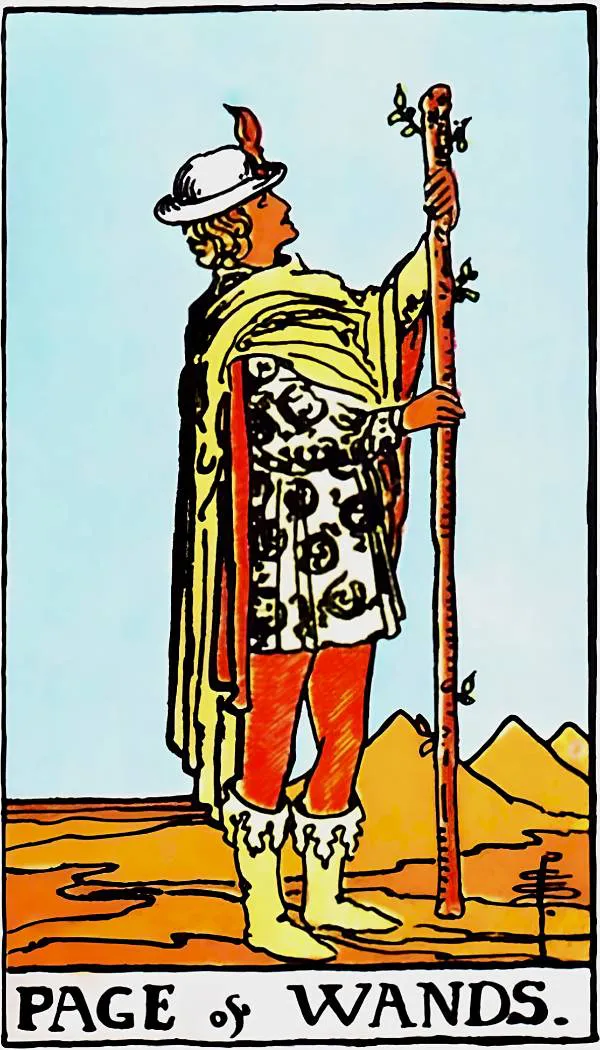
This young man is positioned sideways to the right of the scene, standing in the midst of a desert.

A wand stands before him, which he holds upright with both hands, lifting it off the ground.

He is the Page of Wands, a servant tasked with maintaining the wand, and his role is to announce decrees on behalf of the royal court.

He slightly raises his head to look above the wand, a posture that signifies the proclamation of news or the issuing of decrees, as if declaring the possession of territory.

His yellow attire is embroidered with the pattern of a salamander, and his cloak and boots are also in an orange color scheme that matches his entire outfit.

The sky is clear, and in the background, there are three pyramids, representing the ancient civilization of Egypt.

Wand

The wand held by the Page symbolizes creative energy, new beginnings, and potential. It represents the spark that could ignite into a full-blown passion or career.

Desert

The barren landscape signifies that this is a card of possibility where anything can happen. It asks us to make something out of nothing, using our creativity and passion to transform barrenness into abundance.

Pyramids

Visible in the distant background, the pyramids are indicative of the Page’s untapped spiritual potential. They imply a sense of mystery and suggest that the Page is starting on a journey of spiritual growth.

Salamander

The salamanders adorning his tunic represent transformation and the ability to withstand and adapt to the trials of life. Salamanders are creatures of fire, aligning with the card’s association with the element of fire, denoting enthusiasm, confidence, and bravery.

Ornate Clothing

The lavish and colorful clothing of the Page symbolizes his youthful enthusiasm and the joy he takes in exploring new ventures. The flamboyant attire is a reflection of his bold spirit and his readiness for adventure.

Feathers on the Hat

The feathers adorning the Page’s hat are symbolic of the higher realms of thought and spiritual connection. They encourage the freedom to explore new ideas and express one’s unique perspectives.

Psychological patterns in Page of Wands
Fresh Start Fantasy
The wand is held up as a clean beginning, but it is not planted into the ground. The Page can declare, imagine, and hold the symbol of motion while the desert still shows no established path. Fresh Start Fantasy appears when the mind turns a new beginning into an escape hatch from structural friction. You may keep imagining a different city, career, identity, routine, or version of yourself because the restart feels easier to hold than the messy audit of why the current path feels dead. The card's reversed pressure lives in the gap between proclamation and contact. The spark is real, but the fantasy begins when the beginning itself becomes the emotional reward and the harder work of building direction is postponed.
Potential Projection
The Page's ornate clothing and upright wand create a vivid image of becoming, while the desert around him remains largely blank. In reversal, that image can start carrying more psychological meaning than the figure's actual inner state can hold. Potential Projection happens when the psyche places rescue, identity, or self-worth onto a future breakthrough, new practice, new idea, or symbolic version of the self. The projected possibility becomes emotionally charged because it seems to solve the unresolved material without requiring direct contact with it. In introspective work, this can make the next insight feel like the one that will finally make you whole. The Page of Wands reveals the hidden cost: when potential becomes a projection screen, the present self is left standing in the desert, still waiting to be met without needing to become someone else first.
Strategic Visibility
The Page stands in a clear desert with the wand held upright in front of him, his head lifted as if preparing to send a signal into open space. The posture is not chaotic; the body organizes its energy through one visible channel, turning raw enthusiasm into a deliberate social presentation. That visual structure maps closely to Strategic Visibility because the card is about being seen before the outcome is guaranteed. In a social field, the mechanism is not simple confidence; it is the choice to let a new part of you enter the room with enough form to be readable and enough openness to stay alive. You are not asked to disappear into the group or dominate it. The pattern reveals the moment where visibility becomes a calibrated act: a message is offered, a place is tested, and belonging is approached through clear self-positioning rather than anxious performance.
Premature Visibility
The wand stands upright before the Page like a public signal, while his body remains mostly still. The image is full of announcement energy, yet the desert around him shows that the new direction has not become a lived structure yet. In family dynamics, this maps to the urge to make the self visible before the boundary has enough internal scaffolding. You may announce a move, a relationship, a decision, or a new identity to prove that change is real, only to have the family system flood the fragile beginning with questions, comparisons, pressure, or guilt. The pattern is not visibility itself; it is visibility before containment. The card exposes the gap between declaring a new self and having enough psychological support to keep that self from being pulled back into the old role.
Optimism Bias
The Page stands in an empty desert with his face lifted above the wand, as if the first spark of direction has already started to organize the whole scene. The wand is vertical, bright, and centered in his hands, so attention rises toward possibility before it settles into the practical conditions under his feet. That visual structure mirrors Optimism Bias because the psyche is not refusing reality outright; it is giving the exciting future more weight than the unglamorous audit. In a choice reading, this pattern can make one option feel self-evidently alive while its hidden costs, exit barriers, and resource demands remain under-lit. You are not being shown a lack of intelligence. The card reveals a decision system that is being pulled upward by promise, novelty, and identity charge, and the audit begins by asking what the bright option needs you to ignore in order to keep feeling bright.
Novelty Seeking
The Page’s bright clothing, lifted wand, and open desert create a body organized around ignition. Nothing in the image is settled into routine; the figure is visually tuned to the first signal, the first announcement, the first movement toward a horizon. In love, that same structure becomes Novelty Seeking when the nervous system feels most alive at the beginning of a romantic script. The first message, the first date, the chase, and the fantasy of a new life chapter can become more regulating than the quieter work of mutual consistency. The card does not condemn the spark. It shows that the spark is real, but it also asks whether You are using newness to discover intimacy or using newness to avoid the slower emotional data that intimacy eventually requires.
Action Bias
The Page raises the wand before the desert offers a route, and the gaze follows the spark upward instead of reading the whole terrain. The body converts possibility into declaration faster than the field can confirm direction. Action Bias forms when uncertainty becomes intolerable and the system tries to create clarity through motion. You may make a big move, announce a new path, start a project, quit a direction, or commit to a future because acting feels cleaner than staying with the unresolved signal. The reversed card does not deny the presence of real energy. It shows energy bypassing discernment, where the first visible wand becomes a decision simply because standing in the open desert feels too exposed.
Competence Theater
The Page's raised chin, decorated clothing, and formal hold on the wand create a public-facing image of confidence. In the reversed texture, that same image can become a performance of readiness, especially because the empty desert gives him very little feedback to challenge the pose. Competence Theater emerges when the self-image has to arrive before the actual certainty does. In a choice reading, this can look like sounding decisive, spiritual, brave, or strategically clear while the private logic of the decision remains untested. You are not being asked to shame the performance. The card identifies the protective function of the performance: it keeps ambiguity from being visible. The audit begins where the image of certainty and the evidence for certainty stop matching.
Forced Progress
The wand is held upright in a place that has not yet become fertile. In reversal, the same lifted spark can turn into a body locked around effort, spending energy to keep the signal alive while the ground remains dry. Forced Progress appears when movement is used to overpower timing friction. You may push harder precisely because the season is not responding, turning every delay into a test of will instead of a cue to reassess the field. The Page of Wands makes this pattern visible through the mismatch between fire and terrain. The inner command says move, but the outer landscape shows why raw effort alone may only increase resistance.
Authentic Self-Expression
The Page's yellow and orange clothing, salamander pattern, feathered cap, and upright wand all make the body look aligned with creative fire. He is not hidden inside the scene; he visually declares a style of being, standing in open space as though the outer life could be shaped to match an inner signal. That is the psychological ground of Authentic Self-Expression. The card does not reduce lifestyle to efficiency or control; it shows the need for a daily structure that can carry personality, curiosity, appetite, and creative identity. The wand becomes a tool for making the life system reflect who you are becoming, not just what you are trying to optimize. In a lifestyle reading, this pattern becomes important when your routines technically function but feel borrowed, bland, or disconnected from your real temperament. The Page asks whether your physical environment, rhythm, and habits give your authentic energy a place to move, or whether the system has become so generic that it no longer feels like yours.
Core Struggles in Page of Wands
Potential Overidentification
The young messenger stands in lavish fire-colored clothing, holding the wand as a sign of spark, announcement, and future movement. Yet the barren ground beneath him has not been cultivated, and the distant pyramids keep greatness at the horizon rather than inside the immediate task. In academic life, this visual tension can become attachment to being promising before the promise has been tested by ordinary work. You may feel that every assignment has to protect the image of being bright, original, or capable, because the Page is carrying potential as an identity marker rather than letting it become practice. The card does not reduce your academic pressure to vanity or ego. It shows a structural bind: when potential becomes the thing that must be preserved, the messy learning process starts to feel like a threat to the very self it is meant to build.
Performative Readiness
The Page's role is organized around readiness: the wand is held upright, the head is lifted, and the body looks prepared to announce something. In reversal, that readiness hardens into a pose that can be maintained even when no real social exchange is happening. In social spaces, this becomes the pressure to seem available, exciting, responsive, and easy to invite while the deeper self remains unsupported. You may look like someone who is always up for the next plan or circle, but the posture of readiness can conceal how little contact is actually landing. The card names the frozen social stance beneath the performance. It shows readiness as something that can become a holding pattern, where looking open to connection replaces the harder question of whether the connection has a real container.
Pseudo Growth Loop
The wand remains lifted in display while the desert surface stays unchanged beneath it. Fire-coded clothing, feather, and distant sacred architecture make the scene look initiated, but the symbol has not become a rooted practice. Pseudo Growth Loop is the strain of repeatedly entering the language of transformation without crossing into integration. In introspection, you may collect breakthroughs, prompts, readings, or self-knowledge that keep the inner fire visible while the same old ground remains untouched.
Vision-Connection Split
The Page stands beside the wand, but his gaze travels past it, lifted toward a horizon larger than the object he is holding. His body is still attached to the sign of his current role, while his attention is already pulled toward open terrain and distant markers. In friendship, this creates the exact shape of a growth split: one part of you is still held by shared history, inside jokes, and old emotional contracts, while another part is already oriented toward a wider life. The card does not frame that movement as betrayal; it shows the strain of carrying a new vision while still wanting the old connection to recognize you.
Momentum-Readiness Split
The Page holds a living wand upright in a desert where nothing around him has visibly begun to grow. His hands carry the spark, but his feet stay fixed in sand, so the image separates the urge to begin from the conditions that would let beginning become movement. For timing questions, that split is the exact friction point. You may feel momentum in your body, an idea, a relationship, a move, or a launch, while the surrounding field has not yet provided traction, support, or a real receiving channel. The struggle is not whether the spark exists; it is whether the moment around it can hold what the spark wants to become.
Expression-Reception Gap
The young figure lifts the wand into a clean vertical signal, his head raised as if making an announcement, while the desert around him contains no visible listener. The message is shaped and visible, but the surrounding space provides no shared receiving frame. That is the pressure point inside this friendship struggle: the words may be real, careful, and necessary, yet the bond can still distort them at the point of arrival. You are not simply failing to communicate; the card shows a live signal trying to land in a connection that may not know how to receive it without turning it into threat, guilt, or distance.
Threshold Disorientation
The young Page stands at the edge of movement in a landscape with no road. The pyramids imply a larger journey, but the immediate field offers only exposure, distance, and the vertical wand as a first marker. Threshold Disorientation is not simple indecision; it is the body meeting a beginning before it has a map. In inner work, you may sense that something in you is ready to move, while the old coordinates have already loosened and the new ones have not yet become walkable.
Inherited Role Lock
The young figure holds the wand upright with both hands, lifting it like a charge that must not be dropped. In the reversed structure, that vertical staff stops reading as pure inspiration and becomes an object that keeps the body organized around maintenance rather than movement. Family pressure often works through exactly that kind of upright object: a role, a message, a legacy, a job of staying available. You may look capable because you are still holding the family symbol steady, but the card locates the strain in the gap between carrying the assigned role and having room to choose your own direction. The desert matters because nothing nearby replenishes the effort. The struggle is not laziness or lack of love; it is the slow lock that forms when your energy keeps serving an inherited position before it ever gets to become self-directed life.
Autonomy Guilt Bind
The Page stands turned toward the open scene, but both hands remain fixed on the wand. His head lifts as if to announce something beyond the staff, while the body still has to keep the inherited vertical line from tipping. That is the exact shape of autonomy under family guilt: movement is possible, but it has to be performed without appearing to abandon the structure that raised you. You are not simply choosing between freedom and family; you are trying to move while still proving that your movement does not make you disloyal. The card does not flatten that bind into rebellion. It shows the body mechanics of a young self trying to speak in its own direction while still bracing the symbol that older voices can recognize.
Cycle-Action Desynchronization
A young figure raises a fire-coded wand in a landscape that does not visibly answer it. The sky is clear and the horizon is open, but the ground gives no marked road, no growth, and no immediate sign that the signal has somewhere to land. That is the body of cycle-action desynchronization. You may be pushing at full intensity, but the cycle around you may still be in orientation, preparation, or dormancy. The card gives shape to the specific exhaustion of acting as if the season is ready while the field is still asking to be read.
Inner Emotions in Page of Wands
Limerent Rush
The young Page holds the wand upright with both hands in a bare desert, as if one charged object is enough to make the whole empty field feel activated. His lifted gaze, vivid clothing, and salamander pattern give the scene the physical texture of a spark that has not yet become a stable fire. In love, that visual charge maps onto the rush of a new attachment point: a text, a glance, a date, a person who suddenly makes the inner landscape feel lit from the inside. Limerent Rush names the way desire can flood the imagination before the relationship has produced enough evidence to hold the intensity. The card gives that rush an objective shape instead of treating it as proof of the connection. You can see the spark clearly without handing it the authority to define the whole emotional terrain.
Directionless Urgency
The wand is upright but not planted, the body is posed for announcement but not walking, and the open desert supplies scale without a marked route. In the reversed current, the scene turns into suspended motion: everything looks ready to begin, yet nothing has traction. At work, this becomes the pressure to move fast while every possible career direction feels underbuilt. You may feel pushed to apply, pitch, pivot, or prove yourself, but the card exposes the real knot: urgency is outrunning orientation.
Premature Bloom Anxiety
The young messenger appears already dressed for proclamation, lifting the wand as if a declaration can arrive before the landscape has formed a road. The clothing is vivid, the staff is upright, and the desert remains unmarked. That mismatch becomes the anxiety of needing to look ready before your direction has roots. You may feel pressured to announce a life path, prove momentum, or perform certainty while the real structure underneath is still early and fragile.
Horizon Hunger
The Page's gaze lifts past the wand toward distant pyramids, letting the empty desert stretch between where he stands and what has not yet been reached. The card's space is not crowded by existing community; it leaves the eye with a clean, unfinished horizon. In a friend group, that horizon becomes the ache for connection that can meet your next self, not only the version everyone already knows. Horizon Hunger is the feeling of wanting friendship to stay alive, mobile, and future-facing instead of becoming a museum of old roles.
Message Dread
The Page of Wands is built around announcement: the lifted staff, raised head, and heraldic posture all gather the body toward speech. In reversal, that same structure can feel like a message trapped in the throat before it has somewhere safe to land. Message Dread fits family terrain because a simple text or sentence rarely feels simple inside an old system. A reply can carry years of role expectation, comparison, disappointment, and the pressure to manage everyone's reaction. The card makes the dread visible as a communication threshold. You are not merely avoiding a notification; you are standing at the point where your own voice has to pass through a family structure that has historically made speaking costly.
Cautious Readiness
The young Page stands in a clear desert with both hands around a wand that has just been lifted from the ground. His body is upright, exposed, and gathered around one charged object, like the first clean moment before a study plan becomes action. For academic work, this maps to the feeling of being almost ready. Notes are open, the idea has heat, and the next step still carries a visible cost. You are not empty of motivation; the card shows motivation before repetition has made it feel safe.
Restless Optimism
The young figure stands in a bare desert with the wand lifted upright, chin raised, and bright fire-colored clothing catching the eye before anything around him has become productive. The scene holds the physical sensation of a beginning that has more charge than infrastructure: a signal has appeared, but the landscape has not yet answered it. At work, this becomes the feeling of wanting to move before the career evidence is fully assembled. You may not have a finished strategy, title, or proof of outcome, but the card mirrors the bodily truth of a professional spark that is already organizing your attention toward action.
Playful Courage
The young figure stands in the clear desert with both hands on the raised wand, as if a private spark is ready to become a visible signal. The bright clothing, lifted head, and open sky give the body a sense of movement before anything has fully happened. In friendship, that image becomes the moment before you say the clean thing you have been circling: a boundary, an invitation, a new version of yourself. Playful Courage is not aggression; it is the small internal fire that lets you risk honesty without turning the friendship into a battlefield.
Confrontational Courage
The Page lifts his head above the wand as if a message is about to leave the body. His hands keep the staff upright, turning raw fire into a formal line of speech rather than a scattered burst. Confrontational Courage appears here as the moment before a family truth is spoken. The card does not show aggression; it shows the physical discipline required to let a position become audible when silence has been the easier survival shape. For you, the courage is not loudness. It is the willingness to let your adult voice stand in the room, even while the body still remembers how quickly family conversations can pull you back into old scripts.
Open-Ended Wonder
The raised head, open sky, and distant pyramids pull the Page's attention beyond the wand in his hands. Nothing in the scene crowds him, so the unknown is not presented as a closed wall but as a wide field that can be entered through attention. In introspection, that spaciousness becomes the feeling of looking into your own hidden material without immediately forcing a conclusion. You are not being pushed to solve the whole self at once; the image holds the first clean contact with mystery as something observable. Open-Ended Wonder fits this card because the Page of Wands carries the earliest spark of exploration. The desert is bare enough to reveal what is projected onto it, while the far pyramids keep the mind oriented toward depth that has not yet been reduced to a simple answer.
Outer Contexts in Page of Wands
Professional Infantilization
The figure is young, brightly dressed, and formally positioned as a page, while the pyramids behind him carry the weight of older institutions. The scene gives him visibility but not seniority, making the body of the messenger easier to read as junior even when the message itself matters. In a workplace, that becomes the experience of having ideas filtered, softened, or re-owned by people with more status. You may be placed in the room, asked to contribute energy, and still treated as if your judgment needs a senior translator before it counts.
Premature Launch Pressure
The wand is lifted off the ground while the surrounding desert offers almost no supporting structure. The gesture can become a public signal held in midair before the terrain has anything ready to catch it. In reversed timing, that creates pressure to announce, launch, commit, or pivot while the real-world base remains thin. You are dealing with visibility arriving before capacity, which can make effort feel louder than its actual support system.
Risky Social Overexposure
The Page is fully visible in an open desert, dressed in bright colors and lifting the wand as if broadcasting a message. Nothing in the scene creates privacy around the announcement. Friendship becomes risky when private material moves into group chats, public jokes, social posts, or shared stories before consent is clear. You may be dealing with exposure that feels casual to the group but materially changes your trust in the relationship. The card's open-air setting shows the structural issue: once the message leaves the protected space, it is no longer held by the original bond. The overexposure is not about being too sensitive; it is about a missing container for private friendship information.
Premature Social Launch Pressure
The wand is lifted off the ground in an empty desert, held upright by effort rather than by roots, structure, or a visible audience. The proclamation posture becomes a demand to be seen before the field has supplied feedback, support, or real social traction. Premature Social Launch Pressure appears when a new version of you is pushed into public view too early. You can feel the announcement happening faster than the trust network beneath it, and the image exposes that timing problem without turning it into a personal flaw.
Launch Window Readiness
With the wand lifted like a message standard and the Page's chin raised above it, the image carries the posture of an announcement. The clear sky and open horizon make the signal readable before the journey has fully begun. That is the logic of launch window readiness in a lifestyle context. You have enough clarity to name the reset, but the real issue is whether the declaration will organize your next moves or pressure the system to perform too early.
Premature Insight Harvest
Raised above the barren desert, the wand looks ready to become a declaration before the ground around it has produced anything visible. The Page's lifted chin and courtly messenger role make the spark public before it has been tested by repetition, feedback, or lived consequence. That image fits Premature Insight Harvest because your inner work may be pulled into announcement mode too early. You can see the pattern, name the breakthrough, and even explain it beautifully, while the outer conditions needed to integrate it are still empty, exposing the difference between a flash of clarity and a change that can actually hold.
Strategic Pitch Window
The raised head, courtly clothing, and upright wand make the figure look like a herald about to turn private intention into public speech. The wand is not just held; it is presented as a vertical signal that asks the surrounding field to recognize a claim. In a timing reading, that becomes the moment when an idea needs the right frame, audience, and opening to land. You are not simply deciding whether the idea is good; you are reading whether the social field is ready to receive it.
Thesis Launch Window
The Page lifts the wand like a message about to be released, and his raised head turns the object into a public signal. For thesis or capstone work, this mirrors the launch point where a private idea has to become a proposal, outline, research question, or first conversation with an advisor. The desert matters because the project has not yet grown its infrastructure. You may have the spark and the declaration, but the academic structure still has to be mapped through sources, chapters, methods, and feedback.
Family Infantilization
The Page is young, side-on, and tasked as a servant of a larger court. Even while he holds the wand, the scene keeps him in a junior social position, visible enough to be corrected but not fully sovereign. This is the family dynamic where adulthood is acknowledged in theory but withheld in practice. You may be making your own decisions, paying your own bills, or building your own life, while the family still speaks to the younger version of you. The card makes the demotion visible: the body is ready to move, but the role keeps being read as childlike.
Direct Communication Trial
The Page stands sideways in a clear desert with both hands wrapped around a single upright wand, his head lifted as if he is about to announce something. The image turns communication into a physical task: the message has to be held, stabilized, and made visible before it can become shared reality. In a relationship, that visual structure maps cleanly onto the moment when attraction is no longer enough and terms need to be named. You are not dealing with a lack of feeling so much as a missing public signal between two people, where clarity has to move from private interpretation into a spoken agreement.