Knight of Swords Tarot Card Meaning

Overall Card Structure

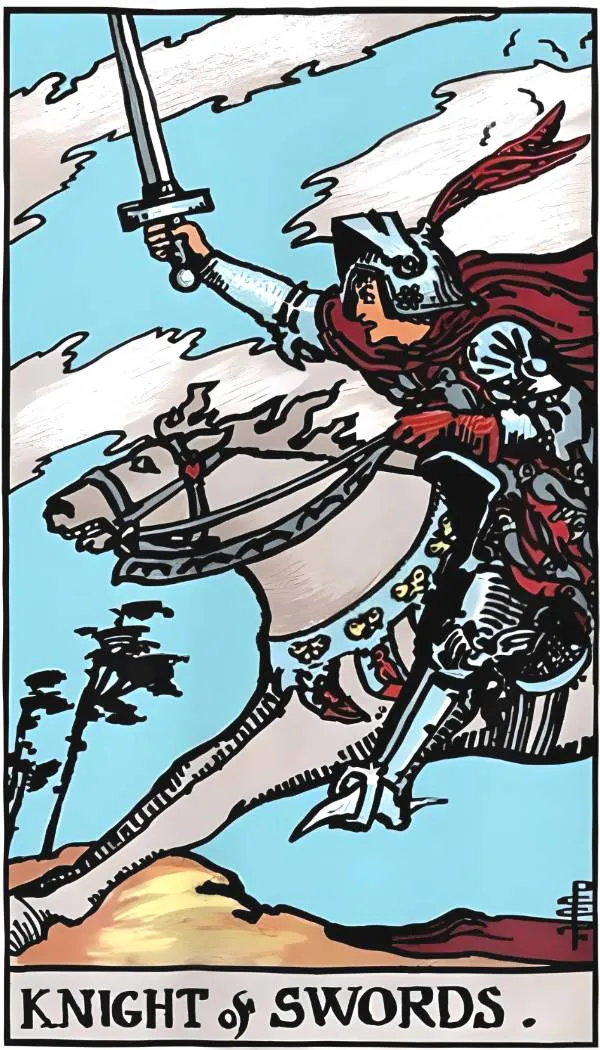
The valiant man riding a white horse and galloping with a sword is the Knight of Swords.

The white horse strides forward with effort, and the knight leans forward while shouting. The knight's right hand holds the sword high and forward, cutting through the air, with the tip of the sword extending beyond the frame of the picture.

The knight and the horse are facing the wind and moving swiftly, with the background creating a sense of speed and the force of the wind's blow. The trees on the hill and the clouds in the sky are all shaped as if being blown backward by the wind. He is fully armored in body armor, yet also pays great attention to the overall decoration.

The Knight of Swords is in the wilderness, riding the horse at full speed, demonstrating his sharp swordsmanship, and his posture is facing the enemy or driving the enemy away, with the task right in front of him.

Detailed Pattern Description

The Knight of Swords has a deep and clear facial outline, with a fierce and determined expression and a fierce gaze. This knight is a typical hero in legendary stories, and his sword is very fast and decisive because his heart is purified. The sharpness of the swordsmanship comes from the clarity of the heart, which can accurately and quickly hit the target. Only those who are noble and loyal are worthy of this sword. The white horse symbolizes pure and clear action, and knights riding white horses are holy knights with clear will.

The knight is driving the horse to gallop, facing the wind and moving swiftly. This knight is not the most powerful, but he is the fastest. He raises the sword, ready to strike the enemy, obstacles, relying on his unparalleled swordsmanship and experience, full of confidence. The Knight of Swords is in a state of battle, facing the task and welcoming the opponent. At this time, he is driving the white horse at full speed, facing or expelling the enemy.

The knight is wrapped in shiny armor, with a red cloth decoration on the top of the helmet, matching the red cloak on his body, and red is a symbol of vitality. The fully armed armor indicates the spirit of battle and competition, and the color of the armor also shows that his combat level is high. The horse's reins have an M-shaped mark, M is a bird pattern. On the blue neckband, there is a yellow butterfly pattern and a red thunderbird pattern. The yellow butterfly on the accessories is the symbol of the Swords Court card. The thunderbird pattern is the same as the light-colored thunderbird pattern on the knight's body. The bird is also the exclusive animal of the Swords Court card, and the thunderbird is a symbol of XXXX.

The background can be seen moving at high speed and the force of the wind's blow. The clouds in the sky, the trees on the hill, all have the feeling of being blown in one direction. The wind-like clouds represent rapid movement, and the sky is like the state of mind, clean and the wind direction is fixed. The trees growing on the hills on the ground represent the struggle between vitality and natural wind power.

The Knight

The Knight serves as the central figure in the card, embodying the characteristics of determination, action, and sometimes aggression. He symbolizes the human will and intellect focused and harnessed for a cause or goal. He is the embodiment of the ‘warrior’ archetype, willing to take on challenges head-on.

Armor and Plume

The Knight is fully armored, representing his readiness for any battle, physical or intellectual. The plume on his helmet is akin to the feather of Ma’at from Egyptian mythology, symbolizing truth, thoughtfulness, and moral integrity. Though aggressive and bold, he is committed to his own ethical code.

The Charging Horse

The Knight’s horse is seen in mid-gallop, signifying speed, momentum, and urgency. The horse symbolizes the raw energy that propels us towards a goal or mission. Its uncontrolled speed can indicate both fearless pursuit and the risk of rushing without adequate consideration.

The Raised Sword

The Knight holds his sword high in the air, indicating mental clarity and the power of ideas. The sword’s raised position represents an intense focus on achieving goals and vanquishing obstacles, almost to the point of ruthlessness. It is a call to action, to seize the moment, but also a warning not to let one’s thoughts become blinding or destructive.

The Winds and Tumultuous Sky

The clouds and winds swirling in the background symbolize the turbulent nature of the mind. It reflects the intensity, unrest, and perhaps impulsiveness that can accompany the single-minded pursuit of a goal. It suggests a chaotic environment created or embraced by the Knight, as he often thrives on challenges and conflict.

Psychological patterns in Knight of Swords
Action Bias
The knight's charge can also be read as a body that has passed the point of easy recalibration: armor fixed, horse running, sword already committed to the air ahead. The same speed that looks decisive can become a closed circuit when there is no visible pause point inside the image. Here, Action Bias becomes an internal pressure system rather than a clean act of will. In a decision spread, the person may make a move because the nervous system needs the suspense to end, not because the choice has been tested against motive, risk, and consequence. You may feel this when the urge to decide arrives with panic, irritation, or a desperate need to get the whole thing over with. The card exposes the hidden substitution: action is being used as emotional relief, while the deeper decision architecture remains only partly examined.
Forced Progress
The sword extends beyond the card's edge while the horse is still straining under the rider's command. Force leaves the image before the body beneath it has caught up, making forward movement look cleaner than the cost of sustaining it. In a lifestyle reading, Forced Progress appears when you keep pushing a routine, workload, or reset because slowing down feels like betraying the mission. The card exposes the hidden bargain: momentum is being used as a defense against checking whether the system has enough recovery to keep moving.
Truth Weaponization
The raised sword is not held close to the body; it is lifted high and driven forward as the knight charges into the wind. The image makes communication look like impact, with the blade carrying the full weight of intention. That posture shows how clarity can harden into force. In a career setting, accurate perception, sharp analysis, or legitimate criticism can become fused with the need to win the room, dominate the argument, or expose weakness before a better strategy has been built. You may be telling the truth, but the card asks what function the truth is serving in the power field. When truth becomes a weapon, it may protect your intelligence and status while making influence, trust, and promotion politics more difficult to navigate.
Reactive Overcorrection
The same charging body can become trapped by its own momentum: armor locked, sword raised, horse committed, wind forcing everything into a single direction. Nothing in the image suggests an easy turn, pause, or recalibration once the charge has begun. That is the reversed psychological pressure of the card. The system reacts to threat by adding more force, more speed, and more correction, even when the original problem requires timing, listening, or political reading. You may notice this after criticism, exclusion from a decision, or a blocked promotion path. The pattern tries to restore control by overcorrecting, but the extra force can create the exact workplace friction it was trying to prevent.
Impulsivity
The raised sword, open mouth, and galloping horse make the card feel like a decision made before the scene has finished speaking. The knight's attention is so locked onto the forward line that everything else becomes background to the charge. In friendship, Impulsivity appears when relational discomfort is converted into immediate action. The message gets sent, the accusation lands, the group chat becomes the battlefield, and only afterward does the fuller emotional picture become visible. The Knight of Swords carries this pattern because its strength is speed, but speed can become a defense against uncertainty. You may be trying to protect a boundary or expose a truth, yet the card shows how quickly urgency can bypass consent, timing, and repair.
Black-and-White Thinking
The sword creates one dominant line of attention, and the whole environment seems to submit to that same direction. Wind, clouds, trees, horse, and rider are pulled into a single vector with almost no visible countercurrent. In the reversed texture, that one-way force becomes a cognitive narrowing. The mind loses tolerance for gradients, timing, and mixed evidence; it wants the clean cut of yes or no, success or failure, evolved or stuck. In personal growth, Black-and-White Thinking appears when You judge your development as either healed or broken, disciplined or worthless, on track or completely lost. The card reveals how the need for mental sharpness can become a blade that cuts away the complexity required for real change.
Achievement Fusion
The white horse and armored rider are fused into one forward vector, with no visible pause between will, mission, and impact. The wilderness does not offer a separate resting place; the whole composition makes identity look organized around the charge. That is the visual logic of Achievement Fusion in study. Academic output stops feeling like something you produce and starts functioning like proof of who you are, so a grade, deadline, or supervisor comment can feel as if it touches the self rather than the work.
Emotional Flooding
The wind in this card does not sit in the background as weather; it seems to move through everything, bending clouds and trees in the same direction as the charging horse. The sword even reaches beyond the frame, as if attention has already outrun the available evidence. That is the anatomy of Emotional Flooding in friendship conflict. A late reply, a changed plan, or a friend's boundary can become emotionally amplified until the whole relational field feels urgent, threatening, and impossible to pause. The Knight of Swords gives this pattern a precise body: thought accelerates faster than regulation, and interpretation starts to feel like fact. You are not weak for feeling the surge, but the card shows how quickly a friendship can be pulled into combat when the mind mistakes emotional speed for truth.
Survival Mode
The knight is fully armored in an open field, charging into wind as if the landscape itself has become part of the conflict. The body is protected, but it is also locked into readiness, with no visible signal that the threat has an edge or an ending. Survival Mode in lifestyle territory turns ordinary maintenance into combat. You are not simply busy; the system is reading tasks, messages, chores, health routines, and rest decisions through the same emergency filter, which makes recovery feel unavailable even when the external situation has changed.
Compulsive Self-Improvement
The knight's charge is so complete that the sword, body, horse, clouds, and trees all point toward the next thing. The landscape offers no visible shelter or resting structure; it only intensifies the sensation of speed. In the reversed texture, the charge becomes less like purposeful progress and more like a loop that cannot discharge. The raised sword keeps creating a new target beyond the frame, so the mind never has to encounter the emptiness or fear that appears when the movement stops. In personal growth, Compulsive Self-Improvement appears when You keep optimizing, upgrading, tracking, and restarting without letting any insight become lived change. The card exposes the hidden mechanism: growth has become the way the system avoids being still enough to feel what it is trying to outrun.
Core Struggles in Knight of Swords
Relational Pacing Collapse
The white horse is caught mid-charge, the rider leaning forward into the wind while the sword pushes beyond the frame. Nothing in the scene offers a braking surface: clouds and trees stream backward, the body is armored for impact, and the whole composition turns movement into pressure. In friendship, that visual structure mirrors the moment a conflict, boundary talk, or unread text starts moving faster than the bond can process. You are not just trying to fix something quickly; you are carrying a relationship at a speed where nuance, repair, and mutual timing cannot stay in the saddle.
Risk Normalization
The reversed charge makes the open landscape feel less like freedom and more like a corridor of speed. Horse, rider, sword, and wind all agree on one hazardous route until the absence of brakes begins to look normal. In career terms, Risk Normalization appears when aggressive timelines, constant exposure, unclear politics, or unstable leadership stop registering as warning signs. You may start treating overextension as proof that you are serious, even when the structure is training you to ignore the cost of staying in motion. The card gives that adaptation a sharp visual boundary. It shows the moment when a dangerous pace becomes familiar enough to pass for a career path.
Timing Control Strain
The white horse is already in full gallop while the knight's sword reaches past the frame, so the body enters the decision before the whole field has appeared. Wind, plume, clouds, and trees all record a world moving too quickly for a clean pause. That physical setup carries Timing Control Strain in choice work: the problem is not simply whether to act, but whether the moment itself can be controlled tightly enough to make action feel legitimate. You are left trying to choose at speed while also demanding safe timing, and the strain lives in that impossible double command.
Cycle-Action Desynchronization
The white horse charges into a wind strong enough to bend clouds and trees backward, while the knight's body leans into the same resistance instead of riding with it. The scene holds real motion and real obstruction at once: the harder the horse runs, the more visible the opposing current becomes. For timing questions, that structure names the pain of acting with intensity while the surrounding cycle is not receiving the action. You are not shown as passive; the card places your effort inside a weather system where speed alone cannot create the right window.
Willpower Dependence Trap
The knight’s body is built for a charge, but in the reversed texture that charge hardens into a system with no release valve. Armor, reins, horse, sword, and wind form a closed circuit where force keeps feeding force, and recalibration has no visible place to enter. In career life, this is the structure behind the belief that every bottleneck must be solved by pushing harder. You may keep adding hours, intensity, responsiveness, and personal pressure because the workplace only seems to move when your willpower is overextended. Willpower Dependence Trap names the point where drive stops being a resource and becomes the operating system. The card does not shame the push; it shows the cost of a career structure that has made your personal force carry what strategy, authority, and support should be carrying too.
Drive-Meaning Misalignment
The knight leans so far into the gallop that the horse, sword, cloak, and wind all become one forward vector, yet the road and the opponent remain outside the visible scene. The image carries enormous propulsion without a mapped destination, so motion itself starts to perform the role of certainty. For a direction reading, that friction names the place where your energy is real but its meaning has not been verified. You may be accelerating toward the next goal because stopping would expose the unanswered question underneath: whether the path still belongs to you after the chase is over.
Truth-Connection Split
The raised sword is clean, direct, and exposed, while the knight's whole body is wrapped for battle. Clarity is present, but it arrives through a posture of force, with the horse driving the truth toward contact before the relational field has softened around it. That is the shape of a friendship where honesty and connection no longer feel like they can occupy the same lane. You may know exactly what needs to be said, yet the card shows why the sentence feels dangerous: the truth has become the edge that could protect the bond or cut through it.
Merit-Politics Split
The sword is clean, bright, and lifted as a symbol of clear thought, but the surrounding field is not clean at all. Trees and clouds are bent by the wind, making the environment itself a force that can redirect, distort, or resist the knight’s straight line. In a career field, that contrast maps onto the split between being good at the work and being able to navigate the conditions that decide whether the work matters. You may keep sharpening the blade of competence while the actual promotion terrain is shaped by timing, sponsorship, stakeholder perception, and informal power. Merit-Politics Split is the wound of realizing that skill is necessary but not sovereign. The card gives that realization a physical shape: a clear blade moving through weather that refuses to behave like a clean target.
Energy Distribution Strain
The sword gathers the knight's intention into one sharp line, while the horse, armor, reins, wind, and terrain carry the rest of the load. The image is efficient at impact, but it is not balanced as a whole living system. Energy Distribution Strain appears when one channel receives the full charge and other necessary systems are left to compensate. The blade can point, but it cannot feed the horse, repair the rider, soften the landing, or widen the path. In lifestyle terms, this is the struggle of overfunding the urgent lane while underfunding the maintenance lanes. Your attention may be clear, but meals, sleep, home care, health routines, social recovery, and mental bandwidth can become the hidden load-bearing structures that crack under the speed.
Truth-Compass Split
The sword is the cleanest line in the image, raised above the rider with absolute intent, but its tip leaves the frame before the terrain confirms a target. The mind has a sharp vector while the wider landscape withholds a stable route. In a direction reading, that split marks the difference between having a correct thought and having a livable path. You may be able to explain the next move with logic, yet still feel the deeper compass refusing to convert that answer into orientation.
Inner Emotions in Knight of Swords
Scattered Overwhelm
The wind bends trees and clouds in one direction, but the sword, gaze, horse, cloak, and frame all compete for speed. The card is full of motion, with very little visible sorting space inside the motion. Scattered Overwhelm fits the lifestyle state where every small thing has become urgent at once. The issue is not that your tasks are individually impossible; it is that your attention has been pulled into a gallop before your inner system has had time to rank, breathe, or land.
Directionless Urgency
The sword points past the edge of the image, and the horse drives forward faster than the scene can reveal a destination. Trees and clouds bend under the same force, so the card is full of motion without the quiet evidence of arrival. In a relationship, that becomes the frantic need to do something while not knowing what would actually repair the bond. Text now, pull back, demand clarity, apologize, end it, keep fighting: each option can feel urgent, but none may feel grounded. Directionless Urgency fits the Knight of Swords because the card shows action becoming a substitute for orientation. It reveals the emotional weather of being unable to stay still with uncertainty, while also sensing that speed alone will not tell you where love is supposed to go next.
Suppressed Rage
The raised sword and sealed armor make the body look ready to strike before anything soft can be seen. The metal surface reflects force back outward, while the wind presses against the knight as though the whole scene has converted feeling into pressure. In a romantic bond, this becomes anger held under a controlled surface: clipped words, icy precision, a sudden need to be right, or the impulse to cut through the other person's defenses before they can touch yours. The deeper hurt may be present, but it has been given a blade-shaped language. Suppressed Rage fits this reversed charge because the card shows emotion hardened into attack posture. It reveals the cost of protecting vulnerability through sharpness: the anger stays powerful, but its real message may remain trapped inside the armor.
Adult Child Panic
The horse's full gallop and the sword extending beyond the frame create a body that has already moved before the destination is visible. The wind presses against the knight, but the charge keeps accelerating, leaving no visible place to slow down and check what is actually happening. Adult Child Panic fits this reversed current because family contact can make the present moment collapse into an old rhythm. You may be grown, capable, and articulate elsewhere, yet one parental tone or message can send the inner system sprinting into defense before choice has time to arrive.
Relational Whiplash
The rider cuts forward while the background is blown sideways, forcing the eye to hold two incompatible directions at once. The figure remains intact, but the surrounding field offers no quiet landing place and no stable social ground. Relational Whiplash appears when a group or connection keeps shifting between invitation and exclusion, warmth and distance, hype and silence. Your inner system is not simply confused; it is being pulled across different social signals before it can settle into one reading. The card names the cost of living inside that unstable motion. It shows why you may feel thrown off by mixed cues, not because you lack social instinct, but because the field itself keeps changing direction around you.
Mixed Signal Dread
The knight moves forward with absolute intensity, but the wind pulls the clouds and trees backward, creating a field where direction is forceful yet unsettled. The sword points beyond the frame, so the scene is full of momentum without showing where that momentum actually lands. In love, that becomes the dread of receiving intensity without clarity. A sudden affectionate message, a long silence, a sharp reply, or a half-apology can all feel like they are pushing the relationship somewhere, but the destination remains unreadable. Mixed Signal Dread fits this card because the Knight of Swords makes ambiguity feel fast, not passive. It reveals the fear that comes when emotional acceleration outpaces mutual understanding, leaving you braced for either repair or collision.
Relational Urgency
The knight leans so far into the charge that his body seems to arrive before the rest of the scene can catch up. The raised sword, the straining horse, and the wind-bent landscape all point toward a single emotional pressure: movement has become the only way to feel in control of what is happening between two people. In love, that visual rush becomes the feeling of needing an answer before the silence can grow teeth. You may not simply want a conversation; you may feel physically pulled toward resolution, clarification, or confrontation because waiting feels like losing your grip on the bond. The card holds up the exact texture of Relational Urgency: speed, certainty, and fear braided together inside one forward motion. It reveals the moment when the nervous system starts treating emotional ambiguity like an emergency, even when the relationship may need slower truth to become readable.
Restless Momentum
The knight’s body is already ahead of itself, leaning past the horse’s center of gravity while the sword breaks the visual boundary of the card. Nothing in the scene is settled; horse, cloak, clouds, and trees all serve the same forward thrust. That physical rush creates an inner structure where motion feels more available than stillness. In introspection, You may recognize the relief of finally having psychological traction, but also the pressure of not wanting to lose it once the mind starts moving. Restless Momentum lives in that charged space between clarity and overrun. The card does not show quiet reflection; it shows the moment when the inner system has found a line of attack and now has to learn how to move with force without turning the entire self into a weapon.
Clarity Shock
The raised sword is not a soft beam of insight; it is a hard bright edge cutting past the picture frame. The knight's gaze follows that edge with no visible pause, while the clean sky and swept-back wind strip the scene of decorative ambiguity. Clarity Shock belongs to the moment in personal growth when a truth about your habits or self-image lands faster than your feelings can process. The card gives that jolt a shape: a clean perception that arrives with force, leaving you awake, exposed, and unable to unsee the pattern.
Truth Relief
The sword rises as one clean line through a sky full of motion, and the knight's gaze does not scatter across the landscape. Even with the horse in full speed and the wind pressing against him, the visual center of the card stays organized around one precise point of contact. In a romantic situation, that precision can feel like relief after too much reading between the lines. You are not looking for a performance of certainty; you are looking for the moment when the fog around an expectation, boundary, or unspoken hurt finally breaks into words. Truth Relief belongs here because the Knight of Swords carries clarity as a bodily event, not just an idea. The card shows how naming the real issue can bring oxygen back into the connection, especially when the relationship has been crowded by avoidance, guessing, and half-spoken signals.
Outer Contexts in Knight of Swords
Impulsive Life Pivot
Wrapped in armor and driving into the wind, the rider's body has become a projectile. The sword is clear, the posture is committed, and the landscape has no visible pause point, which turns motion itself into the loudest argument in the scene. In a major choice, that is the outer shape of a pivot being rushed by pressure, conflict, comparison, or the need to prove movement. You still have agency, but the card separates the clean look of decisive action from the real structure underneath: what is being chosen, what is being escaped, and what is being accelerated before it has been examined.
Premature Launch Pressure
The sword extends beyond the frame before the viewer can see what it will meet, and the horse is already committed to full speed against a hard wind. Armor protects the rider, but it also locks the body into a battle posture; once this charge begins, slowing down requires more than a small adjustment. In timing questions, that image exposes the cost of launching because the pressure is loud, not because the conditions are ready. The surrounding wind, bent trees, and rushing clouds turn the environment into resistance, showing how a fast move can become friction when the external cycle has not opened enough to receive it. Premature Launch Pressure names the external push to announce, publish, quit, move, or confront before the ground is stable. The card helps you separate momentum from pressure: one carries a move forward, while the other makes urgency look like evidence.
Lifestyle System Overhaul
The knight's whole body is arranged around forward motion: armor braced, sword lifted, horse committed, wind cutting across the open ground. Nothing in the image is passive; every visible system has been recruited into a single moving line. That is the lifestyle logic of an overhaul, not a minor tweak. You are not dealing with one isolated habit but with a full operating model where sleep, work blocks, movement, errands, digital inputs, and recovery all have to move in the same direction or fight each other. The card connects to this context because its speed is structured. The raised sword gives the charge a point of focus, while the horse supplies raw momentum; in lifestyle terms, clarity has to become architecture before urgency burns through the week without changing the system underneath.
Direct Communication Trial
The raised sword, forward shout, and charging white horse make communication visible as an action rather than a mood. The card shows language becoming directional, sharpened, and impossible to keep vague once the body has already committed to motion. In a romantic context, that visual pressure maps onto a relationship moment where a conversation can no longer stay soft around the edges. You may be dealing with exclusivity, expectations, conflict, or a decision that needs words clear enough to cut through avoidance without turning the exchange into an attack. The wind-blown landscape matters because it shows the environment moving at the same speed as the rider. This is why the trial is not just about saying something brave; it is about whether the relationship has enough structure to hold direct truth while momentum, urgency, and defensive reflexes are all rising at once.
Premature Insight Harvest
The sword extends past the frame before the horse has reached any visible destination, turning clarity into something that outruns the scene. The rider's posture is decisive, but the landscape is still being blown open around him. Premature Insight Harvest appears when the outside world pushes you to produce a clean lesson before the inner material has stabilized. You may have language, a headline, or a sudden explanation, but the card shows the risk of treating early clarity as a finished map while the actual terrain is still moving.
Always On Availability
The horse is not walking between decisions; it is already in a continuous gallop. Sword, armor, and wind sharpen the whole scene into a response posture, as if every signal in the environment requires immediate action. That visual pressure maps directly onto always on availability. Messages, work pings, household requests, social replies, and self-improvement reminders can turn the day into an exposed field where there is no true off-duty zone. The reversed Knight of Swords fits because motion has become obligation. The card shows a system where responsiveness replaces choice, and where reclaiming agency begins by seeing that constant access to you is not the same thing as a functional lifestyle structure.
Harsh Honesty Fallout
The sword is held ahead of the body, bright and hard, while the rider shouts into the charge. Speech and blade occupy the same visual role: both are designed to cut through resistance quickly. In a romantic conflict, that image becomes the fallout of honesty delivered as force. A partner may call it being real, blunt, logical, or finally saying the truth, but the relationship experiences the delivery as impact before it can evaluate the content. The armor adds another layer because it shows protection around the speaker while the edge is pointed outward. You are dealing with a communication structure where truth is present, but care, timing, and reciprocity are underbuilt, leaving the bond to absorb words that clarify one person's position while wounding the shared space between you.
Premature Confrontation Fallout
The sword tip pushing beyond the frame gives the scene a dangerous excess of speed. The action has already crossed the visible boundary before the environment has offered a landing place, and the horse is still driving forward into wind. You can read Premature Confrontation Fallout through that overextension. In a friendship, a message sent too soon, a callout delivered mid-charge, or a blunt demand for resolution can outrun the available context. The card does not reduce the issue to being right or wrong; it shows how timing, force, and incomplete information can turn a repair attempt into the event that needs repairing.
Point of No Return Moment
The sword extends beyond the frame while the horse is already at full gallop, so the image places the decisive edge ahead of the visible map. Armor, reins and wind keep the whole scene moving toward a threshold that cannot be inspected from a distance. In a long-range direction problem, this becomes the moment when a choice starts reorganizing the rest of your options. You can still reclaim agency, but the card makes clear that the pressure is structural: once movement crosses the edge, hesitation and commitment both carry real costs.
Strategic Momentum Window
The white horse, lifted sword, and forward-leaning rider create a single line of motion, while the wind and clouds move with enough consistency to give that motion a readable direction. The card does not show a stalled figure waiting for permission; it shows a system already in motion, where the main question is whether the rider can use the current instead of scattering force across too many options. In timing questions, that visual pressure maps onto a narrow momentum window. You are not simply being told to move fast; the image shows speed becoming useful only when body, tool, path, and atmosphere are briefly aligned. The sword cutting beyond the frame turns the next action into a threshold moment, where hesitation can cost clarity but reckless acceleration can still overshoot the mark. Strategic Momentum Window names the external condition in which a move becomes easier because several forces are already pointing the same way. The card gives you a timing audit: identify the visible tailwind, confirm the path is actually open, then let precision carry more weight than raw urgency.