Seven of Wands Tarot Card Meaning

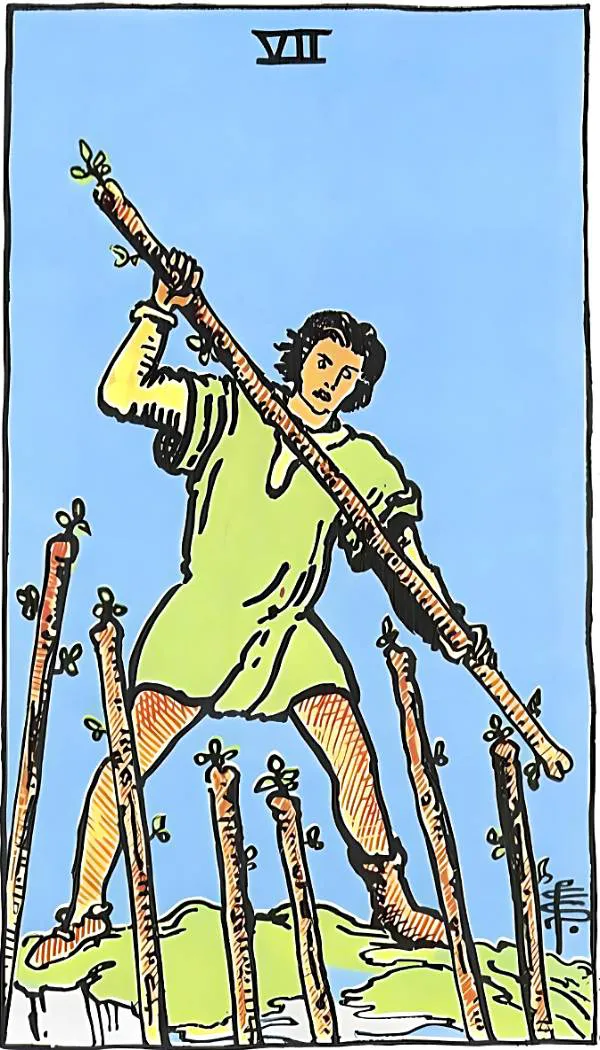
A single wand is leaning diagonally, resisting six upright wands below. In the scene, a young man is depicted holding a wand with both hands, fighting against six other wands aimed at him.

The person raising the six wands is not visible, and they may not belong to the same group, but the wands they hold are all pointed towards the young man. He alone is resisting the six wands that are thrust towards him.

The young man stands on a high ground, with his feet spread wide apart, showing a bold and assertive stance, his expression is focused and slightly tense. He holds the wand with both hands, lifting it up with his right hand and slanting it to the left. The six wands are raised from below, indicating that the people are positioned below the cliff.

Upon closer inspection, the warrior's feet are on either side of a small stream, with his right foot on the edge of the high ground, and part of his left foot on the stream, as if a landslide is about to split his body, and he exhibits a feeling of turning the tide. This scene expresses the idea of transcending the six wands, thus revealing another wand from a higher vantage point.

The high ground is rugged and uneven, indicating that although he has the advantage, it is not actually comfortable. The ground is green, the same color as the young man's clothing, his inner shirt is yellow, and his pants and shoes are in brown shades, giving the impression of a tree. This suggests that the young man himself is a tree, a wand, symbolizing his unity with the wand. His posture is somewhat like that of a magician, although he is in a state of force, all these are skillfully arranged to create an atmosphere.

The sky is cloudless, showing a steely blue-gray hue, which can be roughly discerned as gradient, with the lower layer being lighter and the blue deepening as it goes higher.

The Elevated Figure

The primary figure in this card stands elevated on a higher ground, wielding a wand against six other wands coming from below. This represents a position of advantage or moral high ground. The elevation indicates that the person has a vantage point that gives him a greater perspective, and perhaps, a just cause.

The Six Lower Wands

Pointing upwards towards the primary figure are six additional wands. These represent challenges, opposition, or competitors. The fact that they are lower than the central figure’s wand indicates that these challenges are not insurmountable and can be met and overcome.

Cliff and Terrain

The character stands on a steep incline, adding a sense of urgency and struggle to the scene. This reflects that the character’s position, although advantageous, requires constant effort to maintain.

Boots

The boots on the main figure signify that he is grounded and well-prepared for the fight, perhaps symbolizing the need for practical considerations in the face of multiple challenges.

Stance and Expression

The determined look and posture of the main figure suggest courage, resilience, and a readiness to engage with whatever difficulties lie ahead. This implies not only external battles but also inner resolve.

Clear Blue Sky

The backdrop of a clear blue sky signifies clarity of purpose and a positive environment for defending one’s position. It contrasts the conflict below and could be seen as the Divine supporting the righteousness or clarity of the stand being taken.

Psychological patterns in Seven of Wands
Overfunctioning
The young man is alone on the ridge while six separate wands push up toward him. His own wand is raised across his body, but the image does not show a completed resolution; it shows continuous response, one person meeting too many pressure points at once. In reversal, that posture becomes Overfunctioning. The body keeps blocking because blocking feels like the only available form of control. The cognitive field narrows to the nearest demand, so the deeper question of what should not be yours to hold disappears from view. In lifestyle tarot, this pattern is visible when the day becomes a one-person defense system. You reply, clean, plan, optimize, exercise, manage, repair, and absorb until the routine looks functional from the outside while the person inside it has no recovery space left. The card reveals the hidden trap: being the only visible responder can start to feel like proof that you must remain the only support.
Boundary Discernment
The young man stands above the six raised wands with his own staff held across his body, feet wide on uneven ground and expression fixed on the pressure below. The distance between his high ledge and the unseen challengers creates a visible border: many claims are reaching toward him, but none of them occupy his body or his ground. That geometry turns choice into a boundary audit. You may be surrounded by persuasive options, advice, or competing versions of what would be reasonable, yet the task is to separate external pressure from your own decision criteria. Boundary Discernment names the moment when clarity depends on defending the line between input and consent, not on winning an argument with every possible wand.
Survival Mode
The high ground is an advantage, but it is not comfortable ground. The figure's feet are spread across uneven terrain near a visible edge, so the body has to manage two tasks at once: meet the incoming wands and keep from losing its own footing. Reversed, that precarious platform becomes a psychological container under strain. The mind narrows around immediate threat, and the body organizes itself around staying upright rather than growing wisely. The result is activity without enough inner space to reflect on what the pressure is actually teaching. Survival Mode in personal growth can look deceptively productive. You may still be pushing, learning, optimizing, and defending the next level, but the card shows the deeper audit: progress made from constant threat response is unstable because the system is trying to survive the upgrade instead of inhabit it.
Zero-Sum Thinking
One wand meets six, and the composition gives the scene almost no neutral middle space. Every line points toward contest, impact, and defense, so the field itself teaches the eye to read the situation as a fight. Zero-Sum Thinking appears when a decision becomes a battlefield where one option must survive and the rest must be defeated. You may stop looking for staged moves, blended solutions, or a third position because the mind has fused choice with winning. The card shows how easily a crossroads can become combat when the defended wand feels like the defended self.
Status Defense
The young man stands above the six raised wands with his own staff locked across his body, as if the ridge itself has become a line he cannot let anyone cross. His advantage is real, but it is not relaxed; the uneven ground under his feet makes the position feel earned, unstable, and continuously contested. That physical arrangement mirrors the way status can become a defensive structure at work. When You have fought for a role, promotion path, project, or expert position, ordinary scrutiny can start to feel like an attempt to push You off the ridge. The defense is not random aggression; it is the nervous system protecting a claim that once required effort to secure. Status Defense becomes costly when every question is processed as a challenge to legitimacy. The card's visual pressure shows why this pattern can feel so convincing: You may actually have a stronger vantage point, yet the body keeps acting as if losing vigilance would mean losing the position itself.
Feedback Defensiveness
The six wands rise from below without visible faces, while the young man answers them with a lifted wand before any individual source can be read. The scene makes critique look like impact: incoming, multiple, and already aimed at the body. Feedback Defensiveness grows from that ambiguity. You may hear a professor's margin note, seminar question, or peer comment as a challenge to competence, so the mind moves to rebuttal before it can extract information. The card's raised ground shows why the response can feel justified. There is something worth protecting, but the pattern becomes costly when every piece of feedback has to fight through a defensive wall before it can teach you anything.
Defensive Overfunctioning
The figure's wand meets six rising wands from below, creating a scene where effort is constant and direction is narrowed into defense. His hands are active, his stance is engaged, and yet the visual field is dominated by the need to keep responding. That is the trap of Defensive Overfunctioning: motion substitutes for integration. The psyche keeps proving that it can handle pressure, answer objections, absorb criticism, and stay disciplined, but the energy is organized around not losing ground rather than building a deeper internal structure. In personal growth, You may call this discipline, resilience, or being serious about your evolution. The card reveals the cost more precisely: a growth system can become so busy defending its legitimacy that it has no space left to learn, rest, metabolize feedback, or choose the next move from clarity.
Hypervigilance
The young man is alone on the ridge, gripping one wand against six separate lines of pressure coming from below. His stance is alert, but in the reversed texture the alertness has nowhere to discharge; every line becomes something to watch. That is the body-map of Hypervigilance inside the mind. In introspection, You may scan moods, memories, silence, and tiny shifts in energy as if each one could reveal the next internal threat. The card's pressure does not come from one clear opponent; it comes from faceless force. That anonymity is why the pattern feels so exhausting: the mind cannot finish defending itself because it never fully identifies what it is defending against.
Forced Progress
The young man braces his wand against six upward rods while one foot stays close to the edge and the slope offers no comfortable base. The scene is full of motion pressure, but the body itself is trapped in a repeated block. That is the mechanism of Forced Progress: friction gets misread as a demand for more force. You keep adding effort because stopping feels like losing ground, even when the terrain is showing that the timing structure is not ready to support the move. In timing work, the card exposes the cost of trying to make a season obey intensity. The harder the push becomes, the more important it is to audit whether you are moving with a real opening or fighting the same closed gate from a slightly different angle.
Self-Accountability
The young man does not outsource the defense of the ridge; he stands inside the pressure with both hands on the wand and both feet making contact with unstable ground. One foot is close to the edge, the other appears split by the small stream, so his stability comes from active participation rather than passive safety. That image carries the psychology of Self-Accountability. The wand is not just a tool in the scene; it visually merges with the figure's tree-like colors, making the body look like part of the support structure. The card frames responsibility as a stance: not self-blame, but the willingness to see where your own choices maintain or weaken the system. In lifestyle tarot, this pattern becomes especially concrete. Sleep timing, food, movement, cleaning, admin, digital boundaries, and recovery do not hold themselves together through intention alone. The card shows the dignity and strain of becoming the person who actively maintains the architecture you live inside.
Core Struggles in Seven of Wands
Autonomy Guilt Bind
The central wand is not separate from the figure; it extends from his body like a living branch, yet it must be used as a barrier. The same object that expresses his force also marks the line he has to defend. That is the family shape of autonomy under guilt. Your independence may be real, but the ground beneath it is uneven because each act of self-definition can be treated as a refusal of closeness, gratitude, or belonging. Seven of Wands holds the conflict at the exact place where a self becomes visible. The card shows why autonomy can feel like betrayal inside a family system that reads separation as rejection, even when the deeper movement is toward emotional adulthood.
Control Lock
The same wand that gives the figure leverage can also lock the body into a single defensive shape. When both hands remain fixed and the stance cannot soften, the tool stops being only a response to pressure and becomes the structure that decides what movement is allowed. In a direction reading, that reversal names a future organized around control before clarity. You may keep protecting a route because releasing it would make the whole map feel unstable, even when the deeper problem is that the route can no longer be questioned without triggering alarm. The card’s tension is not about needing less discipline. It shows control becoming a substitute compass: the grip feels like certainty, the defended patch of ground feels like purpose, and recalibration starts to look like collapse even when it is the next honest movement.
Intergenerational Control Loop
The six opposing wands rise from below, but the people holding them are absent from the image. Pressure has direction without a face, force without a single accountable source. That visual absence is essential to the family loop. You may be reacting to a parent's comment, a relative's expectation, a comparison, a silence, or an inherited rule, but the controlling force keeps shifting shape before it can be named cleanly. Seven of Wands reversed shows control as a system rather than a single opponent. The struggle becomes clearer when the question changes from which person is wrong to how the same family pattern keeps recruiting different voices to push you back into position.
Internal Authority Collapse
The six lower wands have no visible faces behind them, so the figure can see pressure without being able to verify its source. The sky is clear, yet the information in the scene is incomplete: force is visible, motive is not. Internal Authority Collapse emerges when that anonymous pressure gets installed inside the decision process. You may still be asking what you want, but the louder structure is already simulating objections, reactions, and imagined consequences until your own signal becomes difficult to separate from the noise.
Boundary Control Strain
The young man plants his feet on broken high ground and uses one wand to hold back six upward wands from below. The posture is not relaxed authority; it is a boundary kept alive through grip, leverage, and constant adjustment on terrain that does not fully support him. Inside friendship, that image becomes the strain of having to make a private limit visible to people who are used to crossing it casually. You are not simply choosing between closeness and refusal; the struggle sits in the effort of defending a real edge while trying not to turn the entire bond into a fight.
Willpower Dependence Trap
The same elevated stance becomes a locked position when the body has to hold it without relief. Both hands clamp the wand, the feet stay split across unstable ground, and the single piece of wood becomes the only barrier between the figure and six upward pressures. At work, the image names a career structure that keeps functioning only when you keep supplying force. The trap is not simple effort; it is the point where every win, boundary, and next step depends on continuous self-bracing, leaving no spare capacity for recovery, strategy, or desire.
Power-Choice Split
The figure stands above the fight, but the high ground does not give him rest: one wand has to meet six rising lines of pressure at once. His advantage is real, yet it only exists while his whole body keeps defending the position that gives him perspective. That structure maps cleanly onto Power-Choice Split in a decision reading. You may technically have the vantage point to choose, but the choice feels fused with a power contest: to take one side is to invite challenge, justify your right to want it, and carry the cost of being seen as the person who chose.
Visibility-Isolation Split
The young man stands above the field with only one wand in his hands, while six unseen challengers aim upward from below. His height gives him visibility, but the same elevation removes peer cover; every movement is easy to see and hard to share. At work, that geometry fits the moment when performance or promotion makes you more exposed than supported. The struggle is not whether you are capable, but whether the recognition that set you apart also cuts you off from the room that once made work feel survivable.
Grade-Identity Fusion
The reversed Seven of Wands compresses the figure and the wand into one defended shape. He is not only holding a position; his body is arranged as if the position must be held for the self to stay intact. In academic life, grades, rankings, supervisor reactions, and peer comparison can start to feel less like information and more like direct contact with identity. A mark on a paper or a challenge in class lands as if the ground under the self has been struck. The card names the fusion between academic standing and personal worth. It does not deny that grades matter, but it shows the cost of making them the terrain your whole self has to stand on.
Merit-Politics Split
The six wands below are made of the same material as the one above, but they are arranged as opposition rather than support. The figure's higher position suggests earned advantage, yet the challenge does not disappear because the ground is higher; it intensifies around the claim he is making. At work, that visual structure fits the split between doing the work well and surviving the power field around that work. You may have evidence, results, or skill, while the room responds through territory, comparison, and challenge; the struggle is the discovery that merit and politics are not operating on the same axis.
Inner Emotions in Seven of Wands
Grounded Agency
The young man plants his feet across uneven ground while holding one wand against six below, turning choice into a stance before it becomes an answer. His higher ground is not comfortable, but it gives him enough perspective to separate his own line from the pressure rising toward it. Grounded Agency lives inside that physical arrangement. You are not free from challenge, yet your body begins to recognize where your leverage is. In a decision spread, this feeling appears when the cleanest choice is not the easiest one, but the one you can defend without abandoning your center.
Imposter Exposure Fear
The figure is elevated, visible, and under direct challenge, while his footing is split across rough ground and a narrow stream. His body occupies a higher position, but the terrain underneath refuses to feel fully stable. Imposter Exposure Fear grows from that mismatch between visibility and uncertain footing. In personal growth, it is the sharp inner sense that once you have advanced, everyone will notice the wobble under your stance and decide you never belonged on that height in the first place.
Hypervigilant Anxiety
The young man’s attention is fixed on the wands rising from below, but the people holding them cannot be seen. The sky is clear, the ground is exposed, and the next point of pressure could come from any of the lower wands already aimed in his direction. In academic life, that creates a nervous system organized around incoming evaluation. Emails, grade portals, seminar comments, revision notes, and deadline reminders all start to resemble the same upward thrust, even when no single one is catastrophic on its own. Hypervigilant Anxiety is the inner weather of never fully stepping down from defense. The card reveals a mind that has mistaken constant scanning for academic readiness, leaving you alert enough to respond but too exposed to feel settled.
Replaceability Dread
One figure holds the high ground, but the ground itself is narrow, rugged, and pressed by six wands from below. His advantage is visible, yet it is not comfortable enough to feel secure. That is the career emotion of being recognized but not settled. You may have the role, the project, the title, or the track record, while still feeling that your position has to be re-justified whenever new pressure appears. Replaceability Dread belongs to the reversed Seven of Wands because the card shows status as something guarded under strain. The fear is not that you have no value; it is that your value must stay constantly defended to remain real in the system.
Defensive Loneliness
The figure stands alone on the ledge while the people behind the six lower wands remain unseen. Only the points of pressure are visible, so the scene gives the body no faces to negotiate with and no shared ground to stand on. In love, that produces the hollow isolation of always being ready to explain, justify, or shield your position. The relationship may still be present, but the emotional field feels crowded with demands and empty of true witness. Defensive Loneliness emerges from the mismatch between a wide open sky and a body trapped in combat posture. There is space above him, yet no felt companionship beside him, which turns self-protection into a private room no one else can enter.
Confrontational Courage
The young man’s wand cuts diagonally across six rising wands, and his feet hold the rough high ground instead of retreating from it. The image turns pressure into contact: force meets force, and the body discovers that resistance can be organized rather than chaotic. In personal growth, that structure mirrors the moment when you stop treating every challenge as proof that you should shrink. Confrontational Courage is the charged feeling of being willing to meet your own limiting beliefs head-on, not because the pressure is comfortable, but because your position finally feels worth defending.
Protective Anger
The wand held across the body creates a hard diagonal boundary against six upward points. Nothing in the scene is soft or passive; the wood, the cliff edge, and the tightened grip all show contact being measured at the perimeter. Protective Anger forms when social access starts to feel too cheap, too constant, or too casually demanded. You can feel the heat because something in the social system has crossed from connection into pressure. The card does not turn anger into permission to lash out. It shows anger as a boundary signal, a way of making repeated impact visible before it becomes silent resentment.
Focused Confidence
The lifted wand forms a clean diagonal through the chaos below, giving the figure one visible axis to organize around. His gaze is not roaming for a perfect horizon; it is anchored to the immediate field of pressure, where attention becomes a tool for keeping his direction intact. This is confidence with muscle in it. In a question about life direction, the card points to the feeling of becoming clear enough to hold focus even while the larger future remains unfinished. You are not being asked to feel invincible; the image shows the quieter power of keeping one line of intention steady while competing signals rise around it.
Scattered Overwhelm
The six lower wands do not arrive as one clean force; they rise from separate points below the ridge. The figure answers them with a single diagonal staff while his feet occupy unstable ground, including the edge of a stream that visually splits his stance. Reversed, that arrangement becomes the inner weather of too many small life systems competing for the same attention. Nothing needs to be individually dramatic for the whole structure to feel unmanageable; the pressure comes from fragmentation, not one obvious crisis. Scattered Overwhelm fits the Seven of Wands because the card shows attention forced into defense before it can sort, sequence, or prioritize. You may still be standing, but your inner bandwidth is being divided by too many demands arriving without a coherent order.
Defiant Relief
The single unbroken wand across the body draws a boundary against six unnamed sources below. The relief in the image is not softness; it is the clean physical fact of having a line to hold. Defiant Relief appears when timing pressure stops being an invisible demand and becomes something you can refuse to rush. You may feel lighter not because the pressure vanished, but because the card gives your not yet a structure strong enough to stand inside.
Outer Contexts in Seven of Wands
Decision Cliff Edge
The young man stands above the six raised wands, but his advantage is planted on rough ground split by a small stream. One foot is near the edge, so the position that gives him leverage also demands constant correction. In a choice reading, that image fits a decision point where every option has a visible cost. You are not simply comparing preferences; you are holding a pressured position long enough to see which move preserves agency and which move only keeps you balancing on unstable ground.
Critique Panel Pressure
The raised wand held across the body turns the figure into a live defense line, while the six lower wands make the challenge visible as a public field of questioning. The high ground gives You perspective, but the uneven footing shows that holding a position still costs effort. In an academic critique, thesis review, seminar, or studio panel, the same structure appears when Your work becomes the object everyone is testing at once. The card does not reduce the pressure to personal weakness; it maps a demanding evaluation setting where the argument, draft, or project must stay coherent while multiple voices press into it. The useful signal here is not that critique is automatically hostile. It is that the environment requires a defensible stance, clear ownership of Your claim, and enough structure to separate useful challenge from noise.
Family Boundary Backlash
A lone figure braces a diagonal wand above six rods rising from below, and the whole scene is organized around a line that has to be held. The high ground gives the boundary visibility, but the rugged ridge shows that holding it is not comfortable or effortless. Family boundary backlash works the same way: a new limit becomes visible, then the system tests it from several angles at once. The card turns the pressure into a map rather than a verdict, showing You where the pushback is coming from and why the boundary needs structure instead of endless explanation.
Strategic Timing Window
From the high ridge, the young man can see the six wands rising before they reach him. The visual field is clear, but the ground under his feet is rugged, which turns advantage into a position that must be actively timed rather than passively enjoyed. Strategic Timing Window fits because the card shows a live interval where leverage exists, opposition is visible, and delay has a cost. You are not dealing with a frictionless opening; you are standing at a point where the window is real but narrow, and the timing has to be read through resistance rather than comfort.
Friendship Boundary Reset
Feet spread across rugged high ground, the figure holds one wand as a visible diagonal line against six raised from below. The image does not show a private preference hidden inside him; it shows a boundary made public, tested by the people close enough to push against it. In a friendship network, that translates into the moment a new limit has to become external and observable. You may be changing how available, responsive, or emotionally open you can be, and the pressure comes from others needing the old access pattern to stay intact. The high ground matters because the stance has leverage, but the uneven terrain keeps it from feeling comfortable. The card links this context to a reset that is necessary and active, where clarity is built by holding the line long enough for the relationship system to reorganize around it.
Triangulated Decision Pressure
Six wands rise from below, but the people holding them remain outside the frame. That absence is the point: the pressure arrives as force, expectation, and implied challenge, while the actual sources stay fragmented and hard to address directly. This creates a decision field where every option seems to come with someone else’s claim attached. You are left holding one wand against several agendas, trying to respond to a crowd of signals that may not even belong to the same conversation. For a direction reading, the card exposes how triangulated pressure can make a life choice feel more urgent than it is. The first structural move is not choosing faster; it is seeing which voices are actually in the room and which ones are only acting through borrowed pressure.
Boundary Backlash
The young man’s raised wand cuts across six lower wands, turning a narrow strip of high ground into a defended line. His advantage is real, but it has to be actively held; every incoming wand makes the boundary visible because someone is pressing against it. In a lifestyle context, that maps onto the moment when a sleep block, no-phone window, home reset, or minimalist rule stops being a private preference and starts disrupting other people’s access to you. You are not defending an abstract ideal; you are defending the physical architecture that keeps your day from being claimed by every demand below the ridge.
Zero-Sum Negotiation
The wands meet as weapons rather than bridges, all angled toward the same exposed figure. Nothing in the scene shows exchange, shared footing, or a neutral table. As a decision context, this captures a negotiation where the available positions have been arranged as wins and losses. You are not just choosing an option; you are navigating a field where every concession appears to cost territory, status, or future leverage.
Zero-Sum Academic Conflict
The six wands do not form a ladder, a circle, or a shared structure; they converge as pressure aimed at one person’s position. The elevated ground creates visibility, but in this orientation it also turns achievement into exposure. In competitive programs, labs, studios, scholarships, curved grading systems, or selective cohorts, academic progress can start to feel like a limited resource. Someone else’s question, grade, recommendation, or supervisor attention becomes framed as a threat to Your own standing. The card names the external field as adversarial without making that field permanent. Once the zero-sum structure is visible, You can distinguish real competition from projected threat and decide which academic battles actually protect Your path.
Zero-Sum Self-Improvement Culture
The staffs do not form a circle, a ladder, or a shared support structure; they form opposition. One raised wand meets six others in a contest over position, turning the scene into a harsh model of improvement as defense. Zero-Sum Self-Improvement Culture emerges when inner work is pulled into comparison, ranking, optimization, and proof. In that environment, even rest, boundaries, journaling, therapy language, or spiritual practice can become evidence that someone is ahead or behind. The card exposes how growth can be distorted by a competitive field. You may be trying to recover inner order, but the surrounding culture keeps asking You to turn that recovery into performance, superiority, or measurable progress.