Nine of Wands Tarot Card Meaning

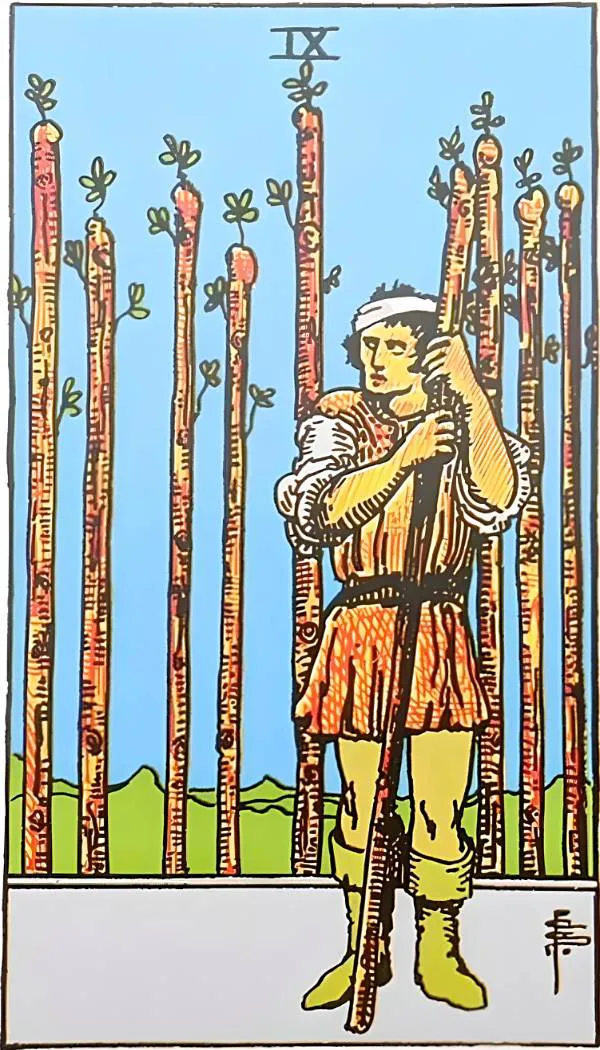
The nine wands are all standing upright on the ground, with one of them being held by the main character, while the other eight wands are arranged in a row behind.

All nine wands touch the ground, but there are differences among them; eight of them are not held. Behind the character, the eight wands stand upright in a straight line, forming a fence.

The main character leans against the wand in front, holding it tightly with both hands in front of the chest. His whole body is tense and straight with a contracted neck, showing a look of alertness and defense, and his gaze is directed to the right, as if waiting for an enemy to appear.

The wands of this protective wall are uneven in height, with almost equal distances between them, but there is a gap next to the tallest wand in the middle, and the main character stands in front of this gap, combining with the wand to form a pillar to complete this line of defense. You could also say that they are a discontinuous gap that has left from this wall.

The character has a white bandage on his head, which seems to imply a struggle. The belt he wears is double-layered, and its appearance is very similar to the self-eating snake of the Magician. The character is dressed in brown clothes and green shoes, which is another simulation of the wand of the Tree of Life.

The ground where the character is located is flat and square, as if it were a concrete floor. The background behind the eight wands is a lush green undulating hills. The sky is a gradient of iron blue-gray.

The Wounded Warrior

The central figure in the Nine of Wands is often depicted as a wounded warrior, bandaged and leaning on one of the nine wands. This image symbolizes resilience and enduring strength despite setbacks and injuries. It represents the fortitude to continue in the face of adversity.

The Nine Wands

Eight of the nine wands stand erect as a barrier or fortification behind the central figure, suggesting preparedness and strong defenses. The ninth wand serves as a staff of support for the wounded warrior. This configuration embodies the wisdom of being prepared and vigilant in the face of impending challenges.

Stance and Expression

The wary, almost defiant expression on the face of the figure reveals a spirit that is not easily broken. Despite being battered, the individual remains on guard, ready to face whatever challenges lie ahead. This captures the essence of survival instinct and vigilance.

Background

The background is generally barren and devoid of life, emphasizing the solitude of the warrior’s struggle. The stark landscape represents the idea that this is a personal battle, and the responsibility for one’s life and choices is solely one’s own.

The Bandage

The bandage wrapped around the central figure’s head serves as a badge of courage and experience. It indicates that this person has seen battle and carries scars, both physical and emotional, but continues to stand firm. The bandage serves as a poignant reminder that trials leave us marked but also wiser and better equipped for future battles.

Psychological patterns in Nine of Wands
Parentification
The figure stands where the wall is incomplete, gripping the wand as if his own body must finish the defense. The eight wands behind him form a structure, but it is his tense presence that makes the line feel closed. The card shows a person who has become infrastructure for a system that cannot fully support itself. Parentification appears when family stability is organized around the child, even after that child has become an adult. You may become the mood manager, mediator, practical fixer, or emotional interpreter because stepping back feels like letting the whole wall fall open. The pattern is not simple helpfulness; it is a learned role where your nervous system confuses responsibility with attachment security. The reversed Nine of Wands reveals the exhaustion inside that role. The wand is no longer only a tool of strength; it becomes the thing You cannot stop holding. In family tarot, this card makes visible the old contract that says love means staying braced in the gap, even when the cost is your own emotional adulthood.
Timing Perfectionism
The wall behind the figure is orderly but not complete; the visible gap makes the whole defense feel almost ready, but not secure enough to release. The figure stands inside that incompletion, gripping the ninth wand as if one more condition must be controlled before movement can begin. In the reversed state, this becomes Timing Perfectionism. The mind demands a flawless alignment of resources, certainty, energy, external approval, and risk control before it will allow action. The card supports this pattern because the scene is not chaotic; it is nearly prepared. You may not be avoiding action out of laziness or confusion, but because the remaining gap in certainty has become psychologically larger than the actual timing signal in front of you.
Hypervigilance
The figure’s neck is contracted, the hands clamp the wand in front of the chest, and the eyes angle toward the side of the frame as if the next impact is already being tracked. The eight upright wands behind him do not form a home; they form a surveillance line, with his body stationed at the break in the barrier. That arrangement turns protection into an attention system. You are not simply standing firm; your inner bandwidth is being recruited to scan for the one cue that might prove the threat has returned. In introspection, Hypervigilance shows up when quiet self-reflection feels less like rest and more like threat monitoring. The psyche keeps checking memories, moods, and body signals for danger, so clarity is delayed by the reflex to brace before anything can be felt.
Emotional Gatekeeping
The held wand sits across the chest like a vertical lock, while the row behind the figure creates a controlled threshold. The body stands in front of the gap as if every feeling must pass inspection before it can enter conscious awareness. That physical guarding mirrors a defense that filters emotion before it becomes expression. You may have enough awareness to know something is moving inside, but the system still decides which parts are allowed to be named and which must stay behind the fence. In introspection, Emotional Gatekeeping appears when the inner world is managed like a border checkpoint. Vulnerability is not absent; it is detained, sorted, and delayed until it feels safe enough to be admitted.
Boundary Diffusion
The wands behind the figure look like a boundary, but they are not a sealed wall. A gap remains, and the figure stands in front of it with his own body and wand completing the line. The image is not just protection; it is protection that depends on personal exposure. Boundary Diffusion shows up when the family boundary cannot hold unless You physically, emotionally, or logistically reinforce it. A parent's disappointment, a sibling's crisis, or a long-standing family narrative may cross into your decisions so quickly that your own preference becomes hard to locate. The defense is active, but the line between care and obligation is not fully differentiated. The reversed Nine of Wands captures the strain of being both the person and the perimeter. The gap in the wall becomes a psychological opening where guilt, expectation, and old roles can enter. This card exposes the specific confusion at the center of family boundary work: trying to protect yourself while still feeling responsible for what crosses the line.
Achievement Fusion
The figure's wound is on the head, the part of the body most visually linked with judgment, interpretation, and mental strain. He stands inside the defensive row as if his continued value depends on staying upright at the breach. In academic life, that image maps onto the fusion of achievement and selfhood. A grade, publication, scholarship, supervisor response, or degree path stops being an external marker and becomes the wall that proves whether the self is still intact. Achievement Fusion is the reversed Nine of Wands because the defense has moved from protecting the work to protecting identity through the work. The pattern can generate endurance, but it also makes every academic demand feel existentially loaded, as if one crack in performance could crack the person behind it.
Family Role Regression
The figure is an adult body in a defended position, but the scene is arranged like an old role being resumed. He stands at the gap, holds the wand in a fixed grip, and watches the edge of the frame as though the next move has already been scripted. The wall behind him gives the image a history; this is not a first reaction, but a rehearsed stance. Family Role Regression appears when contact with relatives pulls You back into a younger version of yourself before conscious choice catches up. A phrase, tone, silence, comparison, or demand can activate the old position: the responsible one, the invisible one, the rebel, the peacekeeper, the one who must absorb the tension. The adult self is present, but the family field cues the body to perform an earlier role. The reversed Nine of Wands makes this regression visible through repetition and strain. The figure is not moving forward; he is guarding a familiar breach. In family tarot, the card reveals how old relational architecture can reactivate inside current conversations, making autonomy feel fragile precisely when You most need access to it.
Boundary Discernment
The row of wands behind the figure is not scattered; it forms a visible boundary line. Yet the line is uneven and incomplete, and the figure stands precisely where the gap appears, using his own body and staff to decide what can pass through. This is the psychology of discernment: not every social opening is automatically safe, and not every boundary is a rejection of connection. In the social field, the mind is learning to separate genuine belonging from access without reciprocity, pressure disguised as inclusion, or a circle that drains more than it gives. Boundary Discernment fits this card because the defense is not only fear-based; it is also observational. You are not meant to disappear behind the wall forever, but the wall shows that selective access can be a mature way of protecting energy while still leaving room for chosen connection.
Guilt Conditioning
The bandage on the figure's head is not hidden. It sits above the guarded eyes while the body still holds the wand in front of the chest. The image shows a person who has been marked by conflict and has learned to treat endurance as evidence that the boundary is legitimate. Guilt Conditioning enters when a family system makes protection feel like something that must be earned. You may feel allowed to say no only after you have been patient enough, available enough, grateful enough, or hurt enough to justify the boundary. The mind turns the wound into a permission slip because direct autonomy has been trained to feel selfish. The Nine of Wands is precise here because the figure is both defended and still on trial inside his own posture. The wall is present, but the body has not relaxed into it. In family tarot, this card exposes the learned equation between suffering and permission, helping You see where guilt has been installed as the gatekeeper of your choices.
Defensive Pessimism
The white bandage wraps the figure's head while his body remains upright on a flat, guarded strip of ground. The wound is carried at the level of perception, so the next situation is filtered through the memory of what already hurt. Defensive Pessimism forms when the mind tries to protect choice by rehearsing the worst possible outcome first. In the Nine of Wands, this is not passive fear; it is active preparation that has become emotionally expensive. Inside a decision reading, the pattern can be useful when it exposes real hidden costs. It becomes limiting when every option is forced through a threat simulation so severe that the future is judged more by potential damage than by aligned desire, agency, or realistic probability.
Core Struggles in Nine of Wands
Threshold Disorientation
The figure stands at the edge of an opening, with the hills visible beyond the line of wands, yet his posture belongs to a checkpoint rather than a journey. The card's space is neither fully closed nor truly open; it holds him at a border where the future can be seen but not entered cleanly. This is the architecture of Threshold Disorientation. In a direction reading, the disorienting part is not that there are no options, but that the body has not updated its coordinates from survival mode to movement mode. You may be standing at a real turning point while still using the posture of someone waiting for the next impact. The card makes that liminal state visible: the horizon is present, but the inner system is still asking whether it is safe to cross.
Readiness Loop
The figure has become another post in the barrier, holding the only wand that is not standing by itself. The gap is filled, but the posture has no exit path; every muscle is organized around staying ready. In a timing spread, that structure names preparation that has stopped functioning as a threshold. You may keep waiting for a cleaner signal, yet the card shows how readiness can turn into a closed circuit where the moment never feels permitted to begin.
Timing Control Strain
The figure stands in front of the gap in the wand wall, gripping the ninth wand as if his own body has to complete the perimeter. His gaze is not on the wand he holds; it is fixed to the side, scanning for a signal that may or may not arrive. In a timing question, that posture turns the future into something you try to guard manually. You are not simply waiting for the right moment; the structure shows the strain of trying to hold readiness, prevent another breach, and control the arrival of the next opening at the same time.
Boundary Rigidity
The held wand supports the figure, but it also locks his arms, chest, and attention into a single defensive column. The same object that helps him stay upright limits how much he can soften, move, or receive what is outside the wall. Boundary Rigidity appears in family life when the line that once protected your autonomy hardens into the whole shape of the self. You may have clear limits, short replies, strict rules, or emotional distance, yet those defenses can become so fixed that every family contact is processed through the same clenched architecture. The reversed pressure of this card is not the absence of boundaries. It is the loss of flexibility inside the boundary, where the self and the wall occupy the same place and safety can only be maintained by staying braced.
Boundary Control Strain
The figure is not simply behind the wall; he is completing it. The gap near the tallest wand is sealed by his own body and the staff clamped to his chest, so the defensive line only works while he stays physically engaged. In friendship, this is the strain of keeping limits alive through constant manual enforcement: answering enough, refusing carefully enough, explaining softly enough, watching for the moment a boundary turns into conflict. The fence is real, but it does not stand without your attention. The card names the cost of a boundary that has to be held by muscular effort rather than mutual recognition. You can see where your agency is still present, and also where the structure is asking your vigilance to do too much work.
Vulnerability Containment Strain
The white bandage is visible, but the hands close tightly around the wand instead of reaching outward. The wound is not hidden, yet the body organizes itself around containment, keeping the injured point acknowledged but not directly accessible. In romantic conflict, that is the shape of Vulnerability Containment Strain. Hurt can be shown through silence, tension, distance, or guarded composure, while the actual exposed feeling remains held behind the staff. The Nine of Wands carries the cost of being visibly marked but still unable to soften into contact. You may want the relationship to understand the injury, while the defensive posture keeps translating vulnerability into controlled endurance.
Willpower Dependence Trap
The wounded figure plants one wand in front of his chest while eight others stand behind him, and his body occupies the gap that the fence cannot cover. The support system is present, but the last load-bearing segment is still a person gripping harder. In lifestyle terms, the card locates a daily architecture that only holds when you become the missing pillar. The struggle is not a lack of discipline; it is a system that keeps converting basic routines, sleep, meals, chores, and recovery into tests of personal force.
Inherited Repair Burden
The row of wands behind the figure looks like a prepared defense, but the line is not complete without him. One body and one held wand become the missing structural element, turning a person into the patch that keeps the wall visually intact. That is the family logic behind Inherited Repair Burden. You are not merely participating in family communication; you are being positioned as the stabilizer who absorbs tension, anticipates escalation, translates silence, or keeps old fractures from becoming visible. The card's pressure comes from the fact that the wall appears orderly only because someone is standing in the gap. In a family system, this can make your maturity, calmness, or emotional labor feel less like a choice and more like the hidden support beam everyone has stopped noticing.
Family System Overidentification
The eight wands behind the figure create a family-like architecture of inherited positions: upright, evenly spaced, already there before the current moment begins. The figure does not build the wall from scratch; he enters a structure that has already decided where the vulnerable gap is. Family System Overidentification takes hold when the old defensive line becomes the main coordinate system for identity. You may evaluate your choices by whether they disrupt the family mood, expose a fracture, disappoint a parent, or force someone else to carry tension they usually avoid. In the reversed Nine of Wands, the danger is that the wall stops looking like a temporary defense and starts feeling like home ground. The card witnesses the moment when loyalty, role, and selfhood become so overlaid that stepping into your own life feels like leaving the family structure undefended.
Wound-Compass Fusion
The white bandage sits on the figure's head while his eyes scan for whatever might come next. The previous impact is not in the background of the image; it is wrapped around the part of the body that orients, calculates, and watches. In academic work, one grade, one rejected draft, one public mistake, or one sharp piece of feedback can become more than a memory. You may start using the old wound as a compass, choosing courses, topics, timelines, and levels of ambition around avoiding the same strike. The Nine of Wands makes that fusion visible without calling it weakness. It shows how survival information can become overpromoted into direction, and how a past academic hit can begin steering present work before your current intelligence has a chance to speak.
Inner Emotions in Nine of Wands
Emotional Numbness
The figure’s guarded posture can harden into a shape that no longer looks responsive, only fixed. The bandage, the tight grip, and the iron blue-gray sky create a scene where the body is still protecting itself, but the inner signal has gone quiet. Emotional Numbness belongs to the reversed Nine of Wands because defense has become a kind of insulation. In lifestyle terms, the day may still run through its required motions, but the felt sense of preference, pleasure, hunger, and genuine rest becomes faint. This card does not frame numbness as emptiness without cause. It shows how a person can become so trained to hold the line that feeling less becomes the only available way to keep standing inside an overextended routine.
Hard-Won Composure
The white bandage, the straightened spine, and the wand used as support create a body that has absorbed strain without falling out of position. Nothing in the image is soft, but nothing is shattered either; the figure is held together by posture, boundary, and practiced restraint. Hard-Won Composure emerges from that exact physical arrangement. In personal growth, this is the feeling of staying centered after setbacks have already marked you, where calm is not the absence of pressure but the ability to keep your inner structure intact while the next challenge comes into view.
Compassion Fatigue
The white bandage, the braced posture, and the staff used for support make care look physically expensive. In friendship, this is the moment when listening, reassuring, and being available have accumulated into a body that still stands but no longer feels replenished. The eight wands behind him read like reserves that are already assigned to defense. Compassion Fatigue surfaces when your care is still real, but the channel it moves through has been overused by one-way venting and constant emotional access.
Hypervigilant Anxiety
The sideways gaze, contracted neck, and exposed gap in the wand fence turn the whole body into a lookout post. Nothing is visibly attacking in the scene, yet the figure is already arranged around the possibility that something could appear. In timing questions, that posture becomes Hypervigilant Anxiety: the inner system keeps scanning for proof that now is the moment, now is the threat, now is the window, now is the mistake. The open hills do not create ease because attention is pinned to the next possible disruption. This card gives that anxious scanning a clear shape. You are not irrational for watching the timing closely, but the image reveals when watchfulness starts consuming the very energy needed for action.
Chronic Overwhelm
The gap in the wand fence matters because the figure is not merely standing near a boundary; he is helping complete it. His own body becomes part of the structure, and that makes the whole scene feel less like a stable shelter and more like a system that depends on constant human tension. Chronic Overwhelm appears in the reversed Nine of Wands when every part of life seems to require manual holding. In a lifestyle reading, the schedule, the room, the inbox, the body, and the recovery plan all become open loops asking for the same limited attention. The card gives this overwhelm a precise architecture. It is not one big dramatic crisis; it is the accumulated pressure of being the backup support for too many daily systems at once.
No Way Out Dread
The open hills sit beyond the row of wands, but the figure remains fixed at the defensive gap. His attention moves sideways toward possible pressure, not outward toward the wider landscape, and the space around him starts to feel narrower than it looks. No Way Out Dread rises from that spatial contradiction. In a lifestyle reading, the same routines that keep life from collapsing can begin to feel like a corridor you cannot exit without risking everything you have built. The reversed Nine of Wands names the dread of being trapped inside your own maintenance system. It does not erase your agency; it shows exactly where the sense of choice has been compressed by too many obligations, too little recovery, and a body that no longer trusts the horizon as reachable.
Timing Dependence Anxiety
The figure stands exactly where the fence breaks, using his body and the held wand to complete the line. The whole structure looks functional, but it also depends on one person staying locked in place. Timing Dependence Anxiety emerges when the external opening feels so important that your whole inner state starts hanging from it. In this card, the hands gripping the wand show how easily readiness can turn into overdependence on the next signal, the next window, or the next permission to move. For timing work, the image is a clean audit of where agency has narrowed. It asks you to notice when the moment matters, and when the idea of the perfect moment has started holding your nervous system hostage.
Repair Fatigue
The staff supports the figure, but it also shows how much weight he is asking one body to carry. Behind him, the row of wands stands upright, yet the gap in the line depends on his exhausted presence to stay closed. In love, this maps onto the tiredness that comes from repeatedly patching the same rupture, clarifying the same misunderstanding, or proving the same commitment. You may still care, but the emotional labor has started to feel like standing watch after every repair. Repair Fatigue fits the Nine of Wands because the card shows resilience with a visible cost. The boundary remains standing, yet the person maintaining it is marked, braced, and no longer moving with ease.
Conflict Hangover
The white bandage, clenched hands, and upright fence make the aftermath visible before anything new happens. The figure is not in active battle; he is standing in the residue of one, with his body still organized around impact. In love, that translates into the charged quiet after an argument, apology, or tense conversation. You may technically be past the fight, but the body still holds its shape, listening for the next sharp turn in tone. Conflict Hangover fits the Nine of Wands because the card shows repair and readiness occupying the same body. The wound is covered, the boundary is standing, and the emotional system has not yet received enough proof that the relational weather has changed.
Survival Mode Fatigue
The front wand is not only a weapon or boundary marker; it is being used as something to lean on. The figure’s body completes the wall, which makes protection depend on continuous bodily effort rather than a structure that can hold by itself. Survival Mode Fatigue appears when personal growth becomes a permanent guard shift. You may still be standing, still disciplined, still technically functioning, but the card exposes the exhaustion of having to be your own fence, lookout, and support system at the same time.
Outer Contexts in Nine of Wands
Decision Cliff Edge
The bandage, the tight grip, and the centered defensive stance place the figure at a hard threshold. The scene is not wide open; it is organized around a line that has already taken effort to hold. In choice work, that visual pressure maps onto the moment when a decision starts changing the shape of the whole field. You can still act with agency, but the card makes the threshold visible: commitment, delay, and withdrawal each carry a different structural cost now.
Sunk Cost Exit Dilemma
The eight wands behind the figure look like accumulated proof of past labor, while the ninth wand is held so tightly it becomes both support and obligation. The bandage makes the cost visible, and the gap in the fence explains why leaving the position feels structurally charged. You are not just choosing between staying and leaving; you are facing a path that has been reinforced by time, effort, and public evidence. The card connects this dilemma to the moment when a long-built direction begins asking for more protection than it returns.
Premature Launch Pressure
The row of wands looks like a completed barrier until the eye reaches the gap where the figure has to stand in as the missing pillar. The body is being used to make the structure look ready before it is actually self-supporting. That is the reality of premature launch pressure. You may be asked to ship, announce, commit, or move before the system can carry exposure on its own, and the card makes the cost visible: readiness is being performed by strain instead of supported by structure.
Bad Timing Loop
Hands clamp around the wand, the body stays fixed, and the path ahead is not visible. The support object has become part of the lock, keeping the figure upright while also keeping him in the same position. That is the mechanics of a bad timing loop: action keeps being generated from pressure rather than from an actual opening. You may keep meeting resistance because the timing field is still closed, and the card exposes the loop where effort repeats before conditions change.
Family Boundary Backlash
The wounded figure stands in front of a fence made of wands, gripping the one movable wand as if the whole line will fail if he relaxes. The wall is almost complete, but the gap beside the tallest wand makes the boundary visibly contested rather than secure. That image maps cleanly onto a family system where a boundary has been named but not yet accepted. You may have created a limit around calls, visits, money, privacy, or emotional access, yet the surrounding structure keeps testing whether that limit is real. The bandage and guarded posture show that this is not a fresh disagreement; it is contact after repeated impact. Family Boundary Backlash names the external pressure that arrives after you stop automatically absorbing the old role, when the family tries to pull the missing piece back into place.
Love in Survival Mode
The contracted neck, locked hands, and sideways watchfulness place the whole body on alert. Behind him, the wands make a defense system, while the iron blue-gray sky gives the scene the pressure of a long watch rather than a single dramatic moment. In a relationship, this becomes love organized around endurance. You may still care, still show up, and still protect the bond, but the daily reality feels like managing the next conflict, tone shift, withdrawal, or emotional demand. The Nine of Wands carries this context because it shows attachment under siege without turning it into collapse. The relationship is still standing, but its operating system has shifted from intimacy to survival, and that shift needs to be named before any real repair can be understood.
Launch Window Readiness
Nine grounded wands create a visible supply of tools, yet one wand still has to be held by the figure standing at the break in the row. The structure looks close to complete, but its final stability depends on direct human coverage. That is the texture of a launch window that is nearly open but not frictionless. You may have most of the pieces in place, yet the card points to the last uncovered gap: the part of the plan that still needs protection before momentum can safely become exposure.
Unscaffolded Healing Environment
The bandage, the lone figure, and the partial fence create a scene where repair is happening without visible backup. Resources exist in the image, but they are arranged behind the body rather than actively sharing the load at the exposed gap. In personal growth, this speaks to rebuilding yourself in an environment that offers inspiration, concepts, or distant possibility but not enough scaffolding. You may see the green hills of a different life, yet the immediate structure still asks You to hold the breach alone. The card makes the missing support concrete. It does not turn your stalled progress into a character flaw; it shows the difference between having growth language around You and having an actual container that can carry pressure.
Friendship Boundary Reset
The bandaged figure stands in front of a visible gap in the wand fence, gripping the ninth wand as a temporary post. In a friendship reading, that image maps to the moment when an old access pattern no longer holds by itself and a new boundary has to be named in real time. You are not outside the bond in this picture; you are at the threshold of it. The pressure comes from having to make your availability, response time, and emotional labor visible enough that the friendship can continue without quietly using your body as the missing piece of the wall.
Parentified Adult Child Role
The figure is not merely standing near the wall of wands; his body completes it. Eight staffs remain planted behind him, while the ninth has to be held by the already bandaged person at the exposed point of the structure. That arrangement turns support into duty. In a family system, the person at the gap becomes the one expected to regulate conflict, anticipate pressure, protect others from fallout, and keep the household narrative intact while everyone else stays fixed in place. Parentified Adult Child Role fits this card because the burden is not only emotional; it is positional. You are placed where the family structure is weakest, then treated as responsible for preventing the whole line from breaking.