When a Gym Membership Becomes a Personality Test: Make It a Fit Check

The 8:47 Streetcar Spiral
If you are a late-20s city person opening a gym renewal email, your banking app, and your calendar in the same five-minute spiral, I can usually tell before I even lay down the cards that this is not really about fitness anymore.
Jordan (name changed for privacy) sat across from me with both hands around a coffee cup and told me about 8:47 PM on the Queen streetcar heading west after another agency day that ran later than it looked like it should. Her gym shoes were still knocking around in a tote bag, the overhead light had that flat fluorescent hum, her phone had gone warm in her hand from flipping between the gym app, the half-loaded cancellation page, and tomorrow's calendar, and the smell of someone else's takeout was hanging in the air while her shoulders kept creeping upward.
'I do not know if I want the gym or just the idea of being someone who goes,' she said. 'Why does one membership feel like a personality test?' The real knot was immediately clear to me: she wanted a routine that genuinely fit real life, but she was terrified that canceling would mean giving up on becoming disciplined. The shame in her body was not abstract. It sat in her like a drawstring pulled one notch too tight around her ribs, small and constant, especially when the renewal reminder landed and her stomach dropped before she could even name why.
I nodded and kept my voice soft. 'Then I am not going to ask the cards to judge you,' I told her. 'I am going to ask them to help us tidy up what is real. Let's make this a map for clarity, not a trial about your character.'

Choosing the Compass: The Decision Cross for a Gym Membership Decision
I asked her to set her phone face down, take one slow breath, and hold the question in one clean sentence while I shuffled. Steam from my coffee curled between us, and that small ritual did exactly what I needed it to do: it gave her nervous system one minute outside the app-switching loop.
For this reading, I used a Decision Cross tarot spread for a yes-or-no subscription choice. This is how tarot works best for practical decisions: not by handing down fate, but by separating the visible choice from the hidden story fused to it. I care about card meanings in context, not card meanings in isolation, and this spread is perfect when the surface question is simple but the emotional charge underneath is not.
I chose it because a larger spread would only feed the decision fatigue. The center card would show me the frozen present moment. The two side cards would compare what renewing and canceling were each really protecting or releasing. The card beneath would expose the hidden fear making this money decision feel moral and final. And the card above would give us the clearest criterion for moving forward: not proof, but fit.
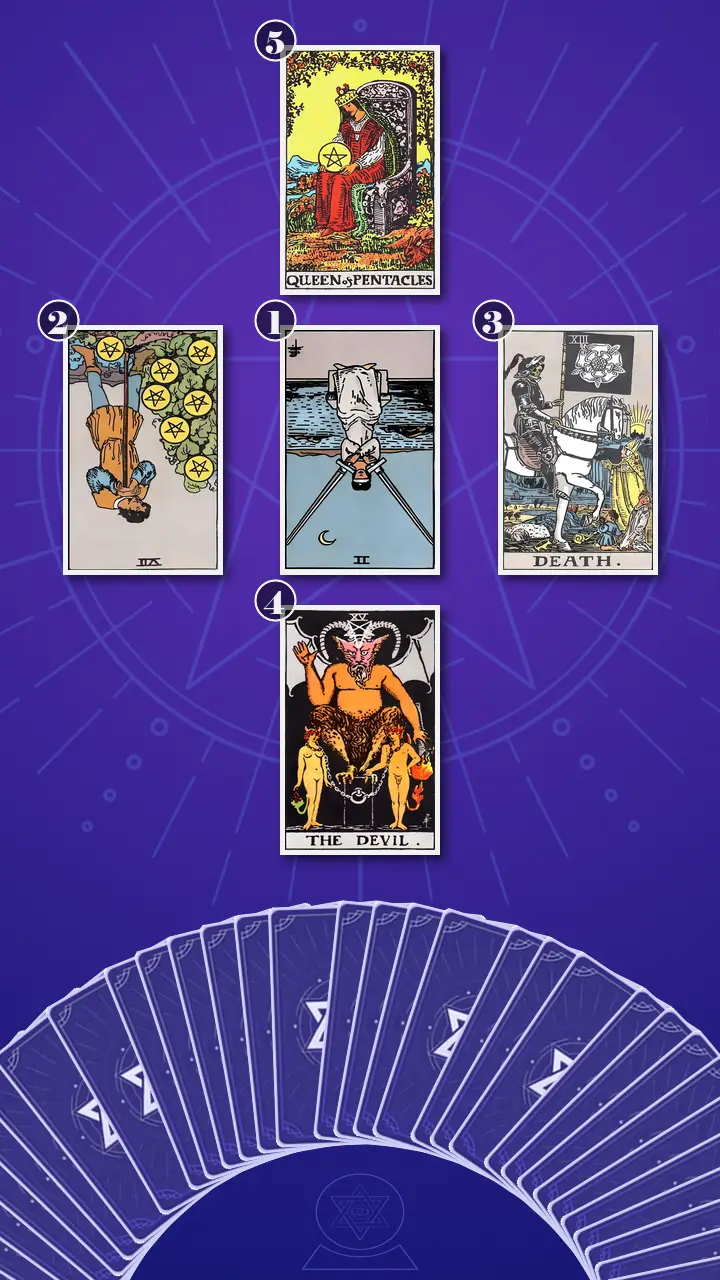
Reading the Tabs That Would Not Close
Position 1: The Loop That Pretends to Be Research
I turned over the first card and said, 'This is the position that shows me the concrete decision knot: the stalled moment between renew and cancel, and the overthinking that keeps the choice suspended.'
The card was the Two of Swords, reversed.
I told her the image translated almost too neatly into modern life. I could see her on the streetcar after work with the gym app open, the cancellation page half-loaded, her bank app one swipe away, and tomorrow's calendar already telling the truth she did not want to hear. It had the energy of having twelve tabs open and still not touching the one that would actually resolve the problem. Reversed, this card is blocked air spilling into overload. The thinking is not creating clarity anymore; it is protecting her from having to say out loud that the membership now carries shame, hope, and self-scoring far beyond its practical use.
'So the problem is not that I need more information,' she said, half laughing already.
'Exactly,' I said. 'The blindfold here is not ignorance. It is avoidance. You keep telling yourself you need five more minutes to think, but what you really need is to name the feeling under the data.'
She nodded fast, then gave that brief bitter laugh people make when a card catches them too accurately. 'This is literally me with the tabs open,' she said, rubbing her thumb along the cardboard seam of the cup.
Position 2: Cost-Per-Class Math at the End of the Month
I turned to the left card. 'This is the position that shows me what renewing is really trying to protect, preserve, or quietly recover.'
The card was the Seven of Pentacles, reversed.
I told her this card always reminds me of the modern ritual of opening attendance history and doing cost-per-class math like it might produce absolution. Renewing, in this position, did not look like straightforward commitment. It looked like sunk-cost thinking. She had already spent money, intention, and a whole healthy-era storyline on this setup, and now she was tempted to spend more because writing off the earlier investment felt worse than another monthly charge. Paying for hope is expensive when hope never gets translated into a Tuesday night plan.
Reversed, this is earth energy gone distorted. Instead of checking whether the routine is growing anything usable, she keeps staring at the numbers, trying to force a sense of payoff. That is why renewing feels weirdly noble for ten minutes and then resentful again the next time the fee hits. The membership is being used to rescue the feeling of waste, not necessarily to support movement.
'Oh my God,' she said, wincing. 'I literally do the cost-per-class thing and then renew anyway because I cannot stand how bad the math looks.'
I let her laugh without piling on. 'That does not make you foolish,' I said. 'It makes you human when money gets tangled with self-worth. But it does mean the numbers are being asked to carry more emotion than they were built for.'
Position 3: Closing the Tab Cleanly
I moved to the right side of the cross. 'This position shows me what canceling is asking you to acknowledge, grieve, or free up.'
The card was Death, upright.
I watched her eyes flick up for a second, so I named the obvious first. 'Not catastrophe,' I said. 'Not punishment. Ending.'
Then I translated it into her real life. This card looked like finally closing a tab that had been open for days. It looked like admitting that a sleek gym membership is not the same thing as a movement practice, and that ending one setup can be the cleanest way to make room for another. Death here was not telling me she would be quitting care. It was asking whether she could let one structure complete its cycle with dignity instead of dragging it forward because the ending felt dramatic.
The energy here is release. Not deficiency, not failure, but a necessary clearing. The sunrise in this card matters to me because it keeps the reading honest: something more livable cannot arrive while an outdated contract is still being treated like a sacred object. I said it plainly: 'You are not quitting care. You may be quitting one setup.'
She went quiet after that. Her jaw unclenched almost visibly, and she stared at the card long enough for the room to settle around us. 'That part feels weirdly relieving,' she said at last. 'Like maybe ending it would be honest, not dramatic.'
Position 4: The Subscription as an Identity Contract
I placed my hand on the card below the center. 'This is the hidden factor. It shows me the fear underneath both options, the thing making a practical money decision feel much bigger than the amount.'
The card was The Devil, upright.
The light outside the window had already gone blue by then, and something about that darker hour always sharpens this card for me. After twenty years of listening to people talk across warm coffee and cold phone screens, I know the exact second a practical question reveals its real shadow: the breathing pauses, the eyes look away, and the person suddenly stops arguing with the details because they have recognized themselves in the pattern.
I told her this card was not about evil. It was about attachment, shame, and mistaken power. The loose chains in the image mattered most. They are real, but they are not locked as tightly as they first appear. In her life, this looked like letting a recurring charge act like a moral scoreboard. It looked like confusing Apple Pay history with habits. It looked like believing the monthly fee could force consistency into existence, as if pressure and guilt were the same thing as self-trust.
'If I cancel, what does that say about me?' I asked, not because I did not know, but because I wanted her to hear the sentence outside her own head.
Her breath caught. She looked down at the table, then back at the card. 'Why does this feel so personal though?' she said, and there it was: the stomach-drop recognition. 'It is just a membership. But it feels like if I stop paying, I am admitting I only liked the fantasy version of being healthy.'
'That is the chain,' I said gently. 'Not the app. Not the charge. The meaning attached to it. A recurring charge is not a moral achievement, but guilt is very good at dressing up as motivation and calling itself discipline.'
When the Queen of Pentacles Took the Verdict Off the Table
Position 5: The Care You Can Actually Carry
When I turned the final card, the room changed. Even the small clink of cups from the front counter seemed to drop away, as if the reading itself had reached the sentence it had been trying to say all along.
'This is the guidance position,' I said. 'The integrating perspective. The wisest criterion for choice.'
The card was the Queen of Pentacles, upright.
I smiled the second I saw her. In a spread full of blocked air, frustrated earth, release, and shame, this was mature earth at last: balanced, resourced, embodied, calm. The Queen does not care whether a routine looks impressive online. She cares whether it is livable at 8:30 PM after a packed downtown workday, a long commute, and a nervous system that is already tired. She asks whether movement supports your actual evenings, actual wallet, and actual body. Less 'new era, new me' and more 'what can I actually repeat next Tuesday?'
This is also where I use one of my own reading tools, what I call Analysis Paralysis Deconstruction. I strip away the abstract what-ifs, the Sunday reset fantasy, the glow-up content, the self-punishing commentary, and I bring the question back to its grounded constraints. Then I reduce the whole storm to one clean practical binary: does this membership support your real week next week, yes or no? The question is not 'Can I force this?' The question is 'Can I carry this?'
The Sentence That Changed the Room
When the renewal email lands, the gym tab, your bank app, and tomorrow's calendar suddenly feel like evidence in a trial about who you are. That is usually the moment the choice stops being about the gym at all.
You do not become more worthy by staying tied to the charge; like the Queen holding her pentacle in a living garden, choose the care you can actually tend.
I let that sit between us for a beat.
Jordan did not soften right away. First came the freeze: her breath stopped, and one hand hovered halfway to her cup. Then came the cognitive slip, that brief unfocused stare I have seen so many times when someone is replaying three scenes at once—the streetcar with the shoes in the tote, the Sunday night Notes app called Reset, the monthly fee landing like a verdict. Then the emotion broke through all at once. Her shoulders dropped. Her mouth tightened. Her eyes brightened, not with neat relief, but with that strange mixture of recognition and grief that comes when a hard truth is kinder than the lie you have been living with.
'But if that is true,' she said, and now there was a flash of resistance in it, 'doesn't that mean I have been making this way more moral than it is? Like... I have been turning a subscription into evidence?'
'Not evidence,' I said. 'A placeholder. You were asking one payment to hold discipline, hope, and self-respect all by itself. Of course it got heavy. That does not mean you were ridiculous. It means you were trying to keep a future self on life support with the tool you had.'
I asked her to think back to last Tuesday, the one where she carried the shoes home anyway. 'If the question that night had been, Can I actually carry this? instead of, Can I force this? what would have changed?'
She exhaled long through her nose and almost smiled. 'I would have stopped trying to prove I was still the kind of person who should go,' she said. 'I probably would have just walked home from a stop earlier, or done ten minutes on my apartment floor. I would have done something real instead of protecting the more impressive plan.'
That was the shift in front of me, clear as day: from shame-based self-scoring and renewal paralysis to grounded self-respect and fit-based clarity. Not a final reinvention. Just the first honest step out of performance identity and into livable care.
From Character Verdict to Fit Check
When I looked back across the whole Decision Cross, the story was coherent. The Two of Swords reversed showed the freeze: the endless toggling between apps, data, and self-talk. The Seven of Pentacles reversed showed why renewing kept seeming noble even when it felt bad: it was trying to rescue past money and missed effort. Death offered the clean ending that performance identity hates but reality often needs. The Devil exposed the deepest blockage—that the membership had become an identity contract, a way to measure discipline and worth. And the Queen of Pentacles answered all of it with one grounded instruction: judge this by actual use, actual energy, and actual support.
I told Jordan her blind spot was not laziness. It was symbolic effort. She had been giving more authority to what looked serious than to what would actually help. She was paying rent for a future avatar who never quite moved in. The transformation direction was simple and hard in the best way: stop treating the membership as proof of discipline, and start treating body care like stewardship.
Then I gave her next steps, because actionable advice matters more than a beautiful insight if it never reaches Tuesday.
- Last-30-Days Usage Audit Tonight, in your Notes app, write the exact number of gym visits from the last 30 days, then open next week's calendar and mark the real after-work windows you would actually use. Ten minutes, max, at your kitchen counter or on the couch. Use evidence, not vibe. Decide from the last four weeks, not from the better month you keep promising yourself.
- Coffee Bean Filter Protocol Make two columns called Absolute Must-Haves and Emotional Noise. Put commute time, monthly cost, distance from home, and energy after work in the first column. Put lines like 'a disciplined person would make this work' in the second. If the renewal deadline is tonight, do the five-minute emergency version now, then revisit the list tomorrow for the full 24-hour sort. You do not need to justify the result to friends, your feed, or a past version of you. Support should make your week more livable, not more loaded.
- One-Week Low-Friction Movement Experiment For the next seven days, pick one movement option that requires the fewest steps after work: a 15-minute walk, one class near home, one short YouTube mobility session, or one apartment-floor workout. Put it in your calendar once at the hour you are most likely to still have energy, not the hour that looks most disciplined. After you do it, write one line: 'Did this support me or punish me?' Small and repeatable beats impressive and abandoned.

A Week Later, the Quiet Proof
Four days later, I got a message from Jordan while I was wiping down my table between appointments. She had canceled the membership that night, moved the amount into a one-month movement budget, and scheduled a twenty-minute walk after work plus one short mobility video at home. She wrote, 'It felt oddly sad for like fifteen minutes, then way less dramatic than I thought.' The next morning, she said, her first thought was still, What if I am making myself smaller? But this time she caught it, smiled at it, and got up anyway.
That is what a real Journey to Clarity usually looks like from my side of the table. Not instant certainty. Not a perfect identity. Just the honest unclenching that happens when someone stops asking a payment to prove they care and starts choosing a form of care they can actually sustain.
If tonight you are caught in that same quiet tug-of-war between what your life looks like and what you think it should look like by now, I want to leave you with this: sometimes the tightest part is not the charge itself but the moment you realize you have been asking one monthly payment to prove you are still disciplined enough, worthy enough, in-control enough to become the person you meant to be.
If you let this become a fit question instead of a verdict, what is one form of movement your real Tuesday night would actually say yes to?