Three of Cups Tarot Card Meaning

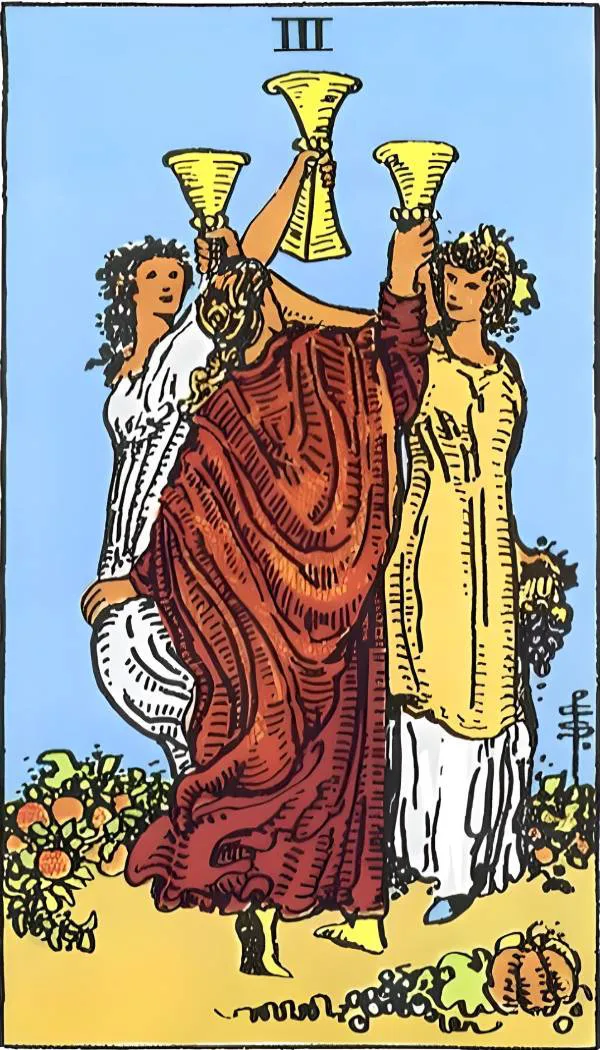
Three women are closely huddled together, dancing and celebrating the harvest in a circle, raising their chalices in mutual congratulations. Each wears a wreath of flowers symbolizing the harvest and colorful robes, with expressions of happiness on their faces. Surrounding them are vines, gourds, and pumpkins, and one woman holds a bunch of grapes, which easily evoke the season of harvest.

These three women have different hair and eye colors, and their attire and wreaths are also distinct, representing that they are all independent individuals with their own personalities. However, within this group, they can respect and love each other. The circular formation of the three indicates there is no hierarchy among them; in this celebratory occasion, everyone is equally valued.

The three women depicted on the card are surrounded by the fruits of maturity, with one even holding a bunch of grapes in her left hand. This signifies that efforts have borne fruit or work has been rewarded. The appearance of the Three of Cups in a reading indicates a sharing of rewards or experiences. The upright Three of Cups can also refer to groups, gatherings, and meetings.

The Three of Cups signifies joy, sharing, or celebration. This card often appears in the weeks leading up to Christmas, as most people are about to celebrate. The three women depicted on the card are celebrating the harvest, with their hard-earned results displayed at their feet. It is a card that signifies victory through obstacles or work that has yielded results.

Three Maidens Dancing

Representing celebration, unity, and a shared joy, the three maidens signify the communal spirit and happiness of human connections. Their dance is symbolic of the rhythm of life and the joyous moments that should be cherished and shared with others.

The Cups Raised

The cups raised in a toast signify celebration, gratitude, and the act of honoring special moments in life. This symbol suggests a successful culmination of a phase or the realization of hopes and dreams that are now being celebrated in unity.

Harvest and Fruit

The bountiful harvest at their feet indicates abundance, the fruition of one’s labor, and the rewards of perseverance. The fruit specifically can also hint at cycles, as the culmination of one season leads to the beginning of another.

The Flowing Garments

The flowing robes of the maidens, much like water, symbolize fluidity, emotions, and the free flow of feelings. It’s an indication that, in this moment, there’s an openness to express joy without reservation.

Golden Goblets

Gold in the Tarot often symbolizes spiritual wealth and divine energy. The golden goblets in the maidens’ hands not only represent the physical act of celebration but also the spiritual blessings and shared emotional connections they enjoy.

Circular Dance Formation

The circular formation in which the maidens dance signifies cycles, unity, and wholeness. This circle, free of a starting or ending point, encapsulates the concept of eternal joy and the interconnectedness of human experiences.

Psychological patterns in Three of Cups
Social Overextension
The women are pressed into a bright shared circle, cups lifted, robes flowing in the same celebratory motion. The scene is joyful, but the body has to stay available to the group rhythm to remain inside the celebration. Social Overextension begins when the nervous system treats inclusion as a timing priority. Invitations, milestones, and shared emotional highs keep taking the space that would otherwise let your own cycle reset. When you lose your action window to everyone else's rhythm, the issue is not simple scheduling. The pattern reveals a boundary cost: staying socially synchronized can quietly drain the exact energy you needed for the move that was actually yours.
Approval Seeking
The three women raise their cups into the same central space, and the whole scene is built around mutual recognition. Their faces, arms, and goblets all confirm the same emotional message at once: this moment is real because the circle reflects it back. That visual structure becomes Approval Seeking when a decision cannot feel legitimate until it receives visible social endorsement. You may already sense which option fits, but the nervous system waits for the equivalent of raised cups before it allows the choice to feel safe. For a crossroads reading, the question is not whether other people matter. The sharper audit is whether their applause has become the final filter through which your private criteria must pass.
Threshold Tolerance
The women raise their cups over a visible harvest of grapes, pumpkins, and gourds. The scene is not the beginning of effort; it is the ritual marking that effort has reached a threshold and produced something real. Threshold Tolerance lives in that exact pause. The body has to metabolize completion before it can honestly sense the next direction, and the card gives that pause a physical container: a circle, a toast, and fruit gathered at the feet. For long-range direction, this pattern exposes the pressure to turn every ending into an immediate next plan. The card suggests that clarity may not arrive through acceleration; it may arrive when the completed cycle is allowed to register without being instantly converted into another performance target.
Emotional Reciprocity
The three women lift their cups at the same height, with no throne, leader, or isolated figure controlling the scene. Their bodies lean into a shared rhythm, but their robes, wreaths, and visible differences remain intact, so the card does not show emotional sameness; it shows contact that can still preserve separateness. That visual balance is the psychological root of Emotional Reciprocity. In a family system, care becomes regulating when it moves in both directions rather than being extracted from one fixed role. The shared toast turns emotion into an exchange instead of a debt ledger. You can read this card as an audit of whether family closeness is actually mutual or only staged as mutual. When the pattern is healthy, celebration does not require you to become the emotional manager, the silent absorber, or the one who proves loyalty through overgiving. The circle works because each person has a cup, not because one person keeps refilling everyone else's.
Groupthink
The three cups rise in a synchronized gesture, and the circular formation gives the scene a powerful sense of agreement. The visual harmony is beautiful, but it can also become so coherent that dissent, doubt, or private perception has nowhere obvious to stand. When the group rhythm hardens into a belief system, consensus starts replacing inner signal. You may recognize Groupthink when the opinions of friends, the couple image, or the social vibe begin to outweigh what you actually experience with a partner in private.
Peer Co-regulation
The three women lean toward one shared center while each body still keeps its own stance, color, and line of movement. Their cups meet in the air, but no single figure holds the whole scene together; the circle distributes emotional weight instead of assigning it to one person. That visual structure makes Peer Co-regulation a precise fit for friendship. The card shows connection as a nervous-system field: joy becomes easier to hold because it is shared, paced, and mirrored by people who are standing beside you, not above you or inside you. In a friendship reading, this pattern names the difference between being supported and being consumed. You are not looking for a friend to fix your inner weather; the healthier mechanism here is a mutual emotional rhythm where people help each other return to clarity without turning care into control.
Instant Gratification
Cups, grapes, fruit, and harvest abundance make pleasure physically obvious in the card. Reversed, the eye can stay caught in the reward field while the quieter requirements of restoration remain visually lower and easier to ignore. The mechanism is a fast reward loop. Pleasure is not the problem; the distortion begins when quick comfort substitutes for the slower forms of replenishment that would repair the system underneath. Instant Gratification appears in lifestyle readings when little treats, sensory hits, spontaneous plans, or small purchases become a way to simulate recovery. The card shows the difference between nourishment and a harvest high: one restores capacity, while the other keeps the system reaching for another cup before it has actually recovered.
Achievement Fusion
The harvest lies at the women's feet as visible proof that effort has produced something real. In the upright scene, that reward can be shared with joy; in the reversed family field, the same harvest can be absorbed into the collective story until it becomes unclear whose labor, choice, or identity is being celebrated. That is the structure of Achievement Fusion. A milestone may begin as yours, but the family system quickly translates it into reputation, sacrifice, comparison, or proof that the family did something right. The celebration becomes emotionally complicated because recognition arrives with ownership claims attached. You may still want your family to witness your growth, but the card asks whether witnessing has turned into possession. The harvest can be honored without letting the circle take over the meaning of what you built.
Timing Discernment
The three women raise their cups at the same height while the harvested fruit sits plainly at their feet. Their bodies are not lunging forward; they are marking a moment that has already ripened, using a shared ritual to name completion before the next movement begins. Timing Discernment is anchored in that pause between effort and action. The image shows emotional energy, social support, and visible harvest converging at one point, so the timing cue comes from alignment rather than panic. When you are anxious about when to move, this pattern reframes the question from forcing the door open to reading whether the season has actually turned. The circle suggests that clear timing is often felt as rhythm, not as pressure.
Authentic Self-Expression
The three women share one dance, but the image keeps their differences visible through distinct robes, wreaths, hair, and placement. Their closeness does not erase their individual form; the circle holds difference without flattening it. That is the psychological mechanism behind Authentic Self-Expression. The psyche can participate in connection without editing every inner part into a single acceptable persona, and that distinction is central to introspection when a public-facing mask has started to feel more real than the private self. In this card, expression is not a spotlight performance. It is a contained rhythm where different aspects of You can appear in the same inner room without being ranked, corrected, or hidden for social safety.
Core Struggles in Three of Cups
Relational Boundary Drift
The circle gives each figure balance through proximity, rhythm, and shared direction. When that structure tightens, personal footing can become hard to distinguish from the momentum of the group. In love, the same drift appears when the relationship's private edge dissolves into friends, routines, social expectations, or one partner's orbit. You may still be moving together, but the question of where the couple ends and the surrounding field begins becomes increasingly difficult to answer. Relational Boundary Drift names a slow spatial problem, not a single betrayal. The Three of Cups shows the appeal of the blur because the shared rhythm feels warm and alive, while the cost is the gradual loss of a protected two-person boundary.
Belonging-Authenticity Split
Three women stand close enough to form a single circular body, yet the image keeps their colors, wreaths, hair, and gestures distinct. Their cups rise together, but each cup remains in a separate hand, so the scene holds unity without erasing difference. In love, that geometry becomes the pressure to belong inside a couple without surrendering the parts of you that do not match the shared mood. You may be participating in the relationship's dance while tracking the small places where your real preference, timing, or discomfort has no room to move. The struggle is not whether connection is good; it is whether the bond can hold difference without treating difference as disloyalty.
Performative Intimacy
The raised cups, wreaths, bright robes, and smiling faces create a complete image of togetherness before any private exchange is visible. The bodies know how to form the celebratory picture, and the circle holds that picture tightly. In the reversed texture, the relationship can become skilled at producing the signs of intimacy while the lived contact underneath thins out. You may have photos, plans, jokes, shared friends, and public ease, yet still sense that the bond is being performed at the surface rather than inhabited from within. Performative Intimacy names the moment when love becomes more legible to observers than to the people inside it. The card's celebration is not dismissed; it is measured against the quieter question of whether the cup ever comes down from display long enough to be received.
Reciprocity Deficit
Three cups rise in the same celebratory gesture, but the material details are not identical: one figure also carries grapes, and the harvest sits at their feet as something that must be gathered, shared, and maintained. The image presents mutuality while quietly showing different loads in the same ritual. In friendship, this is the point where equal affection can hide unequal carrying. You may be the one remembering birthdays, absorbing crises, smoothing tensions, checking in first, or making the group feel emotionally held while everyone still calls the bond mutual. Reciprocity Deficit belongs to this card because the cups are raised together, yet the work of keeping the celebration alive may not circulate evenly. The struggle is the ache of being included in the toast while privately becoming the support system that makes the toast possible.
Social Clock Entrapment
Three women move in a circle with their cups raised at the same height, and the scene gives no single figure the role of leader or exception. In the reversed state, that shared rhythm stops behaving like mutual celebration and starts behaving like a timing field that every body must match to stay inside the circle. The harvest at their feet makes the group moment look objectively valid, as if this is the season when everyone should be arriving, celebrating, and showing proof. You can still have your own cycle, but the card shows how easily visible collective milestones can overwrite the quieter signals of your actual readiness. Social Clock Entrapment lives in that pressure: the problem is not that other people are moving, but that their movement becomes the only visible clock. The card names the strain of trying to locate your right moment while surrounded by a rhythm that looks warm, successful, and hard to step out of without feeling out of phase.
Social Accountability Tension
Three women raise their cups while their feet keep a shared circular step, so the scene's momentum does not belong to one person alone. The celebration is carried by synchronization: each body has to match the others closely enough for the toast to hold its shape. In an academic setting, that structure maps to the tension between peer-driven momentum and self-owned focus. You may get real energy from classmates, study groups, deadlines, or shared revision rituals, yet the same circle can make solo study feel strangely unsupported. The struggle is not a simple lack of discipline. It is the card's circular rhythm made personal: your study system has learned to move when other bodies are moving with it, and the clearest point of friction is where accountability supports agency but also begins to replace it.
Social Exit Paralysis
The three bodies stand close enough that every raised cup depends on the spacing of the others. The open field is visible, but the active path is the circle itself; stepping out would change the whole balance of the toast. In a choice reading, that geometry marks the cost of exit when a decision is tied to friends, collaborators, a shared plan, or a version of you that others are celebrating. You may be able to see the door, but the struggle sits in the social spill: what moves, falls, or gets exposed if you stop dancing in formation.
Joy Performance Fatigue
The women hold the celebratory pose close together, cups raised high enough that the gesture must be sustained. In the reversed current of the card, the toast stops being a release after work and becomes another posture the body has to keep performing. That is where Joy Performance Fatigue takes shape in career life. You may be asked to sound grateful, upbeat, and team-spirited in the very spaces where your energy is already spent, so the celebration becomes a second shift of emotional display rather than proof that the pressure has ended.
Social Integration Strain
The three women do not stand as a loose crowd; they hold a moving circle, each body angled toward a shared center while each cup remains in a separate hand. The scene works only because personal rhythm, distance, and timing stay calibrated moment by moment. In social life, that structure mirrors the strain of entering a group without being swallowed by it or throwing its rhythm off. You are not simply looking for people to be around; you are trying to find a circle where your presence can move with others without constant self-monitoring.
Wholeness Performance Trap
The three raised cups can keep the image of completion alive even after the harvest has already been gathered. When the toast becomes the dominant motion, the body may remain inside the ritual of celebration while the quieter labor of integration is left at ground level. In personal growth, that visual structure becomes a trap when the symbols of evolution start replacing evolution itself. The circle, the robes, the wreaths, and the shared joy all communicate wholeness, but reversed they can harden into a performance of being healed, aligned, or upgraded before the change has reached ordinary behavior. Wholeness Performance Trap names the place where growth becomes most seductive because it looks complete. You may have the language, the aesthetic, the community, and the visible signs of progress, yet the card points to the missing transfer from displayed wholeness into private discipline, embodied choice, and repeatable self-trust.
Inner Emotions in Three of Cups
Reciprocal Warmth
Three women raising cups in an equal circle make support visible as a loop rather than a ladder. Each figure keeps her own color, wreath, and posture, so the shared celebration does not erase individual agency. Reciprocal Warmth grows from that exact structure: you are met by others without being absorbed by them. In personal growth, it names the felt relief of realizing that self-evolution can be witnessed, mirrored, and strengthened by peers without becoming a performance contest.
Grounded Belonging
Three figures form a circle without losing their separate colors, faces, or wreaths. The group has a center, but each body still keeps its own outline, which gives the scene a kind of social stability rather than blur. In friendship, that visual balance becomes the feeling of belonging without self-erasure. You are inside the circle, but you do not have to become the circle; the bond can hold your difference without making it a threat.
Performative Warmth
The same raised cups and smiling faces can harden into a social pose when the circle becomes more display than contact. The golden surfaces stay polished, the gestures stay elevated, and the group image remains intact even if the liquid inside the cups is unseen. In love, that visual tension becomes warmth performed for the room while private feeling stays out of reach. You may recognize the strain of looking like a good couple around friends, at dinner, or online while the real emotional exchange feels thinner than the toast suggests. Performative Warmth grows from the card's glossy celebration when it is read as choreography: connection shaped for visibility, not necessarily for truth.
Platonic Jealousy
Three bodies form a closed circle, and no one looks outward from the toast. The intimacy is not only romantic; it is social, festive, and shared across multiple bonds. In a love reading, that third presence can make the heart track who gets access, who gets chosen, and who seems to belong more easily. You can feel the sting of comparing your place in the relationship to a friend, an ex-adjacent group, or a social circle that seems to know your partner better. Platonic Jealousy fits because the Three of Cups makes emotional attention visible as a circle of inclusion, where being just outside the rhythm can feel sharper than direct rejection.
Social Burnout
The tight huddle leaves very little air between the bodies, and the raised arms keep the group visibly activated. The fruit, cups, robes, and wreaths fill the scene with social and sensory material until the gathering itself starts to carry weight. In career life, that weight can appear through offsites, networking loops, forced team rituals, constant availability, and the expectation that good performance includes emotional brightness. The reversed Three of Cups shows how togetherness can become another workload. You may not dislike people; you may be depleted by the amount of personhood the job keeps asking you to display. Social Burnout names the exhaustion of being professionally social past the point where it nourishes you.
Hollow Celebration
The same raised cups can harden into a required pose, with smiles, wreaths, and bright garments forming a polished surface around the group. The harvest is visible, but the body may register the scene as staged rather than inhabited. In career context, this is the office win that looks correct from the outside and feels strangely flat inside. The team celebrates the milestone, yet the deeper question of whether your work was valued, protected, or fairly named remains untouched. You may be smiling inside a ritual that does not reach you. Hollow Celebration names the gap between a workplace's public success performance and the private absence of emotional truth.
Synchronized Relief
Three women turning in a circle with raised cups create a body-level image of rhythm: no one is outside the loop, and no single figure carries the whole scene. The harvest at their feet turns effort into a visible return, while the distinct robes keep individuality intact inside shared movement. For lifestyle questions, that structure points to Synchronized Relief: the feeling that your calendar, home, body, and social energy are finally responding to one another instead of pulling in separate directions. You are not being asked to optimize harder; the card mirrors the moment when a personal system begins to breathe as one.
Full Circle Calm
The three women standing in a closed celebratory ring, cups lifted over a visible harvest, give the scene a completed circuit: effort has ripened, the body has witnesses, and the moment does not have to push forward immediately. For direction work, that image maps to the rare inner weather where your long-range path feels held by what has already matured. You may still be between chapters, but the circle and harvest let your nervous energy settle into a clean recognition: this season counted, and the next bearing can emerge from coherence rather than scramble.
Mutuality Hunger
Three cups are raised at the same height, creating a visual promise that exchange can be shared evenly. When the scene is strained, that promise becomes painfully noticeable because the surface still says together while the distribution underneath may not match. In friendship, this becomes the ache for care that comes back without prompting. You are not just asking for more attention; you are craving proof that the bond can hold effort, celebration, and emotional labor in both directions.
Guilt-Free Rest
The raised cups appear above a ground already covered with ripe fruit, so the celebration is not floating without evidence. The body language is open, the robes move freely, and the scene gives the pause a material base. For timing questions, Guilt-Free Rest surfaces when the system recognizes that recovery belongs inside the cycle rather than outside productivity. You can stop treating stillness as wasted time because the card shows a moment where the harvest has arrived and the body is allowed to register it.
Outer Contexts in Three of Cups
Emotional Dumping Friendship
The cups are designed for shared celebration, but in a distorted friendship field those same cups become containers that one person keeps filling and another keeps holding. The harvest abundance shifts from mutual plenty into too much material arriving with no balanced return. This context fits the friend who repeatedly brings crisis-level emotional volume into the bond while calling it intimacy. You may be positioned as the reliable listener, the late-night responder, or the person expected to absorb every spiral because the relationship has normalized unlimited access to your attention. The Three of Cups gives the pattern a clean external shape: a cup is not endless just because it is offered in friendship. The card reveals where a ritual of closeness has become a one-way disposal system wearing the language of trust.
Social Gatekeeping Circle
The three women face inward, and the circle gives the scene its boundary. In reversal, that boundary can become an access point controlled by group proximity: who is inside, who is invited, and whose voice counts. For decision work, this points to choices shaped by social entry rather than pure preference. You may be weighing an option that comes with referrals, community standing, mutual friends, or emotional backup, while leaving or disagreeing could narrow your access to the room. The card does not reduce belonging to comfort. It shows belonging as infrastructure, which means the hidden cost of a choice may be the network it threatens or preserves.
Friendship Boundary Reset
The three figures are close, but they do not visually merge. Each keeps a distinct body line, color palette, and wreath while participating in the same circular ritual. That makes the card a precise image for friendship boundaries being reset without rejecting the bond. You may be trying to change how available you are, how much you disclose, how often you respond, or what kind of support you can keep giving inside a friendship that still matters. The circle matters because it is both connection and limit. This card does not frame a boundary as withdrawal; it shows a social shape where closeness survives because each person is allowed to remain separate within the shared space.
Study Group Gatekeeping
The close huddle of bodies and cups forms a ring before it forms a welcome. The resources are visible, the celebration is visible, and the harvest is visible, but access depends on being inside the circle at the right moment. For you, this maps to academic peer spaces where notes, past papers, explanations, group chats, and informal tips circulate through belonging rather than open access. The card makes the blockage concrete: the problem is not that resources do not exist, but that their pathway is socially guarded.
Community Approval Test
Three women raising cups in a tight circle place recognition in the middle of the scene. The harvest at their feet shows that the group is not abstract; it has shared history, shared proof, and a visible language of congratulations. In a decision reading, that social warmth becomes a real variable. You may be weighing not only the option itself, but the approval network attached to it: who celebrates it, who validates it, and what it would cost to choose outside the circle. The card links this context to the difference between support and permission. A clean choice can receive encouragement without needing the group to authorize your agency.
Clique Groupthink
Three bodies move in one rhythm around an empty center. With no formal throne or instructor in the image, authority is carried by the circle itself: the shared gesture, the matching tempo, and the social cost of breaking formation. For you, this describes academic environments where the peer group quietly decides what counts as a safe interpretation, acceptable contribution, or respectable ambition. The pressure is subtle because it arrives as harmony, but it can narrow original thought until independent analysis feels like stepping out of the dance.
Friend Group Triangulation
Three figures are enough to make a circle, but also enough to create shifting pairs inside it. The card's horizontal arrangement removes formal hierarchy while leaving closeness, timing, and side alignment highly visible. In a small friend group, that structure becomes triangulation when loyalty moves through subtle pairings instead of open trust. You are reading the social geometry: who gets pulled into the center, who is left managing the gap, and whether the group can name the pattern before it hardens.
Group Chat Tribunal
The inward-facing circle can become a panel when the exchange stops flowing. Raised cups turn into visible votes, and the shared space starts behaving less like a celebration and more like a room where everyone has a take. In modern relationship life, that structure often appears as the group chat. Screenshots, summaries, reactions, and running commentary can turn a private conflict into a collective review process where the couple is no longer the only place where meaning is being made. The card points to the loss of a neutral container. You may still have friends around you, but the social channel has become an evaluative stage, and the relationship needs its privacy boundary restored before the noise becomes the story.
Party Scene Burnout
The same raised cups and circular dance can become a loop when the circle has no visible exit and every body is still required to keep the toast alive. The harvest at their feet turns from nourishment into fuel for another round of social consumption. In a lifestyle reading, that picture names the moment when celebration starts taking more energy than it returns. You may still have friends, invitations, and a full calendar, but the structure around you is spending sleep, money, and recovery time faster than your daily system can rebuild them.
Credit Sharing Negotiation
Three cups lifted at the same height turn recognition into a visible group resource, while the fruit at their feet shows that real work has produced something worth naming. In a career setting, that image points to the moment after a shared deliverable, when applause is available but attribution can still be vague. The nonhierarchical circle matters because no one stands on a podium to define who contributed what. You are dealing with a structure where celebration is real, but the reward system has to be made legible before the harvest disappears into a generic team win.