Finding Clarity When Drama Makes the Sentence Disappear
If you have ever rewritten "That hurt me" into "Maybe I misunderstood" while sitting on your bed at midnight, I want you to notice something: you are not confused about the issue; you are trying to survive being labeled too much. I heard that pattern in Maya before I heard the full story. She was 28, a junior marketing strategist in Toronto, and she sat across from me with both hands around a coffee cup that had stopped steaming.
She described 11:40 p.m. on a Tuesday in her rented room: iMessage open, Slack still unread, radiator clicking, streetcar brakes squealing outside. The phone had gone warm in her hand while "That hurt me" became "Maybe I misunderstood," then "All good." Her throat tightened like a ribbon pulled around the truth, not enough to choke her, just enough to make honesty feel expensive.
"I can handle conflict in my head," she said, eyes dropping to the table, "but not when it is actually happening. The second someone says drama, I feel my whole argument collapse. I don't want to be difficult, but I also don't want to disappear."
I nodded because I have heard many versions of that question over twenty years of coffee-cooled readings: Why do I shut down when someone calls me dramatic? How do I stop avoiding conflict when I am scared of being too much? I told her, "You do not avoid conflict because you have no words. You avoid it because the moment someone says drama, your body treats honesty like a risk to connection. Today, we are going to tidy the reality, not judge the reaction. We are going to look for clarity."

The Bridge Spread for a Conversation That Keeps Collapsing
I asked Maya to place both feet on the floor. Before I shuffled, I had her say the question once without polishing it: "When they call my concerns drama, how do I stop avoiding conflict?" She exhaled as if the sentence itself had edges. I shuffled slowly, with the deck tapping against the table beside my coffee. For me, that small ritual is practical. It gives the mind a threshold to cross.
For this reading, I chose The Bridge, a five-card relational tarot spread for conflict avoidance, boundaries, and respectful engagement. This was not a private decision like choosing a job offer, and it was not a full life audit. It was a repeated relational pattern: Maya's self-silencing on one bank, the communication climate she experiences on the other, and the fear-filled river between them.
A Celtic Cross would have mapped more context than we needed. A Past-Present-Future spread would have missed the live tension between her side and the energy she was reacting to. The Bridge gave us exactly enough: her stance, the other side as she perceives it, the gap, the inner bridge, and the crossing step. I was clear with her: this is not a way to read someone else's private motives. It is a way to understand card meanings in context and choose a next step with integrity.
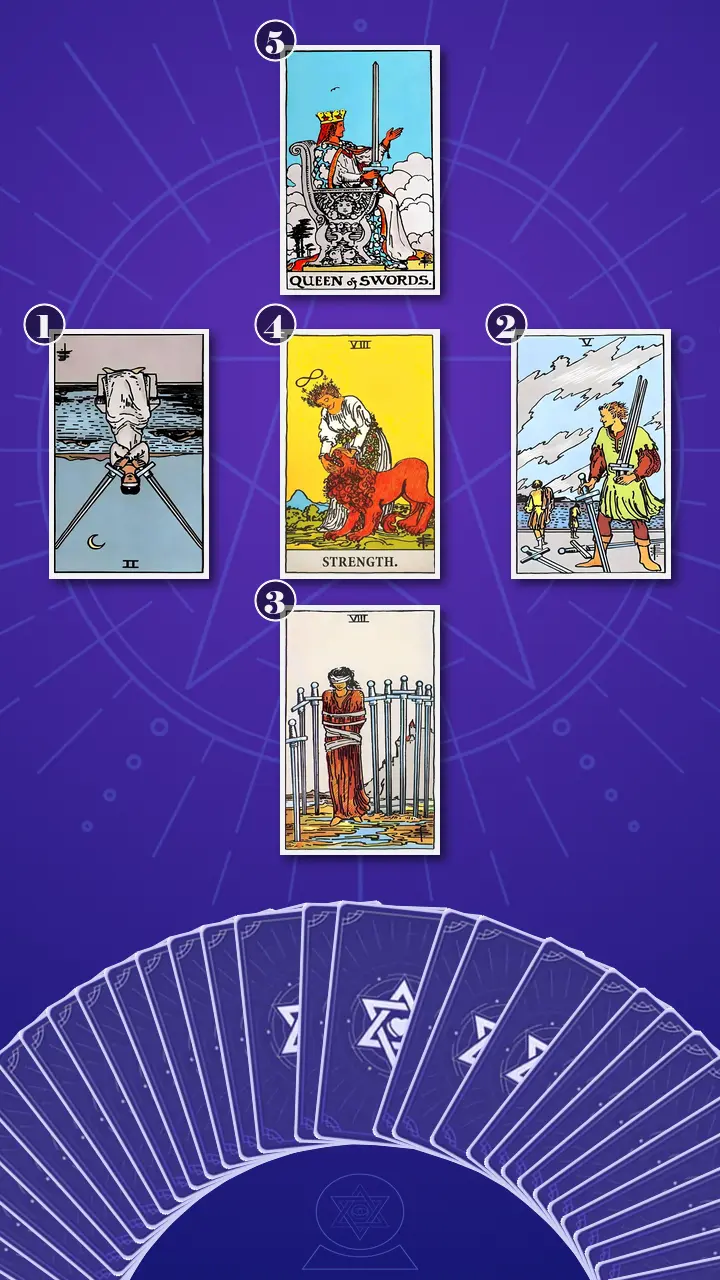
Card one would show her current stance: freeze, edit, minimize, withdraw. Card two would show the communication energy she meets when a concern gets called drama. Card three would name the gap that keeps the loop alive. Card four, the key card, would show the bridge resource. Card five would offer the crossing step: a grounded communication practice she could actually use.
As I laid the cards, the spread looked like a narrow plank over fast water. Maya watched it the way someone watches a Toronto subway map during a delay: there may be routes, but the brain keeps showing only the closed line.
The Cards That Named the Pattern
Position 1: The Courtroom in the Text Thread
Now I turned over the card that represents how Maya freezes, edits, minimizes, or withdraws when conflict begins. It was the Two of Swords, reversed.
On the Rider-Waite-Smith image, two swords cross over the chest of a blindfolded figure. Upright, it often shows stalemate and guarded perception. Reversed here, I read it as a blockage that has become unstable: the protection is no longer protecting the need. It is just keeping the real sentence from crossing the bridge.
I brought it into her life plainly. At 11:40 p.m., Maya was on the edge of her bed in Toronto with the same text open. "That hurt me" became "Maybe I misunderstood," then "All good." The chat stayed calm, but her tight chest knew the concern never arrived. The Notes app had become a private courtroom: evidence, timestamps, screenshots, and then a final message so softened that the case disappeared.
"This card is not calling you weak," I said. "It is showing the moment your nervous system chooses immediate calm over emotional honesty. If I say it like this, they will call me dramatic. If I say nothing, at least tonight stays calm. That is not irrational. It is protective. But it has a cost."
Maya gave a small, bitter laugh and looked at the cup instead of the card. "That is too accurate. Almost rude."
I smiled a little. "Good. Then we will let the card be accurate without making it cruel. The question is not, Why did you protect yourself? The question is, What one fact are you already trying not to know?"
Position 2: The Label That Wins the Exchange
Now I turned over the card that represents the communication energy Maya experiences when concerns are labeled drama, without claiming to know the other person's private motives. It was the Five of Swords, upright.
In the image, a central figure gathers swords while two figures walk away under jagged clouds. This is an excess of sharp Air: words used to end the exchange, not to understand it. A label can be efficient. It can also be hollow.
I said, "When someone says, Why are you making drama?, the topic can shift in one second. It stops being about what happened and becomes about whether you are reasonable enough to be listened to. Someone may feel like they won the moment, but the relationship loses the repair."
The modern version is a group chat argument where the sharpest label gets all the reactions and the original issue gets buried. At work it can sound like "not that deep" in Slack after you ask for a heads-up. At home it can sound like an eye roll before you finish the sentence. In both cases, the sword is not just the word. It is the framing.
Maya's jaw moved once, as if she were chewing on a sentence she had swallowed before. I kept my voice even. "A label is information about the conversation, not a verdict on your worth. If the word drama enters the room, we learn something about the room. We do not have to hand it the power to define reality."
Position 3: The Mental Fence Built From Old Screenshots
Now I turned over the card that identifies the self-reinforcing cycle: how dismissal turns into self-silencing, then into more fear of conflict. It was the Eight of Swords, upright.
The bound figure stands among eight swords, blindfolded, with visible gaps in the muddy ground around her. I read this as a blockage of perception. The problem is not only the other person's dismissive label. It is what happens when that label becomes an internal rule about every future concern.
I told Maya, "This is the algorithm trained on old rejection. It auto-sorts every honest message into danger, do not post. Before you even begin, you have imagined the eye roll, the not that deep, the pushed-away feeling, and your mind says, I already know how this will go, so why start?"
She went quiet. First her breath paused. Then her eyes unfocused, as if a whole archive of late-night replays had opened behind them. Then her shoulders, which had been lifted toward her ears, dropped half an inch. "I thought I was being realistic," she said. "But maybe I have been calling it realism because it hurts less than admitting I am scared."
I pointed to the gaps between the swords. "Exactly. The card does not deny the fear. It asks us to test the fence. Calm is not repair if you had to disappear to create it. One boundary spoken early may protect the relationship better than a perfect explanation spoken never."
When Strength Put a Hand on the Lion
Position 4: The Bridge Plank of Regulated Courage
Before I turned the fourth card, the room changed in the way a room can when both people know the reading has reached the hinge. The radiator clicked once, then went still. The street outside softened under rain. I could smell the last warmth of coffee in my cup.
Now I turned over the card that names the key transformation: moving from proving the concern to holding steady, compassionate courage while speaking it. It was Strength, upright.
In the image, a woman rests calm hands near the lion's mouth. She does not kill the lion. She does not pretend it is a kitten. She stays with it. This card was the bridge because Maya did not need a louder personality. She needed regulated courage, self-respect, and compassionate firmness: enough body beneath the sentence that fear did not get to write the whole message.
Seeing Strength, my mind went to all the years I have watched baristas turn down a screaming steam wand before the milk scorches. Strength felt like that: not a mute button, a volume slider. Enough pressure to tell the truth, enough steadiness not to burn the room down.
This is where I used the lens I call Daily Friction Deconstruction. When someone throws a dramatic label over a concern, I strip away the accusation and look for the mechanical breakdown in the shared routine. What happened? What impact did it have? Where did the repair loop break? In Maya's case, drama was not data. The data was that a concern had been named, the label had interrupted respectful engagement, and her body had learned to disappear before the next interruption could happen.
At 11:40 p.m., with the same message open and her chest tight, Maya kept changing "That hurt me" into something safer until the real point disappeared. She was not searching for better wording. She was auditioning for permission to name what happened.
It is not drama to name impact; it is Strength to keep one hand on the lion of your fear and one hand on the truth you are ready to say.
I let the sentence sit between us. Maya's hand froze halfway to her cup. Her throat moved once, but no sound came. Then her eyes shifted away from the card and lost focus, like she was replaying the last hard conversation from the exact second the word drama entered it. The release did not arrive as instant peace. It came with a flare of anger first. "But doesn't that mean I was wrong before? Like I let it happen?" Her voice was small, then sharper, then tired. I shook my head. "No. It means a strategy that once protected closeness is now costing you self-respect. We update a strategy; we do not shame the part of you that kept you safe." She inhaled, held it, and finally let the breath leave her chest. Her shoulders lowered. Her fingers opened from the tight cup-hold. There was relief, yes, but also that blank, dizzy space people can feel when the map gets clear and they realize they are allowed to choose.
I asked, "Now, with this new perspective, think about last week. Was there one moment when this insight could have changed how you felt, even if it did not change the other person's response?"
She nodded slowly. "I could have kept the first sentence. I could have said it once and stopped trying to make it impossible to dismiss."
That was the crossing inside the reading: from shame-driven self-editing and fear of being too much to the first felt sense of regulated courage and precise, respectful speech. Tarot did not give Maya control over another person's reaction. It gave her a cleaner place to stand.
Position 5: The Queen of Swords Writes the Clean Sentence
Now I turned over the card that offers a grounded next communication practice, one that supports boundaries, self-trust, and respectful engagement without predicting the other person's response. It was the Queen of Swords, upright.
Her sword stands straight; her other hand opens. I read that as balanced Air. The sword gives precision. The open hand keeps the conversation relational. She does not need to prove she is unemotional. She separates feeling, fact, and request so the conversation has shape.
I said, "You do not need a 12-slide deck to prove something hurt. The Queen asks for one boundary sentence, one example, one request, then stop."
I wrote the version on a card in front of her: "When my concern is called drama, I shut down. Last night was an example. I need us to talk about the issue without mocking that I raised it."
Her face changed in a quieter way than it had with Strength. The muscles around her eyes softened, and she touched the edge of the card with one finger. "That sounds possible," she said. "Not easy. But possible."
I nodded. "Possible is enough for a first crossing. The other person's response will matter, but it will be information. It will not be the judge of whether your concern deserved space."
The One-Sentence Impact Check
When I looked at the whole spread, I saw a clear elemental story. The first three cards were Swords: thoughts, labels, arguments, rehearsal, screenshots, Slack tone, iMessage drafts. The issue had been trapped in Air. Strength brought the body back in, and the Queen of Swords returned to language in a cleaner form. Not rumination. Speech.
The story was simple but not shallow: Maya had learned to hold a smoke alarm under a pillow. The room got quieter, but nothing got safer. The blind spot was treating calm as proof of repair and treating someone else's label as a verdict on her belonging. The transformation was not becoming confrontational for its own sake. It was moving from proving her concern was reasonable enough to deserve space into stating one concrete impact and one clear request without over-explaining.
I also used Emotional Clutter Sorting here, because not every conflict means the relationship is doomed, and not every hurt can be solved by better wording. I separated the pile with her: actual incompatibility, fatigue from work and rent pressure, household or timing friction, and the specific disrespect of having a concern mocked as drama. Sorting the clutter kept us from turning one conversation into a total identity trial.
Then I gave her three practices. Small, testable, and unglamorous. That is how tarot works best for me: the cards clarify the pattern, then the person chooses the next honest action.
- The Unsoftened Sentence FirstBefore one hard message this week, open Notes and write: When __ happened, the impact was __. Do this before adding apologies, disclaimers, screenshots, or the paragraph that tries to make your concern impossible to dismiss.Wait ten minutes before deciding whether to send it. If your body floods, stop after the first line, put both feet on the floor, and come back later.
- The Drama-Label RedirectSave this line in your phone: I am not trying to escalate this. I am naming the impact so we can talk about it respectfully. Use it once if the conversation becomes a debate about whether your reaction is embarrassing.Practice it out loud while walking home, so your mouth has already met the words before your mind goes blank.
- The 24-Hour Micro-Boundary ResetFor the next day, choose one non-negotiable time or space boundary around conflict. For Maya, we chose: no drafting hard messages in bed after 10:30 p.m.; write the impact line at the desk, then pause before sending or speaking.Keep the sentence. Lower the volume if you need to, but do not erase the truth. A short sentence is not a command for agreement; it is a way to keep the concern intact.

A Week Later, the Sentence Stayed
A week later, I received a short message from Maya. She had not solved her entire relationship life. That matters. Clarity is not a cinematic ending where everyone suddenly speaks with perfect emotional maturity.
She wrote that she had used the Notes practice before a roommate conversation about dishes and noise after late work calls. She kept it small: one impact, one example, one request. When her chest tightened, she put both feet on the floor and read the sentence once instead of building a defense brief. The other person still got a little defensive. Maya still slept with one first-morning thought of What if I made it worse? But this time, she smiled at herself before checking the thread. The sentence had stayed.
When I think of that reading, I do not think of tarot as a force that fixed the conversation. I think of The Bridge spread as a clean table where Maya could lay down the messy pieces: fear, resentment, body signals, words, timing, and choice. The cards did not make her powerful. They helped her notice where her power had been waiting.
If you have learned to swallow the real sentence just to keep closeness in the room, your body may treat every honest concern like a risk to belonging. Please let this be the gentlest part of the reading: noticing that pattern already means you are no longer fully inside it.
So the next time drama, too sensitive, or not that deep tries to become the loudest voice in the room, what is the one clear sentence you might keep on your side of the bridge before you decide whether to send it?
This story is adapted from psychological research, written so that those in a similar struggle can see their own pattern in it — and find their next step clearly.These insights are not a substitute for professional psychological, medical, legal, or financial advice.
Learn more about our Journey to Clarity.
How did this insight land for you?
🫂 This Resonates Deeply
🌀 Living This Story
✨ Now I See Clearly
🌱 Seeing New Possibilities
🧰 Useful Framework
🔮 The Confirmation I Needed
💪 Feeling Empowered
🚀 Ready for My Next Step
Author Profile
 AI
AI“For twenty years, I’ve listened to stories unfold over the warm aroma of coffee. I don’t believe life’s complexities always require grand theories to be solved; often, we just need a safe place to tidy up our reality. I don’t offer high-minded preaching—just grounded, heartfelt insights to help you regain your sense of control amidst the clutter of daily life.”
In this Love Tarot Reading :
Core Expertise
- Daily Friction Deconstruction: Stripping away dramatic accusations to locate the mundane, mechanical breakdowns in your shared daily routine.
- Emotional Clutter Sorting: Separating actual relationship incompatibility from the stress of household chores, fatigue, or external life pressure.
Service Features
- The 24-Hour Micro-Boundary Reset: A highly pragmatic exercise to establish one non-negotiable physical or time boundary in your shared space to instantly reduce friction.
Also specializes in :
Explore Related Patterns:
Boundary DiscernmentMaya is told that a label is information about the conversation, not a verdict on her worth. That distinction matters because the word "drama" had been acting like a gatekeeper, deciding whether her concern was legitimate before the concern could even be discussed. Boundary Discernment is the ability to separate what belongs to you from what belongs to the other person's response. Your job is to name the impact with respect and precision; their reaction is data about the relationship climate, not the judge of whether you were allowed to speak. The reading strengthens this boundary by sorting what happened, what impact it had, and where the repair loop broke. The practical boundary around timing makes the pattern concrete. No hard-message drafting in bed after 10:30 p.m. is not avoidance; it is choosing a cleaner container for a difficult sentence. Maya's power returns when she can keep the concern intact without handing someone else's label the authority to define reality.
Conflict AvoidanceMaya's 11:40 p.m. rewrite from "That hurt me" to "Maybe I misunderstood" and then "All good" shows the conflict leaving the conversation before it has a chance to be handled. The chat stays calm, but the actual impact never arrives, which makes the calm feel more like containment than repair. The defensive logic is clear. Once the word "drama" enters the room, honesty starts to feel like a risk to connection, so your system chooses the quickest available safety move: edit, minimize, withdraw, and keep the surface smooth. That is the core mechanism of Conflict Avoidance here, not because you lack words, but because the live moment makes the cost of using them feel too high. The pattern becomes visible because it repeats across the story. Maya can argue clearly in her head, build the whole case in Notes, and still lose the sentence when the relational temperature rises. The work is not to become louder for its own sake; it is to notice where immediate calm is being purchased by abandoning the conversation you actually needed to have.
Self-SilencingMaya's line, "I don't want to be difficult, but I also don't want to disappear," is the cleanest signal of the pattern. The issue is not that she has no concern; it is that the concern gets rewritten until it no longer threatens the relationship climate. Self-Silencing shows up when the need to preserve connection becomes stronger than the permission to stay audible. When someone calls a concern "drama," your mind may start treating the other person's comfort as the condition for whether your experience is allowed to exist. The sentence gets smaller, not because it is unimportant, but because being seen as too much feels relationally expensive. The story gives the pattern a cost. Maya gets a calmer thread, but she also loses the truth of what hurt. The shift toward keeping the first sentence is not aggression; it is the recovery of a basic internal boundary where your impact can remain intact even before anyone else agrees with it.
Assertive CommunicationMaya's clean sentence gives the conflict a shape: "When my concern is called drama, I shut down. Last night was an example. I need us to talk about the issue without mocking that I raised it." Nothing in that sentence requires her to overperform calm or prove she is unemotional. Assertive Communication works here because it separates feeling, fact, and request. Your concern does not have to become a courtroom case before it is allowed into the room. One impact, one example, and one request give the other person something real to respond to without letting the conversation drift into whether your reaction is embarrassing. The later roommate conversation confirms the pattern in action. Maya keeps it small around dishes and noise after late work calls, and the sentence stays even though the other person gets a little defensive. The win is not control over their response; it is that she no longer abandons her own clarity before the exchange begins.
Emotional RegulationMaya's body is part of the story from the beginning: throat tight, chest tight, hands around a cold coffee cup, words disappearing under pressure. The reading responds to that fact by bringing her feet to the floor before asking her to speak the question without polishing it. Emotional Regulation is the bridge between fear and speech. It does not erase the fear or force instant confidence; it gives your nervous system enough structure that fear does not get to write the whole message. In Maya's case, regulation looks like pausing, grounding, stopping after the first line if her body floods, and returning when the sentence can stay clean. The week-later roommate conversation shows the pattern becoming practical. Her chest still tightens, and the other person still gets defensive, but Maya reads the sentence once instead of building a defense brief. That is regulation as a usable skill: not perfect calm, but enough steadiness to keep the truth from disappearing.
Rejection SensitivityMaya does not react to the word "drama" as a neutral disagreement. In the story, that label lands as proof that she is too much, unreasonable, or about to be pushed away, and the argument collapses before the actual issue can be tested. Rejection Sensitivity is the mechanism by which an anticipated dismissal starts editing the message before the other person has fully responded. Your system scans for the eye roll, the "not that deep," the sudden drop in warmth, and then tries to prevent that pain by becoming smaller first. Maya even names the cognitive disguise when she says she thought she was being realistic, but maybe realism was easier than admitting fear. This matters because the pattern turns a conversation into a belonging test. The repair step is not pretending labels do not hurt; it is separating the label from the verdict. A dismissive reaction can give you information about the room without becoming the final authority on whether your concern deserved space.
Defensive OverexplainingMaya's Notes app becomes a private courtroom, full of evidence, timestamps, screenshots, and rehearsed arguments. The emotional logic is understandable: if the concern can be made airtight enough, maybe it cannot be dismissed as drama. Defensive Overexplaining appears when proof becomes a shield against invalidation. Instead of naming one impact and one request, your mind starts building a case designed to survive every possible objection. The problem is that the more the message becomes a defense brief, the easier it becomes to lose the clean human sentence underneath it. The story shows the alternative through the Queen of Swords practice. Maya does not need a twelve-slide deck to prove that something hurt; she needs enough precision to keep the concern intact. When she later reads one sentence instead of building another brief, the pattern loosens because the goal shifts from being impossible to dismiss toward being clear enough to stand behind.
Explore Related Struggles:
Self-Editing ExhaustionAt 11:40 p.m., Maya does not run out of language; she runs language through too many safety checks. Notes becomes a courtroom, the draft gathers screenshots and timestamps, and the final message gets polished until it can no longer carry the hurt it was meant to name. Self-Editing Exhaustion is the drain created by trying to make a concern impossible to dismiss. You keep working on the sentence as if the perfect version will remove every risk, while the repeated softening spends the energy that could have gone into one grounded impact statement.
Truth-Connection SplitMaya names the split herself when she says she does not want to be difficult, but also does not want to disappear. The hard sentence is present, yet it keeps getting revised into something that protects the room from friction while leaving her impact outside the conversation. Truth-Connection Split appears when honesty and belonging have been placed on opposite sides of the same bridge. You can see the cost in the calm thread, because the connection stays intact only after the truth has been thinned down enough to stop making demands.
Voice-Safety FusionMaya's body reacts to the word drama before the conversation has finished. The issue stops being what happened and becomes whether she is too much, so the sentence that could name impact starts to feel like a risk to connection. Voice-Safety Fusion captures that lock. The voice is available, but safety feels conditional on keeping it small. You do not need to manufacture a harsher self to break the loop; you need enough ground beneath one clear sentence that another person's label does not get to decide whether the concern exists.
Expression-Reception GapThe concern does not disappear because Maya lacks precision; it disappears when the receiving frame turns impact into drama. The label interrupts the handoff, shifting attention away from what happened and toward whether she is acceptable enough to be heard. Expression-Reception Gap names that mismatch between a clear sentence and a conversation climate that cannot hold it cleanly. You can reclaim agency by separating the two jobs: state one concrete impact and one request, then let the other person's response become information rather than the judge of your reality.
Inner Tribunal LockMaya's Notes app holds evidence, timestamps, screenshots, and the argument she cannot yet speak. Before the other person responds, an internal courtroom has already asked whether she has enough proof to deserve the floor. Inner Tribunal Lock turns a relationship moment into a verdict process. You may start preparing a defense brief for a simple impact, and the longer the trial runs inside, the harder it becomes to remember that a concern does not need to be flawless before it can be stated respectfully.
Explore Related Emotions:
Conditional Belonging FearMaya says she does not want to be difficult, but she also does not want to disappear. That line carries the whole relational pressure of the story. The concern is not just a message to send. It becomes a test of whether closeness will survive her being honest. Conditional Belonging Fear fits because the body starts treating honesty as a possible loss of place. You can know the issue clearly and still soften it into nothing when connection feels conditional. The fear is not irrational in the moment, but it becomes costly when keeping the bond calm requires removing yourself from the conversation.
Invalidation AcheWhen someone says Why are you making drama, the conversation stops being about what happened and starts being about whether Maya is reasonable enough to deserve airtime. The original impact gets buried under a debate about tone, size, and acceptability. Invalidation Ache is the bruise left by that switch. You are trying to name an impact, but the room answers by questioning the legitimacy of your reaction. That kind of dismissal hurts because it makes the real issue harder to locate and makes your own perception feel suddenly exposed.
Label Trap DreadAt 11:40 p.m., Maya does not lose the sentence because she has no words. She loses it after the imagined label enters the room first. That hurt me becomes Maybe I misunderstood, then All good, and the concern is edited down until it can no longer be attacked. Label Trap Dread names the specific pressure of bracing for one dismissive word to swallow the whole exchange. You are not only preparing for disagreement. You are preparing for your concern to be reframed as proof that you are too much, and that anticipation makes silence feel safer than speech.
Quiet Self-RespectThe sentence Maya writes is short, specific, and almost plain enough to miss. When my concern is called drama, I shut down. Last night was an example. I need us to talk about the issue without mocking that I raised it. There is no courtroom performance inside it, only a clean edge. Quiet Self-Respect names the feeling of taking your own concern seriously without demanding that the other person instantly validate it. You are not trying to win the room. You are refusing to erase yourself just to keep the room calm, and that gives the conversation a shape your nervous system can actually hold.
Regulated CourageMaya places both feet on the floor before saying the question without polishing it, and later she keeps one clean sentence in a roommate conversation instead of building a whole defense brief. The shift is physical before it is verbal. Her body learns that the sentence can stay while the room remains imperfect. Regulated Courage fits because the story is not asking her to become louder, sharper, or harder to dismiss. It is showing the steadier middle ground where You can name impact while staying anchored enough not to let fear write the entire message. The courage here is measured, embodied, and usable in real conflict, not performed for approval.
Evidence AnxietyMaya's Notes app becomes a private courtroom with timestamps, screenshots, and softened drafts. Before the concern can be spoken, it has to survive an internal cross-examination about whether it is valid enough, calm enough, and impossible enough to dismiss. Evidence Anxiety is the pressure to overprove a feeling before letting it enter the conversation. You are not organizing facts for clarity alone. You are trying to make your hurt legally bulletproof, because some part of you expects the other person to put the whole concern on trial.
Self-Betrayal AcheThe chat stays calm after Maya sends All good, but her tight chest already knows the concern never arrived. The outside thread looks manageable while the real sentence is left behind in the body. Self-Betrayal Ache names the private cost of maintaining calm by deleting your own impact. You may avoid the immediate sting of being called dramatic, but the unsent truth keeps a record. The ache is not a moral failure. It is the body's way of marking the gap between what happened and what You allowed yourself to say.
Clarity ReliefThe Bridge spread gives Maya a clean table for pieces that had been fused together at midnight. The label, the body tightening, the old screenshots, the timing, the roommate issue, and the actual request stop behaving like one giant trial. Clarity Relief comes from that separation. You do not have to solve the whole relationship in order to know the next honest sentence. The relief is not instant peace. It is the quieter release of seeing the pattern clearly enough to choose one grounded action instead of disappearing into the blur.
Explore Related Contexts:
Conditional Belonging PressureMaya says she does not want to be difficult, but she also does not want to disappear. That line names the social price built into the conflict: staying close seems to require becoming easier to listen to than the truth itself. Conditional belonging pressure is present when connection feels available only if the concern is pre-approved as calm, reasonable, and small. The external pressure is not just one word; it is the repeated rule that closeness is safer when impact is minimized. You do not have to treat that rule as the final architecture of every relationship. Naming one concrete impact lets you test whether belonging can coexist with honesty instead of being purchased by self-erasure.
Defensive Communication LoopThe Notes app becomes a private courtroom: evidence, timestamps, screenshots, and then a final message so softened that the case disappears. The chat stays calm, but the repair never has to happen because the concern never fully arrives. Defensive communication loops form when the exchange keeps moving away from impact and into self-protection. One side avoids being seen as difficult; the other side can become defensive or dismissive; the topic gets buried under the management of reactions. For you, the useful audit is where the loop changes tracks. A clean sentence with one impact and one request keeps the issue in the shared space long enough for the response to reveal whether repair is actually available.
Tone PolicingAt 11:40 p.m., Maya's first sentence, That hurt me, gets rewritten into Maybe I misunderstood and then All good because the drama label has become the strongest force in the exchange. When the conversation can be flipped from what happened to whether she is reasonable enough to be heard, the original concern loses its place on the table. That is the reality structure of tone policing: a label does not answer the concern, but it can make the speaker defend the legitimacy of raising it. You are not dealing with a simple wording problem; you are dealing with a room where naming impact can trigger a credibility test. Seeing that structure gives you back a point of choice. You can redirect the frame once, return to the impact, and treat the other person's response as information about the conversation rather than proof that your concern was too much.
Direct Communication TrialMaya's practice is deliberately small: one boundary sentence, one example, one request, then stop. A week later, she uses that structure in a roommate conversation about dishes and noise after late work calls, and the other person still gets a little defensive. That makes the trial realistic rather than cinematic. Direct communication is not proven by getting the perfect response; it is tested by whether the concern can stay visible without becoming a defense brief. For you, this is the external stage where avoidance starts to lose its job. The goal is a sentence clean enough to survive pushback and specific enough to give the other person a real chance to respond.