King of Wands Tarot Card Meaning

Overall Card Structure

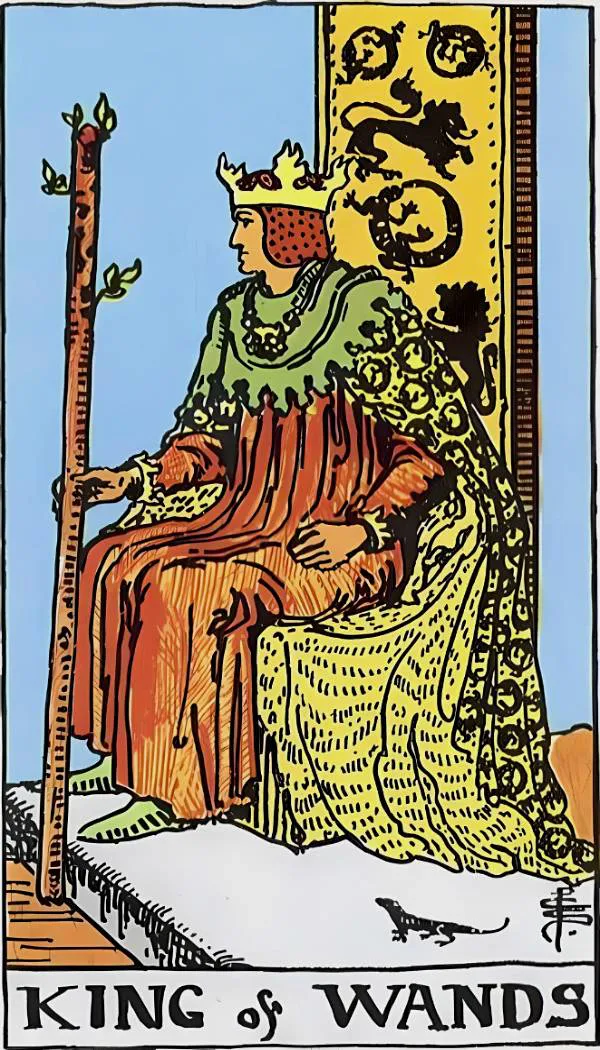
The main character facing to the left of the image is a mature man, who is the King of Wands.

He is sitting upright with a slight forward lean, not leaning back completely on the chair, holding a wand and looking ahead. The King's wand is very long, touching the ground beneath the throne, indicating that he is issuing commands and exercising his exclusive authority.

This king wears a golden crown and a fiery red robe. His cloak spreads across the entire chair and drapes to the ground.

The entire throne is slanted, set in a desert scene. The back of the throne is engraved with the patterns of lions and lizards. On the step to the left of the throne, a fire lizard appears.

Detailed Pattern Description

The King of Wands has a simple and sharp facial outline, representing a straightforward, clear, and strong character. His posture is upright and robust, with a dignified gaze into the distance, sharp and spirited. His left hand is lightly clenched into a fist resting by his side, and his right hand holds a long wand, the end of which touches the ground, symbolizing pragmatism and control over the land. This gesture can also be seen as an authoritative command.

The king's golden crown features several floral patterns, representing the sun-like nobility and brilliance, while also indicating vitality. The red hair cover is particularly exposed, indicating that he is a passionate and energetic person. The red attire is designed to complement the fire element and is close to the color of the wand, with the green chest matching the robe, representing the green sprouts on the wand. The long and heavy cloak represents his majestic presence, with the outer part of the cloak being a striking contrast of yellow and black, symbolizing a distinct personality and a prominent and noble rank. The red and yellow interior of the cloak complements the overall vividness. The cloak is spread over the chair and extends to the ground, indicating the widespread extension of the king's power and prestige.

The throne of the King of Wands is located in the desert wilderness, under the scorching sun and wind, overlooking and surveying. This is a reflection of his character, which is bright, direct, and cheerful. The throne is simple and neat in shape. Only the back of the chair is bright orange and yellow, engraved with black lion and lizard emblems, which highlight the king's solemnity. The lion represents bravery, strength, authority, and leadership, hence the emblems on the back of the chair and the king's necklace pendant both feature lion figures.

The background only shows a sea of red sand, with no buildings or plants growing (the wand in his hand is the only tree of life). The small animal that appears in this image is the fire lizard, which lives in high-temperature and dry places such as deserts and volcanic craters, symbolizing the embodiment of the fire spirit or the guardian of the fire element. The lizard pattern on the back of the throne and the one appearing on the corner of the throne step both strengthen the fire element characteristics. The live lizard on the step may have been shaken out by the king's wand touching the ground and can also be seen as the King of Wands' exclusive pet or alter ego.

The Figure of the King

The King of Wands is full of confidence and charisma. His physical stature and demeanor radiate authority and command. His face usually exudes calm assurance, capturing his wisdom, experience, and understanding. His eyes often look forward, as if contemplating his next action, encapsulating his visionary capabilities..

The Throne of Lions

He is often depicted seated on a throne adorned with lions, a classic symbol of authority and dominion. This symbolizes not only the King’s rule over his domain but also his command over his own inner animalistic impulses. He is a master of self-control.

The Wand

He holds a blossoming wand, a representation of creativity and life force. Unlike other wands in the suit, his wand is fully matured, signifying that he has realized his creative and spiritual potential.

The Salamander

The salamander, a creature of fire, represents transformation and alchemical change, further reinforcing the King’s mastery over his environment and his transformative capabilities.

Golden Garments

The King is usually garbed in rich golden hues, symbolizing his enlightenment, high ideals, and spiritual richness. The golden color exemplifies his refined character and noble pursuits.

The Red Tunic

The red tunic is a symbol of passion, vitality, and a zest for life. It signifies the King’s dynamic energy, emphasizing his drive to take action and make things happen. The red underscores the fiery element of the wands suit, pointing to the King’s mastery over the realms of inspiration, spirituality, and determination.

Psychological patterns in King of Wands
Purpose Anchoring
The wand is the only living vertical growth in a bare red desert, and the king keeps it connected to both his hand and the ground. The symbol is not floating inspiration; it is vitality made load-bearing. Inside the topic of inner clearing, this points to a mind that becomes steadier when it can organize emotion around a real internal aim. You are not simply looking for productivity; the psyche is asking for one grounded axis that can hold scattered heat, fatigue, and desire in the same frame.
Control Coping
The wand touching the ground can read less like rooted leadership and more like a command pressed into the floor. The forward lean, clenched hand, crown, lions, and slanted throne concentrate authority into a single channel of control. Control Coping emerges when relational uncertainty feels safer once it has been organized, directed, or contained by your will. In love, You may try to reduce vulnerability by defining the pace, the terms, the emotional temperature, or the argument's endpoint before the other person can destabilize you. The card does not frame control as evil; it shows why control can feel protective. The cost is that the relationship begins to orbit command instead of contact, and mutual influence has less room to breathe.
Status Defense
The wand touches the ground like a claim, and the cloak spreads across the chair and down to the floor as if the role has become territory. Crown, throne, lions, and command gestures all reinforce the same message: position must be visibly held. In your inner world, that visual pressure can become a defense against feeling small, uncertain, or exposed. The pattern protects self-worth by moving upward into certainty and rank, but it also makes ordinary feedback feel like a threat to the whole self-image.
Strategic Foresight
The wand is not raised in a burst or swung in reaction; it is held upright, grounded, and ready. The throne, crown, lion emblems, and forward gaze all organize the card around directed fire rather than scattered heat. That is the visual logic of Strategic Foresight. The King of Wands carries impulse, but the impulse has been seated inside a larger frame of timing, consequence, and command. In friendship, this pattern appears when you can sense the future cost of a reactive comment, a public confrontation, or a loyalty test before the group dynamic hardens around it. You are not being asked to suppress your instincts. The card shows a more precise use of them: letting your social fire become vision instead of immediate combustion, especially when a close friendship needs directness without escalation.
Secure Visibility
The red robe, crown, lion emblems, and salamander are not hidden in the background; they make the king's fire visible. His posture does not apologize for its presence, yet the grounded wand keeps that visibility from becoming scattered performance. Secure Visibility appears when desire can be seen without being exaggerated for approval or concealed to avoid judgment. In love, You may be learning where confidence, attraction, and direct wanting can exist without turning into a test of worth. The card's authority is not only about being noticed. It shows a body that can hold attention without begging for it, which is the difference between performative confidence and a steadier form of romantic self-expression.
Action Bias
The King's torso leans forward and the wand is already pressed into the ground, as if intention wants to become command immediately. The empty desert offers little friction, so the visual pressure of the card concentrates around movement, decision, and the urge to make something happen. Action Bias forms when motion becomes proof that you still have agency. In a career setting, this pattern can launch projects, job moves, restructures, or visibility plays before the actual constraints have been mapped. The card shows the hidden trap: speed can feel like leadership while quietly bypassing strategy.
Competence Theater
The wand in the king's hand touches the ground like a prop of certainty, while the crown, throne, lions, and rich garments create a complete visual system of competence. Nothing in the image looks improvised; every object reinforces the impression that this figure knows what he is doing and has already earned the right to be seen. That visual certainty can become a social defense when competence has to be performed before connection feels possible. You may learn to enter groups through polish, leadership, advice, decisiveness, or charisma, while hiding the parts of you that are still unsure, tired, or looking for a genuine place to land. In social settings, Competence Theater is not simply showing off. It is a coping mechanism that turns capability into a mask of safety. The room may admire the performance, but the cost is that people connect with the role before they ever reach the person behind it.
Forced Progress
The wand is long, vertical, and grounded like an order being issued to the earth itself. The King's body leans forward, and the desert offers no soft container around that command, only heat, distance, and pressure. When this structure turns inward, ambition becomes a force applied against the self rather than a direction held by the self. Growth starts to feel like something you must extract through pressure, urgency, and self-command. You meet Forced Progress when the inner leader becomes an inner taskmaster, and evolution loses its relationship to integration.
Achievement Fusion
The lion and salamander emblems do more than decorate the throne; they mirror the king's fire identity back at him from the structure he sits on. His wand touches the earth, his robe expands across the chair, and the whole scene turns command into a visible identity. The card makes achievement feel embodied, environmental, and hard to separate from self-image. This is where action stops being only action and becomes evidence of who you are. In a lifestyle context, the clean room, strict routine, disciplined body, optimized calendar, and constant output can all become proof that the self is still coherent. The defense is powerful because it produces results, but it also makes rest feel like a symbolic failure. You may recognize this pattern when daily order feels less like support and more like a performance you cannot drop. The card reveals the fusion point: the system is no longer just helping you live; it is carrying the burden of proving that you are competent, driven, and in control.
Timing Discernment
The king's wand is held with command, but it is also planted. His fist is lightly clenched, not swinging; his body is active, but the throne still defines the boundary of movement. The whole image holds a decision at the edge of execution. That is the visual logic of Timing Discernment. The card does not flatten readiness into immediate action. It shows the psyche testing whether force has a clean channel, whether desire has ground contact, and whether authority is being used to choose the moment rather than escape uncertainty. For timing questions, this pattern is the internal skill of sensing the difference between an opening and a pressure spike. You are not being asked to suppress momentum. You are being asked to locate the point where momentum can meet the least resistance.
Core Struggles in King of Wands
Control Lock
The same throne, wand, and forward lean become rigid in the reversed state: the staff reads less like creative force and more like a brace holding the whole posture in place. The fist, the crown, and the fixed seat turn the body's fire into a closed circuit. In love, that structure names the moment control stops being a tool and becomes the condition for feeling safe. You may keep steering the conversation, the timing, or the emotional temperature, but the card shows how the bond locks when every movement has to pass through the grip first.
Cycle-Action Desynchronization
The King of Wands leans forward from a throne that still holds him in place, with a living wand planted into dry ground like a signal of command waiting for the field to answer. The body is already angled toward action, but the desert around him does not show the density of support that would make movement easy or self-sustaining. This is the shape of Cycle-Action Desynchronization: your inner ignition is real, but the external season may not yet be carrying the same rhythm. In timing questions, the friction does not come from a lack of drive; it comes from trying to move at the speed of vision while the field still moves at the speed of preparation. The card gives the struggle a clear boundary. It shows the difference between being ready to lead and being inside a cycle that is ready to receive leadership, so the next move can be measured by traction rather than panic, peer pressure, or the need to prove momentum.
Internal Authority Collapse
The throne sits at a slant, but the crown, wand, and gaze keep the scene ceremonially composed. The image preserves the appearance of command while the underlying reference point is subtly unstable. In personal growth, this becomes the feeling that you need one more framework before you can trust your own direction. The outer posture may look decisive, but the inner plumb line keeps searching for confirmation outside itself. The card identifies a collapse of internal authority rather than a lack of intelligence. You are not short on concepts; the unstable point is the place from which concepts are being judged, chosen, and acted on.
Power-Intimacy Split
The King sits forward instead of resting back, gripping a long wand that touches the ground like a command line between body, throne, and territory. The lions and salamanders around him intensify the scene with mastered fire, while the empty desert leaves no visible equal across from him. That arrangement carries the friction of wanting a relationship to move through strength, certainty, and decisive direction while also needing the softness that cannot be commanded. You may be trying to protect the bond by taking charge, but the card locates the struggle where leadership starts to crowd out being met, heard, and emotionally changed by another person.
Power-Connection Split
The King of Wands sits forward on a throne while his wand is planted into the ground, creating a direct line from personal will to the shared terrain. His authority is visible before any exchange occurs: the lions, cloak, crown, and staff all make influence part of the room before he speaks. In friendship, that structure becomes a split between wanting to protect or energize the bond and fearing that your force will turn connection into command. You are not simply too much; the card shows a relational field where warmth, leadership, and dominance occupy the same physical channel, so closeness has to negotiate with power before it can feel mutual.
Prestige-Passion Split
The red robe, gold crown, lion throne, salamander, and desert all intensify the same fire signature, while the wand remains the only living growth in the image. Status and vitality share the same fuel source, but the landscape around them does not replenish it. When this structure turns inward in career life, the title or prestige path begins to occupy the space that passion once used to move through. You can still look successful, senior, or impressive, while the living reason for the work is forced to survive as one thin green wand in a dry field. The struggle is not simply boredom with a job. It is the split between professional status and the original fire that made the work feel worth choosing.
Boundary Control Strain
The wand touches the ground like a boundary stake, while the cloak spreads from the body across the chair and down to the floor. In the open desert, there are no walls or paths to make the edge of the King's space obvious, so the body and its symbols have to manufacture the boundary themselves. That arrangement mirrors social environments where you cannot simply relax into contact because every invitation, group chat, or gathering feels like it might overrun your available space. Boundary Control Strain names the continuous effort to keep connection possible without letting the social field take more access than you can actually hold.
Willpower Dependence Trap
The wand is the only visible living growth in the desert, and it is held as both staff and command line. Around it, the robe, salamander, throne imagery, and dry terrain concentrate the entire scene into fire, force, and survival under heat. Willpower Dependence Trap appears when the decision process starts leaning on intensity as its main source of certainty. You keep pressing harder, demanding a cleaner answer, pushing the options into submission, yet the field itself may be too dry to respond to force alone. The card gives that exhaustion a structure. The problem is not that your will is weak; it is that willpower has been asked to do the work of discernment, nourishment, timing, and risk reading all at once.
Power-Choice Split
The King sits forward on a throne of lions, holding a flowering wand like a line of command driven into the ground. Crown, throne, staff, and gaze do not simply decorate the scene; they turn the entire space into a field of authority. Power-Choice Split forms when a decision becomes tangled with the need to remain in control of the outcome. You are not only weighing A against B; you are measuring which option lets you keep leverage, dignity, authorship, or the feeling that the situation still answers to you. The slanted throne and grounded wand show why this kind of choice can feel strangely heavy. The problem is not a lack of options, but the way every option presses on the same axis: what happens to your authority if you choose one path and let the other one go.
Responsibility-Authority Split
The crown, lion throne, and long wand all announce command, but the king sits in a barren field with no visible court, workers, or structure around him. The throne itself is slanted while the wand creates a separate vertical line, so authority appears real but its base is not fully level. In a career setting, this becomes the experience of being made accountable for outcomes before the matching authority has been granted. You may be expected to lead a project, carry a team, manage risk, or own the result, while the actual decision rights, resources, or institutional backing remain partial. The card gives shape to the specific strain of carrying leadership weight from an unstable base. It does not erase your agency; it shows why the burden feels disproportionate when responsibility has arrived faster than structural power.
Inner Emotions in King of Wands
Grounded Agency
The wand touching the ground turns fire into something usable: heat has a point of contact, the body has a vertical line, and the throne gives the impulse a place to sit. The king’s slight forward lean keeps the scene awake without tipping it into scramble. For inner work, that structure maps to the moment when intensity stops scattering your attention and starts becoming self-command. You are not trying to erase the heat in the system; you are locating where it belongs, so your choices can come from a steadier center.
Hollow Control
The planted wand, clenched side hand, and throne covered by the cloak turn control into a heavy surface. Around him, the desert has almost no visible growth, so all vitality has to pass through one staff and one role. Hollow Control forms when the structure still looks authoritative while the inner source feels dry. You may be holding the plan, the image, and the responsibility together, but the card exposes the gap between appearing in command and feeling genuinely oriented from within.
Authority Claustrophobia
The cloak spreads across the throne and down to the ground until authority feels less like a seat and more like an atmosphere. The lions, lizards, crown, and wand repeat the same command signal across the whole visual field. In family systems, this becomes the feeling of being crowded by authority before anyone openly threatens you. A parent's tone, an elder's expectation, or the old family ranking can take up so much space that your current self has nowhere to breathe. Authority Claustrophobia names that squeezed inner weather. The card shows how power can become spatial: not only a person telling you what to do, but a room where the old hierarchy has already arranged the furniture.
Leadership Loneliness
The throne stands alone in a barren red landscape, and the king's gaze moves outward without any visible figure meeting it. The symbols of command are abundant, but the surrounding field is almost empty. Leadership Loneliness forms when the power to choose does not come with the comfort of being accompanied inside the choice. Advice may exist around the decision, but the final interior act remains singular: one body, one wand, one direction held in open space. The card does not frame this aloneness as punishment or superiority. It simply makes the emotional cost of agency visible, showing that some choices become real only when you stop waiting for someone else to fully inhabit them with you.
Suppressed Rage
The red robe, scorched sand, salamander, clenched hand, and sharp crown concentrate fire into a seated body that does not move. The heat is everywhere in the image, but the royal frame demands stillness. This creates the pressure of anger held behind a controlled exterior. You are not asked to act it out or explain it away; the card makes the contained heat visible so it can be recognized before it turns into a permanent inner climate.
Control Fatigue
The wand touches the ground like an instrument of control, while the cloak spreads so widely that the body seems responsible for holding the whole visual field together. Nothing in the desert softens that demand. In a family system, this becomes the exhaustion of monitoring everyone else's tone, timing, reaction, and volatility. You may look composed because you are constantly adjusting the emotional temperature before anyone else notices it rising. Control Fatigue names the cost of being the stabilizer. The card shows control not as dominance, but as a heavy posture that can drain the person holding it when the family field refuses to regulate itself.
Visibility Pressure
The red robe spreads across the throne, the crown catches the eye, and the open desert leaves the figure with nowhere visually soft to recede. Everything about the composition makes the body readable: posture, gaze, rank, color, and command are all placed in the open. Visibility Pressure enters the academic field when being capable also means being watched. In seminars, presentations, critiques, and exams, you may feel the heat of having your thinking made public before it feels fully finished, as if every pause or imperfect sentence carries extra weight.
Focused Confidence
The upright spine, planted wand, and sharp outward gaze make the King of Wands look less like a dreamer and more like a body that has already organized itself around a direction. The fire symbols are not scattered across the scene; they are gathered into a throne, a robe, a staff, and a single focused line of sight. That visual structure mirrors Focused Confidence in personal growth because the inner heat has found a channel. You are not simply excited about becoming better; you can feel your attention choosing one path clearly enough that the next move no longer needs endless permission from doubt. The desert around him matters because it strips away distraction. In that exposed space, confidence becomes less about being applauded and more about being able to hold your own direction when there is nothing soft or crowded to hide behind.
Confrontational Courage
The slight forward lean of the King of Wands matters because the body is already moving toward engagement while still seated in command. The gaze reaches outward, the wand stays grounded, and the lions behind him hold the heat in a recognizable form. In family conflict, that posture describes the moment before a hard truth is spoken. You may not feel fearless, but the card shows courage as directed heat: the capacity to stay present with a parent, sibling, or elder without handing your voice back to the old hierarchy. Confrontational Courage does not glamorize conflict. It names the inner charge that appears when silence has become more expensive than clear contact.
Magnetic Ease
The red robe, golden crown, and live salamander make the King's presence warm before he says or does anything. The throne's lion emblems and the open sand around him turn attention toward him without forcing movement. That is the social feeling of Magnetic Ease: You are not chasing the room, yet the room can still register your signal. The card links this emotion to a coherent inner heat, the kind of ease that comes when your presence feels rooted enough to attract connection without over-performing for it.
Outer Contexts in King of Wands
Strategic Timing Window
The king's gaze travels across open desert while the wand remains planted in the ground. The image is not frantic movement; it is a controlled command position where vision, leverage, and terrain are being read before action. This is the reality of a decision window: the choice may be clear, but the timing determines whether it lands with force or burns through resources too early. You are being shown the difference between hesitation and strategic delay, especially when the next move will change the board around you.
Relationship Power Play
The long wand can read as a staff pressed into the ground, while the sealed fist and elevated throne hold the body in a rigid command posture. The space around the figure has to organize itself around one fixed center. In a relationship, that visual structure maps a power imbalance where one person's preferences, timing, or rules dominate the shared field. You are being shown the mechanics of the dynamic: who gets to define the terms, who has to adapt, and where negotiation has been replaced by positional control.
Founder Mode Overreach
The wand touches the ground like a command rod, while no other figures or support structures appear around the throne. Direction flows from one body into the landscape, and the whole field seems to depend on that single point of control. This is the pressure pattern of a path, venture, or identity project becoming too centralized around your will. The card exposes the moment when leadership stops creating movement and starts turning the future into a system that cannot breathe unless you personally push it.
Main Character Friend Dynamic
The slanted throne, command wand, and cloak swallowing the chair create a social stage where one person's presence occupies more room than the shared environment. Even the small fire lizard sits at the step like an extension of the central figure's domain. In friendship, this becomes the dynamic where one person's stories, crises, launches, preferences, and self-image pull everyone else into orbit. The card exposes how charisma can become a gravitational structure, making you question whether you are participating in a mutual bond or maintaining someone else's permanent spotlight.
Authority Approval Bottleneck
The throne carved with lions places authority in one elevated seat, and the cloak expands that seat until it dominates the surrounding space. The wand touches the ground as if permission and action both have to pass through the same commanding point. This mirrors a growth environment where a coach, mentor, influencer, or imagined evaluator becomes the gatekeeper of the next move. You may have direction available, but the step keeps waiting for someone else's approval to make it legitimate. The slanted throne matters because concentrated authority is not always stable authority. The card reveals how personal agency can get delayed when the external voice becomes larger than the experiment itself.
Community Leadership Trial
The King's upright torso, forward lean, and wand planted into the desert floor create the image of authority being physically held rather than merely claimed. The throne, lions, crown, and salamander make leadership visible as a public arrangement: someone has to set direction, stabilize heat, and turn raw social energy into a shared field. In a social network, that structure maps to the moment when the group starts looking for a person to initiate, host, decide, or hold the tone. You are not just joining the room; you are being tested by the role the room is placing on you, and the pressure is whether leadership can create belonging without becoming a performance cage.
Executive Presence Test
The upright king leans forward with the wand planted into the ground, turning authority into a visible physical structure. His crown, throne, lions, salamanders, and controlled gaze make leadership legible before any task is performed. In a career setting, that image maps to the moment when competence is no longer judged only through output. You are being read through how you occupy the room, hold pressure, and translate intent into command without overexplaining yourself. The card links this context to a test of visible seniority: the work may already be strong, but the gate is whether your presence can carry responsibility in front of stakeholders.
Micromanaging Boss
The grounded wand becomes less like a tool and more like a stake pinning every movement to the ruler’s hand. The forward lean, clenched hand, hard emblems, and exposed field create a structure where command is constantly present. In the workplace, this maps to a boss who turns authority into approval friction. The team may technically have tasks, but movement keeps returning to the same control point before anything can proceed. The card links this context to a loss of operational air. You are not only dealing with a demanding person; you are inside a decision environment where trust has been replaced by supervision.
Micromanaging Friend Dynamic
The wand reaches the ground like a control point, and the throne surveys the exposed desert from a position of command. Lions, lizards, sharp colors, and the King's fixed posture turn the scene into managed territory rather than open exchange. In a friendship circle, that turns into the friend who monitors plans, edits everyone's behavior, decides what counts as acceptable, and treats spontaneity as a threat to their authority. The card reveals the friction between care and control: the group may still call it organization, but the structure is asking who actually gets to move freely.
Authoritarian Parent Dynamic
The same grounded wand that can organize a realm becomes, in reversal, a command stake driven into the floor. The closed fist, high throne, lion emblems, and empty desert concentrate power into one seated figure with no visible peer beside him. That is the family atmosphere where a parent or elder turns contact into directives, loyalty checks, and unilateral decisions. The card exposes the structure around the personality: you are not dealing with mere intensity, but with a household hierarchy arranged so that one voice occupies the center and everyone else has to negotiate around it.