Two of Wands Tarot Card Meaning

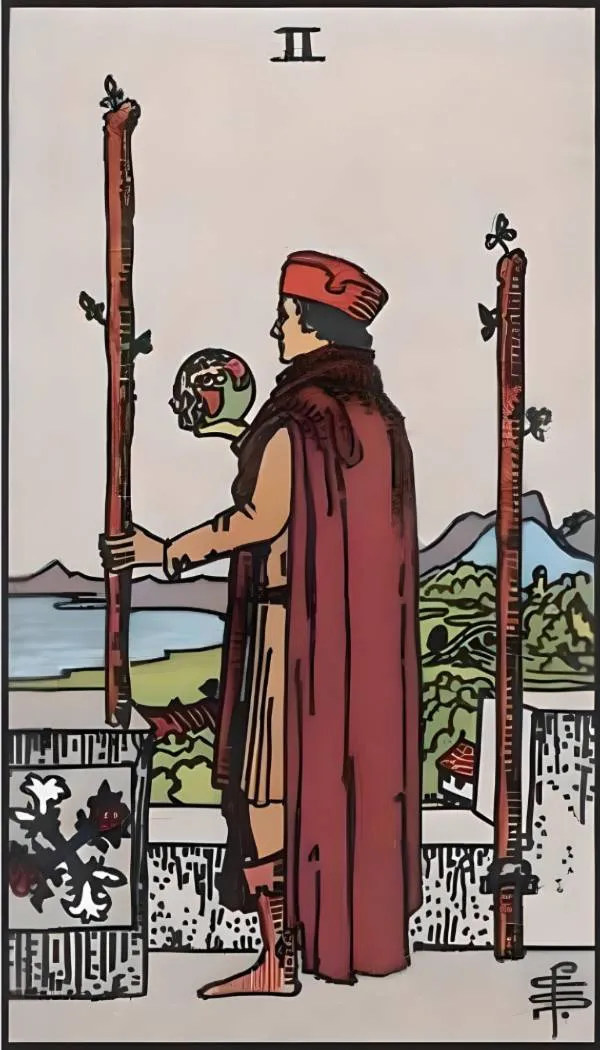
A dignified man stands atop a castle at the mouth of a coastline. This tall figure stands high, overlooking the distant view, holding a globe in his right hand, gazing into the distance along the line of sight of the globe. His left hand holds a wand, resting on the battlement, with another wand leaning against the wall, secured by a buckle on the battlement.

He is a lord, surveying his domain, alternately focusing on the globe in his hand. This moment should be filled with ambition, yet mixed with a myriad of emotions. He seems to be suffering from illness, humiliation, and the sorrow of Alexander over the spectacular wealth of this world. His mood is inscrutable, and his facial expression is indistinguishable.

This card once again features red roses and white lilies – just below the battlement where the wand is pressed. Like a symbol, red roses and white lilies are strung together in a time and symmetrical form. The two roses cross to form an X-shaped mark, a complete and obvious esoteric symbol placed in this card, bearing the symbolic mark of their group, the 'Hermetic Order of the Golden Dawn'. (This may be the first numbered card painted by Miss Smith)

The lord's attire is all in shades of deep red and dark brown, giving a sense of calm and restraint, with the color of the hat and cloak being similar, yet full of energy. The wands form a double pillar, yet not balanced, with the one held in the left hand being shorter, and the relationship between the figure and the wands also suggesting that they are the three pillars of the Tree of Life, adjusting their positions.

Below the city wall, there are land plains and hills, houses, and farmland, which are his domain, rich and prosperous, and spectacular. The ocean is calm without tides, the bay cuts into the purple mountains on the right, and the gray sky all show a low-key and lonely mood.

The Globe in Hand

The globe in the figure’s right hand symbolizes the world, embodying potential and untapped opportunities. It signifies the capacity for the querent to take command of their life, embodying the world as a sphere of influence, a realm to be shaped and directed according to will.

The Wands

The two wands framing the figure represent a decision between two paths or directions. One wand is firmly held while the other is affixed to the castle wall, signifying an internal conflict between desire for adventure and the comfort of home or known situations.

The Sea

The ocean visible in the background symbolizes the unconscious and the unknown, hinting at the unpredictable nature of the adventure or the journey that lies ahead. The sea can be both nurturing and treacherous, representing both opportunities and challenges.

The Castle

The castle symbolizes security, achievement, and the material comfort that has been gained. However, it also stands as a potential trap that can keep one bound to their old ways, foregoing the promise and excitement that new opportunities bring.

The Garments

The figure is adorned in luxurious garments, signifying the comforts of the material world. These garments, however, are not overly ornate, emphasizing the disciplined nature of the person who is ready to explore new horizons but with due diligence and responsibility.

The Landscape

The expansive landscape stretching beyond the castle represents unlimited potential and opportunities. The land is a mix of mountains, seas, and plains, symbolizing the varied challenges and terrains one might encounter in any ambitious pursuit.

Psychological patterns in Two of Wands
Commitment Avoidance
The held wand and the fastened wand create two vertical commitments, one mobile and one locked to the battlement. The figure stands between the secure castle and the open coastline, seeing both paths without putting his body into either one. That suspended posture captures how commitment can become a threat to freedom before it becomes a shared choice. You may keep the relationship in possibility because choosing one direction would collapse the protective distance that currently makes the desire feel safe.
Analysis Paralysis
The gaze travels from the globe to the horizon, but the figure's feet do not leave the castle. The visual circuit is active, even elegant, yet all movement remains contained inside the act of looking, comparing, and projecting. Analysis Paralysis appears when the mind keeps generating clarity as a way to avoid the vulnerability of execution. You may research the ideal sleep schedule, compare habit systems, redesign your planner, and audit every variable because the moment of action would expose the routine to mess, limits, and feedback. The still sea and fixed wands intensify the loop. The environment offers almost no visible motion, so the internal analysis becomes the substitute movement, making the lifestyle reset feel busy while the body remains at the same threshold.
Timing Perfectionism
The figure's gaze runs from the globe to the horizon, creating a precise line of imagined timing. In a strained state, that line becomes too narrow: every possible window must match the private map before the body is allowed to move. The defense mechanism is a perfection standard applied to time itself. Instead of helping You read the season, the mind keeps recalculating readiness until ordinary uncertainty looks like a warning sign. Timing Perfectionism appears when You wait for a moment so clean that real life can never provide it. The card shows how the desire to act wisely can become a holding chamber where the perfect window replaces the usable one.
Sunk Cost Fallacy
One wand is not simply standing; it is secured to the battlement. The image shows attachment to an existing structure, while the globe enlarges the meaning of what has already been built into something that feels too significant to release casually. Sunk Cost Fallacy enters friendship when history starts functioning as evidence that the bond must continue, even when the present exchange is no longer mutual. Years, secrets, birthdays, shared crises, and mutual friends become the wall that keeps the old arrangement in place. The reversed card highlights the mental bind of protecting past investment at the expense of current clarity. You may not be choosing the friendship as it is now; the pattern may be choosing the emotional cost of having already stayed this long.
Decision Deferral
The two wands do not create motion by themselves: one is held, and one is fastened to the wall. The figure can see the wider landscape, but his body remains inside the castle, suspended between knowing a direction and actually crossing the threshold. Decision Deferral is the defense of keeping a friendship boundary in the planning stage so it never has to become relationally real. The mind rehearses the message, the timing, the tone, and the possible fallout, but the body stays in the old position because delay feels safer than disruption. In friendship, this pattern often appears when You already know a conversation is overdue. The card gives that stuckness a physical form: insight is looking outward, but action is still attached to the wall.
Achievement Fusion
The castle below the figure is secure, prosperous, and elevated, but the man's face remains difficult to read. He holds the world in miniature while standing above the domain already gained, as if achievement has created a wider view without necessarily creating inner relief. The scene carries command and emptiness in the same posture. Achievement Fusion appears when the built structure starts carrying the weight of identity. The castle, wand, and globe become more than resources; they become proof that the self has value, direction, and legitimacy. When that proof stops feeling alive, the psyche can experience a strange gap between external success and internal orientation. For direction questions, this card can reveal why a milestone did not answer the deeper question. You may have reached a visible ledge and discovered that the next horizon still asks who You are when accomplishment is no longer enough to organize the self.
Future Self Idealization
The globe in the figure's hand makes the world look graspable, almost personal, while the landscape beyond the castle remains distant. His posture is composed and elevated, but the image is still: the imagined future is vivid before the lived process has begun. That is the visual logic of Future Self Idealization. The mind invests in an identity image before it has metabolized the repetitive, ordinary labor that would make the image real. The future self becomes emotionally charged because it carries relief from present uncertainty. In academics, You may become attached to the idea of being admitted, published, brilliant, fluent, or transformed, while the daily tasks that build that reality feel strangely threatening. The Two of Wands links this pattern to the moment when potential is held so tightly as an image that it delays contact with imperfect practice.
Resource Alignment
The castle wall, the secured wand, and the cultivated land below all show that the figure is not starting from nothing. He is standing inside an existing structure, using what has already been built as a base from which to measure the next horizon. The psychological mechanism here is not raw ambition; it is the calibration of capacity. The card places desire beside infrastructure, showing that timing becomes distorted when vision is separated from available bandwidth, support, money, energy, or emotional steadiness. Resource Alignment appears when You stop treating readiness as a mood and start reading it as a system. The globe may suggest a larger world, but the battlement asks whether the present foundation can carry the weight of entering it.
Comfort Zone Attachment
The man looks toward the sea and mountains, but his body remains inside the castle boundary. One wand is held, while the other is fastened to the wall, turning stability into a visible anchor that keeps the wider world at a controlled distance. This is where Comfort Zone Attachment forms. The known structure is not meaningless; it has protected the figure and given him status, perspective, and safety. The problem appears when that same structure starts regulating fear so effectively that leaving it feels irrational, even when growth requires contact with the unknown. In academic life, You may stay with familiar study methods, safe topics, predictable courses, or low-risk goals because they preserve a sense of competence. The Two of Wands shows how security can become a cognitive defense when the next learning edge would require being visibly unfinished again.
Option Hoarding
Two wands frame the figure, but only one is actively held while the other remains secured to the wall. The globe promises a larger field of possibility, so the scene holds choice as a possession rather than a movement. That arrangement turns options into emotional insurance. You may keep parallel romantic possibilities alive because narrowing the field would force the nervous system to tolerate loss, uncertainty, and the vulnerability of one clear direction.
Core Struggles in Two of Wands
Freedom-Structure Conflict
The castle wall holds the figure above a calm coastline, giving him wide sightlines and almost no visible exit path. One wand belongs to his hand while the other belongs to the wall, so the scene keeps freedom and structure in the same frame without letting either one disappear. You may feel this in daily life as the demand for routine colliding with the need to keep your inner airspace open. The card does not flatten that conflict into discipline versus laziness; it shows a real design problem where too little structure scatters you and too much structure turns the day into a battlement.
Potential Overidentification
The man's hand closes around a globe while the actual world stretches out beyond him. The image compresses unlimited terrain into a single object of possession, making potential feel tangible before it has been lived. In inner work, the future self can become another polished object to hold: the healed version of you, the clear version, the version who finally knows what everything means. That image can give direction, but it can also become heavy when it replaces contact with the present self. Potential Overidentification appears where possibility becomes an identity container. The card locates the strain in the difference between holding a world and inhabiting one.
Autonomy Guilt Bind
The man stands above his lands with a globe in one hand and a wand held against the battlement. The horizon is open, yet the body remains braced inside the castle, so the card's ambition is not floating free; it is measured from the edge of a protected family structure. For family questions, that edge becomes the place where autonomy and guilt bind together. You can see the shape of a life beyond inherited expectations, but every movement outward still has to pass the wall of belonging, approval, and the fear of becoming the one who leaves.
Comfort Entrapment
The open world is visible, but the figure's usable space is the castle wall. The wand, the battlement, and the elevated position all stabilize him, yet that same stability keeps the body from entering the landscape it surveys. In a long-term friendship, Comfort Entrapment appears when the familiar role has become the safest place to stand and the hardest place to leave. The old rhythm may protect the bond from sudden conflict, but it also compresses your ability to change your availability, name a new boundary, or stop performing the version of closeness that used to work. Reversed, the Two of Wands turns the castle from a base of confidence into a private enclosure. You are not trapped because there is no outside; you are trapped because the known arrangement has trained your nervous system to treat the outside as too costly to enter.
Cycle-Action Desynchronization
The globe can be turned again and again in the hand while the coastline remains at the same distance. The figure's height gives perspective, but perspective alone does not synchronize the body with the tide, the road, or the wider field below. Cycle-Action Desynchronization is the strain of acting from the wrong layer of time. You may push when the environment is not ready, pause when the opening is live, or keep reading the map while the actual cycle moves elsewhere. The reversed Two of Wands makes this desynchronization visible through distance. The card shows timing as a relationship between inner drive and outer season, not as a demand to force movement or delay forever.
Reciprocity Deficit
The globe sits in one hand while the entire landscape spreads below the castle, turning a vast field into something one person appears to hold alone. Beside him, one wand is active in his grip while the other is fastened to the wall, creating a relationship between two supports that do not share the same load. That imbalance is the visual core of Reciprocity Deficit in friendship. One side is carrying the emotional overview, remembering the terrain, checking the distance, and keeping the bond oriented, while the other side stays present in a fixed or passive way. You may still have a real connection, but the card shows how a friendship can become structurally uneven without becoming openly hostile. The strain comes from holding too much of the relational world yourself and still wondering why the bond feels less mutual than it looks.
Analysis Paralysis
The globe, horizon, and unused wand create a closed circuit of attention: the hand holds possibility, the eyes measure distance, and the body stays fixed. In this reversed state, the visual system keeps gathering scale while the action system receives no executable path. For You, the card maps the loop where more thinking does not create more agency. The struggle is not a lack of intelligence or care; it is a decision structure where every additional variable increases the size of the world in your hand while leaving your feet in the same place.
Social Exit Paralysis
One wand is buckled to the castle wall, and the other is held while the figure remains stationed behind stone. The scene contains objects associated with movement, but their placement turns them into supports for staying where the body already is. For social exit struggles, that fixed wand becomes the strongest visual anchor. You may see that a group, chat, or circle is draining you, yet the structure that hurts also provides orientation, visibility, or a familiar role. The card does not frame the stuckness as weakness. It shows an exit problem where the route out requires releasing the very support system that has been keeping your social balance intact.
Process-Vision Split
The figure holds the globe close enough to control with one hand while the actual world remains beyond the battlement. The image gives vision a precise shape, but it also separates that vision from the body that would have to climb down, cross the land, and enter the unknown. That split is the structure behind Process-Vision Split in personal growth. You can see the upgraded life, the next-level self, or the bigger strategy with unusual clarity, while the daily process that would make it real stays outside the frame of action. The card does not reduce this to laziness or lack of ambition. It shows a system where vision has become highly developed, but the bridge into repeatable practice has not been built yet, so growth remains visible, compelling, and physically unentered.
Vision-Execution Split
The man is positioned like someone ready to direct a larger world, but his feet remain on the castle platform. One hand holds the wand of active will, the other holds a globe of future reach, and the path from the wall to the coastline is visually missing. Vision-Execution Split lives inside that missing path. You may be able to see the next phase of your life with painful sharpness, yet the body cannot find the timing bridge that turns a wide horizon into a first irreversible step. In a timing reading, this card does not reduce the issue to procrastination. It shows a real structural gap between the scale of the vision and the available route of execution, asking where the next action can meet the least resistance rather than where the fantasy looks most complete.
Inner Emotions in Two of Wands
Existential Vertigo
From the castle edge, the figure sees land, sea, homes, hills, and distant mountains all at once, while the globe repeats that vastness in miniature. The image creates an unusual scale shift: the world is both enormous beyond him and small enough to hold. Existential Vertigo comes from that scale distortion. The more the inner life becomes visible as a total map, the less grounded it can feel inside the body. You may suddenly see too many possible selves, timelines, meanings, and unlived directions, and the overview itself becomes destabilizing. In introspection, this card marks the dizzy edge of self-awareness. It shows the moment when perspective is powerful but not yet integrated, and the task is to let clarity regain human scale instead of turning your life into an abstract horizon.
Timeline Panic
The globe, the coastline, and the distant mountains can become a harsh measuring system when the figure's upright stance locks against the wall. Instead of holding possibility lightly, the eye narrows across the horizon as if one correct window must be found before everything slips out of reach. The card's reversed emotional structure compresses the future into a countdown. The same elevated view that could support perspective becomes a place where comparison, deadlines, and imagined lateness gather in the body. Timeline Panic belongs here because the Two of Wands is already a card of planning, timing, and outward projection. In this state, you are not simply considering when to move; you are feeling watched by the calendar, as if the timing of your life has become a test you might fail.
Independence Guilt
One wand is fastened to the castle wall while the other is held in the figure’s hand, and the globe pulls his attention toward a wider horizon. The image does not show a clean exit; it shows attachment and direction occupying the same body. That is the emotional geometry of Independence Guilt in a family system. You may be looking toward your own home, career, relationship, city, or values, while part of you remains pinned to the old wall of obligation, gratitude, and anticipated disappointment. The card’s power is in making the guilt visible as a tension between two positions, not as a verdict against your independence. The globe suggests agency; the fixed wand shows the inherited tie that makes agency feel emotionally expensive.
Hollow Control
The globe sits in the figure's hand as a perfect miniature of control, but it is dwarfed by the coast, the mountains, and the gray sky around him. The castle wall gives command a platform, while the fixed wand and hard stone make that command feel strangely dry. Hollow Control forms when having the overview does not create inner conviction. You can hold the plan, name the options, and survey the risks, yet the card shows how command becomes empty when none of the mapped paths feels fully inhabited.
Directionless Urgency
The globe is held like a complete map, yet the figure does not cross the battlement. When this image tightens inward, the fixed wand, still sea, and distant mountains turn the horizon into pressure without motion, so the body stays suspended between seeing possibilities and inhabiting none of them. Directionless Urgency names the academic state where every deadline, program option, and future version of yourself feels close, but no path feels enterable. You may be surrounded by plans and tabs and advice, yet the system keeps producing speed without direction, as if the mind is already late to a route it has not chosen.
Decision Dread
The globe concentrates the world into the figure's hand while the coastline, mountains, sea, and domain spread outward in several possible directions. His gaze has a target, but the path from the battlement into the wider terrain is not drawn. Decision Dread emerges when possibility becomes too condensed and too consequential. The card's two wands do not merely suggest options; they create a charged threshold where choosing one path means allowing other versions of the self to remain unlived. In personal growth, this emotion can turn self-authorship into pressure. You are not simply wondering what to do next; you are feeling the weight of what each choice might reveal about who you are becoming.
Authority Claustrophobia
The castle gives the figure height, security, and proof of standing, yet it also keeps his body inside a defined wall. The second wand is fastened into the structure, as if the symbol of initiative has become part of the enclosure. Authority Claustrophobia grows from that secured elevation. The role grants status and perspective, but its boundaries press close around the freedom that originally made the climb meaningful. In career questions, this emotion often appears when promotion, leadership, or expertise begins to feel like a narrowing corridor. Two of Wands shows that the discomfort is not ingratitude; it is the pressure of realizing that a powerful position can still restrict the next version of your agency.
Leadership Loneliness
The lord stands above a prosperous domain, but no other human figure shares the wall with him. The globe, the wand, and the high parapet place him in a role of overview rather than participation. In social networks, that arrangement becomes the ache of being the planner, connector, host, or reliable one while feeling oddly outside the warmth you help organize. You can hold the map of the group and still feel unseen inside it, because competence has become a distance from mutual contact.
Commitment Claustrophobia
The castle wall gives the figure height, safety, and ownership, while one wand is literally fastened to the structure beside him. The same architecture that supports the view also fixes the body in place, turning a lookout point into a perimeter. In a committed relationship, that pressure can feel like a beautiful enclosure: secure enough to stay, tight enough to make the chest pull back. The card does not shame the need for space; it shows how the nervous system can read the next step in love as a loss of movement when autonomy has not been clearly held.
Stalled Momentum Dread
The horizon stretches across sea, land, and mountains, but the figure remains on the battlement with one wand fixed and the globe still in hand. The view suggests a route, while the body stays suspended before the first move. Stalled Momentum Dread grows from that suspended distance. In a lifestyle reset, the new schedule, room layout, sleep rhythm, or health routine may be visible enough to haunt you, but not yet embodied enough to begin. The dread comes from watching possibility harden into pressure each time the first step is postponed.
Outer Contexts in Two of Wands
Analysis Paralysis
The globe turns the world into something small enough to hold, while the open landscape multiplies the number of possible directions. The figure has an overview, tools, and status, but the scene stays frozen at the point where too much mapping can delay contact with the road. In introspective work, this becomes a loop of reading, journaling, comparing frameworks, and auditing every motive before allowing one small change to occur. You may be trying to make the inner map perfect enough to remove uncertainty, but the map itself has become the place where movement stalls. The reversed Two of Wands fits this context because it shows control becoming static. It names the blockage as over-observation: a structure where self-knowledge keeps expanding while the threshold into lived experience stays uncrossed.
Strategic Exit Window
The battlement looks out over a calm bay while the established domain remains visible below. Nothing in the scene is collapsing; the pressure comes from recognizing a route before the moment turns into inertia. For you, leaving may need to be understood as timing, not rebellion. The card shows an exit window where the existing structure still provides leverage, making it possible to plan a departure without pretending the current setup has no value.
Pathless Transition
The coastline opens outward, but the foreground offers no road from the battlement to the far terrain. The figure stands at the edge of a known world with the globe in hand, suspended between ownership of the present and physical movement into the next stage. Pathless Transition names a phase where the old container has lost authority before a new container has appeared. You may know that the current direction cannot fully hold you, yet the next identity, route, community, or structure has not become visible enough to step into. The reversed Two of Wands gives this limbo a map. The absence of a visible road does not mean there is no direction; it means the crossing requires a new kind of path-building rather than another attempt to force the old architecture to produce one.
Premature Launch Pressure
The globe in the hand promises scale, but the body remains on stone while no road, ship, or gate appears below. The fastened wand and the untraveled coastline make the ambition visible before the passage has been built. This is the friction of pushing a move into a field that has not opened yet. You may be surrounded by pressure to act, but the card exposes the difference between a real window and a projection stretched over missing support.
Social Circle Reset
One wand is held by the figure while the other is fastened to the castle wall, turning the scene into a split between the social base already secured and the wider world still ahead. The globe makes the next circle imaginable, but the castle keeps the current circle materially present. For you, this captures a social reset where belonging is no longer only about loyalty to the familiar group. The card shows a structured choice point: what remains a home base, what becomes a launch point, and what needs to be left outside the next map.
Opportunity Cost Tradeoff
The two wands do not simply duplicate each other: one is gripped by the figure, while the other is attached to the wall. The globe in his hand makes the wider field visible, but the castle keeps one option materially anchored. This is the career math of choosing between real benefits, not choosing between good and bad. You can see more than one viable route, yet each route carries a different cost in status, freedom, money, or future range.
Rigid Life Script Lock-In
One wand is literally fastened to the battlement, while the other is held close to the figure's body. The castle hierarchy, cultivated land, and elevated stance create a life architecture that looks orderly from the outside and difficult to revise from within. Rigid Life Script Lock-In appears when the expected route has become structurally embedded. Education, career status, family narrative, relationship milestones, or a carefully maintained identity may all point in the same direction, even when the globe in hand keeps showing a larger world. The card reveals the difference between a chosen structure and a script that keeps choosing for you. Its pressure is not to rebel blindly, but to identify which fixed beam in the architecture is carrying old expectations instead of your current direction.
Career Stability Lock-In
The castle wall gives the figure height, safety, and ownership, yet it also keeps his body inside the known structure while his gaze travels elsewhere. The globe is active in the hand, but the feet stay planted on the battlement rather than moving toward the coast. This is the external bind of a stable role that has become too effective at containing you. A job, title, city, relationship arrangement, or success track may still make practical sense while quietly narrowing the range of moves you are willing to consider. The card names the lock-in without shaming the stability. You are not being asked to reject what works; the structure is showing where protection has started to function as a boundary around your next direction.
Friendship Boundary Creep
The battlement is a boundary, but the card places the wand, the globe, and the figure’s attention right at that edge. The wall exists, yet the whole scene is organized around pressure on the line between private territory and outward demand. Reversed, that edge becomes the place where friendship access quietly expands. A friend may not announce that they expect constant replies, emotional availability, priority status, or private information, but repeated exceptions can turn into an unspoken rule. The Two of Wands makes the creep visible because the boundary is still physically present. The issue is not that you have no limits; it is that the friendship has learned to lean on them until they stop functioning as real protection.
Off-Script Family Path
The globe in the figure’s hand compresses the wider world into something he can study, while the fixed wand behind him remains attached to the castle wall. The visual tension is precise: one symbol can be carried forward, and one symbol belongs to the inherited structure. That is the family pressure behind an off-script path. You are not choosing in an empty field; you are choosing while a familiar story about success, loyalty, location, partnership, or duty still stands upright behind you. The card’s horizon gives the alternative route legitimacy, but it also shows why the choice feels loaded. The path beyond the wall is visible enough to be real, yet far enough away that stepping toward it may require disappointing a family narrative before you can inhabit your own.