Nine of Cups Tarot Card Meaning

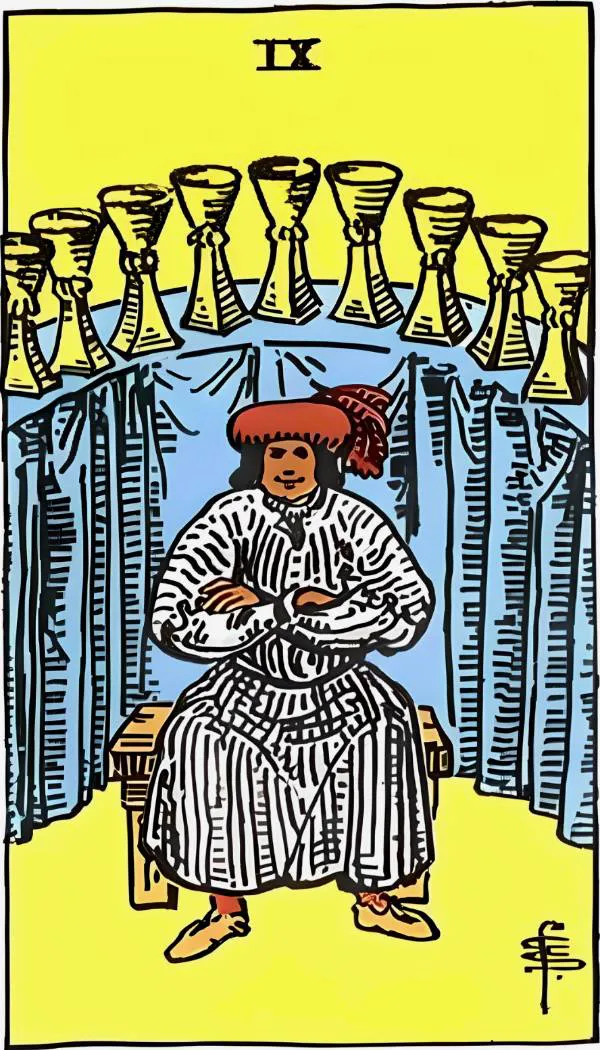
A man dressed as a wealthy merchant sits on a stool with his arms crossed, looking content and at ease. Behind him, on a tall table covered with a blue tablecloth, nine chalices stand in a row, positioned higher than he is. The background is a bright, clear yellow, symbolizing clarity of thought, while his hat, feather, and socks in a vivid deep red show his passion for life. Underneath this passion for life is a blue garment, indicating his spiritual awareness of true value.

His arms are crossed, protecting the source of his love and strength. He is a person of many achievements and takes pride in himself. There are many colors around him, but aside from the red hat and socks, his clothing lacks any bright colors. His lack of colorful attire represents that although he has found great satisfaction within himself, he has not yet found someone to share these feelings with. Before reaching the Ten of Cups, he still needs to put in a little more effort. He needs to understand that while his love is valuable, it is even more valuable when shared with others (this applies to all cards).

The number nine in Tarot also represents deep contemplation; this man is sitting and thinking about what he must give in friendships or love relationships. His waistcoat is gray because his love only has value when given to someone worthy. His waistcoat serves as a reminder that he has not yet reached the state of the Ten of Cups (the card representing the harmonious state of the Cups suit).

This card can also be compared to the Six of Pentacles, where we see a wealthy man with his hand down and a beggar with his hand up; the wealthy man in the Nine of Cups sits with his arms crossed, showing a simple satisfaction, isolating himself from the outside world and even subtly revealing a sense of showing off.

If we consider the table setting as a feast, it is not difficult to speculate that the Nine of Cups also represents indulgence, usually in material and sensory pleasures, such as a luxurious meal, an impressive movie, a lavish spa session, or a wild party. Compared to the Nine of Pentacles, which is closer to nature, perhaps the enjoyment represented by the Nine of Cups is superficial, but after physical and mental exhaustion, nothing can be more relaxing than the indulgence of the Nine of Cups.

Seated Man

In the center of the Nine of Cups, we find a man seated comfortably, his arms crossed in contentment. This figure represents confidence, satisfaction, and the realization of personal desires. His demeanor exudes a sense of achievement, signifying that his wishes have been granted.

Array of Cups

Lined up on the table behind him are nine golden cups, each full and shining. These cups symbolize emotional and material abundance, signifying that the person’s emotional desires and wishes have been fulfilled. They represent the plethora of achievements and emotional riches one has accumulated.

Blue Robe

The man is draped in a blue robe, a color often associated with the element of water and emotions in the Tarot. This attire suggests a deep emotional satisfaction and a state of inner harmony. It signifies that one’s innermost desires and feelings are in alignment with their external circumstances.

Feathered Hat

The man proudly wears a hat adorned with a feather. Hats, in general, are symbolic of our thinking patterns and beliefs. This particular hat, coupled with its feather, signifies honor, success, and a sense of being distinguished. The feather, light and lofty, also adds an element of spiritual elevation and connection. The choice to wear it suggests that the man’s contentment is not just grounded in material or emotional success but also in spiritual alignment and recognition. .

Wooden Bench

The man sits upon a sturdy wooden bench, representing stability and a solid foundation. This suggests that the contentment and abundance he experiences are based on firm ground, indicating long-lasting satisfaction and a stable emotional environment.

Psychological patterns in Nine of Cups
Emotional Gatekeeping
The man's forearms close across the front of his body while the cups rise behind him like a private emotional archive. The posture is relaxed enough to look secure, but the hands do not reach toward the cups or toward anyone else; the heart space is protected before any exchange can happen. That structure maps cleanly onto Emotional Gatekeeping in introspection. You may have real feeling available, even plenty of it, but the first movement is to decide what is safe, dignified, or coherent enough to let into awareness. The Nine of Cups shows satisfaction held in a controlled container: useful for protecting your inner world, costly when the gate becomes so polished that the raw signal never gets through.
Compulsive Consumption
The table of cups can read like a private feast: full vessels, rich color, and a seated body settling into sensory ease. The red accents suggest appetite and pleasure, while the crossed arms keep the experience contained around the self. In career pressure, that containment can become a regulation loop. You may use perks, purchases, food, upgrades, or luxury routines to give the body relief after feeling undervalued, while the actual workplace power dynamic remains untouched behind the display.
Achievement Fusion
The seated merchant places his body in front of a raised row of cups, as if his completed desires have become a backdrop to his identity. His crossed arms protect the center of the body while the cups remain elevated behind him, turning achievement into both proof and shield. In a career frame, that posture maps onto a mind that uses output, praise, and visible wins to stabilize self-worth. You may not simply be proud of what you have built; the pattern starts when every review, title, or project result is treated as evidence for or against the self.
Hedonic Avoidance
The table of cups reads like a private feast: full vessels, bright color, and a seated body resting after satisfaction. Yet nothing in the scene shows movement toward another person, shared exchange, or emotional circulation. In the reversed texture, pleasure becomes a substitute container. The psyche reaches for plans, tastes, purchases, events, and stimulation because they are easier to control than the uncertainty of whether a social circle actually nourishes you. For you, the pattern can feel like chasing a better night out after a lonely one, hoping intensity will solve disconnection. The card makes the loop visible: sensory fullness can briefly quiet the ache of mismatched belonging, but it cannot replace reciprocal contact.
Hyper-Independence
The seated man is alone in front of nine fulfilled cups, composed and apparently satisfied. The crossed arms and steady stool make the body look self-contained, as if the inner world has been stocked well enough to need no one else. That self-containment can be adaptive when it protects dignity and prevents social overdependence. It becomes a defense when aloneness is converted into proof of strength, and the need for belonging is treated as a vulnerability to manage rather than a human signal to understand. In your social ecosystem, this pattern can sound like being fine on your own while quietly wanting a circle that does not require performance. The card's solitary abundance shows how a person can have plenty of inner resources and still keep the doorway to shared belonging tightly monitored.
Instant Gratification
The Nine of Cups places pleasure close to the body and arranges the cups like a finished reward display. When reversed, the same visual abundance can feel less like grounded satisfaction and more like a closed circuit of comfort that keeps feeding itself. The crossed arms matter because the body is not reaching into the next cycle; it is sealed inside the reward field. In timing questions, that can turn the pressure of waiting into a craving for immediate relief, where the system tries to soothe uncertainty with whatever feels good right now. Instant Gratification appears when the need to feel better outruns the timing of the actual process. The card does not shame pleasure; it shows how pleasure can become a substitute signal when the deeper rhythm is asking for patience, preparation, or delayed movement.
Insight Hoarding
The nine cups sit in a perfect row above the seated figure, full and visible but untouched. The man stays still beneath them, arms folded, as if the evidence of emotional richness has been organized into a display rather than entered as lived experience. That is the visual logic of Insight Hoarding. You can collect interpretations, readings, journal lines, and language for your inner world until the shelf looks complete, while the body underneath remains in the same fixed posture. The pattern feels productive because it creates clarity, but the card exposes the missing transfer: insight has to leave the display row and change how feeling moves through you.
Comfort Zone Attachment
The seated man does not reach toward the cups or toward anyone outside the frame; he sits firmly in front of his arranged satisfaction with his arms crossed over his chest. The posture is comfortable, but it is also protective, as if the emotional reward already in place has become something to guard rather than something to examine. That physical closure turns the card into a map of guarded comfort. The nine cups behind him show real fulfillment, yet their elevated display can make the current setup feel complete enough that any new choice looks like a threat to the emotional stability already achieved. In a choice reading, this pattern reveals the moment when comfort starts impersonating clarity. You may feel drawn to the option that keeps the inner room warm, familiar, and validating, while the hidden audit asks whether that safety is genuine alignment or a protected avoidance of risk.
External Validation
The nine cups sit higher than the man, shining above his seated body like visible proof that something has been achieved. The feathered hat adds another signal of distinction, drawing attention toward recognition as much as inner satisfaction. In a career frame, the mind can begin to outsource value to what is seen, praised, or ranked. You may know you worked hard, yet the work does not feel real until a manager, title, compensation band, or public metric reflects it back.
Strategic Surrender
The seated man does not lunge toward the cups, perform for them, or try to multiply them. His crossed arms and steady posture make the body look contained rather than hungry, as if the current cycle has reached a point where further force would only disturb the structure already built. That physical stillness carries a timing logic. The Nine of Cups holds fulfillment in a completed row behind the figure, not as something he is chasing in front of him. You can read this as a defense against panic-driven action: the system pauses, consolidates, and lets satisfaction become information. Strategic Surrender appears here when restraint is not avoidance but rhythm awareness. In a timing question, the card points to the moment when forcing progress would blur the signal, while a deliberate pause lets you see whether the next move is actually supported by the cycle beneath it.
Core Struggles in Nine of Cups
Performative Intimacy
The table can read like a feast, yet no one is being served and the cups remain staged behind a closed body. The scene offers the symbols of closeness without the physical movement of sharing. In friend groups, that becomes closeness as atmosphere rather than contact. You can have the group chat, the photos, the rituals, and the inside jokes, while the structure still leaves nobody actually crossing the distance into mutual emotional access.
Comfort Entrapment
The seated man has stability under him, color at the extremities, and a row of rewards behind him, but his body is organized around staying put. His arms cross the chest, his hips remain fixed to the bench, and the cups can only be reached by breaking the posture that currently keeps him composed. You encounter this card in a choice when the familiar option is not empty. It may be comfortable, impressive, pleasurable, or logically defensible, which makes the pull to remain feel mature rather than avoidant. Comfort Entrapment forms when ease becomes a closed circuit. The card does not dismiss the comfort as fake; it shows how real comfort can quietly remove movement from the decision field until the unknown path feels like an unnecessary disruption of a settled seat.
Abundance Overload
The nine cups form an impressive total, but their accumulation is static. They stand behind the seated figure as evidence of plenty, and the body beneath them has to remain composed under the meaning of having so much. In friendship, abundance can become its own pressure when there are too many histories, loyalties, group threads, invitations, memories, and emotional debts to sort cleanly. You may not be isolated; the problem is that the sheer amount of relational material makes it harder to feel which connections are reciprocal, current, or genuinely nourishing. The card frames overload as fullness without movement. It shows how a crowded friendship life can look rich while quietly freezing your ability to choose where your care belongs now.
Reciprocity Deficit
Nine cups stand in a row behind the seated man, full enough to signal plenty but arranged like a private inventory rather than a shared table. His body sits between the viewer and the cups, turning abundance into something visible, owned, and controlled before it can become mutual. That arrangement mirrors a friendship where the signs of closeness are present, but the flow is uneven. One person may hold the emotional capacity, history, access, or social currency that keeps the bond feeling valuable, while the actual movement of care goes through a narrow gate. The struggle sits in the difference between having enough and exchanging enough. The card gives shape to the quiet frustration of a friendship that looks rich but does not return energy, attention, or repair in a way that feels balanced.
Achievement-Meaning Collapse
The seated figure rests in front of nine completed cups, but his body does not turn toward them or move beyond them. His crossed arms make the achieved state feel sealed, as if the wish has arrived before the next horizon has appeared. For direction questions, that visual structure names the collapse that can happen after a long pursuit finally resolves. You can have the milestone, the proof, and the visible fulfilment, yet still feel the future go strangely quiet because the achievement answered the old question without generating a new one. The card holds that pause without reducing it to ingratitude. It shows a body surrounded by evidence of arrival, while the deeper navigation problem remains: once the goal is no longer pulling you forward, the meaning system has to be rebuilt rather than merely celebrated.
Visibility-Isolation Split
The Nine of Cups places one figure in front of a raised row of vessels, with the cups clearly visible and his arms closed across the body. The scene makes satisfaction public while keeping the source of that satisfaction physically behind him and out of reach. In a social field, that geometry becomes the experience of being visible without being met. You may be read as confident, impressive, or fine, yet the same display that makes you legible to the group can also keep your actual self at a distance.
Joy Performance Fatigue
The seated man faces outward with crossed arms while nine cups rise behind him like a finished display. His satisfaction is visible before any exchange happens; the body presents completion while the chest remains closed. For inner work, that arrangement turns happiness into something you may feel forced to keep legible. You may have enough proof that you should be fine, yet the posture shows a different friction: the more convincing the display becomes, the less room there is for unpolished internal truth. Joy Performance Fatigue names the strain of maintaining contentment as a surface condition. The Nine of Cups holds the moment where pleasure, pride, and relief are real, but they harden into a pose that stops the inner world from breathing.
Recognition-Containment Split
The row of cups stands behind the seated figure like a polished trophy shelf, while his crossed arms keep the chest unreadable. The card’s display is public, but its emotional contents stay behind a guarded body. That arrangement mirrors the family moment where being praised can feel as exposing as being criticized. You may want your growth, success, or stability to be seen, but the same recognition can open a channel for comparison, entitlement, or control; the struggle is the split between being acknowledged and staying internally contained.
Pleasure-Structure Split
The nine cups suggest plenty, taste, and sensory satisfaction, while the figure's seated body treats the completed feast as the endpoint. The red accents carry appetite at the edges, but the posture offers no structure for what comes after receiving the reward. In personal growth, pleasure becomes complicated when recovery, comfort, and celebration start occupying the same space as discipline. You are not asked to reject pleasure; the card shows how pleasure loses its restorative role when it replaces the scaffolding that would let growth continue. Pleasure-Structure Split names the bind between wanting relief and needing rhythm. The card frames the problem as a design failure in the inner system, not a moral failure in desire.
Fulfillment Stasis
The seated man holds his body in a compact, frontal block while nine cups stand completed behind him, higher than his shoulders and out of reach of his hands. The scene shows fulfillment as a finished arrangement: desire has material form, but the body has no active pathway into a next motion. For timing questions, that posture turns satisfaction into a pause that can harden into stasis. You may have reached a milestone, stabilized a resource, or finally gotten a clear yes, yet the system gives no signal for what should begin after the wish has landed. The struggle is not failure to achieve. It is the quieter friction that appears after achievement, when the last completed cycle becomes so physically comfortable that the next opening feels harder to recognize than the original goal.
Inner Emotions in Nine of Cups
Mutuality Hunger
The cups are abundant, but they sit behind one figure rather than between two people. His arms fold across his chest, and the table turns the emotional supply into a private reserve instead of a shared vessel. In love, that composition creates a very specific ache: wanting the relationship to become an exchange rather than a display. There may be plenty of desire, history, attraction, or comfort, but the central question is whether anything truly travels both ways. Mutuality Hunger belongs to the reversed Nine of Cups because the card shows abundance without reciprocity. You are not simply wanting more attention; you are feeling the absence of a shared emotional table where both people can bring, receive, and be met.
Embodied Ease
The seated merchant rests squarely on his stool, arms folded across his body while nine cups stand complete behind him. Nothing in the posture reaches, chases, or scrambles; the body holds its own center while the scene stays bright and uncluttered. That physical stillness translates into a social inner state where presence does not have to be earned through constant participation. You can be in the room, or near the room, without performing for every gaze that might land on you. Embodied Ease belongs to this card because the satisfaction is not abstract. It sits in the spine, the closed but unstrained arms, the steady front-facing body, and the clean visual space around him: a felt permission to stop proving that you deserve to take up social space.
Guilt-Free Rest
The solid stool under the seated man and the filled cups behind him create a rare visual permission to stop moving without collapsing. His body stays upright, contained, and supported by what has already been gathered. Within timing questions, this becomes the feeling of rest that does not need to apologize for itself. You can sense the cycle making room for recovery before the next push, and the card gives that pause a structure rather than treating it as wasted time.
Comfort Numbness
The Nine of Cups shows a body that has stopped moving, with the cups arranged behind him as a still and decorative reserve. The scene is clean and comfortable, but nothing in it spills, reaches, or changes hands. In a relationship, that stillness can become a soft emotional sedation. The connection may be stable enough to stay inside, yet the body starts registering comfort as a padded room rather than a living exchange. Comfort Numbness belongs to the reversed card because the abundance has become too static to move feeling through you. You are not necessarily in crisis; you are noticing the quieter cost of being soothed so consistently that desire, curiosity, and honest ache have gone faint.
Hollow Abundance
The Nine of Cups places nine gleaming chalices above and behind a seated man whose arms remain crossed over his chest. The display is full, polished, and visible, yet the body in front of it is sealed off from the very abundance it is presenting. In personal growth, that visual split becomes the feeling of having visible evidence of progress without feeling internally fed by it. The courses, routines, milestones, and identity upgrades may all be lined up, but the protected chest suggests that the inner system has not fully received them. Hollow Abundance names the moment when success looks complete from the outside but lands with a strange flatness inside. The card does not shame the achievement; it shows the gap between possessing proof and metabolizing meaning.
Hollow Recognition
The nine cups sit high behind the seated figure like a polished record of success, while his folded arms keep the front of the body sealed. The display is visible, orderly, and impressive, yet no cup is being touched or shared in the scene. In an academic setting, that separation can make praise, grades, and visible progress feel strangely external. The structure shows recognition sitting behind you as proof, while the inner body remains hard to reach. Hollow Recognition names the quiet gap between looking accomplished and feeling nourished by what you have accomplished. The card gives that gap a shape, so the emptiness is not mistaken for ingratitude or failure.
Hollow Completion
Nine cups are full and elevated behind the seated man, but the scene offers no road, doorway, or horizon beyond the display. The achievement is visually present, almost too present, while the body remains closed in front of it. Hollow Completion grows out of that closed fullness: the outer proof is there, yet the inner space does not automatically expand. In a long-range direction question, you may be meeting the strange blankness that follows a win, when reaching the thing does not tell you what the next life-shape should be.
Performative Wholeness
The seated figure presents a complete front: crossed arms, composed face, bright field, and a perfect row of cups staged behind him. Nothing in the image spills, reaches, asks, or breaks the surface of completion. In friendship, that composition becomes the feeling of having to look emotionally sorted so no one sees the need underneath. You may show the version of yourself that is fine, successful, funny, and generous, while keeping the less polished need for care behind a locked posture. Performative Wholeness fits this reversed Nine of Cups because the display becomes more important than the exchange. The card reveals how a friendship role can reward looking fulfilled while quietly making vulnerability feel unsafe.
Sensory Fullness
The vivid red hat and socks place heat at the edges of the Nine of Cups, while the blue garment and the full chalices keep that warmth held inside a cooler emotional frame. The bright yellow field makes the pleasure visible without cluttering it. For personal growth, this is the moment when effort returns to the senses. The card does not show a body grinding toward the next milestone; it shows appetite, color, and fullness restored after the self has been organized around discipline for too long. Sensory Fullness names the feeling of being nourished by your own progress. You can still choose your next evolution, but the inner system needs to taste what has already become real.
Synchronized Relief
Seated squarely beneath nine cups arranged in a clean row, the merchant does not reach, chase, or bargain with the scene. The cups are already elevated behind him, the yellow field is uncluttered, and his crossed arms keep the body gathered instead of scattered. For timing work, that arrangement turns relief into usable emotional data. You are not reading the pause as failure; you are sensing that resources, desire, and the current rhythm have briefly clicked into a lower-friction pattern, allowing effort to stop thrashing and become precise.
Outer Contexts in Nine of Cups
Public Mask Maintenance
The seated man faces outward with the cups arranged behind him like a public proof wall. His posture is composed and closed, turning satisfaction into something that can be seen, assessed, and maintained. Your decision may be shaped by the pressure to keep looking settled. Admitting uncertainty can become harder when the outside picture says you already have enough, already chose well, or already became the version of yourself other people recognize. Public Mask Maintenance is the cost of protecting the display after the display has started protecting itself. The card makes the audience visible so the choice can be separated from the performance of being fine with the current arrangement.
Main Character Friend Dynamic
The figure sits centered in front of a polished display, with the cups arranged like proof of his own satisfaction. The body does not reach outward; the scene asks to be viewed, acknowledged, and organized around one central presence. Reversed, that tableau becomes the social physics of a main character friend. You may be inside a group where one person's wins, tastes, dramas, and self-image take up the room, while everyone else becomes audience, validator, helper, or supporting cast. The card's visual pressure comes from how little relational movement is left once the display dominates the frame. It reveals a friendship dynamic where attention is not shared space but a resource pulled toward the person most invested in being seen.
Aesthetic Lifestyle Creep
The table can read like a feast display, with polished cups elevated as symbols of pleasure, taste, and satisfaction. The scene is lush but static, turning enjoyment into something staged for recognition. In friendship, that image can become a circle where closeness is maintained through expensive dinners, curated trips, matching aesthetics, wellness rituals, parties, and constant consumption. You may not be buying objects as much as buying continued access to the group's version of belonging. The card reveals how pleasure can quietly become infrastructure. It does not shame enjoyment; it separates genuine shared delight from the social pressure to keep funding a lifestyle script so the friendship stays intact.
Post-Achievement Plateau
The seated merchant sits in front of nine cups that are already full, arranged, and lifted into view. Nothing in the scene is being built, carried, negotiated, or handed onward; the achievement exists as a completed display behind a body that has stopped reaching. In a career reading, that visual stillness maps cleanly onto the stage after a visible win. You may have proof of value, a strong performance record, or a milestone other people can recognize, but the structure around you has not yet converted that proof into a next path. The card exposes the difference between having results and having mobility. The plateau is not a lack of competence; it is a workplace stage where the reward has arrived before the next meaningful route has been made visible.
Golden Cage Comfort
The seated merchant rests in front of nine cups that are full, polished, and elevated above him. The scene has the texture of comfort that has already been secured, but his crossed arms and fixed stool keep that comfort held inside a closed frame rather than moving through a wider life system. For lifestyle questions, that arrangement maps onto a life that looks stable from the outside: the apartment is comfortable, the rituals are familiar, the purchases or routines have delivered a sense of ease. The pressure point is that the same setup can become a protected enclosure, where convenience and visible success start defining the borders of what daily life is allowed to become. Golden Cage Comfort names the moment when ease is real but no longer fully freeing. The card gives You a clean mirror for separating genuine support from the lifestyle structures that quietly keep energy, movement, and connection inside too narrow a loop.
Golden Child Spotlight
The nine cups stand elevated like a private trophy shelf, with the man seated below them as both beneficiary and exhibit. His content posture is framed by objects that can be counted, admired, and used as proof of success. In a family system, that arrangement mirrors the pressure of becoming the visible achievement that validates everyone else’s story. Praise may be real, but it can also turn you into a symbol before anyone asks what the role costs. You are being shown a display structure, not a simple celebration. The issue is not whether the cups are full; it is who gets to use them as evidence.
Model Student Performance Trap
The cups sit above the figure like a flawless public record, while the crossed arms harden into a guarded brace. The achievement display is no longer just evidence of completed work; it becomes a structure the body must hold up. In academic life, this is the trap of being known as the reliable high scorer, the gifted student, the scholarship kid, the perfect applicant, or the one who always has it handled. The outer pressure comes from the audience around the record: teachers, peers, family, transcripts, supervisors, or the student's own public identity inside the institution. The reversed structure of the card reveals how performance can become heavier than learning. It shows a stage where every new assignment is filtered through the need to protect the row of cups, and that makes it harder to experiment, ask basic questions, submit imperfect drafts, or change direction cleanly.
Academic Spotlight Moment
Nine cups lined above the seated figure create the visual grammar of a public academic result: clear, countable, polished, and hard to ignore. The crossed arms do not erase the achievement; they show a body holding still while the proof of competence sits higher than the person who produced it. In study life, that becomes the moment after the grade, presentation, award, or supervisor praise lands. You are no longer dealing only with the task itself; you are dealing with the visibility that the task created, and with the way recognition can quietly become a new standard to maintain. The structure of the card keeps the focus on the stage around the achievement. It reveals how academic praise can open a real opportunity while also placing you under a brighter light, where the next move has to be chosen from clarity rather than from the pressure to keep performing the same proof.
Friendship Spotlight Test
The seated figure is placed directly in front of a trophy-like row of cups, with the whole scene arranged for visibility. His posture is composed, his achievements are elevated, and the social stage has no clutter to distract from the display. In friendship, that spotlight can test the bond more sharply than failure does. You may be entering a moment where a win, upgrade, glow-up, or visible satisfaction changes the emotional geometry of the group, exposing who can stand near your success without turning it into comparison, teasing, distance, or entitlement. The card's value is in naming the test as external and relational. It does not reduce the issue to ego; it shows that a friendship system reacts when one person's cups become visible, and those reactions reveal the real maturity of the support network.
Wellness Optimization Trap
The cups are not messy, shared, or naturally flowing; they are lined up with almost ceremonial neatness. What should represent nourishment becomes a controlled shelf, and the seated body stays guarded in front of it. That visual order maps closely onto wellness systems that become another form of pressure: trackers, morning routines, supplements, optimized meals, sleep scores, perfect recovery rituals, and rules about what a good life should look like. The external structure promises regulation, but it can also turn rest into a performance standard. Wellness Optimization Trap names the point where self-care becomes an audit that never ends. The card helps You see whether the routine is restoring capacity or simply giving exhaustion a more polished management interface.