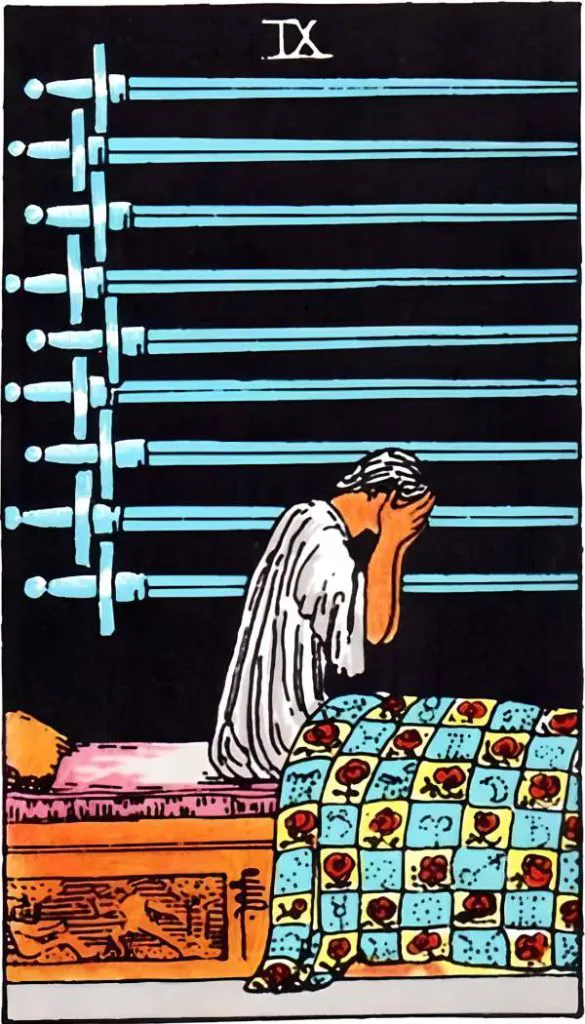
Nine of Swords Tarot Card Meaning

Nine swords are tightly arranged horizontally across the image, with their points directed to the right side. A woman dressed in a white nightgown sits up in bed, her face buried in her hands as she weeps. These swords cross over the woman, with the lower ones piercing through her upper body. The third sword from the bottom grazes the top of her head. The second sword from the bottom pierces her neck. The first sword from the bottom hits the heart area. These swords, piercing through the head and heart and passing overhead, cause her to wake up in a painful headache.

The lower half of the woman's body is covered with a quilt, which features a checkered pattern in yellow and green. The yellow squares have red patterns, while the blue squares contain astrological symbols for the twelve zodiac signs and the ten major planets. The arrangement of these astrological symbols is disordered and chaotic, with many repetitions and none of them complete.

(As arranged on the pattern)

Mars  Taurus  Cancer

Pisces  Gemini  Leo

Virgo  Scorpio  Moon

Capricorn  Aries  Saturn

Sagittarius  Leo  Mars

Mercury  Sun  Gemini

Libra  Capricorn  Pisces  Taurus

The woman cannot sleep, as indicated by the flat bed surface, suggesting she has not been lying down for long. She cries with her face covered, as if she has suffered a great injustice, with sorrow welling up from within.

On the side of the bed frame, there is a peculiar scene depicting a story of violence, where the man on the right is bullying the woman on the left, causing her to lie on the ground. This can be said to be the story of her persecution, the psychological root of her dream, and since this part is not covered by the quilt, it can be explored.

The entire background is a black space, with dark walls or corners, reflecting the deep-seated fears within the mind.

Swords Above the Figure

The nine swords that hang above the figure represent the weight of mental anguish, fears, and worries. These are the tormenting thoughts that keep one awake at night, contributing to a sense of dread and hopelessness.

Seated Figure

The seated figure, with hands over face, manifests the emotional and mental pain that is being experienced. This is not merely an external struggle but one that deeply affects the psyche. The posture suggests a lack of hope or a perception of inescapable anguish.

Dark Background

The dark and heavy background adds to the overall atmosphere of despair and sorrow. It is a representation of the oppressive emotional landscape that the figure inhabits, lacking in light, relief, or comfort.

Quilt with Astrological Symbols

The quilt that adorns the bed is embellished with astrological symbols, pointing to the cosmic and fateful dimensions of human suffering. The quilt suggests that sometimes our worries and fears are tied to larger existential questions that may be beyond our control.

Engraving on the Bed

The engraving on the side of the bed serves as a reminder of the long-standing patterns, perhaps even ancestral or karmic influences, that may be contributing to the present state of mental anguish. These engravings can be seen as a coded language, pointing to the deeper, unconscious drivers of one’s suffering which may not be easily deciphered.

Psychological patterns in Nine of Swords
Hypervigilance
The swords dominate the upper half of the image, stacked like a system of alerts running through the head, throat, and heart. The woman is awake in the dark, not engaging with a visible threat but reacting as though threat is everywhere in the field. Hypervigilance in social life has that same architecture. The system keeps scanning tone, timing, facial shifts, reactions, likes, seating patterns, and group energy because missing one cue feels dangerous. Attention becomes a surveillance grid instead of a bridge to connection. The card's reversed texture shows the cost of that strategy when it turns inward at night. The more the mind scans for rejection, the less rest, spontaneity, and ordinary social ease remain available.
Inner Critic
The woman's face is hidden by both hands, so the self disappears at the exact point where pain becomes visible. The carved conflict on the bed remains exposed below, while the swords above turn the room into a chamber of accusation. That arrangement shows judgment moving from outside event to inner verdict. Inner Critic appears when uncertainty about your path stops being information and becomes a prosecution of your worth, making every delay, detour, or unclear desire feel like evidence against you.
Rumination
The woman’s face is sealed behind both hands while nine swords hang across the dark space above her head, neck, and heart. Nothing in the image is moving, yet the mind is visibly overloaded; the body is awake while the room becomes a chamber for repeated thought impact. That visual structure mirrors Rumination because the threat is not arriving from a new event in the room. It is being replayed, sharpened, and held in place by attention. In a choice reading, this pattern turns decision-making into repeated mental prosecution, where every option is examined again not to gain clarity, but to keep the anxiety loop alive. You may feel as if more thinking will eventually produce certainty, but the card shows a different mechanism: thought has become a ritual of containment. The decision cannot settle because the mind keeps using repetition as a defense against the emotional risk of choosing.
Catastrophizing
The swords stretch across the card like a row of conclusions already formed, while the quilt below carries repeated symbols that never settle into a complete order. The image holds two kinds of pressure at once: the sharp mental line above and the chaotic interpretive code underneath. Catastrophizing grows from that exact structure. In a social setting, one ambiguous cue gets pulled into a larger story of rejection, humiliation, or permanent exclusion before the wider context has been checked. The mind is not simply noticing risk; it is building a total future from partial evidence. The dark background matters because it removes any visual counterweight. You are left with the swords and the waking dread, which is how this pattern feels when a delayed reply or missed invitation becomes the beginning of an entire imagined social collapse.
Shame Binding
The woman's hands block her face while the swords visually bind the head, throat, and heart into one channel of pain. The private boundary of the bed is breached, so the inner room cannot protect self-worth from the force of mental accusation. Shame Binding forms when a performance signal fuses with identity. Instead of letting feedback stay attached to a specific behavior or piece of work, the mind binds it to the whole self and makes visibility feel dangerous. In academic life, this can turn one poor draft, one awkward answer, or one failed exam into a private sentence about who you are. You may avoid asking for help because repair would require being seen exactly where the shame has attached itself.
Self-Judgment Loop
The swords align with the woman's head, throat, and heart while her face disappears behind her hands. Beneath her, the quilt's repeated incomplete signs create the sense of a mind trying to assemble meaning from fragments and using those fragments against itself. Self-Judgment Loop forms when thought becomes an internal tribunal. Instead of separating performance, effort, context, and identity, the mind fuses them into one accusation that keeps returning with sharper language. In academic life, this pattern turns feedback into a character verdict. You may begin with a practical issue, such as a weak paragraph or a missed concept, and end in a much harsher sentence about being lazy, unserious, or not smart enough.
Action Paralysis
The upper half of the card is all pressure: swords, darkness, and a face closed off by both hands. The lower half is covered and still, with no visible step from the bed into the world. In the reversed state, Action Paralysis is not quiet indecision; it is a body stalled by an overloaded inner command system. You may know exactly that growth is needed, but the mind has attached so many meanings to the next move that movement feels like a verdict on your whole identity. The absence of a doorway or horizon matters. The card connects to this pattern because it shows mental urgency without a usable path, a self-development crisis where the body cannot translate pressure into one grounded action.
Sleep Anxiety
The woman is upright in bed, covered for sleep but fully activated, with the dark wall behind her and the swords crossing the space where rest should be. The bed has become a stage for impact rather than recovery, and the covered face shows a body trying to disappear from stimulation that is already inside the room. Sleep Anxiety fits when bedtime stops functioning as an off switch and becomes the moment every unprocessed signal gets louder. In a lifestyle system, the night is no longer a neutral container; it becomes the audit point where unfinished tasks, body sensations, and tomorrow's demands gather into one sharp field. The card makes that mechanism visible without turning it into a diagnosis: the pattern is about anticipatory activation around rest.
Anxiety Spiral
The swords form a closed line across the sleeping space, and the figure has already been pulled upright by the pressure of the mind. In the reversed state, the bed no longer holds rest; it becomes a chamber where activation keeps feeding itself. Anxiety Spiral begins when one fear about growth demands another check, another forecast, and another imagined consequence. You are not receiving clarity from the loop; the loop is using the need for clarity to keep itself alive. The darkness around the scene removes scale, so the next step can feel as large as the entire future. This card connects to the pattern because it shows anxiety becoming self-generating, turning personal growth into a night-long circuit of threat and verification.
Analysis Paralysis
The woman remains upright in bed, but her hands block the very field she would need to orient herself. Beneath her, the quilt is filled with repeated, incomplete symbols, a surface of many signals without a coherent order. Analysis Paralysis emerges from that exact split: the mind keeps gathering signs, inputs, interpretations, and comparisons while the body remains unable to move. In a choice reading, the problem is not a lack of information. It is the absence of a decision threshold that tells you when enough has been seen. You may keep searching because more data feels safer than commitment. The card shows how that safety ritual becomes its own trap, turning the decision into a symbolic maze where every new clue delays the moment of choosing.
Core Struggles in Nine of Swords
Inner Compass Overload
The nine swords hang in a perfectly ordered band above a bed covered with scrambled signs, turning the sleeping space into a pressure chamber of information. The body sits upright between those two systems: sharp linear thoughts overhead and a broken symbolic map below. For a direction reading, that visual structure names a future field that has become too crowded to navigate. You are not lacking signs; the card shows too many signals pressing on the same inner instrument until guidance and noise become hard to separate. The figure's covered face matters because the overload does not create clearer seeing. It pushes the body into a closed loop where every possible path feels like one more blade in the room, and clarity can only return when the structure of the overload is made visible.
Mental Bandwidth Depletion
The swords are not scattered; they are stacked in a tight horizontal band, creating a compressed ceiling of sharp mental lines. Below them, the quilt carries repeated and incomplete symbolic markings, so the visual field offers too many signals and no stable way to sort them. For career pressure, this links to the point where every metric, stakeholder cue, and future option enters the same crowded headspace. You are not lacking intelligence; the structure shows a processing field overloaded by signals that keep cutting into the same limited bandwidth.
Life Audit Exhaustion
The room has no morning, no window, and no outside measure of time; only the bed, the blades, and the broken pattern remain available. The figure's hands keep returning to the face, while nothing in the scene actually moves the swords, clears the quilt, or opens the dark field. For a direction reading, this is the exhaustion of reviewing life until review itself becomes the trap. You are not simply reflecting on where you have been; the structure keeps converting memory, missed timing, and possible futures into an endless internal audit. The card's reversed texture makes the loop feel sealed inside the room. It names the moment when trying to understand your path stops restoring agency and starts draining the energy needed to take the next step.
Social Self-Judgment Lock
The woman sits up in the dark with her face buried in both hands while the swords pass over the head, throat, and heart. The card gives judgment a physical location: it is not floating in the room, it is arranged as a set of hard lines crossing the very places where thought, speech, and feeling would normally move. In a social context, this becomes the inner tribunal that keeps convening after the room has emptied. You may not be receiving active criticism anymore, yet the structure of the scene shows how a group gaze can keep operating inside the body, turning every ambiguous comment, silence, delayed reply, or awkward pause into evidence. The struggle is not that you care too much about people. It is that your need for belonging has been pulled into a closed judgment system where the self is forced to answer charges that no one has clearly spoken aloud.
Inner Tribunal Lock
The woman’s hands seal her face while the swords form a hard, horizontal grid across the space of thought, speech, and feeling. The image does not show an open conversation; it shows a private chamber where every point of contact is converted into evidence and every soft place is crossed by a sharper line. In love, this structure becomes an internal trial that keeps running after the actual interaction has ended. A text, a pause, a look, or a memory can be pulled into the same mental courtroom, but the verdict never settles because the judging apparatus is also the source of pressure. You are not simply overthinking a relationship; the card locates the struggle in a system where pain has taken over the role of judge. Clarity cannot arrive while every signal is forced to testify under the same blade-shaped logic.
Academic Shame Spiral
The nine swords do not sit in the room as distant threats; they cross the bed and press through the zones of head, throat, and heart while the figure folds into her hands. Thought, voice, and self-worth are forced into the same narrow line, so the body cannot simply rest or respond. Academic pressure takes this shape when grades, comments, or looming exams stop being information and begin acting like evidence against the whole self. You are not just worried about performance; the card locates a shame circuit where every attempt to think about school reopens the same wound of judgment.
Emotional Containment Strain
The woman's face is sealed behind both hands while the lower body remains covered and unable to move out of the bed. The posture is not an outward action; it is a body trying to contain impact without a usable outlet. In friendship, this becomes the strain of holding other people's emotional volume inside a private container. The card does not frame you as weak; it shows a containment system taking more pressure than it was built to hold.
Pain-Logic Fusion
The swords do not simply decorate the wall; they cross the zones of head, throat, and heart, giving thought the visual force of a blade. Beneath them, the figure hides her face while the exposed carving on the bed keeps a conflict story attached to the place where she tries to sleep. Pain-Logic Fusion forms when the mind's attempt to understand hurt starts carrying the same sharpness as the hurt itself. The card shows thoughts no longer acting as tools for perspective; they press directly into the body, making interpretation, memory, and self-protection feel like one inseparable mechanism. For introspection, this is the trap of trying to think your way out of pain while thought keeps reopening the pain's exact channel. The card gives that loop a boundary: the wound is not only what happened, but the way logic has become fused to the wound's pressure.
Rest-Permission Split
The image is staged in a bed, but the body is not permitted to lie down into it; the flat surface and covered legs hold the form of rest while the upper body is pulled into rigid wakefulness. The blanket contains the lower body, and the sword band keeps the upper body activated. During finals, thesis work, or heavy coursework, rest can become another place where school continues to press on you. This card names the point where stopping feels unsafe, so sleep, recovery, and permission to pause are invaded by the same academic demand you were trying to put down.
Rumination Entrapment
The figure sits upright in bed, but the body has not returned to the world. The quilt fixes the lower body, the hands close the face, and the swords repeat the same pressure across the head, throat, and heart as if one thought has become many identical cuts. For a relationship, this is the architecture of private replay. The breakup, argument, silence, or mixed signal keeps re-entering the same internal room, and each attempt to solve it by thinking adds another pass of the blade instead of opening a door. You are held inside a loop that looks like analysis but functions like confinement. The card gives the loop a boundary: the pain is not endless because it is true; it feels endless because the mind has been forced to use the same closed route for every unresolved feeling.
Inner Emotions in Nine of Swords
Scattered Overwhelm
The Nine of Swords places a strict row of blades above a quilt filled with repeated, incomplete symbols below. The eye moves between rigid pressure and chaotic detail, but it never finds a stable organizing center. Scattered Overwhelm in a lifestyle context has exactly that texture. Life is not only heavy; it is fragmented. The mind jumps from laundry to sleep debt, from unread messages to groceries, from health routines to work spillover, and each fragment feels urgent without forming a clear map. The card helps name the difference between having a lot to do and losing the internal hierarchy that makes doing possible. Its value is in showing that the chaos is not just in the tasks; it is in the way they occupy the same mental plane with no horizon.
Timeline Panic
The woman sitting upright in bed, face buried in both hands, gives the body no transition between rest and alarm. The nine swords above her compress the upper half of the image into a hard mental ceiling, so the mind has nowhere to stretch out a sequence, a plan, or a softer order of events. For timing questions, that visual pressure becomes the inner weather of a clock arriving all at once. You are not simply choosing a moment; you are feeling every delayed decision, peer milestone, and imagined deadline crowd the same dark room. The card names Timeline Panic because the body in the image is awake before it is oriented. It shows the nervous rush that happens when timing stops feeling like a rhythm you can read and starts feeling like a verdict you must outrun.
Quiet Shame
The white nightgown, hidden face, and blades crossing the head and heart create a private scene of exposure without any audience in the room. The figure does not argue or reach outward; she folds into a small sealed shape beneath the pressure. In career questions, this becomes the aftermath of a correction, mistake, comparison, or meeting comment that keeps replaying long after everyone else has moved on. Quiet Shame names the low-volume collapse behind professional composure, where the work issue has started to feel like a flaw in the self.
Emotional Numbness
The woman’s hands cover the entire face, and the eyes have no visible contact with the room. Above her, the blades form a cold horizontal layer, turning the upper half of the card into a rigid surface rather than a space that can breathe. For a direction reading, this numbness arrives after the future has been over-questioned for too long. The inner compass does not disappear; it goes quiet under repeated pressure, as if the system has reduced sensation to survive the noise. Emotional Numbness names the flatness that follows too much unresolved dread. The card makes that flatness visible without treating it as failure, showing where feeling has gone offline so clarity can be rebuilt from a less punishing place.
Decision Dread
The bed forms a small protected island, but the swords have already crossed into the space above it. The figure is neither fully at rest nor fully in motion, held in a posture where waking up does not yet become action. A major decision can create the same suspended pressure. The dread is not attached to one single outcome; it gathers around the act of choosing, because the moment of selection will make one set of costs real. Decision Dread belongs to this card because the image turns choice into a night chamber. You can see the boundary, the pressure, and the absence of forward space all at once, which makes the emotional weight of choosing legible without surrendering agency to it.
Boundary Guilt
The woman sitting upright in bed with her face sealed behind both hands gives Boundary Guilt a body before it becomes a thought. The bed offers partial cover, but the head, throat, and heart remain exposed beneath the row of swords, turning private rest into a scene of internal cross-examination. In friendship, this visual structure mirrors the moment after you protect your capacity and then feel emotionally put on trial for it. The covered gaze shows how hard it is to look directly at your own limit when a close friend’s disappointment is imagined as evidence against you. The card does not frame the guilt as proof that you did something wrong. It shows guilt as the pressure that gathers when care, loyalty, and self-protection all occupy the same narrow room, asking you to separate genuine accountability from the reflex to make yourself available at any cost.
Adult Child Panic
The woman sits upright in bed with her face buried in both hands while nine swords press across the dark upper field. The body is not moving through a normal waking rhythm; it has been yanked into a braced posture, with the lower half still trapped under the quilt and the upper half exposed to the blade line. That image mirrors the way family contact can collapse adult distance in seconds. The bed should be a private zone, but the swords enter it anyway, turning rest into a scene of mental intrusion. You are left with the feeling of being older on paper while your nervous system reacts from a much younger room. Adult Child Panic belongs to this card because the distress is not just fear of a conversation. It is the sudden loss of present-tense agency when a parent’s tone, expectation, or criticism makes the body behave as if the old family hierarchy has returned intact.
Wrong Choice Panic
The figure's eyes are hidden, yet the body is fully awake, sitting in the dark under a row of blades. The lowest swords strike through the zones of head, throat, and heart, so the card visually binds thinking, speaking, and feeling into one pressured impact line. In a high-risk choice, panic often gathers around the imagined after-moment: the instant where the decision has been made and the body realizes it may have chosen against itself. The covered eyes intensify that fear because perception is blocked exactly when orientation is most needed. Wrong Choice Panic is the inner weather of that blocked orientation. The card does not claim that one option is objectively wrong; it shows how the fear of irreversible misreading can become so loud that the user loses contact with their own signal.
Profound Loneliness
The figure sits alone in a bed that should imply rest, closeness, or shared shelter, yet the black field around her absorbs any sense of witness. Her face is hidden, and the room offers no responding presence. In love, this is not simple solitude. It is the loneliness of being emotionally unreachable while still attached, where the relationship may exist in name but the inner night is faced alone. Profound Loneliness fits this card because the image turns isolation into an atmosphere rather than an event. It gives shape to the ache of wanting to be met in the most private part of the bond and finding only your own thoughts waiting there.
Toxic Shame
The woman hides her face completely, while the side of the bed carries a carved scene of one figure overpowering another. The image places private pain above an exposed record of domination, as if the room itself contains both the reaction and the source pattern. Toxic Shame fits this card because the feeling has turned inward and become totalizing. In a family setting, repeated criticism, comparison, dismissal, or emotional control can leave a person covering the face even when no one is physically present. The old gaze has become internal enough to activate in the dark. The card does not reduce you to that shame. It makes the mechanism visible: a family power pattern enters the private mind, and the self starts treating its own needs, anger, or separation as evidence of being wrong.
Outer Contexts in Nine of Swords
Analysis Paralysis
The swords do not scatter; they line up across the head, throat, and heart like a hard grid of possible conclusions. The figure is upright but unable to leave the bed, caught between rest and action while every line overhead becomes another reason to stop. In a direction reading, this maps onto an external decision environment overloaded with options, criteria, timelines, and advice. You are not lacking effort; the system around the decision is producing too many signals and no usable hierarchy, so movement stalls at the point where a path should become visible.
Emotional Dumping Friendship
The swords crossing the head, throat, and heart show outside material lodged in the body's main channels of processing, speaking, and attachment. The bed and quilt are still there, but they do not convert the pressure into rest. In an emotional dumping friendship, another person's crisis enters your private space with no clean endpoint. The conversation may be over, but their conflict, worry, or anger remains stored in your evening, your sleep window, and your next decision about whether to pick up the phone. The card's value is in separating care from unpaid containment. It shows a friendship structure where one person keeps exporting pressure while the other becomes the bed that holds it.
Always On Availability
The nine swords stretch across the sleeping space like a hard row of incoming demands, cutting through the place where the body should be off duty. The bed is present, but it does not function as a boundary; the pressure has crossed into the hours meant for recovery. In a career context, this image maps cleanly onto work that keeps reaching past the official end of the day. You may technically be away from the desk, but the role still occupies your nervous bandwidth through messages, escalations, implied availability, and the expectation that you can be pulled back online at any time. The card does not frame the problem as weak discipline. It reveals a boundary failure in the work system itself: rest has become another surface where the job continues to press for access.
Sleep Debt Loop
The figure is in bed, yet the bed is not functioning as rest. The flat surface, upright posture, and blades across the head and neck make sleep look interrupted before it can become recovery. In career terms, this is the loop where the workday keeps reproducing itself at night. Deadlines, conflict, review pressure, and tomorrow’s unread messages occupy the body so completely that the next day begins with less capacity than the last one required. The Nine of Swords gives this pattern a concrete shape. It shows sleep loss not as a random side effect, but as a repeated extraction from the same resource your job expects you to bring back every morning.
High-Stakes Exam Pressure
Nine swords fixed in a tight horizontal stack above the bed create the look of an exam schedule turned into a ceiling. The lower blades cross the head, throat, and heart line, so evaluation is not floating in the abstract; it is drawn through the body’s thinking, voice, and confidence. In academic life, that visual pressure maps cleanly onto an assessment environment where one result appears to carry too much weight. You may technically be facing a paper, a final, a viva, or an entrance exam, but the structure around the test has made it feel like a total verdict on competence. The card does not frame the pressure as a personal flaw. It shows a high-stakes academic system pressing inward until sleep, preparation, and self-trust occupy the same narrow space.
Group Chat Tribunal
The nine swords sit in a strict stacked register, like repeated lines laid out above someone who has no visible shield from the room. The bed becomes an exposed surface, and the pressure arrives as accumulation rather than dialogue. A Group Chat Tribunal works through that same visual logic. Screenshots, interpretations, receipts, and moral verdicts can stack up until a friendship issue becomes a collective case file instead of a repairable exchange between people. The card's value is in showing how quickly private conflict can become public evaluation inside a small circle. It gives you language for the structure, so you can see the difference between accountability and a social court with no fair process.
Toxic Workplace Dynamics
The figure sits under a row of swords that do not function as tools, protection, or strategy. They hang as repeated pressure points over the head, throat, and heart, while the dark room gives the scene no social witness and no visible exit. That visual structure fits a workplace where the air itself has become adversarial. Criticism, hierarchy, gossip, surveillance, or shifting power plays can turn ordinary tasks into a constant calculation of what might be used against you next. The card’s power is in separating the work from the atmosphere around the work. It shows that the drain may not come from the job description alone, but from the social architecture that makes every mistake, silence, and status move feel loaded.
Friendship Pressure Cooker
The seated body is caught between the bed below and the sword band above, with the hands clamped over the face inside a black, exitless room. The scene concentrates pressure rather than releasing it; every element is close, private, and over-contained. A Friendship Pressure Cooker forms when conflict, resentment, loyalty, and unspoken need stay sealed inside a bond for too long. Nothing has to visibly explode for the structure to become heavy; the pressure builds through delayed conversations, careful wording, and the fear of destabilizing the group. The Nine of Swords makes the hidden compression visible. It shows that the problem is not a single message or awkward hangout, but an enclosed friendship system that has run out of breathable space.
Free Therapy Friend
The woman sits up in bed with her face covered while the swords run through the space of the head, throat, and heart. The scene turns a private bedroom into a container for material that has nowhere else to go, with the body forced to hold what should have been shared, processed, or returned to its proper owner. In a friendship context, that visual pressure maps closely onto the role of the unpaid emotional container. You are not simply listening to a friend; the structure has made your private bandwidth the place where their repeated crises, conflict loops, and late-night distress are deposited. The disordered symbols on the quilt and the carved conflict on the bed frame show a wider pattern sitting underneath the immediate exchange. This card names the moment when care stops being mutual support and becomes an unspoken service role, giving you a clearer boundary map without turning your compassion into a permanent job.
Breakup Closure Limbo
The black background has no horizon, and the nine swords hold the night in a fixed horizontal band. The figure is awake in bed, caught between rest and action, with no visible path out of the scene. That structure fits breakup closure limbo because the relationship story has stopped without giving the mind a usable ending. You are not simply waiting for a message; you are stuck with an unfinished relational frame that keeps reopening the same questions in the private hours.