The World Tarot Card Meaning

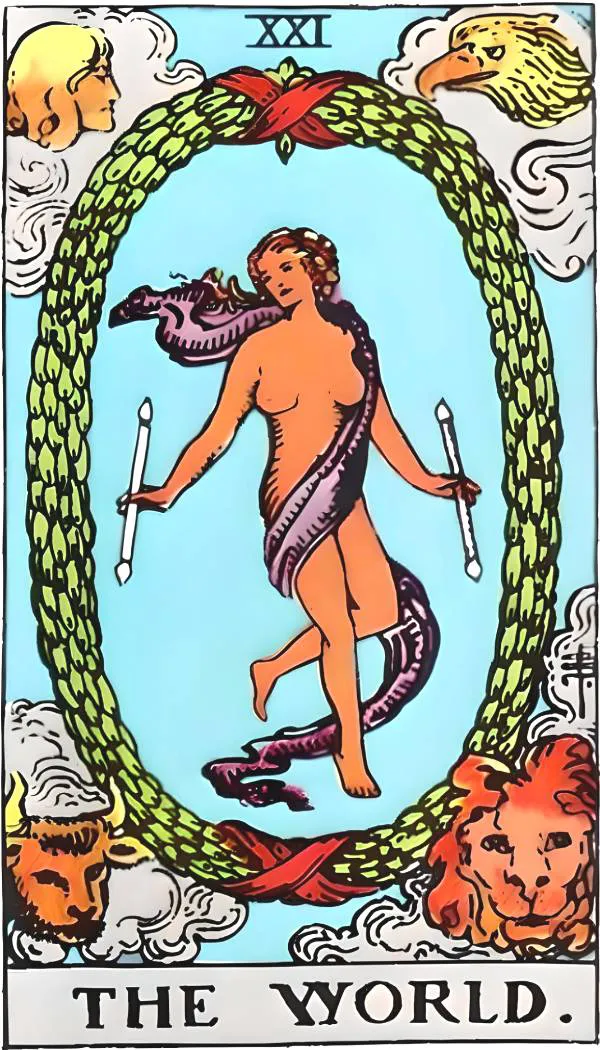
A massive elliptical wreath of laurel flowers encircles the central nude woman, forming the main scene. The woman's dancing movements echo the divine creatures in the clouds around her.

The female figure within the wreath represents the goddess of the new world. There are many opinions about the identity of this goddess. Perhaps she is from the scene of Revelation, the new bride of the new world, and also the original undifferentiated Adam. She could also be a goddess from another religion, the androgynous cosmic god of Hinduism. Some even believe that this figure symbolizes one of the "Three Wise Men", who has reached the highest level of enlightenment, pursued the truth, and the wreath is the "crown of the wise man".

In short, she is a perfect integration, an ideal, the ultimate hope of mankind, a perfect form, and the prototype of the human form that people yearn for. It can be said that this figure is androgynous, just like many of the previous cards, appearing in a special gender when needed. This goddess, like the goddess of the "Star" card, also symbolizes "Truth", but it is more pure and absolute.

The goddess wears a wreath of laurel flowers on her head, which echoes the outer wreath, a cycle of mutual reflection like a mirror. The wreath is the goddess's crown and also symbolizes the manifestation of truth. The golden long hair is elegantly fluttering, with the same rhythm as the fluttering ribbons, also integrating the crown on the head with the ribbons on the body.

The purple scarf is gently tied at the waist, wrapping the goddess's body softly. This spiral ribbon extends from the head to the feet, blown by the breeze, which is the goddess's clothing, and also covers the private parts. The purple ribbon represents the winding state and also the mode of operation of energy. The goddess holds a stick in each hand, which seems to be a dance tool, they are a wand and a magic wand, symbolizing many meanings. These two magic wands are not short, and the ends are drop-shaped, the same shape as the magic wand in the magician's hand. The goddess holds the double sticks, and the power seems to be higher, and there is a meaning of balance between left and right. Holding the "double sticks" is also to correspond to the "double pillars", and the shape of the sticks is very similar to the pillars of the hall.

The goddess's dance posture, stepping on a beautiful pace, dancing the eternal dance, she follows the ribbon, dancing the song of life, stepping on the magical cosmic rhythm. The goddess practices lightly and easily, but seems to have a mysterious energy. The magic wand held by the goddess has the effect of connecting and sensing various magnetic fields, and the ribbon on her body also seems to indicate that energy is drawn from the feet to the top of the head, and the energy is swirling on the body.

The huge wreath around the goddess is composed of green leaves, forming an ellipse. This is the highest level of crown, the highest glory that can be reached by the world, and a symbol of perfection. The upper and lower ends of the wreath are also tied with red ribbons, forming an infinite interlocking cycle symbol, representing the echo and connection between the upper and lower, heaven and earth, and also implying an endless connection cycle. The space inside the wreath is another dimension, the world in the mirror. The goddess wanders in it, but is not restricted. The mood in the world, there is a person dancing, is the real happiness and pleasure. The circle is a complete meaning, and can also be seen as the image of OK.

The four living creatures in the Bible appear again in the four corners of the picture, sometimes called the four divine beasts, are the incarnation of the four evangelists, and also the image representation of the magical "four-letter holy name" JVHV. The four divine beasts gather around the wreath, as if linked with the wreath, giving the wreath more life perception. The position of the four divine beasts is exactly the same as in the Wheel of Fortune, with the human head on the left, the eagle head on the right, the cow head on the left, and the lion head on the right. However, their appearances and expressions are different, and the directions of their faces are also different from the Wheel of Fortune.

The four divine beasts in the World card show bright colors and clear head portraits, no longer small pictures of the whole body, and their faces are complete and clear. At this time, the wings of the four divine beasts are not visible, and they are silent and no longer recite scriptures. They are no longer involved in the rotation of fate, because the mission has been completed, and the world is already complete and peaceful. The reappearance of the four living creatures represents the reorganization of the four elements, and also represents the arrival of God, sending the four divine beasts to inspect the new world first. At this time, the four divine beasts are divine guardians, watching the dance of the goddess.

This card has a blue sky as the background, with the clear white clouds behind the goddess, presenting a peaceful meaning. All the characters in the picture are born out of nothing, floating in the air, which is the most magical depiction method, and the space created in the wreath makes the effect of dimension transformation more intense.

The design of the World card has many elements to echo, connect, and integrate with each of the previous cards. As the last major secret, the content theme is related to "the end", which cannot be ignored. It must show the best and the end of the cosmic system, and depict a deeper feeling, and the secret is hidden in it, the cosmic ecstasy is when it understands itself in God.

The Wreath

The oval wreath, often seen as a lemniscate or symbol of infinity, represents the totality of the world, success, and completion. It’s a symbol of victory, achievement, and being surrounded by the protection and grace of the universe.

The Dancing Figure

At the center, the dancing figure signifies the end of the Fool’s journey, having found joy and wholeness. She is the essence of balance and realization, having integrated all lessons from the Major Arcana.

The Four Creatures

Each corner of the card displays a creature: a man, an eagle, a bull, and a lion. These represent the four Evangelists of the Christian tradition, as well as the four elements (air, water, earth, and fire). They indicate harmony between all facets of life and the spiritual and material worlds.

The Wands

The dancing figure holds two wands, symbolizing balance and mastery over the material and spiritual realms. They echo the magician’s power to manifest reality through will.

The Flowing Scarf

Wrapped around the dancing figure is a flowing scarf. The way the scarf flows around the dancer is indicative of the seamless integration of life’s experiences. It’s a dance between the spiritual and the physical, the conscious and the subconscious. This intertwining suggests that the individual has achieved a sense of unity and wholeness with all aspects of their being.

The Red Ribbons

The red ribbons that form a cross pattern around the wreath signify the integration of the four elements and the four creatures. It also hints at the alchemical process, indicating that both the spiritual and material worlds have been mastered and united in the dancer’s journey.

Psychological patterns in The World
Timing Perfectionism
The eternal dance inside the wreath can turn into a beautiful loop with no exit when the card is read through reversed timing. The red ties and oval frame keep the eye circling, and the dancer's repeated motion can become preparation that never crosses into the next phase. Timing Perfectionism is the mind's attempt to remove risk by waiting for the flawless moment. The defense looks responsible because it studies conditions, but underneath it converts discernment into delay. In timing questions, this pattern keeps You searching for a launch window that cannot disappoint You. The World exposes the trap: a cycle can be complete enough to move, while the nervous system keeps demanding a more perfect sign.
Sunk Cost Fallacy
The red ribbons on The World's wreath tie completion into a continuous loop. The card shows an ending, but the shape of that ending is circular, which means the finished cycle can easily become a reason to keep circling. That is where Sunk Cost Fallacy enters the career field. The more time, education, status, and sacrifice you have invested in a path, the more the mind may treat departure as a betrayal of meaning rather than a strategic reassessment. The reversed mechanism is not laziness or indecision. It is a cognitive accounting trap: the past keeps being used as proof that the future must stay inside the same wreath, even when your transferable skills are already pointing elsewhere.
Strategic Surrender
The figure's dance follows the spiral scarf and the oval wreath instead of fighting their shape. The red ties pull the eye through a continuous loop, while the body moves with the loop's rhythm rather than trying to dominate it. Strategic Surrender is not passivity here. It is a defense mechanism that has matured into timing intelligence: the nervous system stops interpreting every pause as failure and starts registering resistance as data. In timing questions, this pattern shows You where effort has become friction. The card does not remove agency; it relocates agency from forcing the moment to sensing where the cycle is already beginning to open.
Closure Chasing
The wreath closes around the dancer in a perfect oval, and the red ribbons bind its top and bottom into repeated signs of continuity. The dance appears complete, but its circular structure also suggests motion that can continue inside the same frame without crossing a threshold. Closure Chasing emerges when the mind cannot tolerate partial completion. In study, this can look like rereading the same chapter, revising the same introduction, or reorganizing the same notes because the work does not yet feel internally sealed. The search for a clean endpoint becomes the loop that prevents the endpoint from arriving. The reversed texture of The World is especially precise here because completion has become compulsive rather than satisfying. You are not simply trying to do good work; the psyche is chasing the bodily relief of 'finally done,' and the chase consumes the energy needed to move on.
Achievement Fusion
The small laurel crown on the dancer's head mirrors the larger wreath around the whole body, making inner self-image and outer achievement echo each other. The success symbol does not sit beside the figure; it becomes the world the figure is displayed inside. That is the trap inside Achievement Fusion. You may reach the goal and still feel strangely unmoored because the psyche has been using completion as proof of selfhood; once the finish line is crossed, the system loses the scoreboard it depended on to feel real.
Wellness Perfectionism
The World is visually organized around totality: an intact wreath, balanced corners, an idealized body, and a scene where every element appears resolved. In reversal, that beauty can harden into a demand that the self must always look integrated, optimized, and clean. Wellness Perfectionism turns growth into another perfection standard. For you, self-improvement may stop functioning as support and become a measuring system where every skipped routine, emotional mess, or unfinished habit feels like evidence that the whole self is broken.
Timing Discernment
The laurel wreath is both a crown and a closing frame, holding the dancer inside a completed cycle rather than pointing toward an ordinary road. The red knots and oval shape make the image feel finished, contained, and rhythmically sealed. Timing Discernment grows from that sealed completion. You may be between life chapters, but the blockage is not automatically failure or laziness; it can be the psyche refusing to launch a new direction before the old achievement, role, or identity has actually been metabolized.
Threshold Tolerance
The laurel wreath surrounds the dancer like both a completion sign and a threshold. She is suspended in open sky, held by the four corner presences, with no ordinary ground beneath her feet. That floating center captures the psychological stress of becoming too large for an old identity before the next one feels familiar. Threshold Tolerance is the capacity to stay conscious in that exposed middle space, where your growth has already changed the system but your nervous system still wants the old map back.
Shadow Integration
The nude dancer stands inside the laurel wreath with both wands balanced, her body exposed without collapsing into shame. Around her, the four creatures hold the edges of the image, so the center does not have to reject the margins in order to stay whole. That structure mirrors Shadow Integration because the psyche is not organized by cutting off difficult material; it is organized by giving every part a place in the circle. You are shown a model of introspection where hidden anger, tenderness, envy, need, and ambition can be witnessed without becoming your whole identity.
Fresh Start Fantasy
The laurel ring closes around the dancer like a finished world, while the red knots turn that closure into an endless loop. The figure keeps moving beautifully inside the portal, but there is no floor, no room, and no ordinary next step. That is the exact structure of a lifestyle reset that keeps promising a new self without repairing the current system. You stay close to the image of completion because the fantasy of beginning again feels cleaner than the friction of continuing imperfectly.
Core Struggles in The World
Freedom-Structure Conflict
The wreath gives the dancer a perfect boundary, but it also fixes the only stage on which the dance can happen. The sky is open, the body is free, and the movement is fluid, yet all of that freedom exists inside a strict oval container. In lifestyle readings, that geometry names Freedom-Structure Conflict: you want enough routine to protect your energy without turning your days into a cage. The card locates the pressure at the edge where support stops feeling like support and starts feeling like a perimeter you keep testing.
Threshold Disorientation
The World holds a dance at the end of the sequence, but the figure floats in blue space with no floor, road, doorway, or horizon line. The wreath completes the circle beautifully, yet it does not show where the next step lands. Career transitions often produce that suspended geometry after a project closes, a promotion arrives, a degree becomes a job, or a senior identity starts replacing an old one. You have crossed a real threshold, but the old map stops before the new operating surface becomes trustworthy. Threshold Disorientation names the instability of being finished and not yet placed. The card gives that state a precise shape: completion behind you, no ground beneath you, and a body still trying to move with dignity inside the gap.
Belonging-Authenticity Split
The wreath gives The World its beauty and its limit. Inside it, the dancer appears whole, recognized, and held; outside it, the blue sky is visible but not an obvious place to stand. In family life, that visual split becomes the conflict between being accepted by the system and being real within yourself. The family may offer belonging as long as you remain understandable inside its finished picture, while your authentic self requires space the picture was not built to include. Belonging-Authenticity Split names the pressure of choosing between emotional recognition and inner truth. The card does not flatten the choice into staying or leaving; it shows the deeper wound of needing both connection and selfhood when the family frame treats them as rivals.
Inherited Role Lock
The World places the body inside a flawless wreath, with each arm extended into a symmetrical holding pattern. When that structure hardens, the dance stops reading as free movement and starts reading as a posture that must be maintained so the whole image stays intact. In a family system, inherited roles often work this way. You may look functional, balanced, and adult from the outside, while contact with parents or relatives quietly returns your body to the old assignment: the calm one, the successful one, the mediator, the problem child, the one who does not make the system uncomfortable. Inherited Role Lock is the moment the wreath becomes the only room your nervous system remembers how to move in. The card witnesses the pressure of performing a completed self while an older family script keeps deciding which version of you is acceptable.
Autonomy Guilt Bind
The dancer stands exposed at the center of a laurel wreath that reads as both completion and enclosure. Her arms stretch outward with two balanced wands, but every line of movement remains held inside the same oval boundary. In family dynamics, that visual structure mirrors the pressure of becoming independent while still being measured by the family's emotional idea of wholeness. You can move, grow, and claim your adult life, yet the system keeps asking your freedom to prove it has not betrayed belonging. Autonomy Guilt Bind lives in that exact friction: the body is dancing, but the frame still decides what counts as a complete dance. The card does not reduce the struggle to rebellion or loyalty; it shows the cost of trying to become yourself without being emotionally cast outside the family circle.
Sunk Cost Paralysis
The laurel wreath that should crown completion can also read as a closed circuit, especially when the dancing body has no ground outside it. The proof of arrival becomes the same border that keeps the figure orbiting inside what has already been built. For a high-stakes decision, that image matches the bind of past investment becoming present containment. You may be measuring the next step against the entire cost of the journey so far, and the card locates the paralysis at the point where evidence of progress starts functioning like a barrier to exit.
Resource Integration Strain
The World is built from interlocking systems: the dancer, the wreath, the red ties, the two wands, and the four corner figures all hold their places in one complete field. No single symbol carries the whole image; the card's stability comes from every part arriving into relation with the others. Resource Integration Strain appears when timing cannot be solved by effort alone. You may have energy, ambition, and a clear desired move, but the surrounding supports may not yet be assembled: money, attention, collaborators, information, recovery, emotional bandwidth, or external access may still be arriving at different speeds. The card gives this strain a visible container. Its harmony is not passive perfection; it is the exact burden of waiting until the system can receive the action without scattering it.
Cycle-Action Desynchronization
The red knots close the top and bottom of the wreath while the dancer is caught in a step that never visibly lands. Hair, scarf, and limbs all imply motion, but the whole scene is suspended in a completed circle rather than moving across ground. That suspended loop gives Cycle-Action Desynchronization a clear body. You may keep restarting the same lifestyle cycle, but the action never fully synchronizes with the rhythm you imagined, so each reset feels active while the larger pattern stays oddly unlanded.
Shadow Integration Strain
The dancer at the center of the wreath is not fragmented across the card; every symbol gathers around one body. The scarf, the wands, the laurel ring, and the four corner figures all demand inclusion in a single moving field, while the body has to keep the rhythm without dropping any part of the composition. That is why this card can locate the strain of inner integration so precisely. In private shadow work, You may not be dealing with one isolated feeling, but with a whole system of selves, memories, defenses, desires, and public identities trying to occupy the same inner space. The image does not treat wholeness as a clean finish line. It shows wholeness as an active bodily negotiation, where every part must be brought into the ring without being forced into silence.
Achievement-Meaning Collapse
The laurel wreath frames a finished world: a closed oval of victory, integration, and arrival. Inside it, the dancer is still moving, still holding two wands, still animated by a rhythm that has not stopped just because the journey has reached its visible end. That physical contradiction is the core of Achievement-Meaning Collapse. You may have reached the milestone, completed the cycle, or become the version of yourself that once looked like the destination, yet the body of the card keeps moving inside the symbol of completion. The structure shows why arrival can feel strangely hollow when the old goal has stopped producing direction. In a direction reading, this card does not treat the emptiness after achievement as failure. It locates the exact boundary of the struggle: the old map worked, the old crown was earned, but the next horizon cannot be generated by repeating the same victory shape.
Inner Emotions in The World
Grounded Agency
The central figure stands within a complete wreath without being trapped by it, holding two wands in a left-right balance. The image creates a boundary, but that boundary does not shrink the body; it gives the movement a clear container. This is the emotional architecture of Grounded Agency. The choice field has edges, the options can be named, and the self is not dissolving into other people’s expectations or the pressure of the timeline. You can hold competing possibilities without becoming owned by them. For decision tarot, The World gives this emotion unusual force because the card’s completion is active rather than passive. The dancer is not waiting for permission from the scene; the body is already participating in the next movement with structure, clarity, and self-possession.
Courageous Vulnerability
The figure is exposed at the center of the card, but the exposure is not chaotic; it is held within the strong oval of the wreath. Her body is visible, upright, and moving, while the boundary around her remains intact. Courageous Vulnerability in love comes from that exact tension between openness and containment. You are not being asked to spill everything in order to be loved; the card shows a form of being seen that still protects your inner perimeter. The two wands add another layer of agency. They make the openness active, as if vulnerability has become something you can hold with both hands rather than something that happens to you when your defenses fail.
Bittersweet Release
The wreath is complete, but the dancer is still moving inside it. The image holds an ending that does not freeze the body; the cycle has closed, yet the ribbon and hair keep carrying motion through the finished shape. Bittersweet Release appears when a family pattern has finally run its course and your body does not know how to treat the quiet that follows. The card gives that mixed feeling a precise form: relief that the loop is closing, and tenderness for the version of you that survived by moving inside it for so long.
Hollow Recognition
The laurel wreath surrounds the dancer like a finished crown, but the image offers no road beyond it and no visible ground beneath it. Completion is visually undeniable, yet the space after completion is strangely suspended. That is where Hollow Recognition enters the card. The symbol of arrival becomes a sealed frame: everything looks achieved, integrated, and complete, while the next living direction has not yet appeared. The psyche can register the achievement and still feel an interior blankness where meaning was supposed to land. You may have reached something that once mattered, only to discover that being recognized by the old map does not automatically generate a new one. The card does not dismiss the accomplishment; it shows the quiet gap between external completion and inner orientation, where the real direction question begins.
Full Circle Calm
The unbroken wreath closes around the dancer without pinning her down, while the blue sky keeps the whole scene spacious. For an academic cycle, that image turns completion into a container: the semester, thesis, exam season, or degree has a shape you can stand inside. Full Circle Calm comes from the rare moment when the ending does not feel like a drop-off. You can sense the work as a whole arc, and that wholeness gives your attention somewhere stable to land.
Integration Relief
The scarf curling around the dancer, the paired wands, and the doubled laurel circles all move as one coordinated system. Nothing in the image looks like a loose fragment; the body, frame, and corner figures share the same orbit. Integration Relief grows from that visual closure. In social life, you stop splitting yourself into different versions for different rooms, and the nervous effort of managing every persona gives way to a clearer inner alignment.
Completion Anxiety
The World is crowded with completion markers: the laurel oval, the head wreath, the paired wands, the red knots, and the balanced figures at the edges. When reversed, that finished structure can feel less like arrival and more like a sealed system where nothing unfinished is allowed to remain visible. Completion Anxiety appears when an inner process is supposed to be done, but the psyche keeps scanning for the missing flaw. In introspection, the fear is not about ordinary success; it is about whether closure itself can be trusted when deeper material may still be hiding under the surface. The card names the unease of standing inside a completed pattern while still listening for an unprocessed echo. You are not failing to finish; you are noticing that the inner system needs a more honest definition of done.
False Closure Unease
The wreath is complete, polished, and ceremonial, but the dancer inside it is still moving. The card’s surface suggests wholeness while the body keeps circling inside the frame, creating a subtle gap between resolved appearance and unfinished motion. False Closure Unease lives in that gap. In a decision, one option may look clean because it completes the story neatly, satisfies the spreadsheet, or protects the version of yourself that has already invested so much. Still, something in the system keeps registering that the loop has been sealed too quickly. The World gives this feeling a precise image: completion as a beautiful container that may also hide what has not been fully integrated. The emotion is not a command to reject the choice; it is a signal to audit whether closure is real or simply well-presented.
Hollow Completion
The wreath, ribbons, wands, and four corner figures all declare completion, while the central body remains suspended in a weightless sky. In study, that mismatch mirrors the strange emptiness that can arrive after a grade, thesis, or degree has been achieved on paper. Hollow Completion is not a failure to appreciate success; it is the gap between an external milestone and an inner system that has not caught up. The World holds that gap clearly: the frame is finished, but the lived sense of arrival may still feel absent.
Performative Wholeness
The same wreath that completes the image can also read like a polished display case, with the nude body held at the exact center and the four corner figures looking on. The wands, ribbons, and circular frame create a flawless composition that leaves little room for mess. Performative Wholeness lives in that pressure to appear socially integrated before the inside has caught up. You may look connected, well-liked, or fully settled in a circle, while privately tracking how much of your real texture has been edited out to keep the image seamless.
Outer Contexts in The World
Life Reset Phase
The oval wreath works less like a wall than a threshold, holding the dancer inside a completed frame while the blue sky leaves the surrounding field open. The four corner figures stabilize the scene, so the reset is not random drift; it is a moment when previous structures have been gathered into a new coordinate system. Life Reset Phase appears when the old chapter has enough closure to stop being the main source of direction. You are not simply starting over; the card shows a whole cycle being compressed into usable orientation, so the next life structure can be built from what has already been integrated.
Sunk Cost Exit Dilemma
The wreath and crown display accumulated achievement, while the closed oval shows a cycle that has already formed around the central figure. The two wands remain in her hands, suggesting active commitments that still occupy both sides of the body. When this structure turns into a decision problem, the weight comes from everything already invested. Time, identity, public recognition, money, training, and emotional labor can make an exit feel wasteful even when the original path has completed its useful function. The card does not erase the value of what has been built. It separates past investment from future permission, so the decision can be judged by what the structure can still carry rather than by how expensive it was to build.
Social Circle Reset
The wreath is a closed cycle, echoed by the smaller wreath on the dancer's head. The image does not show a half-built space; it shows a completed frame with a clear threshold, where one social world has been organized enough to be reviewed, honored, and released. That makes the card a precise mirror for resetting a social circle after a phase has run its course. You may still recognize the value of the old network, but the structure shows that access, energy, and belonging need to be redistributed around the person you are now.
Off-Script Family Path
The wreath looks complete, yet it does not point to a road laid out by anyone else. The dancer's movement is self-contained, rhythmic, and already integrated, which makes the card especially sharp for family pressure around approved timelines and inherited roles. You are dealing with a structure where family belonging may be offered only through the familiar script. The card places the adult self at a threshold where a life can be coherent without being pre-approved by the household story that came before it.
Chosen Family Transition
Within the laurel wreath, the dancer is not isolated; the four corner figures hold the edges of the scene while the red knots keep the circle coherent. The image turns belonging into a shaped container, where visibility, protection, and mutual recognition have to work together. In friendship, this points to the moment when a loose set of people begins acting like a core support network. You are testing whether the circle has enough reciprocity, privacy, and role clarity to become chosen family without recreating obligation under a softer name.
Family Boundary Backlash
The wreath gives the dancer a perimeter that every corner can see. In the reversed state, that visible edge becomes the thing the surrounding system reacts to, especially when the person inside stops being fully available for inspection or control. Family boundary backlash often arrives as pressure, comparison, withdrawal, or sudden concern about what your limit says about the household. The card frames the conflict as a system response to changed access, helping you see the backlash without surrendering the boundary's basic legitimacy.
Lifestyle System Overhaul
The four corner figures, paired wands, tied ribbons, and oval wreath all answer to the same architecture. Every part of the image has a place, and the dancer's movement works because the surrounding system is coherent. In a growth context, the pressure is not a lack of ambition but a mismatch between upgraded values and outdated infrastructure. Your calendar, spaces, tools, and recovery patterns may need to be reorganized so the new self-concept has somewhere real to live.
Launch Window Readiness
The paired wands are already in the dancer’s hands, the wreath is intact, and the four corners hold a stable field around the center. The image is not searching for tools; it shows tools, timing, and support gathered in one place. Launch Window Readiness names the stage when the external conditions are no longer the main obstacle. You may still feel the weight of crossing into a bigger direction, but the card’s structure shows a threshold where preparation has become sufficient and further delay starts to drain the available momentum.
Strategic Timing Window
The dancer's body, twin wands, flowing scarf, and laurel wreath are all synchronized inside one closed frame. The four corner figures hold the perimeter, making the scene feel less like raw motion and more like a completed system ready to release a clean signal. For timing questions, this visual structure points to a window where action gains traction because the surrounding conditions have cohered. You are not being measured by how hard you push; the relevant pressure is whether the cycle has enough closure, support, and public shape for a move to land without unnecessary friction.
Chemistry to Commitment Test
The dancer's movement is light, but it is framed by a complete wreath and held together by two matching wands. The image is not just attraction in motion; it is motion becoming a stable pattern. For a relationship, that points to the stage where chemistry has to survive definition. You may still have spark, but the real pressure is whether the bond can become visible, named, and livable without losing its rhythm.