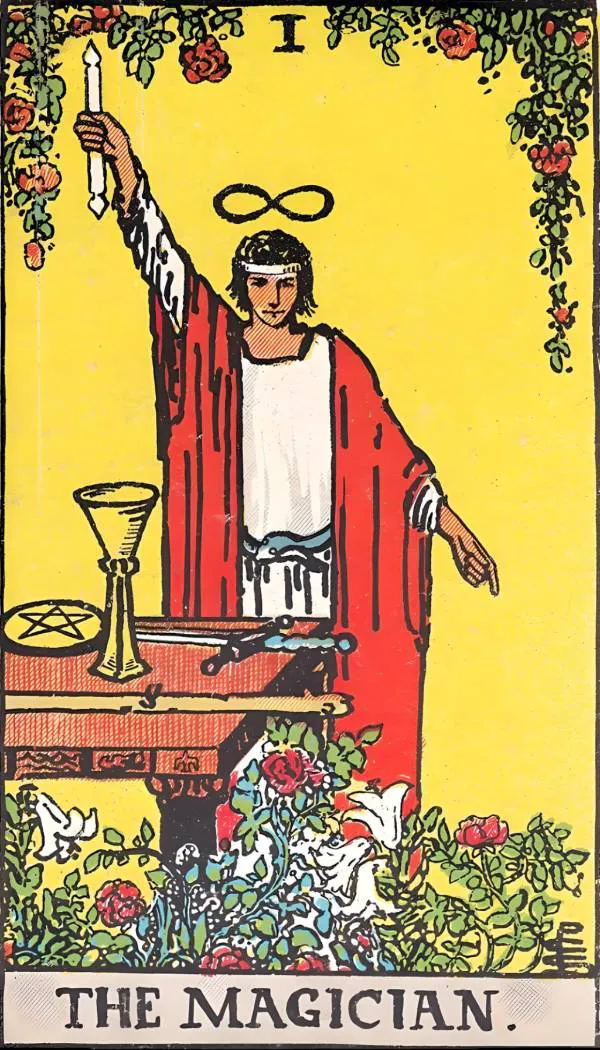
The Magician Tarot Card Meaning

The Magician's attire is actually quite ordinary, dressed in a white robe and a red cape, symbolizing his bright and upright heart and mind, yet harboring a fervent ideal, thus having a positive and worldly action, practicing righteousness and casting spells in the human world, serving the people.

On the table in front of the Magician are the magical tools of the four elements - the Cup, Pentacle, Wand, and Sword. These four items are magical tools and props here, and only when distributed to the Minor Arcana do they become everyday items. Of course, no matter as magical tools or daily items, the symbolism and significance of these four tools are the same.

From the Magician and the four elemental magical tools on the table in front of him - the Cup, Pentacle, Wand, and Sword, we can tell that this is a state of casting a spell. For the Magician's gesture of one hand holding the wand pointing to the sky and the other pointing to the ground, we do not need to have excessive associations, this is exactly the action of casting a spell, most people who practice magic have done such an action. We can also say that this is to connect the consciousness and energy of the universe, because this is the induction and energy operation of the spell.

The young Magician holds a magic wand in his hand, which has the function of conducting mysterious messages and energy. We can capture the Magician's firm and resolute gaze, full of confident demeanor, and the appearance is also a typical male Magician's appearance.

This spell caster, with a white headband tied around his forehead, is an expression of limiting mental power to the brain, as well as concentration and focus of thought. His black hair adds a touch of mystery.

The accessories on the Magician's body also include a belt, which is wrapped with a snake that bites its own tail. This symbol of the "Ouroboros" is a way of expressing the mystery of the universe, and here it is used to express the mystery of the Magician. Of course, this kind of snake-shaped accessory as a belt is also a very common accessory for practitioners, which can be worn on the waist as a temporary and emergency weapon and magical tool. Magicians mostly have the ability to play with snakes and snakes can also be a symbol of healing, which also represents one of the tasks of the Magician - healing others.

The symbol ∞ on the top of the head, generally called infinity, is actually a representation of the principle of cosmic transformation and energy conversion, which is a symbol used by Eastern mystics to represent eternity. Originally a three-dimensional illustration, it was later simplified into a symbol and widely spread and adopted by the West. Of course, the edge of the Magician's hat is also a similar shape, so it is directly drawn as this symbol, clearly expressing the characteristics of the Magician - change and creation. This symbol is located above the head, and it has also become the meaning of the magnetic field momentum that the Magician is casting a spell.

The Magician has many props and accessories, but the scene is relatively simple. Lilies and roses grow on the ground, and red roses hang down above. These two red and white flowers just echo the Magician's clothing, and also echo the position of the Magician's two hands. These two colors represent - sincere and fervent, and they are also the meanings of the two flowers. The characteristics of these two flowers come from the connotation of mystery and religion, they are the flowers favored by God, bringing people faith and positive thoughts. Therefore, the Waite Tarot likes to use these two flowers, and both patterns of these two flowers are used in the first card.

The Lemniscate (Infinity Symbol)

Floating above The Magician’s head is the lemniscate, the mathematical symbol for infinity. This indicates the infinite possibilities and boundless potential inherent in the realm of the Magician. It’s a representation of eternal spirit and the infinite cycles of transformation and rebirth.

Single Wand Raised to the Heavens

The Magician holds a wand up towards the Universe, and with his other hand, he points down to the Earth. This signifies the connection and balance between the macrocosm and the microcosm, illustrating the Hermetic axiom “As above, so below.” It showcases the Magician’s ability to harness spiritual energies and manifest them in the physical world.

The Table

Before the Magician is a table displaying the symbols of the four Tarot suits: Wands, Cups, Swords, and Pentacles. These represent the four elements of Earth, Air, Fire, and Water. They symbolize the Magician’s mastery over these elemental forces and his ability to harness and utilize all the tools at his disposal.

Ouroboros Belt

Around the Magician’s waist is a snake biting its own tail, a symbol known as the Ouroboros. This ancient emblem represents cycles, renewal, and the eternal nature of things. It signifies that the Magician understands the cyclical flow of energy and life.

Red and White Clothes

The Magician dons a white robe symbolizing purity and innocence, layered beneath a red outer cloak representing wisdom, knowledge, and power. This combination signifies his alignment with both the spiritual and material realms.

Roses and Lilies

The flowers in the foreground, roses, and lilies, represent the duality of human desire and experience. Roses are symbolic of passion, desire, and earthly matters, while lilies stand for purity, innocence, and spiritual pursuits. The presence of both indicates the Magician’s mastery over both realms.

The Garden

The lush and fertile backdrop indicates that the world is the Magician’s garden, a place where he can manifest whatever he so desires. The greenery signifies growth, potential, and the fruitful possibilities that arise when one harnesses their inner power.

Psychological patterns in The Magician
Illusion of Control
The wand lifted upward, the finger directed down, and the four tools neatly displayed on the table create a scene of total coordination. You can see a mind trying to make every layer of reality line up, which is exactly how career anxiety turns into control logic: if every variable is managed, maybe visibility, credibility, and timing can all be made safe. The infinity sign over the head and the ouroboros at the waist intensify that loop by making thought feel self-renewing and hard to stop. In work life, that can look like scripting conversations, micromanaging impressions, and treating promotion as something that can be engineered through perfect calibration. The deeper issue is not discipline itself, but the way uncertainty becomes intolerable once control is carrying your sense of professional safety.
Competence Theater
The white robe, red cloak, fixed gaze, and carefully staged table create a strikingly polished image: everything is visible, ordered, and under control. Even the flowers and symbols support a presentation of composure, potency, and readiness. Around family, that kind of visual order can become a defense built from performance. You learn that being prepared, articulate, impressive, or unfazed earns more safety than being messy, uncertain, or openly hurt. The card fits Competence Theater because the self on display is not false, but it is curated; competence becomes the costume that protects your autonomy from family judgment or regression into the old child role.
Strategic Intimacy
The Magician stands centered behind a table that both presents and limits access. His tools are visible, his gestures are exact, and even the strong vertical line of the scene suggests an ongoing loop between signal and response. That structure fits Strategic Intimacy in friendship because closeness is not absent here; it is curated. You may know exactly how much warmth, insight, humor, or disclosure to offer to keep the bond alive while still protecting the parts of yourself that would place you in real dependence. The card points to intimacy as something skillfully managed, which is why the connection can stay strong while still feeling strangely controlled.
Spiritual Bypassing
The Magician is one of the clearest cards of symbolic correspondence: sky and earth linked by one body, infinity suspended overhead, ritual tools lined up for transformation. In timing questions, those symbols can become seductive because they make the next step feel spiritually legible. You may start searching for signs, alignment language, or special confirmation that the moment is cosmically sanctioned. Reversed, that symbolic field can drift away from reality-testing. Instead of using intuition alongside preparation, you may use spiritual language to soften the discomfort of missing resources, weak sequencing, or inconvenient constraints. The pattern is not about belief itself; it is about using belief to step around the concrete timing work the season is still asking from you.
Fresh Start Fantasy
The symbols of infinity and cyclical return sit above and around a figure who already has every tool on the table. In one state, that imagery speaks to available potential; in another, it turns possibility into a loop that never has to narrow. The garden stays fertile, the options stay alive, and the mind keeps receiving a fresh hit of relief from imagining what the next version of life could be. You may not be lacking vision at all. You may be overfed by possibility, using reinvention as an emotional exit whenever one road starts asking for boredom, trade-offs, or sustained loyalty. In direction readings, that is how Fresh Start Fantasy operates: the next chapter feels pure because it has not yet met reality.
Action Bias
The raised wand, the hand aimed downward, and the full toolkit already laid out on the table create a body that is not waiting to reflect for long. The image is built around immediate conversion: intention becomes movement, possibility becomes task, and available resources get pulled into use with very little visual hesitation. Even the centered composition pushes energy straight through the figure instead of letting it disperse. Around your routines, home setup, and energy management, that physical logic can become Action Bias. When your daily system feels messy, doing something fast can feel safer than staying still long enough to identify what is actually draining you. You are not short on initiative here; the card points to a pattern where activity itself becomes the quickest way to regulate uncertainty, which is why the system keeps moving while the real friction point stays untouched.
Overfunctioning
The wand is already in hand and the four tools are laid out within immediate reach, so the card shows almost no pause between tension and response. The body is centered, focused, and ready to act, as if stillness would be riskier than intervention. In family dynamics, that readiness becomes a habit of stepping in before anyone asks—smoothing conflict, explaining intentions, arranging logistics, and absorbing what others leave undone. You may look capable on the outside, but the deeper mechanism is that activity has become your way of regulating threat. The Magician maps Overfunctioning because the need to keep the system moving quietly turns you into its most reliable extra pair of hands.
Optimism Bias
Infinity above the head, four complete tools on the table, and a fertile garden at the figure's feet create an atmosphere where potential seems endless and resources seem sufficient. The card does not show scarcity first; it shows readiness, abundance, and the fantasy that capacity can keep expanding to meet the moment. That abundance can tip into a decision bias where possibility looks brighter than cost. You may assume skill, willpower, or clever execution can make either option work, which quietly discounts friction, switching costs, and the parts of reality that do not negotiate. In choice work, this pattern keeps hidden tradeoffs underpriced because potential feels more convincing than consequence.
Self-Sabotage
The Magician’s image is famous for agency, but its structure is also precarious: one body is trying to connect heaven and earth while four distinct tools wait for use. When that focused circuit breaks down, the same arrangement can start short-circuiting itself. Effort is still present, capacity is still visible, but the field becomes overloaded by too many simultaneous meanings and too many competing moves. You may look productive from the outside while repeatedly undoing your own momentum at the exact moment a path begins to demand commitment. A new option appears, the plan gets split, the energy scatters, and what could have become direction dissolves back into experiment. In this topic, that is how Self-Sabotage shows up: not as a lack of potential, but as a repeated interruption of your own line of force.
Analysis Paralysis
The same posture that can channel action upright can also lock into a held instruction. The wand remains raised, the hand still points down, and the table stays crowded with available tools, yet the composition gives almost no sideways movement. Everything funnels through one narrow axis, as if the mind has turned choice into a single overcompressed pipeline. That geometry fits the experience of analysis replacing decision. You may keep comparing, refining, checking spreads, or rehearsing scenarios because choosing one option would also mean losing the others. In choice work, the stall is not a lack of intelligence. It is a defensive loop that keeps thought moving so commitment does not have to happen yet.
Core Struggles in The Magician
Capacity Misalignment
The raised wand, the downward-pointing hand, and the full table of tools create a body that looks fully equipped while carrying two directions of demand through one frame. The Magician can conduct energy, but the image also shows that every available instrument still has to pass through a single human center before anything becomes real. In friendship, this is the shape of being seen as capable enough to hold every role: listener, fixer, mediator, planner, and emotional translator. You may have real skill and care, but the card exposes the hidden mismatch between what the friendship assumes you can provide and what your actual capacity can sustain. The open garden around the table matters because possibility is not the same as bandwidth. The struggle becomes visible when having the tools makes it harder to admit that the relational container is asking too much from one person.
Potential Overidentification
The Magician stands with every visible layer arranged around his body: the wand above, the pointing hand below, the tools across the table, and the growth at his feet. The scene makes potential unusually concentrated, as if possibility has gathered into one person before any single road has been chosen. That concentration can become a burden when direction is the question. You may feel identified with what you could become, what you could build, and what you could still choose, while the actual path remains waiting on the table untouched. The struggle is not a lack of gifts or a lack of future. It is the pressure of mistaking broad capacity for a lived trajectory, where the self becomes attached to being full of options because choosing one would make the other possible selves fall away.
Manifestation Gap
The wand is lifted above the head while the cup, pentacle, sword, and second wand remain on the table, close but untouched. The body appears to carry a current between above and below, yet the working surface where action would become concrete is still separated from the gesture. You may recognize this as the moment when a move has energy, language, and resources around it, but the timing has not clicked into a usable opening. The struggle is not simple hesitation; it is the visible gap between having the signal and finding the exact point where the signal can enter reality.
Readiness Loop
The table is already set, the garden is fertile, and the Magician's gesture is held at the charged instant before the work begins. The body is not empty-handed; it is paused inside a fully prepared scene where the next movement would make the ritual real. In personal growth, that pause becomes the loop where another plan, course, reset, or identity upgrade seems required before action can start. You are caught at the threshold where preparation still feels productive, but the untouched tools reveal the boundary between being ready and crossing into practice.
Sunk Cost Paralysis
The Magician’s belt closes around the waist as a snake biting its own tail, placing a self-feeding loop at the body’s center. Around it, the garden remains fertile and the table remains full, but the figure is still held inside the same ritual frame. In a choice reading, this structure matches the point where an old path keeps claiming authority because so much has already been placed inside it. You may see other possibilities, yet leaving would force the decision to include the cost of what has already been spent. Sunk Cost Paralysis belongs to the reversed Magician because the loop is not empty repetition; it is invested repetition. The struggle is the closed circuit where time, effort, identity, and hope keep recirculating, making exit feel like a loss of meaning rather than a recovery of agency.
Performative Competence Split
The table displays every tool, and the Magician's pose makes capability visible before any tool has actually been used. His gaze is steady, the wand is raised, and the whole scene presents mastery as an image that arrives before the work underneath can be seen. In a family system, that image can become a trap. You may be treated as the capable one because you look composed, translate conflict, handle logistics, or stay articulate, while the cost of maintaining that performance has no clear place on the table. Performative Competence Split lives in the gap between displayed capacity and lived capacity. The card does not deny your skills; it shows how family pressure can turn skill into a stage role, making it harder for limits, needs, or exhaustion to be recognized as real.
Knowledge-Output Gap
The raised wand, lowered hand, and full table create a vertical current that never visibly enters the tools. The image holds the exact friction of having the ingredients for work while the final transfer into matter remains suspended. For academic work, that suspension becomes the distance between understanding a lecture, collecting sources, and producing a paragraph, proof, or remembered answer under pressure. You are not looking at simple laziness; the card locates the block at the conversion point where knowledge must become output and the system cannot yet carry it through.
Resource Integration Strain
The four elemental tools sit side by side on a compact table while one body tries to hold the whole operation through a single raised-and-lowered axis. Each implement has a different weight, function, and demand; none is missing, but none is yet integrated into one usable sequence. In personal growth, the friction comes from having too many valid parts of yourself and no stable way to make them cooperate. You can feel the strain of trying to turn mindset, emotion, skill, discipline, and desire into one coherent practice without letting one tool cancel out the others.
Threshold Disorientation
The raised wand and the downward hand form a bridge between intention and matter, yet the cup, pentacle, sword, and wand on the table are not being touched. The image holds the exact instant before activation, where everything is prepared but the first grounded movement has not crossed the table's edge. This is Threshold Disorientation as a lifestyle struggle. You can see the life you want to build, name the habits, and assemble the resources, but the passage from setup to use loses definition. The card gives form to the moment where planning has become visible, but the first embodied sequence has not yet become real.
Idealization-Reality Split
The Magician stands among red roses and white lilies, with the same red and white polarity repeated on his clothing. Desire and purity are not separated in the image; they are arranged together around a figure whose gesture binds the higher and lower fields without dissolving their difference. In love, that visual pairing can describe the split between the partner as a real person and the partner as a vessel for longing, meaning, and projection. You may feel both the physical pull of the connection and the urge to protect an ideal version of it, which makes ordinary inconsistency feel disproportionately destabilizing. The table keeps the scene staged, as if the relationship must remain symbolically coherent before it can be touched in its messier human form. The struggle appears where romantic meaning becomes so charged that reality starts to feel like an interruption rather than the place where love has to prove itself.
Inner Emotions in The Magician
Scattered Overwhelm
When the same table of tools turns into an overloaded surface, each object pulls on a different kind of attention. The sword asks for analysis, the cup for feeling, the pentacle for cost, and the wand for action, while the shallow stage leaves little room to spread them out. That is how Scattered Overwhelm forms in a choice reading: every option feels reasonable, every tool feels necessary, and the mind keeps grabbing at all of them at once. The Magician becomes a mirror for the moment when having resources does not feel empowering because they have not yet been organized into a decision. You are not looking at a lack of capacity here. The pressure comes from too many forms of capacity firing at once, each demanding to be the deciding factor before the inner system has chosen a hierarchy.
Performative Calm
The steady gaze, lifted wand, clean robe, red cloak, and arranged tools create a flawless public surface. Every element is visible, composed, and placed where it can be read. Performative Calm gathers when social composure becomes a role you have to keep holding. You may look easy in the room while privately tracking tone, timing, facial control, and whether the group is seeing the version of you that can survive their attention. The reversed texture of this image is not loud collapse; it is overmanaged presentation. The card exposes the gap between a smooth social exterior and the unspoken labor required to keep that exterior intact.
Grounded Agency
The table in front of the figure is not empty inspiration; it holds cup, pentacle, wand, and sword within reach. The body stands between upper reach and lower contact, turning abstract intention into something that can be handled, tested, and placed on the table. That arrangement gives Grounded Agency its emotional weight. You do not need the entire long-range map to feel a next move become yours; the card’s structure shows a future being approached through available tools, clear boundaries, and a body willing to act from the present tense.
Hollow Control
The tools on the Magician’s table are perfectly present, yet the image freezes them as display objects rather than active exchange. The table becomes a controlled surface, and the fixed gaze turns capability into something sealed behind presentation. Hollow Control in friendship feels like managing every variable while no longer feeling emotionally met. You may know when to text, how to phrase the boundary, how to avoid escalation, and how to keep the group stable, but the connection itself starts to feel strangely flat. The reversed Magician links to this emotion because mastery loses warmth when it becomes only optics. The card reveals a relational atmosphere where control is still available, but contact has thinned out behind it.
Charisma Fatigue
The red cloak pulls the eye toward the Magician, the plain background offers little distraction, and the raised-and-lowered arms must remain suspended in a display of competence. The body becomes the focal point that holds the entire scene together. Charisma Fatigue emerges in friendship when being socially gifted turns into an invisible job. You become the planner, mediator, hype person, translator, or emotional first responder, and the very traits that make you magnetic start to feel like a role you cannot put down. The reversed Magician makes this emotion precise because it shows performance without rest. The tools are available, the presentation is convincing, and yet the human body at the center is still required to keep the whole field activated.
Focused Confidence
With one hand raised and the other pointing down, The Magician turns a split field into a single vertical line of attention. The table does not look chaotic: cup, pentacle, wand, and sword are separated, named, and within reach. That visual order mirrors the moment when a choice stops being a swarm of possible losses and becomes something your mind can hold. You are not being handed certainty about every outcome; the card is showing the body state of Focused Confidence, where attention narrows enough for the next move to become real. In a decision reading, this emotion matters because clarity is not presented as a perfect forecast. It appears as the quieter ability to keep your gaze steady while the options remain visible, imperfect, and still actionable.
Magnetic Ease
The roses, lilies, red cloak, and steady forward gaze soften the Magician's precision into a form of social warmth. The scene is active, but it is not visually frantic; the figure can be seen without appearing swallowed by the room. Magnetic Ease comes from that combination of visibility and containment. You are not forcing a persona into place; the social field feels receptive enough for your presence to arrive without pushing. For social connection, this emotion matters because it shows belonging beginning before performance takes over. The card gives a visual language to the rare moment when being noticed does not require abandoning your natural rhythm.
Imposter Exposure Fear
The raised wand, fixed gaze, and immaculate symbols place the Magician in a public display of competence. The table is not hidden; the tools are on show, and the body has to look like it knows exactly what to do with them. In school, that display can become Imposter Exposure Fear when seminars, supervisor comments, grades, or submissions make you feel visible before you feel internally ready. You are not only afraid of being wrong; you are afraid that the performance of knowing will be seen before the private process of learning is complete.
Timeline Panic
The infinity sign above the head and the ouroboros at the waist repeat closed loops around the body. In a reversed timing frame, those loops stop feeling like open potential and start operating like a clock that circles without releasing a clear next point. The raised wand and lowered hand hold the body in suspension while the shallow scene offers no distant route forward. You can feel time as pressure rather than rhythm, as if every delayed move proves the window is narrowing even when the actual signal remains unclear.
Limerent Rush
Red roses hang above and bloom below, the cloak carries the same vivid red, and the wand lifts the scene into a charged vertical current. The cup on the table gives that charge a vessel, so attraction appears as something bright, immediate, and full of projection. Inside romance, Limerent Rush is the inner weather of being lit up by possibility before the relationship has fully proven its shape. You feel the spark as a live signal, and the card mirrors how quickly chemistry can turn into a whole imagined world.
Outer Contexts in The Magician
Routine Collapse
The wand above, the pointing hand below, and the tools on the table form a circuit that has to stay coordinated. When that circuit is under strain, the idea remains elevated, the material tasks remain present, and the body in the middle has to hold the connection. Routine Collapse appears when the life system cannot keep that transfer stable. Sleep, work, food, money, cleaning, movement, and messages keep arriving, but the order that used to move them through the day has stopped carrying the load. The Magician links to this context because it shows that the failure point is not a single missing tool; it is the broken coordination between tools. You regain clarity by seeing which part of the daily circuit is carrying too many jobs at once.
Love Bombing Pace
The red cloak, roses, raised wand, and fully stocked table create a scene of concentrated intensity. Everything arrives at once: beauty, confidence, symbolic abundance, and a carefully controlled front-facing display. In love, that can mirror a pace where attention feels complete before trust has had time to become real. The visual abundance is not automatically the problem; the pressure comes from how much of the stage is controlled by one person while you are placed in the audience position. This context asks you to read speed as structure. When affection, promises, and availability flood the connection too early, the deeper question is whether mutual ground is being built or whether momentum is replacing consent, time, and discernment.
Academic Fresh Start Transition
The raised wand, lowered hand, and clean worktable create a visual line between intention and the material workspace. The cup, pentacle, wand, and sword are already laid out, so the scene is not empty; it is staged for first contact with a new operating system. In an academic setting, that becomes the first weeks of a course, thesis stage, lab placement, or reskilling track where the materials are visible but the routine is not yet proven. You are not looking at a lack of potential; you are looking at the fragile moment before tools become habits and habits become output.
Emotional Blackmail Cycle
The red cloak and white robe create a polished surface of sincerity and intensity, while the closed-loop belt holds the body inside a repeating circuit. In reversal, that visual polish can become a way to make pressure look like care, sacrifice, or moral concern. Family emotional blackmail often works by changing the subject from the boundary to the pain your boundary supposedly causes. A request for space becomes proof that you do not care enough; a different life choice becomes evidence that you have forgotten where you came from. The Magician reversed links this context to managed signals and controlled exchange. You are not facing a single difficult conversation; you are facing a family loop where affection, guilt, silence, and approval are used to pull the same response out of you again.
Self-Help Content Spiral
The table is full of tools, and the Magician's body creates a channel between idea and action. In a reversed reading of this image, the problem is not emptiness; it is overload disguised as preparation, where every tool promises clarity but the sequence never settles. That is the structure behind a self-help content spiral. You may be moving between frameworks, creators, personality maps, productivity systems, life-purpose videos, and optimization language until direction becomes another feed to refresh. The card locates the bottleneck at the table itself. The tools must stop competing for authority before any one of them can become useful, because a long-range path cannot be built from endless intake without grounded selection.
Lifestyle System Overhaul
With one hand raised and the other pointing down, The Magician creates a visible bridge between an idea and the surface where tools are waiting. The cup, pentacle, wand, and sword are not scattered across the scene; they are gathered on one table, close enough to be assigned roles. In lifestyle terms, that layout mirrors the moment when your daily life has become a system-design problem. Work, sleep, money, health, space, and attention may all be present as resources, but they need a usable order before they can carry a better routine. The card connects to Lifestyle System Overhaul because it shows agency becoming physical infrastructure. You are not only choosing a better habit; you are deciding what belongs on the table, what each tool is for, and how much load the whole arrangement can realistically hold.
Productivity Theater
The table is crowded with symbols of capability, while no finished object appears on it. The raised wand, the downward gesture, the clean robe, and the displayed tools can become a performance of command before the material work has actually moved. In school, that turns into the beautifully arranged study system that keeps replacing the assignment itself. You may have dashboards, flashcards, tabs, playlists, and planning rituals, but the card exposes the structural swap: visible preparation is taking the social place of academic production.
Launch Window Readiness
The raised wand, the earthward hand, and the table below form a direct line from signal to action. The figure is not wandering through an open landscape; he is positioned at a threshold where the work surface is ready and the next transfer has to happen through the body. This is the personal growth stage where an idea stops being protected by private planning. You have enough structure to make a move that can be observed, tested, and adjusted, even if the larger path is still unfolding. Launch Window Readiness carries pressure because timing becomes part of the environment. The card does not frame growth as a vague wish; it frames it as a moment when attention, tools, and a first concrete act are close enough to connect.
Resource Readiness Check
The worktable is not empty, improvised, or chaotic; each tool is placed within reach. The figure's grounded stance makes the scene feel like a readiness audit, where intention has to be matched by usable resources. In career terms, this reflects the moment before a raise conversation, role pitch, job change, or independent launch. You may have motivation, but the external question is whether evidence, leverage, timing, network support, and execution capacity are assembled enough to carry the move. The card keeps the focus on structure rather than hype. It asks what is actually on the table, what is missing, and which part of the career system must be strengthened before visibility turns into sustainable progress.
Chemistry to Commitment Test
The raised wand and downward hand turn the whole image into a bridge between attraction and form. The figure is not floating in possibility; he is standing behind a table where every needed tool is visible, sorted, and ready to be used. In love, that visual structure mirrors the moment when chemistry stops being only a private feeling and starts asking for a shared container. You may have enough attraction, access, timing, and communication to move the connection forward, but the pressure point is whether both people are willing to make the same reality. The table matters because potential alone is not the relationship. The Magician's layout shows a test of translation: whether the spark can become a clear agreement, a next step, or a mutual definition without one person carrying the whole conversion alone.