

The Hierophant Tarot Card Meaning
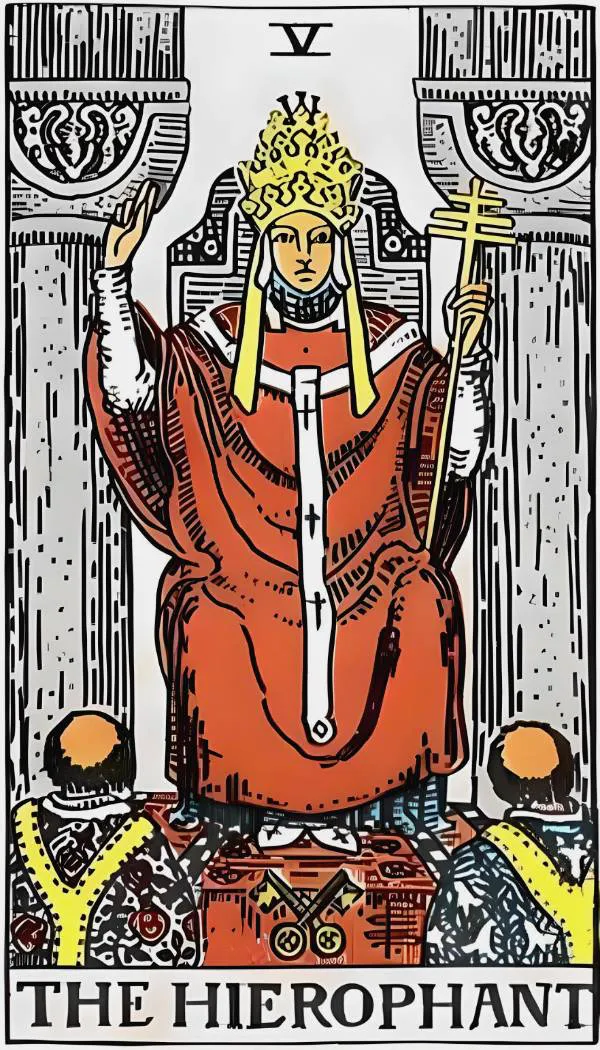
This lecturing man is a high-ranking spiritual leader, with two followers in front of him, respectfully listening to his teachings. He is known as the Hierophant, who dominates the power of external religion, just as the High Priestess is the excellent innate power of the esoteric. The Hierophant is preaching, which is also an education, and it is the oldest form of propaganda. The whole picture also presents the initiation ceremony of the Masonic system, actually using the orthodox position of the Hierophant to imply the orthodoxy of the secret society. Therefore, there are many decorations and symbols on the Hierophant and in the background that are related to Freemasonry.
This Hierophant sits inside the temple, on the steps, wearing a Taoist robe, holding a staff, and raising his right hand with a divine gesture. His face is thin and clear, his eyes are focused, and his slightly raised gaze reveals his confident and authoritative gaze. This Hierophant has no beard, which represents that he is good at expressing, the communication is smooth, and it also represents that his male gender characteristics are not so obvious. Although he is not old, he has a lot of cultivation in the spiritual aspect.
The Hierophant is dressed in a noble and bright and simple way, representing the superficial religion, the leader under the religious system. The red robe, white vestments, shoes, and outer lining. The blue inner lining is exposed at the neck and lower part, and the blue color represents clear speech and clear thoughts. The red Taoist robe is a symbol of nobility, as well as enthusiasm and vitality.
The Hierophant wears a triple crown on his head, higher than the crown worn by the emperor, representing that the spiritual power of the Hierophant is more noble. However, wearing an overly high hat, it is inevitable to be overly self-inflated. The Hierophant has less practical action power and pays more attention to spiritual power. His power must also be exercised through the will of God. There are white earlaps and tassels on both sides of the hat, representing pure and flawless cleanliness, and also symbolizing the filtering of secular noise.
The Hierophant holds a triple cross staff in his left hand. Such a staff is the authority of God, the authority of religion or belief, and also the leadership and guidance of thought. The triple cross staff represents the unity of body, mind, and spirit, as well as the symbol of the Holy Infant, Holy Spirit, and Holy Father Trinity, and also the past, present, and future. This combination is also related to the secret society related to Freemasonry, symbolizing the basic initiation ceremony, and the three levels that must be experienced - apprentice, co-repair, and master. There are many images related to "three" on the Hierophant and around, and there are many symbols composed of three crosses, and there are three crosses embroidered on the vertical ribbon in the middle of the red robe, falling on different parts.
The Hierophant's right hand makes a gesture of the index finger and middle finger together upward, and the thumb holds the ring finger and little finger. This is a well-known church symbol. In many Western paintings, the Hierophant is dressed in this way and also holds this gesture. This gesture is used here to represent "esotericism", connecting the will of God and conveying it. This gesture reveals mysterious information and the difference between the doctrine represented by the Hierophant and the High Priestess. The names of the Hierophant and the High Priestess have no relativity, indicating that they belong to different doctrines. The Hierophant is a powerful spiritual force, not a subtle spiritual light. The Hierophant card integrates various religious and beliefs, while the High Priestess is attributed to the private spiritual side.
The podium is covered with a red carpet, and there are two black and white checkerboard patterns on the strip. The checkerboard pattern represents the struggle and integration of opposing forces. Close to the inner side of the two strip patterns, there are four circular cross marks, divided into two columns in front of the two feet, just representing the combination of the four elements, and also symbolizing the four wheels in the wheel of the Christian God. The arrangement of the circular plate in this way represents that spiritual beliefs can make people transcend and ignore the changes of fate. The two shoes of the Hierophant are exposed outside the robe, each with a cross, and the two feet are close together, located between the checkerboard ribbon and the circular cross.
There are two crossed keys in front of the Hierophant, hanging on the side of the steps facing the crowd. These two keys are used to open the spiritual realm, seek the truth, and are also tools to open and pass through various barriers or time and space fields, and also symbolize the key to understanding. The handle of the key has a circular cross, representing the spiritual realm of God. These two keys are all made of gold, representing the sun and the obvious, external world, and if they are made of silver, they represent the moon and the hidden, internal world. These two keys are just between the two monks in front of the Hierophant, indicating that they are related to the two followers, and can serve and enlighten the believers and seekers. The X shape of the keys just connects the two monks, connecting the red rose and the white lily, which is the mystery of the "Golden Dawn". This X shape has also appeared in other cards in various forms.
The two priests in front of the Hierophant are the representatives of the divine, dressed in the clothes of the holy office, facing the Hierophant on the left and right, listening to the sermon in a kneeling position. The robe of the one on the right hand of the Hierophant is light yellow with red roses and green branches, and the other is blue with white lilies. The picture of roses and lilies used in groups is mentioned in many pictures of the Waite Tarot. Here it is used to show the two aspects of the sanctity and secrecy of the Hierophant, the rose is the supernatural mystery, and the lily is the mystery of the heart and spirit.
Only the back of these two monks can be seen in the picture, and there is a yellow Y-shaped ribbon on the back of the clothes of both, which is like a shackle. It is like a collar and chain worn on the body, representing that they are herded by God, that is, they are the servants of God. They also have a ring hairstyle with the top of the head shaved and the hair around, and many ancient clergy have similar attire.
The Hierophant sits upright on a stone chair, with the back of the chair exposed on the shoulders, and the two stone pillars on both sides are gray. The entire building is almost gray and colorless. The only color is the blue pattern on the top of the two pillars, which is on both sides of the Hierophant's head, resembling the pattern of oak or pine cones, and also resembling the uterus of a woman. This pattern indicates that the Hierophant protects the female secrets of the High Priestess. And these two symbols are also the two cups in the Temperance card and the two bottles in the Star card. This pair of marks also represents the transfer device, which is the symbol of the intersection of the sun and the moon, and the harmony of Yin and Yang. The Hierophant's hands have different movements and functions, but they all point to these two symbols, the fingers of the right hand, the staff of the left hand, pointing outward to these two places. What is pointed to is the place of mystery, and this kind of two-way mystery is even represented by many action lines in the entire picture.
The gray stone pillars and the colorful clothes of the Hierophant present the contradictions of religious life. The brilliance of the surface also represents that the preaching of the Hierophant pays great attention to performance and image, and the Hierophant will pay great attention to the image, which is very inconsistent with the actual situation. The bright color and the gray is a strong contrast, and the two inconsistent levels are inconsistent with the profound spiritual level that religion should have. This building is the dwelling of God, and the glory of God is in it. Behind the back of the chair and between the two pillars is a deep blank. There are many levels in the temple that we need to explore and discover, especially behind the Hierophant, what is hidden, but it is unknown.
Papal Cross
The Hierophant holds a triple cross, which symbolizes his religious status and authority. It also represents the trinity and spiritual unity.
Two Acolytes
Beside the Hierophant are two monks, signifying the dual nature of the card – the balance between conscious and subconscious, seen and unseen. They also represent the followers of doctrine and established spiritual teachings.
Raised Hand
The Hierophant’s right hand is raised in a specific manner, with two fingers pointing skyward and two pointing down, representing the bridge between heaven and earth, as well as spiritual and material realms.
Keys
At the Hierophant’s feet lie two crossed keys. They symbolize the keys to heaven or the keys to spiritual knowledge. The cross of the keys denotes the balance between the conscious and subconscious minds.
Rich Papal Garb
The clothing of the Hierophant, rich in texture and appearance, represents religious authority, tradition, and established order.
Crown
The Hierophant’s crown has three levels, which again relate to the trinity and also signify his high position in the spiritual world.
Throne
The Hierophant sits on a grand throne, indicating his spiritual and worldly authority.
This card, in essence, speaks to religious doctrine, conventional wisdom, and traditional beliefs. It calls attention to established institutions and their teachings, and to the desire to conform and belong, to be accepted in the society and to the need for approval in the community.

After a Sunday Family Call, One Boundary Changes What Belonging Costs

From Grad-School Research Loops to One Bounded Career Test

Acting Younger for Family Help: Name the Need, Keep Your Choice

When 'Where Are You From?' Becomes a Night of Replay: One Answer, One

When Code-Switching Becomes Performance: Keeping Meaning Audible
