Page of Swords Tarot Card Meaning

Overall Card Structure

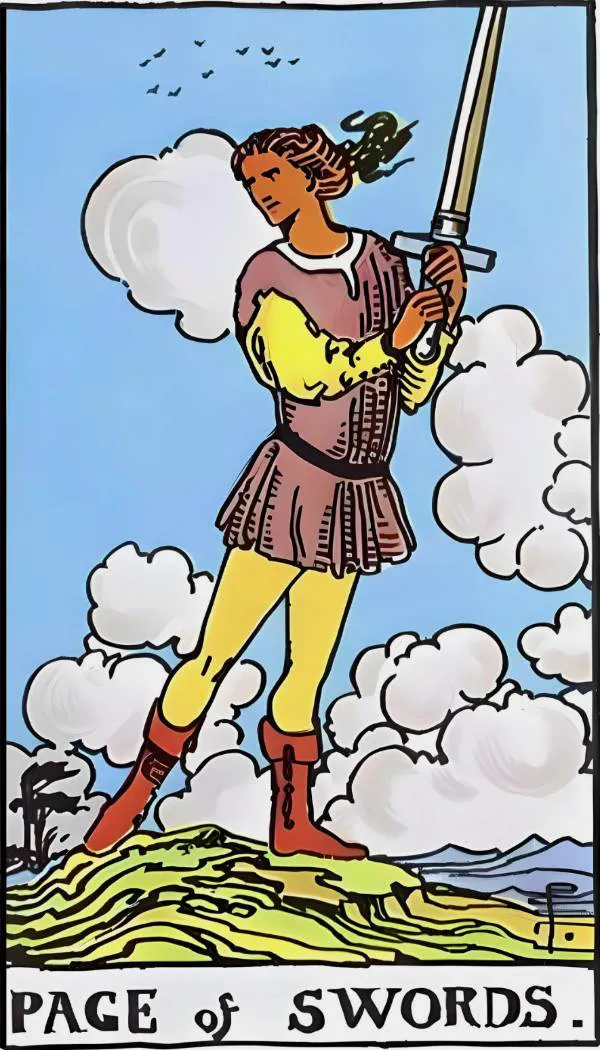
This young man has a rather serious expression, yet his posture is gentle, with hair fluttering in the wind.

The Page of Swords is positioned on a towering mountaintop, with rugged terrain indicating a less than peaceful environment. He holds the sword in both hands, pointing to his left, while his face is turned in the opposite direction, his entire body twisted as if turning back.

He is the Page of Swords, a squire tasked with maintaining the sword, and holding the sword is his duty. He bears the heavy responsibility of defending and warding off enemies.

His attire is simple and straightforward; he is not wearing a hat but has his hair tied up. He wears a beige garment complemented by a dark brown coat, with slightly red boots on his feet.

The clouds in the background sky appear to be near him, surrounding him, and a group of birds can be seen in the distance above his head.

Detailed Pattern Explanation

The Page of Swords has a sharp facial appearance, with delicate features that convey caution and meticulousness, as well as a sense of defense and depth. He holds the hilt of the sword with both hands, raising it straight up, his figure is nimble and agile, swiftly walking on the uneven ground. His posture is particularly distinctive, as the direction of the sword and the direction of his face are different, a turning back pose, making him the most dynamic. At this moment, the Page of Swords has a serious and solemn expression, his eyes tense, cautious, as if facing a formidable enemy.

Actually, this squire is in a very special situation, and there is a reason for this posture, with enemies lurking in the background. He is alert and agile, looking at the path as if an expected enemy could appear at any moment. He stands alone on a high ridge, having ascended to this peak after overcoming many difficulties. He looks back on the path he has taken, which is not smooth but full of rugged, steep slopes, with a rough surface full of crises, where one could easily fall or slip, even rolling down to the bottom of the mountain.

The Page of Swords' attire is simple and unadorned; he is only wearing a headband instead of a hat, with his hair blowing in the wind. He is dressed in a brown coat, the same color as his hair, with a strong protective hue. The yellow inner shirt represents lightness and cheerfulness. The red shoes symbolize swift action.

The Page of Swords traverses the rugged terrain, and the path is shrouded in dark clouds. The clouds in the sky are thick, with cumulus clouds piled up layer upon layer, denser towards the lower parts, as if surrounding him, symbolizing hidden dangers lurking everywhere. In the distant background, there is a blue mountain, but it appears lower than here, showing that this place is not easy to stay. At the top of the sky, there is a group of birds, which is the symbolic animal of the Sword Court cards. In the lower left corner, beyond the rugged rocks, you can also find a few trees in the distance. This scene, like the Knight of Swords, has trees on each Sword Court card, and they are all quite similar, except for the King of Swords, whose background has trees on both ends.

The Page

The youthful figure of the Page symbolizes curiosity, openness, and the spirit of inquiry. The character is typically seen as the ‘student’ of the tarot court cards, eager to learn and quick to observe. Standing in a readied posture, the Page is prepared for any intellectual or communicative challenge that may come his or her way.

Clouds

The clouds in the background signify ambiguity and uncertainty, reflecting the inquisitive nature of the Page who seeks clarity and information in an unclear world.

Sword

The sword held upward by the Page represents the weapon of intellect, symbolizing the Page’s quest for truth, knowledge, and justice. It is also a call to action, pointing towards the sky and future possibilities.

Landscape

The uneven terrain suggests that the journey of this youthful figure is not without challenges. Yet, the Page seems prepared and alert, embodying the essence of youthful exuberance and readiness to face these obstacles.

Wind

The wind blowing through the trees and the Page’s hair symbolizes the presence of unseen forces or changes, reflecting the Page’s role as a messenger or harbinger of new ideas and attitudes.

Birds

The birds in the sky represent higher thought and spiritual purpose. Their flight can be seen as the aspiration of the Page to rise above petty concerns and to aim for higher intellectual and spiritual understanding.

Psychological patterns in Page of Swords
Analysis Paralysis
The sword and the face do not agree on a single direction. The blade is raised for one line of action, while the Page's gaze turns elsewhere, and the uneven ground makes every movement require extra calculation. That split creates the mechanics of Analysis Paralysis: attention keeps seeking the correct route while the body is already standing inside the problem. The mind treats the next choice as if it must resolve the entire landscape. In your lifestyle system, this can turn simple routines into decision fields with too many possible errors. Reversed, the Page's intelligence no longer cuts through ambiguity; it multiplies it. The same sharpness that could observe the day clearly becomes a loop of comparing, revising, and delaying, until the next ordinary action feels harder than the whole plan.
Hypervigilance
The Page's tense eyes, raised sword, and exposed position on the ridge create a body built for scanning. Clouds press close, wind moves through the scene, and the open height offers visibility without shelter. Hypervigilance forms when the orientation system starts treating change itself as incoming threat. You may read every comment, market shift, delay, milestone, or unstable feeling as a signal that your whole direction needs to be rechecked. The card shows how watchfulness can become exhausting when there is no clear boundary between useful alertness and constant threat detection. The future stops feeling spacious because the nervous system has turned it into weather to survive.
Insight Hoarding
The Page is dressed like a young watcher of the sword, surrounded by clouds, wind, birds, and rough ground that all offer signals to decode. His two-handed grip and alert posture make the whole scene feel like a mind collecting data before it dares to move. Insight Hoarding forms when that gathering becomes the main event. You may keep saving interpretations, readings, screenshots, journal prompts, and shadow-work language because each new insight briefly restores order. The card's tension shows the cost: information can become a holding pattern when the older emotion still has not been metabolized.
Truth Weaponization
The sword is the sharpest and most orderly object in the card, held upright against a sky of clouds and wind. The Page's severe face and two-handed grip make truth look less like a quiet insight and more like something that must be wielded. Truth Weaponization forms when clarity is delivered with force. You may use accurate observations about yourself as evidence in an inner prosecution, cutting faster than you can integrate. The pattern reveals a crucial distinction: truth can expose a structure, but it does not have to become a blade against the self.
Information Hoarding
The young Page stands as a student of the sword, reading wind, birds, cloud layers, and the rough terrain as if every element might contain usable data. The raised blade is not only a weapon; it becomes a mental tool for gathering, sorting, and staying prepared. Information Hoarding emerges when inquiry stops serving movement and starts serving protection. You may keep collecting frameworks, readings, podcasts, personality language, or long-term planning advice because one more piece of information feels safer than placing your weight on the path. The visual field shows a mind that is awake and perceptive, but also at risk of making perception into a holding pattern. The Page reminds you that data can clarify direction only up to the point where it replaces direct contact with choice.
Certainty Seeking
The raised sword cuts a clean vertical line through a sky filled with layered clouds, as if one precise answer could be lifted out of an unclear field. Above the Page, distant birds suggest perspective, but they remain far away while his hands stay fixed on the blade. This visual logic reflects a psyche trying to turn ambiguity into a single reliable signal. You may be waiting for the choice to feel unmistakably confirmed before moving, using clarity as a shield against the vulnerability of not knowing everything.
Mind Reading
The Page's gaze and sword do not point in the same direction, so the image holds two competing lines of interpretation at once. Under the crowded clouds, the eye is pulled toward what might be hidden rather than what is plainly present. Mind Reading begins in that split. The mind tries to reduce social uncertainty by filling in other people's private thoughts, turning partial cues into a full narrative before reality has supplied enough evidence. In social circles, this pattern can make a pause, a glance, or a dry text feel like a message you are supposed to decode. You may be reading for safety, but the loop can quietly replace contact with assumption.
Forced Progress
The Page stands on a ridge where the ground is rugged and the wind keeps pressing through the scene. The sword is raised, but the footing is not smooth; the image holds a tense mismatch between readiness in the upper body and instability under the feet. Forced Progress appears when the mind treats resistance as something to overpower rather than information to read. You may push harder because slowing down feels like falling behind, even when the terrain is showing that resources, timing, or support are not yet aligned. In the reversed current of this card, movement can become a compensation strategy. The blade of intellect tries to cut through the season itself, but the deeper pattern is a refusal to let timing be a relationship with conditions rather than a test of willpower.
Boundary Discernment
The Page stands on a high, uneven ridge with the sword held upright in both hands, his body angled one way while his eyes check another. The blade gives his alertness a clean line: not panic, but a deliberate attempt to separate signal from noise while the clouds keep the situation ambiguous. In friendship, that posture maps to the moment when You stop absorbing every request, mood shift, or implied obligation as automatically yours to carry. Boundary Discernment turns the vague pressure of closeness into a clearer audit of reciprocity, access, and timing, so care can remain real without becoming unlimited availability.
Defensive Pessimism
The Page's serious face and guarded grip belong to someone who has already imagined the enemy before it appears. The rugged ridge and low clouds make the environment feel test-like: every step could slip, so the body rehearses danger while still trying to move. For study, this becomes pre-loading failure as a way to feel less exposed to exams or professor judgment. You may forecast the worst to make uncertainty manageable, but the pattern also teaches the nervous system to enter every assignment as a defensive drill rather than a learning process.
Core Struggles in Page of Swords
Binary Choice Lock
The Page's body is arranged like a living fork in the road. The sword commits to one side while the face checks the other, and the open sky does not translate into easy movement because the feet still have to survive the ridge beneath them. Binary Choice Lock forms when the decision frame itself becomes too narrow to hold the truth of the situation. You may be treating two options as the only possible exits because the pressure of the moment has turned the question into a blade: choose this or choose that. The card's deeper tension is not simply between two paths, but between the apparent openness of possibility and the cramped footing of a forced choice. It asks for the structure of the question to be audited before either answer is allowed to define your agency.
Cycle-Action Desynchronization
The Page's sword, gaze, feet, and wind all pull across different directional lines. The blade is ready to act, the eyes are still checking another field, and the ground refuses to offer a clean forward track. That physical split gives timing its specific friction. You are not simply delaying or rushing; the card shows an action system and a signal-reading system firing out of sequence, so each move feels slightly early, late, or misregistered. Cycle-Action Desynchronization names the moment when effort increases but rhythm does not lock in. In timing work, the card locates the problem at the junction between motion and signal, where the body is already moving before the cycle has become readable.
Analysis Paralysis
The Page of Swords holds the blade as if clarity is already in hand, yet the body is turned across itself: sword one way, face another, feet negotiating a rough ridge under unsettled clouds. The card does not show stillness; it shows movement interrupted by the need to keep reading the field. That interruption is the physical shape of Analysis Paralysis in a decision spread. You are not failing to think clearly; the structure keeps making every thought responsible for preventing the wrong move, so analysis becomes a safety posture instead of a path toward choice. The sword wants a clean line, but the terrain and sky keep multiplying variables. This card locates the struggle at the point where mental sharpness stops serving agency and starts holding the whole decision in suspension.
Responsibility-Authority Split
The young Page carries a full sword on a high ridge without armor, rank markers, or a stable platform beneath him. The scene gives him the tool and duty of defense while withholding the physical protections that would make that duty proportionate. At work, that structure names the strain of being responsible for outcomes without the authority, sponsorship, or room to enforce them. You are not simply overloaded; the role places you in the line of consequence while keeping the levers of decision somewhere else.
Truth-Connection Split
The sword points away from the Page's face, creating a clean split between the line of the blade and the line of sight. The tool made for cutting through confusion is held upright, but the body is already turned toward a different field of information. In romantic communication, that split gives form to Truth-Connection Split: the need to say the sharp thing and the need to keep contact do not move through the same channel. You are not just deciding whether to speak; the card shows the strain of carrying honesty as something that might clarify the relationship and wound the bond at the same time.
Clarity-Exposure Split
The Page's blade is raised like a line of truth, but his body is exposed on the ridge and his gaze checks the opposite direction. Clarity is physically present as a weapon and a signal, yet using it makes the body more visible to whatever is moving through the clouds. At work, that tension captures the cost of naming what others prefer to keep vague. You may need direct questions, honest feedback, or a clean position to move forward, but each clear statement also puts your judgment, loyalty, and political safety under review.
Insight-Integration Gap
The sword rises as a clean instrument of thought, but the Page has to place his feet on broken ground. The card keeps the intellectual tool visible while the terrain quietly insists that knowing the truth is not the same as being able to walk it. Personal growth often breaks at this exact point. You can understand the limiting belief, name the pattern, save the framework, and still find that the daily body of your life has not reorganized around what you know. This struggle belongs to the distance between insight and integration. The blade can identify what is real, but the ridge asks whether that clarity has entered rhythm, repetition, and lived behavior.
Clarity-Timing Split
The raised sword is a clean instrument placed inside a moving, cloudy atmosphere. It can symbolize sharp perception, but the environment around it does not behave like something that can be cut, pinned down, or forced into a single answer. That is the precise pressure of Clarity-Timing Split. You can keep asking for the signal to become cleaner, yet timing often arrives as weather rather than evidence: shifting, partial, and only readable through contact. In this card, the Page's serious watchfulness carries the cost of wanting certainty before motion. The timing question becomes difficult because the moment is asking for calibrated movement while the mind is still trying to turn uncertainty into proof.
Truth-Compass Split
The sword rises as a symbol of clear thought, but the Page's face turns away from its line. Around him, wind and clouds keep the air unsettled, so the instrument of truth is present without producing a settled heading. Truth-Compass Split emerges from that misalignment. You may be able to name facts, read patterns, compare futures, and understand what looks logically correct, while still feeling no internal lock on where your life is actually pointing. The card holds the difference between knowing and orienting. Its tension shows that clarity can become another moving object in the sky when it is not connected to the body of choice.
Protection-Progress Split
The Page's defensive readiness can harden into a posture that keeps the whole body organized around possible threat. The sword remains raised, the ground remains uneven, and the energy that could become movement is spent maintaining alert control. Protection-Progress Split forms when the part of You that wants to keep the future safe becomes the same part that prevents the future from opening. In direction questions, every path may need to prove it will not expose You before it is allowed to become a real option. The reversed pressure does not remove intelligence from the card; it traps intelligence inside guarding. The struggle is the cost of making protection the gatekeeper of progress until the gate rarely opens.
Inner Emotions in Page of Swords
Scattered Overwhelm
The Page's sword and face point in different directions, turning a single body into two competing lines of attention. Around him, wind, clouds, birds, and rugged ground add motion to a scene that already refuses to settle. That divided geometry fits the academic mind pulled between readings, tabs, deadlines, feedback, citations, and possible interpretations. You may know that one task needs attention, yet the field keeps multiplying until every direction feels equally urgent. Scattered Overwhelm comes from this collision of sharpness and dispersion. The sword wants precision, but the surrounding weather keeps breaking focus into fragments, making the next academic move feel harder to locate than the work itself.
Directionless Urgency
The sword points upward and left while the Page's face turns the other way, leaving the body stretched between competing vectors. The red boots suggest movement, but the jagged ridge gives that movement no clean channel. Directionless Urgency is the inner weather of wanting to move now while your signals refuse to line up. In a direction reading, the card names the pressure to choose a route before your attention, values, and timing have formed one shared axis.
Knowledge Anxiety
The Page is the student of the sword court, alert on a ridge where clouds press close and the path remains uneven. Knowledge is present as a blade, but the surrounding air keeps changing around it. In personal growth, Knowledge Anxiety appears when learning becomes charged with the need to protect yourself from being wrong, late, or unprepared. The card shows a mind trying to turn information into safety before the body is allowed to move.
Wrong Choice Panic
The Page's face and sword refuse to face the same direction, splitting the image into two competing vectors. On the steep ridge, that split does not feel abstract; the ground itself suggests that a misread step could carry consequences. Wrong Choice Panic belongs to this reversed card because the blade becomes a symbol of finality before the situation has actually reached final form. The mind starts rehearsing the damage of the wrong cut, turning decision-making into a scene of imagined aftermath. In a choice reading, this emotion often appears when both options are viable enough to keep the body activated. The Page shows that panic is not proof that one option is secretly doomed; it is the nervous system reacting to the burden of choosing without total visibility.
Mixed Signal Dread
The sword points in one direction while the Page's face turns sharply toward another, so the card's central image is not stillness but crossed signals held inside one body. Wind moves through the hair and clothing, birds cut across the sky, and the clouds leave the scene charged with information that does not settle into one clear message. That visual split maps cleanly onto the dread that appears when a romantic dynamic says yes and no at the same time. You may be receiving affection, distance, warmth, defensiveness, and delay in the same emotional field, leaving your mind to keep triangulating what the relationship is actually communicating. Mixed Signal Dread belongs to the Page of Swords because this card lives in the space before clarity becomes stable. It captures the moment when the truth feels close enough to chase, but every cue arrives with another cue attached to it, making the heart wait for a clean line that has not yet appeared.
Hypervigilant Anxiety
The two-handed grip, tense eyes, and backward twist make the Page look as if the next threat could arrive from outside the visible line of action. The clouds surround the ridge, and the exposed sword turns attention into a blade that cannot easily be put down. In career terms, this becomes Hypervigilant Anxiety: the body-level feeling that every message, meeting invite, shift in tone, or leadership silence might contain a hidden consequence. You are scanning for impact before impact arrives, and the workplace starts to feel like terrain that must be watched from every angle.
Strategic Unease
The upright sword gives the Page a clean vertical axis, yet his feet are still on a rough mountaintop where the next step cannot be taken casually. The distant mountains sit lower than his current ridge, making the scene feel like a watch point rather than a destination. That image carries the texture of Strategic Unease in a decision spread. You have enough perspective to analyze the board, but the terrain keeps reminding you that perspective is not the same as safety. Every option has movement inside it, and every movement asks for a tradeoff. This card links to the feeling of being mentally prepared without being emotionally settled. The Page does not collapse under uncertainty; he studies it. The unease becomes useful when it helps you identify leverage, blind spots, and the real cost of staying where you are.
Clarity Hunger
The upright sword cuts a vertical line through a sky crowded by clouds, while the Page turns his face toward what he cannot fully see. The image holds a young mind trying to get a clean read on a shifting environment. When daily life feels full of half-finished systems, this becomes the ache for a sharper blueprint. You are not just wanting another planner; you are wanting the inner click of seeing where your energy, sleep, space, and attention are actually going.
Cautious Momentum
The Page is not planted like a statue; his body has movement in it, even on broken ground. The red boots, wind-tossed hair, and raised sword create a figure who is already engaging the terrain while still watching the horizon. Cautious Momentum fits the choice space where waiting forever would cost you, but rushing would flatten the complexity. The card holds a particular emotional tempo: forward motion that keeps its intelligence online, readiness that does not need to become recklessness. In a decision reading, this is the feeling of being able to move without pretending the risk has disappeared. The Page's alert posture turns momentum into an audited action, one that preserves your agency because it keeps observation and motion in the same frame.
Quiet Readiness
The young figure on the windy ridge holds the sword with both hands while keeping enough lightness in the body to move across uneven ground. The blade gives thought a clean axis, and the red boots keep that mental focus connected to action rather than abstraction. In a career reading, this becomes the feeling of being seriously prepared without losing mobility. You may be approaching a promotion conversation, role shift, or difficult stakeholder exchange with a quiet internal brace: sharp enough to notice the terrain, steady enough to choose your next move deliberately.
Outer Contexts in Page of Swords
Professional Infantilization
The figure is unmistakably young, yet he holds the sword with the seriousness of someone expected to guard the field. The card compresses maturity and junior status into one body, creating the exact tension of being trusted with consequences but not with full respect. Professional infantilization shows up when a workplace extracts real skill while keeping you socially small. You may be asked to carry responsibility, solve problems, or absorb risk, while your judgment is still treated as provisional because the organization benefits from keeping you in the learner position.
Friendship Secrets Gatekeeping
The Page holds a single blade in an open landscape, with no container, shield, or enclosed room to protect what is being carried. Around him, clouds thicken and birds remain distant, making the information field visible but not fully accessible. That image maps onto a friendship circle where knowledge becomes unevenly distributed. Some people know the full context, some receive curated fragments, and the person outside the information channel has to interpret silence, tone shifts, and selective disclosure. The card frames secrecy as a social structure rather than a private inconvenience. You are being shown how access to information can become leverage inside a friendship network, especially when clarity is withheld but social consequences keep moving anyway.
Unscaffolded Learning Environment
The young sword-bearer stands alone with one useful tool, no visible mentor, and no protective wall around the ridge. The mountaintop gives perspective, but it also leaves the body fully exposed to weather, uneven ground, and the burden of self-direction. That visual structure fits a growth path built from scattered books, videos, notes, and private resolve without a stable learning container. You may be trying to upgrade your thinking in a space that gives you curiosity and pressure but not enough feedback, pacing, or support to turn inquiry into skill.
Critique Panel Pressure
The Page grips the raised sword with both hands while his face turns away from the weapon's direction. That split posture creates a body built for academic defense: one part holds the argument upright, while another scans for the question that may come from the side. The high ridge makes the scene public and exposed rather than private or settled. In study terms, this maps cleanly onto critique, viva, seminar, or presentation settings where your work is no longer only something you wrote; it becomes something you must hold steady under live evaluation. You are not being shown a simple fear of judgment. The card frames a social structure where intellectual readiness, public visibility, and fast response are all demanded at once, which is exactly why critique can feel less like feedback and more like standing on uneven ground with a blade in your hands.
Direct Communication Trial
The raised sword, the turned head, and the wind moving through the page's hair create a picture of communication under pressure. The blade is clear and upright, but the body has to keep scanning in more than one direction, which mirrors a workplace where a single sentence can carry political weight. Direct communication becomes a trial when clarity is necessary but rank, timing, and audience all matter. You are not just saying what is true; you are learning how truth travels through a team, how quickly it can be misread, and where a sharper message needs a steadier delivery.
Always On Availability
The page's body is twisted into vigilance, with the sword ready and the sky pressing close around him. There is no room in the scene for rest, privacy, or a clean off-duty boundary; the terrain itself keeps demanding attention. Always on availability turns work into a watch post. You are not only completing tasks, you are being trained to stay reachable, scan for signals, and react before anyone has formally admitted that constant responsiveness has become part of the job.
Harsh Honesty Fallout
The sword is sharp, upright, and ready, but the body twists against its own direction. That split creates the image of truth moving with force before the surrounding terrain can absorb it. In a friendship, this becomes the aftermath of a message that may have contained real clarity but arrived with a cutting edge. You can be dealing with the social cost of a callout, a blunt boundary, a screenshoted text, or a confession delivered in a tone that left no protected space for repair. The Page of Swords holds the realism of that fallout without making honesty the enemy. It shows that words can be structurally necessary and socially destabilizing at the same time, especially when a friendship has been avoiding direct language until the only available tool feels like a blade.
Backchannel Politics
The Page looks one way while the sword points another, with birds moving above and clouds gathering around the exposed peak. The picture carries the mechanics of split communication: visible speech in one direction, unseen signal movement somewhere else. Backchannel Politics names the social field where decisions, alliances, or judgments form outside the conversation you are allowed to see. You may be responding to what is said in the room while the real pressure is being organized in side chats, private threads, or quiet status negotiations.
Premature Confrontation Fallout
The Page's blade is raised like a sentence ready to be spoken, while the body remains twisted on a harsh ridge. The communication tool is active before the whole scene has settled into a stable receiving field. This is why the card can map a confrontation that arrives too early. You may have a clear point, but the surrounding conditions can turn clarity into impact if the timing, audience, or footing is not ready to hold the message.
Family Privacy Negotiation
Wind, birds, and the lifted sword make the Page of Swords a card of information moving through open air. Nothing in the landscape is enclosed; privacy has to be created through stance, timing, and selective disclosure rather than through walls. In a family setting, You may be deciding what relatives are entitled to know and what belongs to Your adult life. The card links this context to the tension between communication and exposure: the same channels that keep family contact alive can also become routes for intrusion when boundaries are not defined.