

Ace of Wands Tarot Card Meaning
Overall Composition
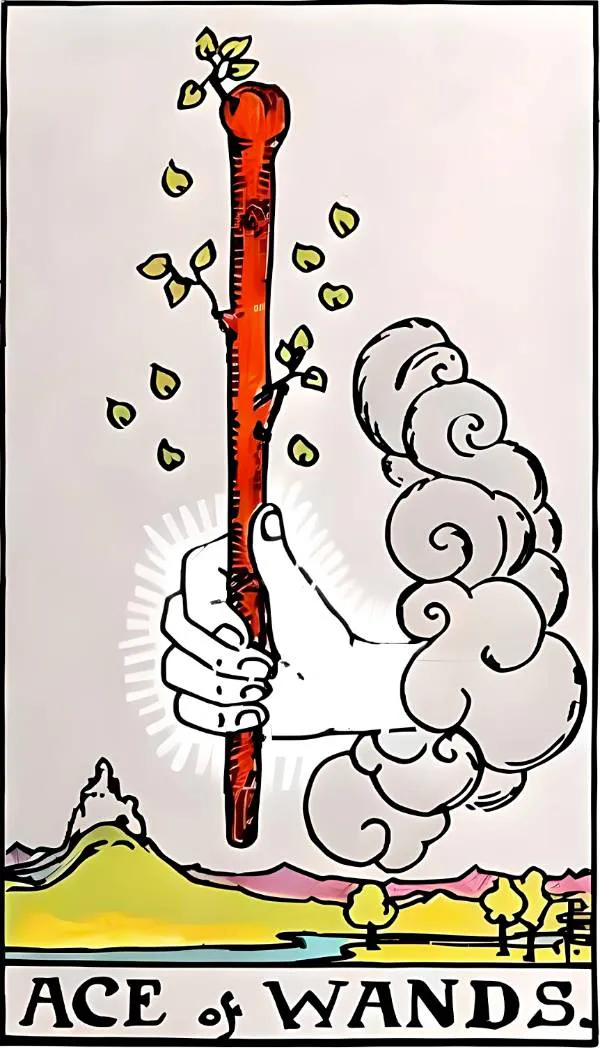
A hand reaches out from the clouds on the right side of the image, firmly grasping the wand. Like the Ace of Swords, it is held by hand, representing the element's exclusive object.
The wand in the Ace is quite thick, with many branches and leaves growing on it.
There is a river on the ground, flowing from the left side of the image towards the inside. On the opposite bank is a thriving green hill with layers of hills, and the highest peak in the lower left corner has a castle or fortress at its summit. The river meanders under the hand, and several trees grow on the bank in the lower right corner.
Detail Pattern Description
Here represents the Ace wand, which is shorter than the ones in the numbered cards, more inclined to represent the substantial power of life. This thick wooden staff gives a feeling like a living tree, with many branches and leaves, just like the trunk of a tree, fully representing the power of the 'Tree of Life'. The hand is gripping the wand forcefully, with the thumb raised for more strength. There are a few leaves falling from above the wand.
The hand tightly gripping the wand represents the firm grasp of life energy, or the appropriation of life resources. From another perspective, this posture of holding the wand also represents the possession of a position and mission. The wand can also be used as a weapon and self-defense, but its lethality is not strong. The authority of the wand comes from the consensus of the people, and it is not necessarily the material lethality or competitiveness of the wand itself.
Looking closely at this hand, it is thick and powerful, showing a healthy and confident attitude. The way this hand holds the wand is different from the sword because the sword has a guard, but the wand is one-piece, so it allows the hand to hold up the thumb. The thumb and the base of the thumb (Venus mound), in Western palmistry, is a symbol of the source of life. The thumb is raised and the Venus mound is clearly visible, representing the exposure of the part of vitality. The thumb is vertical and parallel to the wand, which also allows one to feel the force of the thumb pressing forward.
As for the leaves falling in the picture, it is not only a decorative painting method but also represents the role of power shock, causing the leaves on the tree of life to fall, showing the dynamic of this picture. Leaves are a symbol of life, and the leaves on the trunk are a symbol of life sprouting and growing, while the falling leaves indicate the power of continuous renewal, also representing the dynamic expansion of the tree. The fallen leaves still contain energy and will have an impact on the surroundings, returning to the land to become nutrients. The shape of these leaves is also very similar to the 'Finger of God', representing the divine will of the start of life.
The terrain and appearance of the ground are not monotonous, and it is full of vitality, with rock veins, green land, and trees, as well as undulating hills and rivers flowing through. Although it is like a hot area, it is not dry. This thin river flows from the lower left of the picture across the entire lower part of the picture, representing the pipeline connecting emotions and feelings. Water appears here to indicate that the fire element symbolized by the Ace of Wands contains the water element. This echoes the meaning of the water element in the Ace of Cups containing the fire element (represented by the inverted M mark).
The terrain on both banks of the river is different. The right bank is a flat plain, and the trees on the riverbank echo the wand in the hand, implying the source of the wand - that is, the source of life, starting from nature. The left bank of the river is a layered terrain, and the distant mountains in the back are gray rocky mountains. The water is more moist, and it is a green land. There is a raised hill on the left, once again emphasizing the symbol of masculinity. A towering building stands on the hill, representing a backing and a symbol of power from a commanding height.
The Wand
The central figure in the Ace of Wands is, of course, the wand itself. It is both a symbol and an instrument of will, creation, and inspiration. The wand is usually depicted as sprouting leaves, indicating that it is alive with creative force and potential. In essence, it is a conduit for making the intangible tangible, bringing ideas into the realm of reality.
The Hand
A divine hand emerges from a cloud, grasping the wand. This signifies that the inspiration or creative force behind the Ace of Wands often comes from a higher power or an external source. It is as if the Universe itself offers the wand to the querent, inviting them to take action.
The Landscape
The card often shows a rich, verdant landscape below the hand and wand, signifying fertile ground for the querent’s ideas. The implication is that the environment is ripe for planting the seeds of creativity and taking decisive action.
Clouds and Sky
The clouds from which the hand emerges can be considered a veil between the mortal world and the divine. They may signify mystery or the unknown, but in this context, they are parting to allow divine intervention. The sky is often depicted as clear and bright, emphasizing clarity of thought and purpose.
The Castle
The castle often depicted in the background serves as a symbol of achievement, stability, and long-term vision. It represents the potential end result of the creative endeavor or new beginning heralded by the Ace of Wands. The castle is the culmination of the journey, standing as a testament to the possibilities that lie ahead should one seize the offered wand with conviction and clarity of purpose.

Keeping the Grainy Opening: From Approval-Seeking to a Steadier Voice

The Same Tab Glowed at 4:37—Then One Rough Sentence Moved the Day

Mentor Feedback and Two Decks at 10:43 P.M.; One Bounded Pivot Test

Waiting for Interest Before Studying? Let One Page Offer Evidence

Belonging Is Not a Tone Check: How to Adapt Without Erasing Yourself
