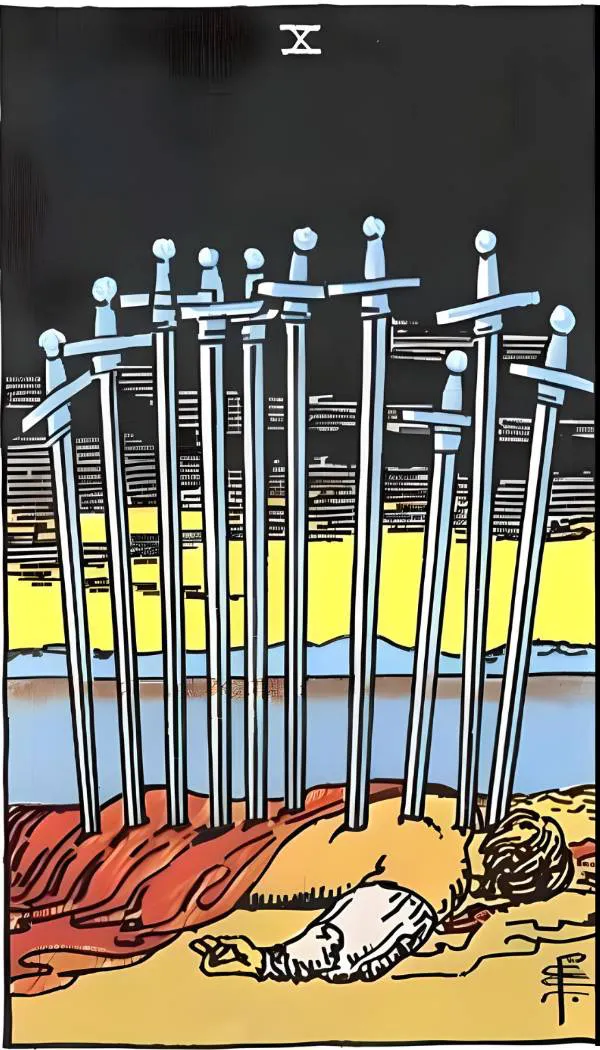
Life Reset PhaseThe calm river and thin yellow horizon sit behind the fallen figure, not as instant rescue, but as proof that the world has not ended with the foreground impact. The ten swords strip the scene down to what can no longer be denied, while the landscape keeps a clean line of passage beyond the damage. A life reset phase begins when the growth system you were using has been emptied of credibility. You are not being asked to decorate the old structure with another method, mantra, or tracker; the card shows a stripped field where the next phase has to be built from observable facts. The reset is difficult because it starts after the performance of progress has stopped. Its leverage is precision: what failed, what remains, what still has a path, and what no longer deserves energy.
Routine CollapseThe body has fallen before the river can be crossed, so the route exists while movement has stopped. That visual tension captures the specific frustration of knowing the next action, seeing the system that used to work, and still being unable to move through it. In personal growth, routine collapse happens when habits, trackers, morning rituals, or discipline structures stop carrying momentum after accumulated overload. You may still know the routine intellectually, but the card shows the body of the system pinned before execution. The insight is not that routine is useless. It is that the old routine may have been built on pressure, not resilience, and its collapse gives you hard evidence about the load it was secretly carrying.
Decision Cliff EdgeThe fallen figure lies at the riverbank, close enough to the crossing for the route to remain visible but too late for the old timing to hold. The calm water and distant yellow light create a sharp threshold: there is still direction, but the previous window has closed around the body. A Decision Cliff Edge appears when delay has become part of the cost structure. You are not simply choosing between options; you are reading what the missed timing has changed, which risks are now unavoidable, and which path still has enough ground beneath it to support a deliberate move.
Sunk Cost Exit DilemmaThe fallen figure is already covered by the full count of ten swords; the sequence has reached completion rather than negotiation. The red cloth and fixed hand gesture show attachment to a structure even after the practical route across the river has closed. Sunk Cost Exit Dilemma fits because the card shows the moment when previous investment becomes visible as weight, not leverage. You can honor what the old timeline cost without pretending it still has a working passage forward.
Family Boundary BacklashThe fallen figure reaches the edge of a possible crossing, but the body is stopped before the river can be used. The swords do not scatter randomly; they are planted with a controlled downward force, turning escape into the exact point of impact. Family Boundary Backlash is anchored in that blocked exit. You may be trying to move out, say no, limit visits, stop explaining, or claim adult privacy, and the family system answers at the threshold rather than inside the old arrangement. The card makes the backlash legible as a structure, not a sign that your boundary was unreal. Pressure increases precisely where the old system detects that your access rules are changing.
Family Estrangement ThresholdTen swords driven into the fallen figure's back create an image of a relationship structure that has stopped pretending it can keep moving. The body lies at the riverbank, close to a crossing, but the route is blocked by the accumulated weight of what has already happened. Family Estrangement Threshold appears here because the card turns repetition into a visible endpoint. You are not looking at one awkward conversation or one bad visit; you are looking at the moment where repeated violations, loyalty tests, or betrayals make automatic access to you structurally impossible without a new boundary. The thin yellow light on the horizon matters because the scene is not only collapse. It marks the first evidence that clarity can exist after the family script loses its authority over your next move.
Friend Group Pile-OnTen swords pin one figure to the ground while the surrounding landscape remains empty of anyone sharing the impact. The visual excess mirrors several trusted friends adding comments, endorsements, or private disclosures after the core point has already been made, turning a dispute into cumulative betrayal. The dark sky ends at a bright horizon, making the pile-on a definable rupture in the friendship system rather than an endless measure of your worth. You can assess the aftermath through concrete changes in trust, confidentiality, and direct access instead of treating the group's numerical agreement as the final description of every friendship involved.
No-Win DecisionThe swords occupy the body's most consequential line with almost administrative precision. Nothing about the arrangement feels accidental; the visual field suggests a decision structure where every available opening has already been assigned a cost. A No-Win Decision is the external stage where choice still exists, but no option offers clean relief. You can use the card to audit which losses are built into the situation, which are being exaggerated by pressure, and where a smaller act of agency can still prevent the whole field from being defined by damage.
Infidelity FalloutThe row of swords is too orderly to read as random impact; each blade has found a vulnerable line along the body. The figure's hidden face and exposed back turn trust into a physical record of what arrived from behind the visible field. In love, that configuration matches the fallout after cheating or a hidden parallel life is discovered. You are not only reacting to one act; the whole evidence trail rearranges the past, making ordinary memories feel like a structure that now has to be audited from the ground up.
Academic Rejection LetterThe swords in this card have already landed, and their arrangement carries the coldness of a decision that has been delivered rather than discussed. The visible crossing and distant blue mountains make the scene sharper: there was a route toward a quieter place, but the body was stopped before reaching it. An academic rejection letter works in the same way when a program, scholarship, supervisor, placement, lab, or publication closes a door that had become part of the student's imagined path. The experience is external and concrete: an institution has said no, and the next version of the route must be rebuilt from the ground rather than from the original plan. The faint horizon keeps the card from becoming a total closure. It does not erase the rejection, but it shows that the blocked path is not the entire landscape. The useful question becomes where the rejection has narrowed the map and where it has clarified which route was never fully supported.