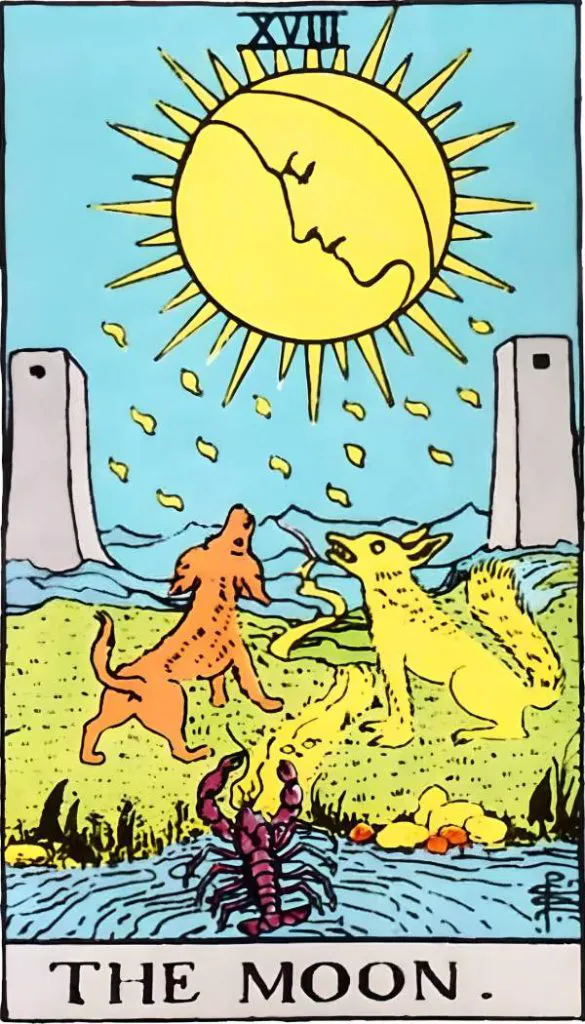
The Moon Tarot Card Meaning

The Moon card conveys the atmosphere of a dimly lit night, filled with an eerie and frightening aura. The moon appears in the dark sky, radiating light and casting dew. The scene on the ground is complex, with a path leading from the water's edge to a gap between two towers. On the land, two animals are howling at the moon, and a crayfish emerges from the water's surface.

The moon hangs high in the night sky, centrally positioned, with a detailed facial expression within its circular shape. The moon's appearance is divided into two parts within the circle, with the crescent-shaped face on the right looking downwards to the left. A thin crescent is added to the far right, resembling hair. The entire moon is of a yellow hue, with the non-facial part being darker, and the illuminated part is on the visible face. The human-like face shows a solemn expression with closed eyes and pursed lips, looking downwards. We can also perceive its compassion, as this face represents the compassionate aspect of the moon, situated above the two towers on the right side, which symbolize mercy.

This depiction of the moon is a common representation, not only found in many tarot decks but also in common illustrations of the moon. The portrayal of the moon's face within a full circle, combining the crescent and the full moon, is an intentional expression of the moon's phases and fluctuations, symbolizing the three aspects of femininity. It also implies that the moon does not emit its own light, unlike stars and the sun.

Outside the moon's disc, there are rays similar to the sun, with two uneven rows. The number of rays is primarily sixteen, with each row having sixteen. The moon's circumference is connected to the spiky rays, totaling sixteen longer primary rays and sixteen shorter secondary rays, making thirty-two rays of varying lengths. This expresses the significance of the number sixteen and its multiples.

Sixteen is the number of court cards in tarot, linking various character images and elemental changes. The number 16 itself is also a mystical number for the moon, as it equals two times eight, or 'two eights,' which is the moon's 'twenty-eight' day cycle. This cycle is also the moon's 28 constellations. Twenty-eight can be transformed into 4 times 7 equals 28, representing a month's four weeks, thus linking the Moon card to the week. Two 'two times eights' can be considered double 28, which is fifty-six, the great cycle of the moon—fifty-six years for the moon to meet the sun at the same point. Of course, 56 is also the total number of minor arcana cards in tarot, and the number of rays connects the major arcana Moon card to the minor arcana.

The two rows of rays actually total thirty-two, half of 56 but representing the minor arcana. This mysterious arrangement creates a connection between the arcana and the 'Kabbalah.' The number thirty-two is also the number of paths on the Tree of Life in Kabbalah, with ten spheres (Sephiroth) and twenty-two channels, totaling thirty-two elemental paths. Thirty-two also represents detailed directional indicators, as a compass has thirty-two directions.

Beneath the moon in the sky, yellow dewdrops are scattered, these droplet-shaped fifteen points are the moon's rays and the night's dew, combined to form yellow-rayed points. This night dew is like tears from the moon, referred to as 'tears of pearl' or the tears of the goddess Isis, nourishing the earth. A closer look at these fifteen points reveals the shape of the Hebrew letter Yod, the finger of God. This indicates that these are not ordinary droplets but a mystical force. These points also serve to connect the moon with the ground.

The number fifteen also holds significance. Naturally, this number is closely related to the moon itself, as the moon's movement causes the phases to change every fifteen days. The fifteen points tell us that all aspects of the moon are contained within them. From a further perspective, the number of droplets from the moon, one less than the number of moon rays (sixteen), indicates the presence of a hidden factor, suggesting the meaning of these fifteen points.

The theme of fifteen has always been associated with religious legends related to the Virgin Mary and the Passion of Christ, and the connection to sixteen is even more significant. This set of numbers is related to the Virgin Mary and the Passion of Christ, often depicted with fifteen rose petals surrounding the Virgin Mary, representing the fifteen joys and sorrows in the life of Mary and Jesus Christ. These experiences are the themes of (MYSTERY), and many European literary, musical, and artistic works have been based on this theme, often presented in sets of fifteen continuous works, representing the three stages of joy, suffering, and glory in the lives of the Virgin Mary and Jesus Christ, culminating in glory or angelic protection after suffering.

In the foreground, there is a body of water, with the shore being land, and the distant view consists of rugged hills, with the two towers forming a gateway. The ground includes both land and water, representing the dual nature of the moon. This body of water is the river of the underworld. The land holds more wonders. The boundary between the land and the pool, right in the middle, is where a path begins, from the shore's center, leading to the realm of death. The winding path stretches long, traversing green fields, mountains, and into the gap between the two towers, extending to the horizon, the unknown territory. This shore is the critical line between water and land, with an undulating meeting point; part of this path is submerged by the current seawater, suggesting it may be even longer, potentially leading to the abyss of the depths.

A crab or a freshwater crayfish emerges from the water. The crayfish is a symbol of Cancer, and in ancient times, the animal of Cancer was indeed this type of crustacean. It pokes its head out of the water, about to climb onto the shore, touching the vertical path by the central shore. At this moment, the crayfish is on the shore and right at the beginning of the path, seemingly coincidental or precise, yet it is just following its natural habit. It moves from the unseen abyss to the visible land, heading towards the land, as if to continue along this path, but perhaps it will sink back.

This path leads to the distance, and if the crayfish climbs up from here and walks on this path, it must endure a painful period to reach the far unknown. Especially since it must pass through the guard of other animals along the way. The journey is full of unknown variables and is difficult to traverse. And this path is only illuminated and guided by the moon's reflected light, not very clear or bright.

On the land by the shore, there are two canine animals, usually dogs (other tarot decks may use two dogs). The two animals in the Waite Tarot's Moon card are similar yet different; the one on the left with drooping ears and a reddish color is a dog, while the one on the right, yellow with erect and pointed ears, is a wolf. They guard the entrance to the Hall of Death, representing a change in the state of life, serving as a warning and guiding force.

These two canines are barking at the moon, representing a reaction to something, filled with feelings or fear, with their fur standing on end. It could be the moon's influence or the unease facing the unknown territory between the two towers, where some message might be revealed, causing primal fear to arise.

The two towers in the card are similar to the towers in the 'Death' card, representing death and the unknown, as well as an area that is difficult to explore. Behind the two towers is a cold, low-lying hill, symbolizing isolation and desolation. The night sky is a dark blue tone, adding to the feeling of loneliness and desolation. Even though the moon in the sky is bright, the unknown territory remains mysterious, creating a great contrast and tension.

The Moon

The primary symbol representing the subconscious, the realm of dreams, intuition, and the ebb and flow of emotions. It sheds a mysterious and fluctuating light on our path, highlighting that not everything is as it seems.

Two Towers

Guarding the distant horizon, they symbolize the boundaries between the conscious and the unconscious. They can also be viewed as dualistic elements present in life: good and evil, male and female, light and shadow.

The Path

The winding path signifies the soul’s journey, representing the complex route we must traverse, filled with illusions and ambiguities, as we navigate life’s challenges and uncertainties.

The Dog and Wolf

These animals symbolize the tamed and wild aspects of our minds. The dog represents the domesticated, familiar parts of our nature, while the wolf embodies the wild, primal, and untamed.

The Pool

The pool at the base of the card represents the subconscious mind, where memories, instincts, and deeply rooted emotions reside.

Fifteen Yods

The drops falling from the Moon, resembling tears, are fifteen in number and reference the Hebrew letter Yod. They symbolize the spiritual gifts or energies descending upon the Earth and also hint at the mysteries of the subconscious.

Crayfish or Lobster

Emerging from the pool, this creature signifies the early stages of consciousness unfolding. Its presence reminds us of the primal feelings and instincts arising from our deepest self.

Psychological patterns in The Moon
Avoidance Coping
The pool occupies the foreground like a dark container, and the path only begins where the creature rises out of it. The water offers concealment, while the land exposes the body to the dogs, the wolf, the towers, and the unclear distance. Avoidance Coping appears when returning to the familiar emotional pool feels safer than testing the next stretch of direction. You may avoid naming what you want, avoid looking at the long-term path, or keep the future vague because vagueness protects you from the discomfort of being seen by your own desire.
Certainty Seeking
The road is present, but it is lit only by the Moon's reflected glow, not by daylight. The towers mark a destination without explaining it, and the animals react loudly to a light that cannot give full certainty. Certainty Seeking turns ambiguity into a demand for a final guarantee before any choice can be made. You may keep asking for one more sign, one more reading, or one more piece of proof, but the card's half-light reveals how the demand for perfect clarity can become the defense that keeps the decision suspended.
Timing Perfectionism
The Moon shows a path that can be followed but not mastered. Its light is partial, the gate is distant, and the animals make the threshold feel more charged than calm. Timing Perfectionism fits because the reversed image turns partial visibility into a demand for perfect conditions. You may wait for the emotional weather, external signs, and practical variables to align so completely that the risk of choosing disappears. In timing questions, this pattern is costly because it hides avoidance inside discernment. The card suggests that the right moment may never arrive as total certainty; it may arrive as enough signal, enough readiness, and enough willingness to move through low light.
Mind Reading
The path between the towers is visible but not well lit, and the moon's closed face offers no direct answer. The animals respond to the sky as if they can decode it, even though the scene gives them only reflected light, distance, and atmosphere. That is how Mind Reading operates inside close friendships. You may treat a late reply, a shorter message, or a shifted tone as if it reveals the hidden truth of the relationship, because not knowing feels more threatening than waiting for clearer contact. The Moon makes this pattern easy to see because its whole landscape is built from partial information. The mind tries to complete the missing parts, but the completion often says more about fear than about the friend's actual intent.
Hypervigilance
The dog and wolf stand under the moon in an activated posture, their attention pulled upward while the route ahead stays narrow and uncertain. The card's whole field feels watched, guarded, and difficult to cross without triggering alarm. Hypervigilance in love follows the same body logic. You begin monitoring tone, timing, facial expression, message length, and emotional availability as if the smallest change could reveal the future of the relationship. The Moon makes the cost visible. Constant scanning promises protection, but under unstable light it can turn fragments into threat signals and keep the nervous system locked at the entrance to the path.
Rumination
The winding path runs away from the water into darkness, lit only by the Moon's partial and reflected glow. The animals keep calling toward the same source, but the scene gives no clear answer back. Rumination follows that same night route: the mind keeps returning to unclear family signals, replaying tone, wording, pauses, and old scenes as if one more pass will make the truth appear. The Moon shows why the loop feels compelling; the material is emotionally loaded, but the available light is too indirect to deliver certainty.
Boundary Diffusion
The shoreline is not a clean border; water, land, and the beginning of the path press into each other under dim lunar light. The crayfish is half in one world and half in another, exposed at the threshold before the route has become safe. Boundary Diffusion emerges when that threshold stops functioning as a boundary and becomes a leak. In a family system, another person's mood can enter your body as guilt, obligation, or panic before you have chosen a response. The Moon makes the mechanism visible through a blurred edge: You are not refusing connection; the map between self and family has become too porous.
Forced Progress
The crayfish has just emerged from the water, touching the beginning of the path before it has fully adapted to land. Ahead of it, the road is long, dim, and guarded by animal alarm. Forced Progress fits the reversed Moon because emergence is being mistaken for readiness. You may push forward the moment something becomes visible, even when the body, resources, or environment have not caught up to the transition. In timing questions, this pattern makes effort feel virtuous while the friction keeps increasing. The card shows that the first sign of movement is not always the signal to sprint; sometimes it is the signal to stabilize before crossing the next threshold.
Catastrophizing
The path narrows toward two remote towers under a dark sky, and the animals respond to the landscape as if the unknown has already become danger. The hills behind the towers are cold and low, making the horizon feel less like open space and more like a guarded passage. Catastrophizing grows when the mind fills missing information with threat. You may experience every life direction as a trap, a dead end, or proof that you are already too late, but the card shows a nervous system interpreting low visibility as catastrophe rather than uncertainty.
Shadow Projection
The Moon's face looks down with closed eyes while the dog and wolf answer it from below, as if the sky has become a screen for instinctive material. The tame and wild animals mirror two sides of the same inner field, both reacting to a light that is indirect and unstable. Shadow Projection appears when disowned fear, resentment, or shame is seen first in someone else. In family dynamics, You may experience a parent's anxiety, sibling rivalry, or inherited shame as if it were simply the truth about you. The card shows projection as a reflected light problem: what feels like direct knowledge may be an old family shadow landing on the present.
Core Struggles in The Moon
Threshold Disorientation
The winding road moves from the pool toward two towers, but it is guided by moonlight rather than daylight, so direction is present without reliable certainty. The animal voices and the rough hills turn the route into a passage that must be felt before it can be confidently mapped. For family readings, that passage captures the disorientation that happens when going home or speaking to parents pulls you between old coordinates and adult self-definition. The card does not frame the lostness as immaturity; it shows a threshold where the map changes while you are already walking.
Relational Boundary Drift
The shoreline under The Moon is not a clean boundary; water laps into the beginning of the path, and the road forms out of the very place where hidden depth meets exposed land. The two towers promise a gate, but the foreground already shows that entry and retreat are not neatly separated. In love, that blurred terrain mirrors boundaries that shift whenever feeling, fear, care, and obligation overlap. You may keep adjusting your edge to preserve the connection, until the relationship no longer shows where your inner life ends and the shared field begins.
Belonging-Authenticity Split
The dog and the wolf stand on the same ground and answer the same moon, but they carry different bodies: one domesticated, one wild. Their shared howl makes the social field feel like a place where both the acceptable self and the unedited self are activated at once. You can want the group and still feel your body resisting the version of yourself that gets approved there. The card holds that split as a structural conflict between belonging and self-recognition, not as a failure to be easier to like.
Inner Compass Overload
The reversed Moon turns the whole scene into a field of competing cues. Reflected light, animal calls, water pressure, the emerging creature, and the narrow path all ask to be read, but none of them becomes a stable center of orientation. Inner Compass Overload takes shape when every signal starts to feel meaningful and therefore none of them can organize movement. In personal growth, that can look like mistaking every fear, body sensation, algorithmic self-help prompt, synchronicity, and ambition spike for an instruction about who you are supposed to become. The card does not say your inner compass is gone. It shows a compass flooded by too many inputs, where the deeper task is not to chase another sign but to recognize the noise field that has swallowed your sense of direction.
Intuition-Reality Split
The road is lit by the Moon, not by direct daylight, and the animals respond upward to the source of the glow instead of forward along the road. The pool reflects, the towers mark distance, and every visible guide carries some distortion. You are trying to separate a real timing signal from fear, projection, and environmental noise. The card gives that split a precise shape: intuition is present, but it reaches you through reflected light, so reality-testing and inner knowing keep slipping out of alignment.
Unseen Cost Bind
The path begins at the pool's edge, partly claimed by water before it winds toward the two towers under faint lunar light. What can be seen is only the surface of the route; the depth beside it and the distance ahead hold costs that are not yet measurable. You are dealing with a choice whose visible benefits are easier to name than its hidden toll. The card anchors Unseen Cost Bind in the gap between a path that appears open and a terrain that withholds what the decision will demand once you step onto it.
Ambiguity Dependence
The reversed Moon keeps the scene functioning under conditions that were never meant to become a permanent map. The droplets keep falling, the animals keep reacting, and the path remains visible enough to postpone crisis but unclear enough to prevent full commitment. That is the structure of Ambiguity Dependence. You are not merely confused; the fog has started doing protective work by keeping the academic claim, topic, or future path flexible and therefore less exposed. In study, this can look like a research question that never sharpens, an essay plan that stays expandable, or a major choice that remains technically open. The card identifies the hidden bargain: uncertainty lowers immediate risk while slowly draining the power to move.
Emotional Secrecy Spiral
The Moon's face is closed while drops fall from it, and the animals below release sound into the night without changing the road ahead. Expression is present everywhere in the image, but it does not become a clear exchange between bodies on the ground. In a relationship, that structure holds the strain of feelings that keep moving indirectly because direct speech feels too exposed or too consequential. You are not facing simple silence; you are inside a loop where every unsaid thing becomes another layer of atmosphere the bond has to breathe through.
Cycle-Action Desynchronization
The Moon hangs over a road that begins in water, while the crayfish, the dog, the wolf, and the falling dew all move in different ways under the same dim field of light. The scene is full of motion, but none of that motion has become clean forward travel; every body is responding to a cycle before the road is fully visible. You are not dealing with a simple lack of effort here. The card frames timing as a mismatch between inner activation, external conditions, and available visibility, which is why pushing harder can increase friction when the season itself has not caught up to the action.
Shadow Integration Strain
The dog, the wolf, and the crayfish divide the landscape into civilized response, wild response, and submerged instinct. They are not decorations around the path; they are the bodies stationed at the point where any future route has to begin. Reversed, the scene shows those forces competing for the same center line instead of forming one usable signal. You may be trying to choose a direction with only the acceptable part of yourself, while the ignored instinct keeps rising from the water and disrupting every clean plan.
Inner Emotions in The Moon
Existential Vertigo
The winding path begins at the water's edge and moves toward two distant towers, but the moonlight never makes the whole route plain. You can see enough to know there is a direction, yet not enough to feel fully oriented inside it. That visual tension turns the future into a moving target. The card holds the exact sensation of standing before a life path that exists in outline while refusing to become clean, measurable, or easy to explain. Existential Vertigo appears when the question is not simply what to do next, but whether any available direction can carry the weight of who you are becoming. The Moon keeps your agency intact by showing that the dizziness comes from partial visibility, not from a lack of inner capacity.
Social Vertigo
The winding path between the pool and the towers gives the reversed Moon a disorienting social geometry. The road is visible, but the reflected light, leaking thresholds, and distant gate make the scene feel navigable and unstable at the same time. Social Vertigo names the feeling of losing your inner reference point inside a group field. You may know the roles, chats, invitations, and circles exist, yet still feel unsure where your body is supposed to stand or which version of you is being read.
Directionless Urgency
The winding path leaves the pool and runs toward the two towers, but the only light on it is the Moon's reflected glow. The route is visible enough to create motion, yet not clear enough to settle the body into trust. That is the exact weather of a life system that feels like it has to be fixed immediately while refusing to show the next reliable step. You can sense the pressure to repair sleep, food, work rhythms, screen habits, and domestic order, but each option appears under partial light. Directionless Urgency emerges from this mismatch between movement and orientation. The card holds the body at the start of a path, already activated, already called forward, while the practical blueprint remains too dim to read without distortion.
Relational Anxiety
The dog and wolf howling under the Moon create a scene where instinct is awake before language has arrived. Their bodies are fixed on a distant, indirect light, while the path ahead remains visible enough to follow but too dim to trust completely. That is the emotional architecture of Relational Anxiety in love. You are not reacting to a clear rupture; you are reacting to the unstable space between closeness and uncertainty, where every small signal starts carrying too much weight. The Moon gives this feeling a precise shape: a relationship can still be present and still feel unreadable. The card does not turn ambiguity into certainty; it shows why your nervous system keeps searching the shadows for evidence of where you stand.
Submerged Anxiety
The pool at the bottom of the card is not decorative; it is the place the crayfish rises from before the path even begins. Water touches the road, the shore wavers, and the moon's drops fall through dark air, making the visible world feel fed by something underneath. For study, that creates anxiety that arrives before a clear reason does. You may sit down with readings or revision notes and feel pressure coming up from below the surface, as if the problem is not one assignment but the whole unseen load behind it.
Intuitive Self-Doubt
The Moon's face looks downward with closed eyes while the dog, wolf, and crayfish all respond from instinct rather than evidence. The scene is lit by borrowed light, so perception is active, but none of it arrives as a crisp spreadsheet of proof. Intuitive Self-Doubt in career shows up when you sense a shift in the room, a hidden power move, or a mismatch in someone's feedback, then immediately question whether you are reading too much into it. The card gives that uncertainty a shape: your intuition is picking up low-light information, and the work is to audit it without dismissing your own signal.
Decision Dread
The winding road begins at the waterline and runs toward two distant towers, but the endpoint never fully resolves. The Moon makes the route real without making it reassuring. Decision Dread is the heaviness of knowing that standing still is also a choice. In a crossroads question, this card captures the moment when the cost of not choosing starts pressing as hard as the risk of moving.
Suppressed Rage
The dog and wolf in the Moon are not silent, but they are not advancing either. Their force gathers in the throat, their bodies stay at the threshold, and the path remains dimly available without becoming a place of free movement. Suppressed Rage fits the reversed Moon because the emotion has energy but no safe route. In family systems where direct anger is punished, mocked, or turned back on you, the body learns to hold the charge in controlled forms: clipped answers, shutdown, private arguments, or sudden sharpness. The card makes that pressure visible without turning it into a command to explode. It shows anger as a blocked signal from the instinctive self, asking to be recognized before it is forced to keep speaking through distortion.
Adult Child Panic
The dog and wolf barking under the Moon turn the entrance of the path into a nervous threshold. Their bodies are not calmly walking forward; they are reacting upward, caught between instinct and warning, while the crayfish rises from the water at the exact point where the journey begins. That physical arrangement mirrors the way family contact can pull an adult self back into an older nervous system. The path exists, but the first step is surrounded by alarm signals, blurred boundaries, and the sense that something ancient in the body has already reacted before the mind can organize itself. Adult Child Panic belongs to this card because the Moon does not show a clear external attack; it shows an atmosphere that makes the body regress into primitive defense. You may know you are grown, capable, and separate, yet a family tone, look, or message can still make the inner weather feel suddenly small, exposed, and braced for impact.
Wrong Choice Panic
The dog and the wolf howl at the same moon from opposite sides of the path, turning one route into a chamber of competing signals. The gateway ahead is open, yet it is guarded by instinct, conditioning, and the imagined consequences of choosing badly. Wrong Choice Panic emerges when every option starts carrying the ghost of the option you might lose. The card does not frame the panic as weakness; it shows a nervous system trying to make an irreversible-feeling call under low light.
Outer Contexts in The Moon
Third Path Search
The winding road begins at the waterline rather than inside the guarded towers, giving the scene a route that is present but not immediately owned by either side. The crayfish touches the start of that road from a marginal place, and the moonlight makes the path visible without making it simple. That is the structure of a third path search. You are not only deciding between two displayed options; you are testing whether the frame itself is too narrow, whether the real movement begins at the edge of the obvious comparison. The card keeps agency in the act of mapping. It does not promise an easy alternative, but it shows that the route worth investigating may begin where the current decision language has no clean category yet.
Risk Blind Spot
The road is visible, but the light that reveals it is reflected and incomplete. Beyond the shoreline, the route bends through low hills and toward towers that cannot show what waits on the other side. That visual field matches a risk blind spot. You can see enough to build a confident argument for one option, while the real exposure sits outside the current evidence set: timing risk, reputational cost, dependency risk, or an assumption no one has tested. The card gives the uncertainty a location. Instead of treating risk as a general mood, it turns the question toward the uninspected stretch of the road and asks which part of the decision has been made visible only because the harder part is still in shadow.
Pathless Transition
The path is visible only in fragments: it begins where water still interrupts the ground, winds through a dim field, and disappears toward distant towers. The crayfish has emerged, but its body is still marked by the environment it is leaving. That is the pressure pattern of a pathless transition. You are not simply undecided; the external route itself has lost stable markings, so ordinary planning tools cannot fully restore direction. The card gives shape to the stage where movement has begun before the map has caught up, which is why the future can feel both unavoidable and unreadable.
Premature Launch Pressure
At the shore, the creature has surfaced before the road has become hospitable. The dog and wolf flank the entry zone, so the first step onto land is not just movement; it is exposure under pressure. This fits the external demand to launch, announce, decide, or prove momentum before the route has enough support. The Moon’s light makes the threshold visible, but its dimness also shows how risky it is to confuse visibility with readiness. The reversed Moon links this context to premature pressure because the scene compresses emergence and scrutiny into the same moment. Your agency comes from separating a real opening from a forced performance of readiness.
Bad Timing Loop
The road under the Moon does not disappear, but it keeps refusing clean timing. The creature is caught at the edge of emergence, the towers narrow the distant passage, and the falling droplets create contact without giving the ground a stable feedback system. This is the loop of moving too soon, pulling back, waiting too long, and then pushing again under the same low visibility. The problem is not a missing desire to act; it is an external rhythm that keeps producing unclear signals and poorly timed openings. The reversed Moon anchors this context through a path that can be seen but not trusted at full speed. You regain agency by naming the loop itself, because the first leverage point is no longer effort, but rhythm detection.
Situationship Ambiguity
Under the closed-eyed moon, the road is visible enough to follow but not bright enough to confirm what lies beyond the towers. The dog and wolf keep reacting at the threshold, and the crayfish has only just surfaced from the water, so the whole scene sits between contact and definition. That is the structure of a situationship: a romantic path exists, but its rules, destination, and level of commitment stay half-lit. You receive signals that keep the connection alive, yet the relationship never fully steps onto land where status, exclusivity, and expectations can be named. The card's pressure is not the absence of chemistry; it is the cost of navigating by reflected light. Clarity returns when you separate real movement from signals that only make the road feel possible.
Pathless Social Transition
The road begins clearly at the shore, then bends through hills and disappears between towers under unstable light. The crayfish has left the water enough to be exposed, but not enough to be securely established on land. That layout captures a social transition where the old circle no longer holds you, and the next circle has not become real yet. You are not without movement; you are in a liminal stretch where the route has to be tested before it can become a social identity, a rhythm, or a place to belong.
Friendship Boundary Creep
The path begins exactly where water becomes land, with the crayfish touching the threshold and the two animals flanking the route ahead. That image makes the boundary visible, but not settled: there is a line between private depth and shared territory, yet every figure in the scene is already reacting across it. In friendship, this maps to access that expands through hints rather than agreements. Late-night messages, assumed availability, old loyalty, and unspoken expectations can keep moving the line while everyone acts as if the line is obvious. The Moon gives this situation a clear outer shape: the issue is not whether the bond matters, but whether the entrance to your time, attention, and emotional bandwidth has become too foggy to protect. Once the threshold is named, the friendship can be examined as a structure rather than treated as a test of personal devotion.
Off-Script Family Path
The winding road begins at the waterline and moves toward a distant gap between two towers, lit only by the moon's borrowed light. The crayfish has just left the pool, but the land ahead is not yet a secure home; it is a threshold with no bright map. Inside a family system, that image captures the moment when you begin moving away from the inherited route. The choice may involve career, marriage, location, belief, identity, or lifestyle, but the pressure is the same: the old family map still has gravity, while the new path has not yet proved itself to anyone watching. This card connects the context to the reality of leaving a script before you have a clean replacement narrative. It does not treat the uncertainty as failure; it names the passage as structurally dim, socially monitored, and still available to be walked with clearer agency.
Family Script Pressure
The road is already drawn before the crayfish fully leaves the water, and it leads toward two fixed towers under a patterned sky. The moon's repeated rays and droplets create a rhythm that feels older than the creature now arriving at the path. That is how family scripts often work: the route exists before the individual has language for choice. The household may carry assumptions about education, career, marriage, gender roles, money, caregiving, or respectability, and your adult life is measured against that inherited template. The Moon links this context to pressure that operates through atmosphere rather than explicit instruction alone. You may not be directly ordered at every step, but the map has been drawn around you, and the work is to identify which parts of the route are yours to keep and which parts were installed before consent.