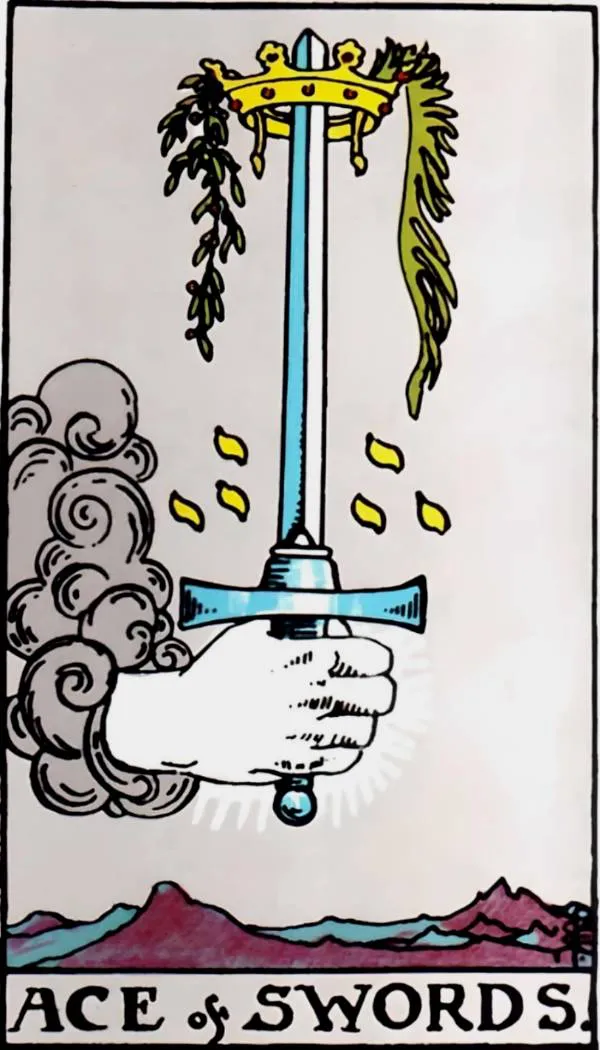
Ace of Swords Tarot Card Meaning

Overall Card Structure

A hand extends from the clouds, firmly grasping a brilliant sword.

The tip of the sword is fitted with a crown, a golden crown adorned with jewels, shaped like six six-petal flowers. On both sides of the crown, different plants hang: the plant on the left has small fruits, which is the olive tree; the cluster of leaves on the right is palm.

The hand holding the sword has a glow, and above the guard of the sword, there are several bright yellow symbols that represent the dazzling light of the sword in the shape of Hebrew letters.

The background of the picture is an empty sky and a barren ground, with the ground being a blue-purple undulating hill.

Detailed Pattern Description

The appearance of this sword is medium in length and not wide, with a round guard. The size of the hilt is also suitable for the hand, and there is a small spherical decoration at the end, which is not sharp. Both sides of the blade represent two directions of action.

The hand holding the sword is strong and decisive, and this hand should also have a quick response ability. This hand firmly grasps the hilt, which is a knuckled Saturn hand, representing wisdom and deep perseverance. This hand firmly holds the sword, as if it were exercising, and in fact, you can see the light or magnetic field around the hand, indicating the infusion of Qi and strength.

This sword raised upwards represents the power of thought. If a person's hand holds the sword in the same posture as in this picture, it means that he is executing with a belief, and his current action may be slow, but as long as there is a change, if he wants to achieve any goal, he should be able to break through like a bamboo. This is also a snapshot of determination and persistent power. In fact, the sword is not completely upright, and the angle is slightly tilted, which is to express a sense of dynamics, because the sword is swinging.

Now this sword also penetrates the crown, lifting the crown with the sword. The crown represents a symbol of nobility and is also the highest guiding principle of alchemy, representing that the ultimate purpose of the sword is to pursue this crown. The picture shows the hand holding the sword accurately piercing the center of the crown, representing the capture of the highest spiritual wisdom. The crown has six petal-shaped protrusions (but only four are shown in the picture), representing glory, wisdom, and beauty and peace.

The crown is adorned with different plant branches and leaves on both sides. On the left is the branch and fruit of the olive tree, and on the right is the palm leaf. The olive plant has been valued by many civilizations since ancient times, often regarded as a sacred tree in religion, and also an indicator of civilized life, providing many practical uses. Olive is a symbol of peace, kindness, and hope for the future, and also represents the pillar and axis of the world. The image of the olive with many fruits symbolizes a bumper harvest, and can be refined into olive oil, thus symbolizing purification, refining, refining, and refining. Olive oil has many functions, delicious and pure in food, and can also be applied to the body and utensils. Therefore, it symbolizes the nourishment of life and the light of enlightenment. The palm represents wisdom and connects to the "High Priestess". Both of these main plants are important sacred trees in many cultures, especially in the Mediterranean civilization's religion. They also represent glory and victory, and holiness. The combination of the two is the palm, which is the most nourishing, especially in the local desert climate.

Those few bright yellow symbols can be regarded as the light of the sword, a soft and faint light, all the light waves of wisdom. This is also the "Finger of God" that appears again, connecting to all the cards with this pattern in the picture, and also represents the meaning of infinite potential. Six light spots are above the hand and the hilt of the sword, half on both sides of the sword, representing glory. Six also echoes the number of petals on the crown.

The sky is the activity field of the sword, and if the sword is not swung in the air, it is sheathed. The background is a light grayish-blue-purple tone, and the barrenness of the surface is exhausted, and the lack of moisture and emotion of the sword is undoubtedly revealed here. The cold purple rocky hills represent the spiritual level and cool wisdom.

The Upraised Sword

The primary symbol, an upright sword, signifies the clarity of thought and the intellect. It heralds a moment of revelation or new insights. The double-edged nature of the sword also represents duality, suggesting decisions that have both positive and negative consequences.

The Crown

Above the sword is a crown, indicating mastery, authority, and the realm of ideas and intellect. The crown symbolizes success but reminds that it comes with responsibility.

The Laurel and Palm Fronds

Encircling the crown are a laurel and a palm frond. The laurel signifies victory, and the palm frond symbolizes peace. Together, they represent the balanced outcome of intellectual pursuits or battles.

The Cloudy Sky

The background shows a sky with clouds, representing the realm of the unknown. The sword’s point penetrates these clouds, symbolizing clarity piercing through confusion and uncertainty.

The Mountains

In the distance, mountains are visible beneath the clouds. They symbolize challenges and obstacles but also the heights that can be achieved through intellectual clarity and focused will.

The Hand Emerging from the Cloud

A hand appears from a cloud, holding the upright sword. This signifies divine intervention or the abstract form of thought and intellect coming into concrete reality. It acts as a bridge between the divine or universal knowledge and human understanding, presenting the sword as a gift or tool to be used wisely.

Psychological patterns in Ace of Swords
Timing Discernment
The hand rising from the cloud grips the sword with enough firmness to give thought a body. The blade does not wander through the sky; it creates one clean vertical channel through the uncertain air, with the crown held at the point where insight becomes directed action. That visual structure mirrors Timing Discernment because the card is not only about having an idea. It shows cognition becoming precise enough to distinguish signal from noise, opening from pressure, and readiness from urgency. The empty sky around the blade matters: there is space to see the timing field before the strike lands. For You, this pattern names the difference between forcing momentum and recognizing the moment when momentum is actually available. The sword's clarity does not erase uncertainty; it cuts through the part of uncertainty that is only mental fog, leaving the real conditions visible enough to act with less friction.
Boundary Discernment
The sword rises from a single hand into open air, with each element held in clean separation: hand, blade, crown, branches, sky, and distant ground. Nothing bleeds into anything else, and the card's force comes from the precision of its boundaries. That structure maps onto the ability to separate emotional truth from emotional merger. The sword does not deny connection; it gives connection a line, a language, and a shape that can be held without collapsing into confusion. In love, this pattern names the moment when clarity protects intimacy rather than cutting it off. You can care about someone while still distinguishing your need from their reaction, your boundary from their disappointment, and honest communication from emotional control.
Intellectualization
The sword rises straight through the cloud, turning uncertainty into a clean mental axis. The crown at the tip makes the intellect look elevated and controlled, while the hand's firm grip keeps the whole image organized around thought rather than feeling. That is the useful side of Intellectualization: the mind creates enough distance to see a social situation without being swallowed by it. The danger is subtle, because the structure can feel so clear that emotional data starts to look like interference. In social ecosystems, You may explain a group's dynamics perfectly while still not letting yourself feel whether you are lonely, guarded, bored, or genuinely connected. The Ace of Swords holds the blade of insight high, but the barren landscape below shows the cost of relying on cool analysis as the only social instrument.
Feedback Integration
The cloud-borne hand does not hover vaguely; it grips a straight sword and turns an abstract flash into a usable instrument. The yellow light around the hilt makes the moment feel like raw information becoming structured enough to hold, aim, and apply. That is the psychology of Feedback Integration: a signal arrives from outside the usual self-story, and the mind has to decide whether to defend against it or metabolize it. In personal growth, the sword's clean line shows the difference between taking feedback as identity threat and using it as a precise cut through confusion. You are not being asked to accept every opinion as truth. The pattern reveals the moment when critique, reflection, or sudden clarity can be separated from shame and converted into a next move that actually changes the system.
Emotional Cutoff
The sword stands in a dry, pale field of sky and stone, held by a disembodied hand that has no visible face, heart, or lower body. The image privileges clean thought, edge, and elevation while the ground below carries almost no moisture or softness. Emotional Cutoff appears when your lifestyle system is run by clean logic while bodily and emotional feedback gets edited out. You can keep functioning, scheduling, and deciding, but fatigue, need, irritation, and recovery signals are treated as noise instead of data. The Ace of Swords links the pattern to precision rather than chaos. The problem is not that the blade is weak; it is that the blade has been asked to manage a whole life without listening to the living ground beneath it.
Analysis Paralysis
The sword looks decisive, but it is also suspended in empty sky, held in a moment before contact. The hand grips the tool, the crown marks the target, and the barren ground below remains untouched, creating a visual loop of intention without execution. Analysis Paralysis grows from that suspended force. You may keep refining the thesis, comparing sources, and waiting for the cleanest possible angle, while the actual draft stays outside the blade's reach because the mind is trying to solve uncertainty before allowing itself to begin.
Black-and-White Thinking
The sword's two edges create a strict split, and the point pierces the crown through a single central line. Around it, the sky is bare and the hills are cold, leaving very little softness for ambiguity or partial progress. Black-and-White Thinking appears when your lifestyle rules become as sharp as the blade: the day is either optimized or ruined, the habit is either perfect or pointless, the routine is either clean or contaminated. The mind uses a hard edge to reduce uncertainty, but the cost is a system that cannot absorb ordinary variation. The Ace of Swords makes the mechanism visible because clarity is powerful here, but under pressure it becomes a binary filter. The same edge that can simplify life can also erase nuance from it.
Certainty Seeking
The hand grips the sword in a single, clean vertical line, lifting the blade through open sky toward the crown. Everything in the image is organized around separation: cloud from hand, blade from air, crown from barren ground, thought from the emotional texture below. That visual sharpness mirrors a mind trying to stabilize itself through certainty. In direction questions, the sword becomes the wish for one unmistakable answer that can cut through the noise of future possibility and make the next chapter feel objectively correct. Certainty Seeking is not a failure of courage; it is a control strategy. The card reveals how clarity can become a gatekeeper when You wait for the whole route to become sharp before allowing yourself to move.
Inner Critic
The sword pierces the crown directly through its center, as if even the symbol of mastery must be tested by the blade. The hand holds the instrument with unwavering pressure, and the surrounding light makes the edge feel exposed, exacting, and impossible to ignore. Reversed, this visual precision can turn inward as scrutiny. The same blade that could clarify hidden material begins to inspect every motive, shame every inconsistency, and demand a pure explanation for feelings that are not meant to be pure. In introspection, the result is self-awareness with teeth. You may call it honesty, but the mechanism is often correction: every shadow, flaw, or contradiction gets cut open before it can be understood with any warmth.
Rumination
The sword's single vertical line is powerful because it concentrates attention. Reversed, that same concentration can become a mental corridor with no exit, where the mind keeps returning to one phrase, one face, one pause, or one unread message. Rumination is not random overthinking; it is an attempt to use the blade of analysis to extract certainty from social ambiguity. The problem is that the blade keeps cutting the same material, so the thought becomes sharper while the situation becomes no clearer. After a social event, You may replay the moment that felt slightly off until it starts to define the whole interaction. The Ace of Swords shows the mechanism exactly: insight turns into an inner loop when clarity is demanded from a field that only gave partial information.
Core Struggles in Ace of Swords
Inner Compass Overload
Crown, olive, palm, light, and blade all balance on one narrow vertical instrument. The whole image concentrates authority, peace, victory, and thought into a single axis, while the hand must keep that axis steady without any visible body or ground beneath it. You may be asking one inner answer to carry too much: timing, purpose, identity, risk, approval, and the shape of the next decade. The struggle is not that your compass is missing; it is that the compass has been overloaded until every direction feels too heavy to hold.
Internal Authority Collapse
The sword offers a brilliant reference line, but in the reversed structure that line can become the only axis left. The hand still grips and the blade still looks clean, yet there is no grounded body beneath it and no wider landscape of feeling to correct its angle. In family systems, this is how an inherited voice can start posing as inner wisdom. The logic may sound clear, mature, or responsible, but it keeps returning you to standards that were built to preserve the family structure rather than your self-trust. The collapse happens quietly. You still make decisions, still explain yourself, still sound reasonable, but the authority behind the choice has shifted away from your own center and back into the family's old ruling line.
Responsibility-Authority Split
The hand grips the sword firmly enough to hold the crown, palm, and olive in alignment, but all of that symbolic weight rests on a narrow point suspended in the air. The image gives the hand responsibility for balance without giving it ground, footing, or a visible support structure. In career terms, that is the pressure of carrying outcomes before the workplace has matched your load with authority. You may be asked to decide, lead, fix, absorb risk, or represent a direction while the title, mandate, budget, or political cover remains elsewhere. Responsibility-Authority Split names that structural mismatch. The Ace of Swords shows the force of decision, but it also shows the cost of being made the stabilizing hand for a crown you do not fully control.
Consequence Lock
The hand grips the hilt firmly while the crown, olive, and palm are held on the sword tip above it. A single point carries the symbolic weight of victory, peace, and authority, so the smallest shift in the blade changes the balance of everything attached to it. That is the shape of Consequence Lock in a major choice. You can sense that choosing will not just select an option; it will redistribute status, safety, desire, and future obligation around one irreversible line.
Truth-Connection Split
The hand in the clouds does not hold a soft object; it holds a double-edged sword, lifted through the crown and flanked by signs of peace and victory. The image makes truth, recognition, and social peace share one narrow vertical line, so clarity arrives with a cost built into its shape. In social life, that structure mirrors the moment when naming what is real may cut through the atmosphere that keeps a group comfortable. You can see the issue clearly, but the same clarity that restores your inner alignment may threaten the connection you are trying to preserve. Truth-Connection Split lives in that pressure point: the blade can open a clean path, but it cannot guarantee that the circle will stay intact after the cut. The card gives form to the struggle of knowing that silence protects belonging in the short term, while honesty protects the self that wants to belong without disappearing.
Vision-Execution Split
The sword is held with precision, but its blade is not cutting into the terrain below; it is lifting a crown in the open sky. The tool of thought is elevated into a symbol of achievement, while the ground where work would actually be done stays distant and dry. That distance gives this card its career pressure. You may have a clean insight, a sharper plan, or a strategic read on what needs to happen, yet the path from that mental clarity to visible execution is not physically present in the scene. Vision-Execution Split names the gap between knowing what would move the work forward and having the grounded structure, mandate, or leverage to make it happen. The Ace of Swords does not dilute the clarity; it shows why clarity alone can feel exposed when the workplace has not built a runway for action.
Boundary Ambiguity Lock
The reversed blade gives the eye no stable ground for judging what counts as straight, fair, or too sharp. Cloud, empty sky, tilted steel, and distant barren hills leave the hand holding the only reference point. That is the geometry of a friendship where every boundary can be reinterpreted as rejection, coldness, or overreaction. You may not be confused because the issue is small; the reference system itself keeps shifting around what care is supposed to cost. Boundary Ambiguity Lock is the state where clarity exists but cannot settle into a shared line. The card's inverted structure shows the boundary tool still present, while the field around it makes every edge feel arguable.
Clarity-Exposure Split
The sword rises out of a clouded sky and creates the strongest vertical line in the card, while the barren hills below offer no soft landing for what gets revealed. The image gives clarity a physical shape: sharp, bright, elevated, and difficult to ignore. In a relationship, that kind of seeing can feel exposing because it does not only answer a question; it reorganizes the whole field. You are not just noticing a detail, you are watching the idea of the relationship meet the evidence of the relationship. The struggle lives in the gap between wanting the truth and fearing what the truth will uncover. The card holds that gap as a clean blade through uncertainty, showing how insight can become both relief and exposure at the same time.
Clarity-Timing Split
A hand breaks from the cloud holding a clean, raised sword, while the ground below stays barren and distant. The blade carries a precise line of thought into the open sky, but the scene gives that thought no body, road, or prepared surface to enter. That is the exact shape of Clarity-Timing Split. You may have the insight, the sentence, the decision, or the strategic cut, yet the timing field around it has not become usable enough for the move to land. The card holds clarity and season apart without making either one wrong. It shows a sharp internal signal suspended above an external landscape that still needs the right moment, the right texture, and the right opening.
Knowledge-Output Gap
The hand emerging from the cloud holds a clean, brilliant sword, but the card gives that hand no body, desk, page, or grounded surface where the insight can land. The blade is perfect as a line of thought, yet the scene suspends it in open air, separating mental sharpness from the slower material act of making something finished. In academic work, that separation becomes the Knowledge-Output Gap. You may understand the reading, see the thesis, or know what the essay should argue, while the transfer into writing, revision, or exam performance still jams at the point of contact. The crown at the sword's tip intensifies the pressure because the idea is not neutral; it is already carrying proof, mastery, and visible achievement. The struggle is not a lack of intelligence, but the structural distance between having a clear cut of thought and producing work that can survive being seen, marked, and judged.
Inner Emotions in Ace of Swords
Decision Dread
The sword is raised, double-edged, and slightly tilted, as if the cut is already gathering momentum. Beneath it, the rocky hills offer no warm landing place, only a stark field where the consequences of action feel exposed. Decision Dread forms when the mind recognizes that staying undecided is also a kind of movement. In this reversed texture, the blade becomes less like clarity and more like the pressure of an approaching cut, especially when every option seems to remove something you still value. For a crossroads question, the card captures the inner weather of knowing that the decision matters before knowing which cost you can live with. You are not weak for feeling the dread; the system is showing you that the real issue is not choosing fast, but identifying which loss is honest.
Clarity Shock
The sword rises from a clouded sky and punctures the crown at its center, turning scattered atmosphere into a single, sharp line. In a relationship, that image mirrors the moment when one sentence, text, or admission suddenly organizes months of noise. The shock comes from how clean the symbol is: the blade does not negotiate with the fog, and the crown is held by the point rather than by warmth. You may recognize the truth before your feelings have caught up, leaving the inner system bright, alert, and newly exposed.
Certainty Hunger
The empty sky leaves the sword as the only decisive object in the scene. The hand grips it with such functional pressure that the blade begins to look like the one structure capable of organizing everything else. Certainty Hunger appears when the desire for a clean answer becomes stronger than the capacity to stay with complexity. In a choice reading, this can feel like needing one signal, one principle, one final argument that will end the discomfort of holding multiple realities at once. The reversed Ace of Swords shows how the hunger for certainty can become more intense than the decision itself. The card does not shame that hunger; it reveals where the need for relief may be masquerading as the need for truth.
Sterile Clarity
The sword’s metal, the hard crown, and the dry blue-purple hills create a scene where precision is abundant and moisture is absent. Even the olive and palm hang from the crown rather than growing from the ground, so nourishment appears suspended above the body of the landscape. In academic work, Sterile Clarity shows up when you understand the material but cannot feel any living connection to it. You may be able to outline the argument perfectly while sensing that the work has become polished, cold, and emotionally airless.
Truth Relief
The hand rising from the cloud holds the sword with a grip that is firm but not frantic, and the blade enters the open sky as one clean line. In a friendship reading, that visual precision turns hidden relational pressure into something finally nameable. You may have been carrying a vague sense that a friendship was uneven, too demanding, or quietly conditional. The Ace of Swords gives that feeling a defined edge, not to make you colder, but to stop the inner blur from draining you. Truth Relief belongs here because the card shows clarity arriving as a physical object: bright, sharp, and lifted into view. The relief is not about everything becoming easy; it is the nervous system loosening because the unspoken pattern has finally become visible.
Quiet Certainty
The sword is not lost in motion; even with its slight tilt, it keeps a single upward focus against the wide sky. The distant hills remain readable beneath it, giving the image a spare, steady horizon. In friendship, Quiet Certainty appears when you no longer need the group, the old history, or the other person's reaction to authorize what you already know. The card's sharp light gives form to an inner knowing that has stopped negotiating with every possible interpretation. This certainty is quiet because it does not need to perform dominance or become cruel. It is the felt steadiness of having enough clarity to speak a boundary without turning the friendship into a courtroom.
Focused Confidence
The strong hand closing around the hilt gives the blade a stable center. The sword is raised, but it is not thrown upward in panic; the grip, guard, and crown align into a controlled line of intention. Inside a career question, that control becomes a felt capacity to cut through noise. You can recognize the skill, argument, boundary, or strategy that actually matters, and your attention no longer leaks into every possible objection. Focused Confidence is the inner weather of competence becoming usable. It is not loud certainty or forced bravado; it is the clean bodily sense that your mind has found the handle and can hold it.
Pattern Recognition Calm
The six lights around the sword echo the crown’s petal structure, while the blade creates a single vertical axis through the open sky. The scene is sparse, but its repetitions make the emptiness readable. For psychological clearing, that geometry becomes a map of scattered signals arranging themselves into order. Pattern Recognition Calm is the quiet settling that appears when You can see the shape of a loop without being swallowed by every detail inside it.
Disciplined Calm
The grip around the sword is firm without looking frantic, and the crown carries olive and palm as living signs attached to a hard metal axis. Force, nourishment, and order are held in one controlled vertical structure. That arrangement gives discipline a different emotional temperature. In lifestyle work, it points to the calm that comes when a routine is not used to punish the self, but to protect sleep, attention, health, and the basic dignity of a livable day. Disciplined Calm belongs here because the sword does not scatter its power. You are being shown a form of structure that can cut excess while still leaving room for what keeps life usable and human.
Cognitive Overwhelm
The reversed sword gathers too many meanings onto one narrow axis: crown, lights, olive, palm, blade edge, and distant ridge all competing for interpretation. The image still has intelligence, but the concentration of symbols makes the mind work harder than the body can comfortably hold. That is the texture of Cognitive Overwhelm in lifestyle questions. You are not simply busy; you are trying to solve sleep, health, work rhythm, clutter, money, meals, and attention as if one perfect mental framework could stabilize everything at once. The reversed Ace of Swords names the point where clarity becomes overloaded by its own ambition. The card does not ask you to abandon thinking; it shows where the thinking system has become too crowded to create usable order.
Outer Contexts in Ace of Swords
Analysis Paralysis
The sword is sharp, raised, and slightly tilted, holding motion inside a single suspended line. Its two edges create opposing directions at once, and the open sky gives the mind space to keep extending the question without landing it anywhere concrete. The crown at the tip raises the stakes because the decision is not merely practical. It touches self-definition, principles, and the need to be mentally correct before anything moves. In introspection, this becomes the trap of processing the inner world so thoroughly that every insight produces another branch of interpretation. You are not lacking awareness; the structure shows awareness becoming a closed airspace with no grounded path for integration.
Strategic Exit Window
Firmly grasped by a cloud-borne hand, the sword is already angled with motion. It is not resting, waiting, or displayed as decoration; it is a tool caught at the moment when a precise cut can still be made. That visual timing matters for a Strategic Exit Window. The external situation has not fully closed, but the structure is asking for clean separation before the old track turns into a heavier lock-in. The Ace of Swords connects to this context because its clarity is active rather than theoretical. You are being shown the difference between understanding that a cut is needed and recognizing the window in which the cut can still protect your agency.
Decision Cliff Edge
The sword is double-edged, lifted high, and aimed through the crown with no soft surface around it. Its clarity is useful because it cuts, and that cut makes a line between what can continue and what must be left outside the new structure. In lifestyle terms, this is the edge where a decision stops being a mood and becomes an architecture. Changing sleep, work availability, home setup, spending, social bandwidth, or health routines may create relief, but it also removes the old compromises that kept every option half-open. The crown above the barren hills shows why the choice carries weight. A cleaner daily system may be available, but it requires the authority to let one path become real and allow other paths to close.
Opportunity Cost Tradeoff
The double-edged sword carries the crown between olive and palm, making gain and cost visible in the same object. The image gives you one blade, two edges, and symbolic rewards that cannot all be held in the same way once action begins. That is the reality texture of an Opportunity Cost Tradeoff. A choice can be rational, promising, and still expensive because every route spends a different form of time, energy, identity, or access. The Ace of Swords is useful here because it does not soften the cost of clarity. You get a cleaner line of sight, but the blade also shows that choosing one edge means accepting what the other edge will cut away.
Lifestyle System Overhaul
A single sword rises from the clouds, held by a hand that turns abstract thought into a physical instrument. The crown, light marks, and straight blade gather the whole image around one governing axis, while the empty sky and bare hills strip away every secondary distraction. That visual structure fits a life system that can no longer be managed through small patches. You are not simply adding another habit or productivity trick; the card points to the need for one clarifying principle that can reorganize sleep, work, space, maintenance, and recovery into a system that actually holds. In a lifestyle context, the sword becomes the audit tool that separates functional structure from accumulated noise. The pressure is not to become more perfect, but to name the rule your current daily architecture has been missing and let that rule cut through the backlog of half-built routines.
Strategic Timing Window
The sword rises through the open sky with the hand already locked around a tool that fits its grip. Its point carries the crown, and the paired branches make the scene feel less like random force and more like a clean opening where clarity, legitimacy, and action briefly share one line. For timing work, that image maps to a window where the external field is no longer purely resistant. You may still be facing hills in the distance, but the card's structure suggests that a precise move can travel farther now because the signal, criteria, and available leverage are aligned.
Direct Communication Trial
The sword is sized to the hand and lifted into open air, so the tool and the grip appear matched. Nothing in the image suggests a maze of signals; the visual force moves through one line, one blade, and one clear point of contact. That structure fits the friendship moment when indirectness has become too costly. Hints, delayed replies, ironic jokes, or side-channel complaints cannot carry the weight of what needs to be said, because the actual issue is sitting at the center of the bond like the crown pierced by the blade. You are facing a trial of clean language. The card does not make bluntness automatically virtuous; it shows that a friendship under strain needs words precise enough to cut through confusion without turning the conversation into a social weapon.
Relationship Power Play
The blade passes through the crown, joining speech, rule, and status into one commanding line. In a reversed relationship context, the problem is not only what gets said; it is who gets to define the terms of reality. A power play can look like calm logic, superior maturity, selective facts, or a partner deciding which feelings are reasonable enough to count. The sword becomes a tool for framing the argument before the other person can fully enter it. The landscape below sits far from the elevated crown, which mirrors the gap between abstract authority and lived relational impact. You may be facing a dynamic where clarity is claimed by one person while the relationship itself becomes less mutual.
Friendship Boundary Reset
The hand gripping the upright sword does not gesture vaguely; it holds one clean instrument in a fixed line. The blade is bright, narrow, and double-edged, turning clarity into something that can separate one side of a friendship from another without pretending the split is not there. In a close friendship, that visual structure points to the moment when a boundary stops being a private thought and becomes a spoken line. The crown on the sword shows that the issue is not a minor preference; it sits near questions of respect, status, and what the friendship is allowed to demand from you. You are not being asked to disappear from the bond or win a social argument. The card frames the reset as a reality audit: which parts of the friendship still support mutual care, which parts have become entitlement, and where the cleanest line has to be drawn so connection can remain possible.
Harsh Honesty Fallout
The sword is not wrapped, softened, or set down; it is driven upward in a firm grip and exposed against an empty field. Its double edge makes the truth visible as something that can clarify and cut at the same time. In a friendship conflict, this becomes the aftermath of a statement that lands with force. The content may be sharp because it names something real, but the surrounding emptiness shows the missing relational container: no repair language, no shared ground, no buffer between clarity and impact. You are not being shown that honesty was wrong. The card isolates the cost of truth delivered as a blade, asking where the friendship can still distinguish necessary clarity from a wound that now has to be accounted for.