King of Swords Tarot Card Meaning

Overall Picture Structure

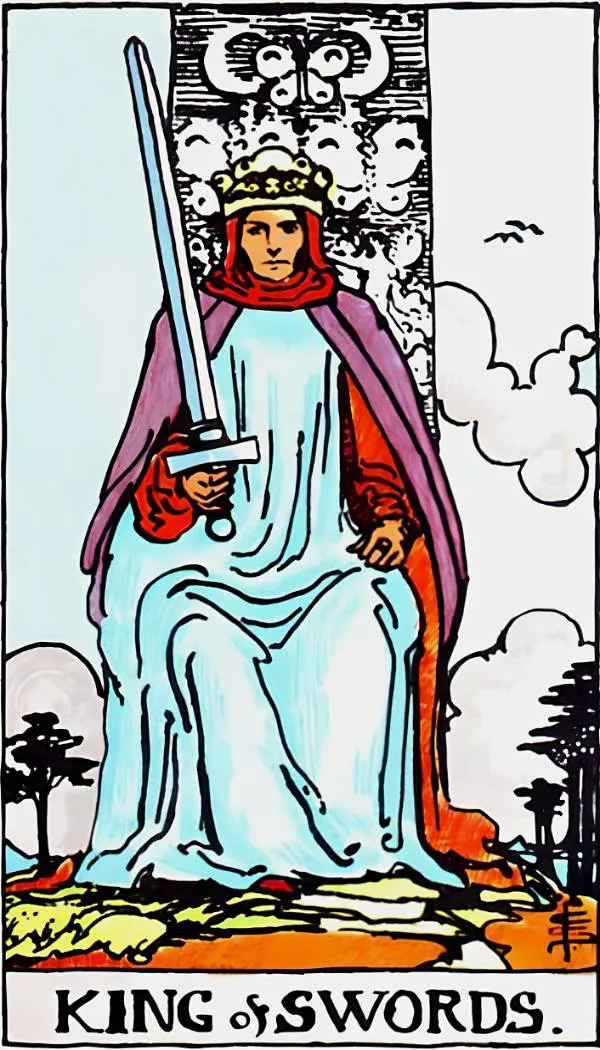
Directly facing the central figure in the scene is the King of Swords, a mature man sitting upright and poised. His expression is stern and righteous, with a drawn sword held high in his right hand, his gaze fixed on the sword ahead. The posture of the King of Swords suggests determination or the act of making a judgment or decision.

He wears a golden crown and a red hood, dressed in a light blue robe and a royal blue cape. The grey stone throne sits atop a barren earthen mound, with a high back but no armrests, engraved with the mark of a white butterfly. In the background, one can see distant trees, as well as clouds and birds in the vast sky.

Detailed Pattern Explanation

The King of Swords sits upright on his throne, his expression solemn and serious, his gaze deep and righteous. He faces directly forward, holding a long sword aloft with his right hand, as if looking through the sword. His facial features are rugged, giving an impression of severity and depth. The King of Swords embodies similar qualities to the Justice card's figure of justice, representing the virtues of the Justice card. However, as a sovereign, he seems to be announcing a verdict and is about to exercise his ultimate power over life and death.

The King's golden crown has an oval shape resembling clouds, implying a spirit that is as pure and free as the clouds. He wears a blue robe and a royal blue cape, colors that represent wisdom and rationality. However, his hood and the upper garment on his elbows are red, contrasting with the light blue robe and cape he wears outside. Red represents the heart and passion, the corner of warmth and enthusiasm. The common feature of his attire is the absence of any patterns, indicating that this king does not focus on superficial beauty but values the spiritual and conceptual aspects.

The throne of the King of Swords is located on a small mound, and from the limited background, it can be seen that the positions of the objects are relatively low and small. This arrangement suggests the King of Swords' aloof character. His throne is in a light gray tone, a cold and hard stone slab, also representing the characteristics of this king, whose life is as simple and regular as the seat. The back of the throne is engraved with a large butterfly pattern, the butterfly being the exclusive animal of the Waite Swords court cards, symbolizing positive meanings such as immortal fame and transformation, but also fleetingness and the idea of change.

The background is simple and clear, reflecting the state of mind. The green carpet on the ground represents a heart of kindness and generosity. The distant trees represent stable life growth, a symbol of nature. The entire background sky symbolizes the king's heart and is also the standard background of the Swords court cards – representing the air element. The clouds and birds are originally symbolic of the Swords suit.

The Figure of the King

The figure of the King is a personification of intellectual power and authority, seated on a throne and embodying the Air element. His countenance is stern, his gaze focused and intense, denoting a man of unwavering principle. His sword is upright, symbolizing that truth and justice are the bedrock of his dominion.

The Throne

The throne on which the King sits is adorned with butterflies and clouds, representing transformation and higher thought. This signifies that his ruling perspective is not only of the mind but also transcends to more lofty ideals and spiritual aspects of life.

The Sword

In one hand, he holds an upright sword, a symbol of his intellectual clarity and decisiveness. The sword’s upward position suggests that the King is a man of action, prepared to enforce his judgements and cut through any deception or falsehood.

The Cloudy Skies

The sky behind the King is cloudy, suggesting that he rules during challenging times that require decisive action and intellectual rigor. Yet, he appears undeterred by the winds of change, underlining his steadfastness and commitment to his principles.

The King’s Attire

The King of Swords is adorned in a blue tunic, which symbolizes his alignment with the element of air and signifies wisdom, clarity, and intellectual power. This solid coloration without any other embellishments emphasizes his straightforward nature, focused solely on truth and justice.

Psychological patterns in King of Swords
Emotional Cutoff
The stone throne, barren mound, and stern face create a field where nothing soft can easily enter. The King remains present, but the body is so composed that warmth has almost no visible route outward. In love, this becomes the moment when conflict turns the nervous system into a locked chamber. You may still be thinking, listening, and forming judgments, but the relational signal goes cold, leaving the other person unable to find emotional contact. Emotional Cutoff is not simple indifference in this card. It is a protective shutdown that uses composure, silence, or rational distance to prevent vulnerability from becoming visible when the relationship feels too charged.
Certainty Seeking
The sword stands upright like a demand for one clean line through a cloudy sky. Around it, the throne is hard, elevated, and stable, creating the impression that judgment should be firm before the surrounding uncertainty is allowed to move. That visual demand becomes Certainty Seeking when the psyche treats uncertainty as a flaw in the decision instead of a feature of the situation. The mind keeps looking for a proof point strong enough to make risk disappear. In choice work, this pattern can disguise itself as responsibility. You may keep waiting for the option that feels guaranteed, but the card shows that the search for absolute clarity can become a protected enclosure that keeps you away from the living field where the decision actually has to be tested.
Inner Critic
The King's stern face, elevated throne, and upright sword create the atmosphere of an internal court. The body is composed, but the scene leaves little room for softness, error, or unfinished process. Reversed, that court can move inside you as a constant evaluator. The sword no longer clarifies the next truth; it measures every delay, inconsistency, and imperfect attempt as evidence against the self. In personal growth, this pattern turns evolution into prosecution. You may keep demanding discipline from yourself, but the harshness of the verdict becomes the very pressure that makes sustainable change harder to inhabit.
Timing Discernment
The King sits squarely on a stone throne, facing forward while the sword rises in a clean vertical line through the center of the image. Nothing in his body rushes toward the horizon; the authority of the card comes from stillness, posture, and a narrowed field of attention. That visual structure turns timing into a cognitive discipline rather than an emotional reaction. The sword does not swing wildly; it is held upright, making judgment visible as containment, sequencing, and discrimination. You are being shown a mind that can hold urgency without obeying it. Timing Discernment emerges when the pressure to move is filtered through evidence, readiness, and field conditions. In timing questions, this pattern names the capacity to separate a real opening from social noise, panic, or the need to prove momentum.
Boundary Discernment
The sword stands upright between the King and the open sky, and his throne lifts him just far enough above the ground to see the whole field. The posture does not reach, plead, or collapse. It establishes a line that can hold pressure. In close friendships, this visual logic maps to the moment when care has to be separated from unlimited access. You are not severing connection; the pattern is trying to name where reciprocity ends and overextension begins, so the relationship can be seen without guilt fogging the verdict.
Self-Judgment Loop
The raised sword can look decisive, but reversed it becomes a gesture that keeps repeating the same verdict. The visual field is narrowed around a single blade, a single line, a single standard of evaluation. The king's stillness then stops feeling like composure and starts feeling like an inner court that never adjourns. That is the mechanism behind Self-Judgment Loop. In introspection, You may keep returning to the same question after every trigger: what was wrong with me, why did I react, why am I not cleaner, calmer, better. The sword promises resolution, but the loop uses judgment to reopen the wound. The card reveals how insight can become punishment when the mind confuses self-audit with self-sentencing. The pattern is not the desire to improve; it is the compulsive reissuing of a verdict when the psyche actually needs contact, context, and integration.
Intellectualization
The sword is held upright like an instrument of exact judgment, while the King's blue clothing, stone throne, and severe frontal posture remove almost every decorative distraction. The image is clean, cold, and mentally organized, as if emotion has been given a strict place outside the decision chamber. This creates a defense of distance. Feeling is not absent, but it is processed through rules, frameworks, and verbal clarity before it is allowed to influence action. You may be using analysis to make timing feel controllable when the real discomfort is the vulnerability of acting inside uncertainty. Intellectualization is useful when timing needs precision, but it becomes costly when the map replaces the weather. In timing questions, the card points to the mind's attempt to solve a seasonal problem with pure logic, even when the body and environment are already giving data that cannot be spreadsheeted into certainty.
Moral Certainty
The throne faces forward like a court bench, and the sword is not loose or exploratory; it is lifted as a standard of judgment. The king's severe expression, crown, and centered posture turn the whole scene into a single axis of principle, as if ambiguity must submit to a clean verdict. For you, this links to Moral Certainty when the search for direction becomes a demand for the objectively right path. The mechanism protects you from drifting by giving the future a legal structure, but it can also let inherited expectations dress themselves up as truth. When every option has to pass as righteous, mature, or defensible, the inner compass gets cross-examined instead of listened to.
Truth Weaponization
The upright sword is built to clarify, but in the reversed psychological state it becomes the only object the King trusts. His rigid frontality and severe face make language feel less like contact and more like a blade held between people. In friendship conflict, this pattern can convert accuracy into impact. You may tell yourself you are only being honest, while the structure underneath is using truth to regain control, punish disappointment, or make vulnerability unnecessary.
Action Paralysis
The King sits in a decision posture, but the throne fixes him in place and the sword stays lifted rather than enacted. The body is prepared for judgment, yet the scene contains almost no bodily forward movement. That tension mirrors the moment academic pressure turns readiness into freezing. You may know the assignment, the deadline, and even the first step, but the internal verdict system activates before action can begin, so starting the essay feels like stepping into a courtroom instead of opening a draft.
Core Struggles in King of Swords
Control Lock
The reversed King of Swords turns the upright blade and rigid throne into a closed command system. The same posture that once organized thought now suggests a body maintaining control by tightening the axis, staying elevated, and treating distance from the ground as normal. This is the structure of trying to solve a direction crisis by increasing control over the future. More criteria, more rules, more prediction, and more self-command may create the feeling of order, but the card shows a system that has stopped receiving enough feedback from the living world to recalibrate. For long-range choices, Control Lock can feel productive because it looks disciplined from the outside. The deeper struggle is that the hand keeps gripping the symbol of certainty while the horizon needs adaptation, leaving your direction governed by command when it is asking for contact.
Timing Control Strain
The raised sword, crown, and stone throne compress the scene into a rigid command axis. Around that axis, the sky stays unsettled, the birds keep their own route, and the low trees remain far outside the King's direct reach. When timing slips, the structure can harden into an attempt to rule the moment by force of mind. You are not looking at simple indecision here, but at the strain of trying to make a living cycle obey a fixed verdict.
Internal Authority Collapse
In the inverted image, the crown, sword, and throne no longer sit as a grounded chain of command; they hang as heavy symbols above the body. The very objects that should stabilize judgment become the pressure system the figure must keep obeying. Inside introspection, that turns self-authority into an unreliable reference point. A thought may sound absolute because it carries the tone of law, but its source no longer feels calmly anchored in your lived reality. This struggle is the collapse of trust in your own inner court. You are not simply unsure; the part of you that issues verdicts has lost calibration, so clarity and coercion begin to feel dangerously similar.
Prestige Path Lock
The reversed King holds the costume of authority together even as the red underlayers suggest a heat the blue public surface must contain. The sky remains wide, but the body is still enthroned, implying a future chosen for credibility while a different current stays compressed underneath. Prestige Path Lock emerges when a direction keeps its official legitimacy after it has lost contact with vitality. You may still know how to explain the path, defend it, and make it look coherent, yet the card shows the embodied cost of staying seated in a role that no longer receives enough living consent from the self. This is especially sharp in direction work because the question is not whether the path is impressive or sensible. The card asks where the throne has become more important than the road, and where the identity of being someone who chose well has started to override the movement of becoming someone real.
Analysis Paralysis
The sword remains the brightest line of function in the card, yet the King's body is still fixed in place. In the reversed state, that clean blade becomes less like a path forward and more like a point of return, pulling attention back into evaluation each time the body might move. This is not simple indecision. In a lifestyle system, it is the loop where every reset begins with more research, more comparison, more self-review, and another attempt to find the perfect structure before the day is allowed to start. The card gives that loop a visible boundary: the problem is not a lack of intelligence or standards, but a command system that keeps converting action energy back into judgment. You are not standing before an empty plan; you are seated inside a plan that has become too sharp to inhabit.
Life Audit Exhaustion
The King sits above the landscape with the sword held as a single, uncompromising line. The living details behind him are small and distant, while the throne and blade dominate the field of reference. In the reversed state, this creates a lifestyle structure where the audit becomes louder than the life it was meant to clarify. Sleep, meals, recovery, clutter, exercise, and attention are constantly measured against a central standard, but the body's quieter signals lose space to register. The card does not condemn structure; it shows the exhaustion that arrives when structure becomes a permanent tribunal. You may be trying to recover order, but the image reveals where the act of reviewing your life has started to drain the same bandwidth it was supposed to protect.
Truth-Connection Split
The King's gaze travels through the sword before it meets the world. His tool of truth becomes the channel of perception, and the living signs around him, butterflies, birds, trees, and moving clouds, are held at a distance by the hard geometry of blade and throne. In a family field, that image carries the split between saying what is real and staying connected to people who may only accept closeness when the truth is softened, delayed, or edited. The sword can clarify, but it can also make every honest sentence feel like it might cut the bond. You are not simply choosing between honesty and peace. The card shows a structure where truth has been loaded with relational consequences, so clarity feels powerful and dangerous at the same time.
Inner Tribunal Lock
The sword, crown, throne back, and frontal gaze form a closed system of judgment. In reversal, that system stops functioning as clear discernment and becomes an internal court where every movement is measured against an invisible standard. Family pressure often survives this way after the conversation ends. You may leave the room, move out, or build an adult life, but the old verdict still sits inside the body as a voice asking whether you are selfish, ungrateful, too much, too cold, or wrong for wanting your own life. This card locates the struggle inside the inherited tribunal rather than inside your character. The issue is not that you lack clarity; it is that clarity has to pass through a family-made courtroom before it can feel like yours.
Self-Optimization Martyrdom
The King is both the source of order and the body being held under that order. His sword rises cleanly above him, while the throne fixes him in a position where authority has no soft exit from itself. In the reversed lifestyle pattern, this becomes an optimization regime with no off-switch. The same intelligence that can simplify, edit, and refine the day begins cutting into sleep, pleasure, mess, appetite, and ordinary human fluctuation until the self becomes a project under permanent review. The card's severity gives the struggle a precise edge. You are not simply trying to improve your life; the image shows a life system where improvement has become a court of command, and the person inside the system is carrying the cost of being both ruler and subject.
Strategy-Integrity Split
The sword is not swung; it is held upright between action and principle. The red fabric under the blue robe keeps heat inside a rational shell, while the butterfly carved into stone turns change into something formal and controlled. That visual pressure fits a career moment where every effective move has an ethical charge. You are not simply choosing a tactic; you are trying to stay strategic without letting strategy rewrite the part of you that still wants the work to mean something clean.
Inner Emotions in King of Swords
Authority Claustrophobia
The stone throne rises behind the king like a hard vertical frame, while the body stays locked into the public shape of command. The mound elevates him, but it also removes him from ordinary ground, placing every gesture inside the architecture of authority. Authority Claustrophobia appears when career power stops feeling spacious and starts feeling like a role you cannot safely step out of. The card’s rigid posture and high-backed seat show how leadership, management pressure, or proximity to senior decision-makers can compress the body into constant self-control. This emotion is not a rejection of responsibility. It is the inner pressure of being watched, evaluated, or expected to sound certain before your full self has had room to breathe.
Intellectual Loneliness
The throne rises on a small mound, setting the king apart from the green ground and distant trees. The wide sky gives the mind space, but the body remains alone on a hard seat. In academic life, this turns intellectual strength into a solitary altitude. You may be able to see the structure of a problem clearly, but the clearer it becomes, the harder it can feel to find someone who shares the same mental weather.
Self-Audit Anxiety
The stern face, direct posture, and upright sword create the visual grammar of cross-examination. The throne does not look plush or forgiving; it looks like a place where motives are weighed, language is tightened, and excuses are stripped down. Self-Audit Anxiety forms when the decision turns inward and every reason you give yourself becomes suspect. You are trying to choose cleanly, but the inner judge keeps asking whether the desire is real, whether the fear is disguised, and whether the logic belongs to you.
Sterile Clarity
The King’s blade is perfectly upright, the throne is cold grey stone, and the body is held in a fixed front-facing axis. The scene is visually clean, but its cleanliness is sparse: the living trees sit at a distance, and the mound beneath the throne offers little softness. That is the precise texture of Sterile Clarity in a direction reading. You may be able to explain the plan, defend the logic, and make the future look coherent, while the emotional field around the plan remains dry and underfed. The card reveals a form of clarity that has lost contact with aliveness. It does not mean the direction is wrong; it shows that the current way of holding it may be over-filtered through correctness, leaving You with a route that is sharp enough to justify but too thin to feel inhabited.
Truth Relief
The upright sword turns the scene into a single line of definition, held above a throne built for sober judgment. The King's gaze does not wander across the background; it stays with the instrument that separates clear signal from noise. In social life, this becomes the relief that follows naming the truth of a group dynamic, a friendship mismatch, or a boundary that has been softened for too long. You feel the internal air clear because the vague pressure finally has a shape.
Strategic Unease
The sword is raised, the face is stern, and the body remains fixed to the throne. Nothing in the image is casual; even the empty space around the King feels like a chamber where a decision is being weighed. This creates a precise kind of unease around timing. You may have enough clarity to move, but the card shows the tension of holding force until the right threshold appears, so action does not become noise.
Clarity Hunger
The sword is held high enough to become the organizing point of the entire image. The King's eyes do not drift toward the landscape or the viewer; they stay locked to the blade as if every loose feeling must pass through one clean line before it can be trusted. That visual pressure mirrors the hunger for an answer in love when ambiguity has become too expensive. You may not be looking for control as much as a stable edge: a definition, a sentence, a truth that lets the nervous system stop scanning every mixed signal for meaning.
Grounded Agency
The throne sits on a small rise, giving the King a wider view without removing him from the ground. His body is settled, the sword is lifted, and the surrounding landscape remains separate enough to be seen rather than swallowed. That arrangement gives Grounded Agency its emotional shape. In personal growth, you are not chasing an abstract upgraded self; you are locating the part of you that can observe your patterns, choose a standard, and act from a stable center. The card's power is not domination. It is the felt return of authorship: the moment your growth stops feeling like a vague demand from outside and starts feeling like a system you can consciously steer.
Quiet Certainty
The sword held upright, the centered spine, and the King's fixed gaze create a single vertical line through the scene. The blue robe and clear sky keep the atmosphere cool and readable, while the throne gives the mind a stable seat. Quiet Certainty belongs here because the card shows an inner system that has stopped scattering itself across every possible interpretation. You are not being pushed into noise or performance; you are recognizing the clean line that remains after the hidden objections have been examined.
Disciplined Calm
The upright sword, the straight spine, and the unornamented blue clothing create a scene where force has been narrowed into form. Nothing spills out of the King of Swords; the body, blade, and throne all hold one clean vertical argument. In career questions, that visual control maps onto the emotional state of staying composed under pressure without going numb. You are not floating above the situation or pretending it does not matter; the card shows a mind using structure to keep the body from being pulled into every provocation. Disciplined Calm belongs here because the card does not show ease as softness. It shows steadiness as a practiced container, the kind that lets you handle a review, negotiation, promotion conversation, or leadership call without surrendering your center to the room.
Outer Contexts in King of Swords
Lifestyle System Overhaul
The King sits upright on a high stone throne, holding the sword vertically as if the whole scene must answer to a single standard. The barren mound, plain blue robe, and unsentimental posture strip the environment down to structure, priority, and command rather than comfort or decoration. That visual architecture matches a lifestyle system that has outgrown patchwork fixes. You are not dealing with one isolated habit; the card frames the whole daily operating system as something that needs an audit, with rules clear enough to decide what gets protected, what gets cut, and what no longer deserves space. The sword does not soften the workload, but it separates signal from noise. In this context, the card points to the moment when work, rest, home, body maintenance, and attention need to be reorganized under a cleaner hierarchy so your life stops being managed by whatever shouts the loudest.
Strategic Timing Window
Seated on a grey throne with the sword held upright, the King turns action into a timed verdict rather than a reflex. The blade is lifted but controlled, and the open sky behind him gives the decision a clear field of view. That visual structure fits a Strategic Timing Window because the pressure is not simply to move; it is to move when the criteria are visible and the external field can receive the cut. You regain agency by distinguishing a clean opening from raw urgency, then letting the narrowest useful moment carry the force.
Decision Criteria Black Box
The sword is visible, but the system behind the verdict is not. The stern face, plain robe, and stone throne present certainty without revealing the full process that produces it. That image fits a future-planning moment where the rules for a good life keep shifting or remain unspoken. You are trying to orient by standards that have not been made transparent, so clarity begins with naming the criteria that are actually being used against your choices.
Authority Approval Bottleneck
The sword in the King's hand turns the whole scene into an approval gate. Movement gathers at the blade, but the seated authority controls when judgment becomes permission. Authority Approval Bottleneck fits this card because the timing problem is not lack of effort; it is external clearance concentrated in one seat, one standard, or one decision layer. You can see where the flow is held, which helps separate your readiness from the gatekeeper's pace.
Community Leadership Trial
The King sits front-facing on a high stone throne, with the sword lifted where everyone can see it. His body is not mingling with the landscape; it is installed as a decision point, a place where standards, timing, and consequences gather. That visual pressure maps onto the moment when a social circle starts treating you as the moderator, organizer, or final adult in the room. You can see the need for judgment, but the structure also asks whether the group is sharing responsibility or quietly handing one person the whole burden of order.
Emotional Suppression Culture
The severe posture, grey stone, and raised blade create a social climate where composure is treated as proof of competence. The red beneath the blue robe shows warmth still present, but the visible architecture privileges cool language, control, and formal correctness. Reversed, this becomes an environment that rewards You for sounding unaffected while narrowing the space where emotional truth can appear. The card exposes suppression as a cultural rule, not a private flaw: the outer standard has trained the inner world to edit itself before it is even heard.
Values Alignment Crossroads
The King's sword stands upright between his gaze and the open sky, turning the whole scene into a line of discernment. The throne is stable, the robe is plain, and the clouds are moving, so the visual pressure is not to rush forward but to decide what standard will steer the next stretch of life. For direction work, this maps to a crossroads where the problem is not lack of options but lack of clean criteria. You are being asked to separate a path that looks acceptable from a path that actually matches the principles you are willing to live under.
Accountability Reckoning
The stern face and raised sword turn the scene into a public standard of judgment. Nothing in the composition is soft enough to hide behind: the robe is plain, the throne is hard, and the sword makes evasion physically difficult. For you, this points to a friendship moment when vague tension has gathered enough evidence to require a clear reckoning. Accountability Reckoning is the outer context where impact, responsibility, and repair move out of implication and into a shared record that can be examined.
Academic Integrity Scrutiny
The upright sword in the King's hand is not decorative; it is a rule made visible. His plain blue robes and stone throne strip the scene down to principle, evidence and a decision that can be enforced. In academic life, that visual field becomes the moment when originality, citation practice, AI use or authorship is placed under institutional review. The pressure comes from being asked to prove the clean line between your work, your sources and the system's rules. The card does not turn this into a moral panic. It shows the structure of scrutiny: a formal standard, an exposed student record and the need to make your process legible before authority draws its conclusion.
Group Chat Tribunal
The King's frontal stare and lifted sword turn the viewer into someone standing before a verdict. The throne's cold stone and the blade's hard vertical line create the atmosphere of a hearing room rather than a conversation. In a group chat, that same structure appears when screenshots, reactions, and side commentary replace direct repair. You are dealing with a collective judgment machine, and the useful question becomes where the actual issue ends and the performance of consensus begins.