Queen of Pentacles Tarot Card Meaning

Overall Picture Structure

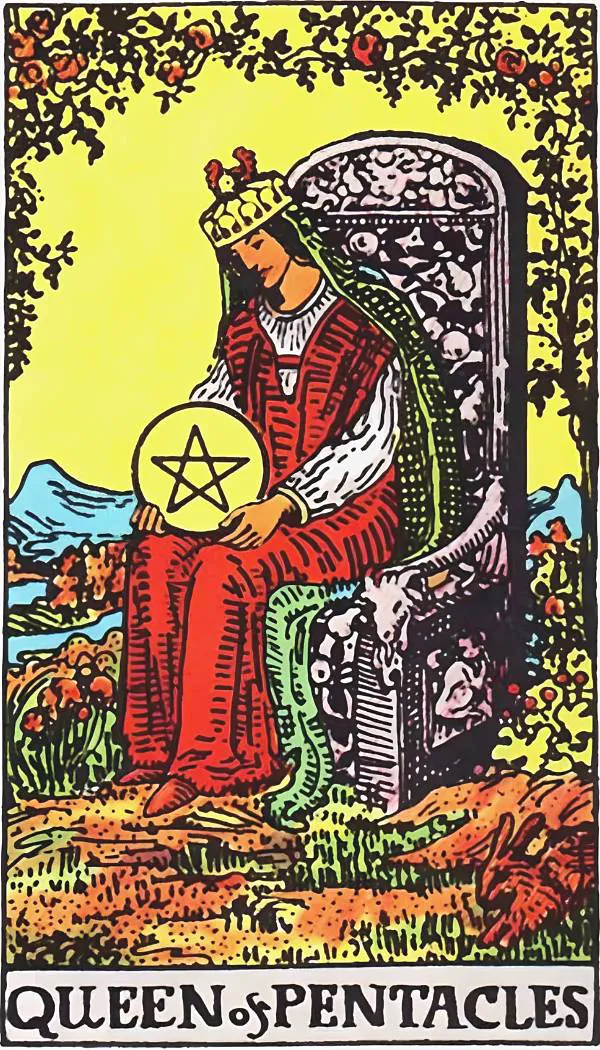
This woman wears a crown and sits on a meticulously carved seat, holding a coin in both hands and gazing down at it thoughtfully.

She is dressed in a red robe, with two feathers on the crown that fall from the green cloak draped over her shoulders to the ground.

The armrests of the throne are carved with the symbols of ram's heads, and the sides of the seat are adorned with reliefs of children. The back of the throne is covered with vines and melon leaves. Her seat is under the shade of the forest, beneath an archway of roses, with the grassy area where her seat is located blooming with numerous roses, and in the distance, one can see the foothills and rivers. At this moment, a rabbit is entering the scene from her left rear.

This woman is the Queen of Pentacles.

Detail Pattern Explanation

The Queen of Pentacles has a dignified and upright appearance, indicating that she is a woman who values practicality and has deep thoughts. She also has a serious and rational temperament. She holds the coin in her hands, gazing at her possession, and from it, she can see the world, which relates to the principles of the Golden Dawn (to be explained later). Her posture is elegant, her expression serene, and her gaze peaceful, as if she is immersed in it.

Her crown is dome-shaped, with two red feathers inserted in the middle, symbolizing the passion and drive of the spiritual aspect. The Queen of Pentacles' robe is red, with the sleeves of the white inner shirt exposed, creating a red and white contrast. The green headscarf extends from her head down to the seat, forming a shawl and cushion fabric, with green representing harmony and pleasure with nature.

The Queen's throne is situated in the greenery of an estate, under the dense shade of trees. The seat is stone-carved and covered with decorations. There are some angel patterns, similar to the throne of the Queen of Cups, with ram heads carved on the front ends. The foreground next to the throne is a fertile land, full of green grass and flowers. The rose trellis above indicates passionate love and romantic sentiment.

On the ground to the left of the throne, a hare is seen hopping by. Hares are always endearing small animals, generally symbolizing love, fertility, and the cycles of women. In some traditional cultures, hares are thought to have certain magical powers that can break the spells of witches and demons. Additionally, hares seem to have an inseparable relationship with the moon, and people sometimes see their figures in the moon. The hare is also a symbol of the Queen of Pentacles' femininity and gentleness.

The distant background features mountains and water, with green water flowing into the blue mountains, representing the integration of the material and spiritual emotional aspects. The undulating mountains behind her create a special scene—the reappearance of the Golden Dawn—the position of the coin coincides with the upper edge of the mountain, similar to the sun. This coin represents wisdom and light, making the card's meaning extraordinary, not just materialistic. This action seems to be meditating, divining, feeling, and gazing with the object held in the hand.

Throne

The throne on which the Queen sits is a symbol of her authoritative position in the realm of earth and matter. She is the epitome of stability, groundedness, and maternal energy. Her authority is not to dominate, but to nurture and sustain.

Pentacle

The pentacle she holds in her lap is the central symbol of the Earth element, representing not only wealth but also the interconnectedness of all things physical and spiritual. Her comfortable handling of the pentacle suggests her mastery over material concerns and her ability to manifest abundance.

Garden and Rabbit

Behind the Queen, a lush garden and a rabbit are visible. These symbolize fertility, prosperity, and the abundance of life’s pleasures. The rabbit, in particular, suggests a flourishing existence, supported by the natural world.

Carved Stone Throne

The intricately carved stone throne featuring cherubs and goats signifies her connection with the divine and the earthly simultaneously. The goats, animals deeply rooted in Earth energy, signify fertility and earthly wisdom, while the cherubs symbolize the spiritual aspects of existence.

Water Stream

A stream of water can be seen in the background, flowing through the fertile landscape. Water is the symbol of emotions and intuition, suggesting that the Queen of Pentacles is not only materially abundant but also emotionally rich, blending the elements of Earth and Water seamlessly in her personality.

Psychological patterns in Queen of Pentacles
Resource Alignment
The Queen's hands form a steady container around the pentacle, and her gaze does not scatter across the whole fertile landscape. The body, the coin, the throne, and the cultivated garden all point to the same mechanism: orientation becomes clearer when desire is checked against what can actually be held, tended, and sustained. Resource Alignment grows from that visual discipline. You may be trying to separate a future that only looks inspiring from one that can support your nervous system, schedule, energy, and material reality. The card does not shrink the horizon; it asks the horizon to pass through the hands.
Scarcity Mindset
The Queen's eyes remain on the single pentacle even though the garden, stream, flowers, and distant hills show a wider field of support. In the reversed state, the object in the lap can become louder than the environment that already surrounds it. That visual tunnel maps to Scarcity Mindset because attention begins to treat one resource as the whole story. In lifestyle questions, the pattern appears when time, money, energy, clean space, or groceries never feel like enough, even when there is evidence of capacity somewhere in the system. The card's audit is precise: the problem is not only the size of the resource but the way attention clings to the threatened point. When the inner map is built around shortage, every routine starts defending against collapse instead of responding to the actual day.
Social Overextension
The Queen's downcast attention and two-handed hold can become a closed circuit when read through the reversed current, with the surrounding garden pressing in as everything asks to be tended. The fertile scene stops feeling spacious and starts feeling like a field of demands. That is the social architecture of Social Overextension: care becomes availability, and availability becomes depletion. You may look capable from the outside, but the card shows the body paying for every invitation, favor, and group role before the connection has a chance to nourish you back.
Overfunctioning
The Queen’s body is composed, grounded, and fully oriented toward the pentacle in her lap. Her hands hold the object with care rather than force, while the carved throne and cultivated garden make provision feel like an entire ecosystem rather than a single task. That visual structure mirrors a coping system that turns emotional uncertainty into competent maintenance. You may not panic, withdraw, or explode; you may organize, provide, anticipate, and stabilize until the family field feels manageable again. In family dynamics, Overfunctioning becomes visible when care stops being a choice and becomes the way you keep everyone regulated. The card does not shame the competence itself; it reveals the hidden cost of becoming the household’s emotional infrastructure before anyone has asked whether you are also allowed to be held.
Parentification
The Queen holds the pentacle with the stillness of someone trained to handle what matters. In reversal, that stillness can harden into a role: the hands keep holding, the body keeps stabilizing, and the surrounding abundance keeps circling around one central caretaker. This is the mechanism of becoming emotionally older than your position in the family should require. You may manage moods, anticipate needs, mediate tension, or protect others from consequences because the family system has treated your reliability as a shared resource. Parentification appears here as a care ritual that lost its consent. The card makes visible the difference between mature support and being quietly assigned a role that should never have been yours to carry alone.
Co-dependency
The Queen is surrounded by the world she sustains: vines, roses, fertile ground, carved figures, and the pentacle held close to the body. In reversal, that closeness can stop feeling like grounded care and start feeling like identity fusion, where the self and the support role are difficult to separate. Co-dependency emerges when care becomes the proof of connection and self-worth. In friendship, You may find yourself monitoring another person's mood, anticipating their needs, and treating their distress as an emergency that automatically overrides your own inner signals. The card gives this pattern a concrete shape: the garden is beautiful, but the Queen is also embedded inside it. The bond may look nurturing from the outside while privately training You to confuse being needed with being securely loved.
Emotional Gatekeeping
The Queen's composure is visually convincing: her posture is upright, her hands are controlled, and her gaze is lowered into the pentacle with quiet concentration. Nothing in the body spills outward, and the garden around her creates a soft but distinct perimeter between the inner chamber and the wider world. Reversed, that same containment can become an emotional access system that only permits feelings once they have been made useful, calm, or presentable. The pentacle becomes the approved object of attention while more disruptive signals stay at the margins. The defense is subtle because it looks like groundedness from the outside, even when it is functioning as an internal gate. In introspective tarot, this pattern shows how You may manage the psyche by screening what is allowed to be felt. The hidden cost is that grief, envy, resentment, need, or shame do not disappear; they wait behind the gate and continue consuming bandwidth because they have been organized out of awareness rather than integrated.
Boundary Diffusion
The Queen is surrounded by life, fabric, foliage, carving, and cultivated growth until her personal outline almost belongs to the whole scene. In reversal, the abundance that should support her can blur into an environment that claims her attention, body, and role. That visual merging maps directly onto boundary diffusion inside a family system. Needs arrive as if they are already yours, emotional pressure feels like a shared emergency, and saying no can feel like damaging the entire field. Boundary Diffusion does not mean you lack care. It means the family ecosystem has trained closeness to override separation, so your limits become hard to locate when guilt, resources, or inherited roles are activated.
Achievement Fusion
The Queen's gaze rests so completely on the pentacle that the object can become more than a resource; it can become a mirror. In the reversed psychological field, the hands no longer simply hold value, they clamp around the thing that seems to prove whether the self is stable, useful, and safe. That is the mechanism of Achievement Fusion in career life. A title, salary band, promotion timeline, manager's praise, or perfect output starts carrying the emotional weight of identity, so ordinary workplace signals feel like verdicts on your entire worth. The card makes this fusion concrete because the pentacle sits close to the body inside an enclosed throne space. When work becomes the only object that can reflect value back to you, career strategy stops being a practical question and becomes a self-worth survival loop.
Emotional Reciprocity
The Queen's hands do not clutch the pentacle as if it might be stolen; they hold it with deliberate steadiness. Around her, the garden, water, throne, and distant hills share the visual field, so value is centered without becoming the only thing that exists. That balance reflects a relational mechanism where giving and receiving remain connected. Care is not a performance of usefulness, and receiving is not treated as weakness; the exchange can move because the field is resourced enough to hold both people. In love, this pattern reveals whether affection is mutual or quietly one-sided. The card turns attention toward the quality of the exchange: who tends the bond, who lets themselves be tended, and whether practical devotion is being matched by emotional presence.
Core Struggles in Queen of Pentacles
Resource Integration Strain
The Queen sits inside a living estate rather than above it: carved stone, green fabric, fertile ground, roses, water, and the pentacle all gather around her lap. The coin is not displayed outward; it is held close, with both hands and full attention, as if every practical resource has to pass through one still point before it can become usable. In lifestyle work, that image gives shape to the strain of making work, sleep, health, food, home, money, and recovery support each other without splitting into separate emergencies. You are not simply failing at balance; the card shows a system where every life module is asking to be integrated through one limited human body.
Caretaker Role Lock
The Queen's hands close around the pentacle while the garden, children, vines, and fertile ground crowd the seat with images of provision. In the reversed state, that abundance no longer flows outward cleanly; it loops through the person seated at the center until care becomes a fixed job the body cannot put down. At work, this is the shape of being needed because you make everyone else functional. You may be valued as the stabilizer, fixer, or team parent, while the same usefulness keeps your career path contained inside maintenance instead of recognized leadership.
Soft Power Strain
The Queen sits crowned, but her authority is carried through a lowered gaze, a held pentacle, a shaded garden, and a throne softened by vines and child reliefs. Power is present, yet it moves through steadiness and provision rather than force. At work, that image names the pressure of leading through trust, emotional calibration, and practical support while still needing to be taken seriously. You may be holding influence in a form that keeps the team alive, but the card marks the strain of making that quiet authority visible without turning yourself into a harder version of someone else.
Golden Handcuff Bind
The carved throne does not look harsh; it is ornate, shaded, and surrounded by life. Precisely because the seat is comfortable, the body can stay fixed while the wider landscape remains unentered. That soft enclosure is the shape of a choice that has become difficult to leave because it still provides real benefits. You are not simply attached to comfort; the structure shows how stability, reputation, resources, and previous effort can become a polished frame around a shrinking range of movement.
Conditional Nurture Bind
The Queen sits in a fertile estate, holding one pentacle with both hands while her gaze narrows into it. The garden is alive around her, but the care-symbol is concentrated in a single object that must be held, watched, and kept close. That structure makes nurture feel charged rather than free. In a family system, help can arrive with warmth on the surface while carrying invisible terms underneath: stay available, stay grateful, stay aligned with the role that made the care possible. You are not simply reacting to support itself. The card locates the struggle in the bond between receiving and owing, where family care becomes emotionally expensive because acceptance is treated as quiet consent.
Possessive Care Bind
The Queen's pentacle is not simply present; it is held close, watched closely, and kept at the center of the scene. Around her, the garden is generous, but the central symbol of care remains contained in her hands. Reversed, that containment can turn nurture into possession. In a family system, care may be real and still become controlling when the giver treats help as proof of access, influence, or emotional ownership. The card gives this struggle a clear boundary: the problem is not that you reject care. It is that care has been structured so that being loved, protected, or helped also means being held inside someone else's claim.
Capacity Misalignment
The reversed image compresses a wide field of maintenance into a very small carrying point. A garden, a throne, a crown, a cloak, and a pentacle all converge around one seated body, while the hands remain responsible for holding the central weight. In lifestyle terms, the card gives a physical outline to the feeling that ordinary tasks have become too large for the bandwidth available. The problem is not the size of any single chore or habit; it is the mismatch between the scale of the life system and the narrow channel through which you are trying to carry it.
Social Energy Drain
The Queen holds the pentacle with both hands while the garden keeps blooming around her. In the reversed structure, that closed grip turns the resource into something monitored and spent rather than something freely circulated or restored. In social life, the card gives shape to the exhaustion that follows constant replying, showing up, hosting, smoothing, and staying available. You are not drained because connection is wrong; the image locates the drain in a field where too many social channels draw from the same center without returning enough grounded nourishment.
Comfort Entrapment
The throne sits in a garden that looks safe, fertile, and complete, yet the Queen’s body remains enclosed by stone arms, draped fabric, shade, and roses. The open landscape is visible behind her, but the immediate body-space is protected and fixed. In personal growth, comfort becomes a structure when the safest seat starts defining the limits of movement. You can have stability, taste, and support while still feeling the pressure of a life arranged to preserve what already works instead of testing what could grow.
Abundance Overload
The throne is surrounded by roses, foliage, water, carved reliefs, and a rabbit entering the scene; the card is visually full before the Queen even moves. Her hands can hold the pentacle, but the surrounding fertility exceeds what one lap, one metric, or one moment can contain. At a crossroads, that fullness becomes pressure rather than simplicity. You may be facing several good options, yet each one carries its own promise, maintenance load, and identity claim, so the decision becomes less about finding value and more about surviving too much value at once.
Inner Emotions in Queen of Pentacles
Grounded Agency
The queen's upright body, carved throne, and firmly held pentacle create a scene where material reality is not scattered across the ground but gathered into one workable center. The garden does not swallow her, and the throne does not imprison her; each element gives the body a place to sit, hold, and assess what is actually present. In an academic frame, this maps to the inner shift from being dominated by vague pressure to feeling able to handle one concrete learning task at a time. You are not being asked to prove your entire future through a single paper or exam; the card shows attention returning to the part of the workload that can be touched, shaped, and understood. Grounded Agency emerges when knowledge stops feeling like an abstract threat and becomes a physical object in your hands. The emotional clarity here is practical: you can name the resource, locate the next movement, and let your sense of capability come from contact with the work rather than from imagined evaluation.
Cozy Suffocation
The roses arch overhead, the greenery presses close, and the throne holds the Queen inside a cultivated pocket of the world. In a reversed emotional register, the softness of the garden can become an enclosure that keeps the body still even when the wider landscape remains visible. Cozy Suffocation is the feeling of being protected by the very conditions that limit movement. Nothing in the scene is visibly hostile; the pressure comes from comfort, beauty, and containment becoming too complete. For direction work, this emotion appears when a familiar life has become difficult to leave because it is not obviously bad. You may be feeling the cost of a path that keeps you safe while quietly narrowing the amount of future you can imagine.
Premature Bloom Anxiety
The Queen is surrounded by bloom, but her hands still contain the pentacle close to her lap. Her gaze does not follow the distant river or mountains; it stays concentrated on the one object that represents what can be held, tended, and not yet spent. In its pressured emotional register, the same fertile scene can become too loud with potential. Roses, vines, and the rabbit create a visual field of growth, but the body remains seated, careful, and contained. That mismatch gives Premature Bloom Anxiety its shape: the feeling that because something could grow, it must be made to happen now. For timing questions, this card names the panic of trying to force an opening before the roots have finished taking hold. You are not lacking desire; the emotional friction comes from mistaking visible potential for complete readiness, then feeling alarmed when the body refuses to move at the speed of expectation.
Resource Readiness Shame
The Queen is surrounded by visible support: the pentacle in her hands, the carved throne beneath her, the fertile garden around her, and water moving in the distance. Yet the gaze stays lowered into the single object, making the abundance feel concentrated into a private audit. Resource Readiness Shame forms when the life system appears to contain enough material support, but movement still does not arrive. In lifestyle tarot, this can feel especially sharp when the planner is open, the groceries are bought, the apartment is workable, the apps are installed, and the body still will not cross the threshold into action. The card does not frame that stuckness as laziness. It shows the emotional pressure of being visibly resourced while internally stalled, and it gives you a way to separate usable support from the shame that has gathered around it.
Reciprocal Warmth
The Queen's hands cradle the pentacle at the center of a shaded garden, while roses, leaves, water, and carved stone hold the scene in layers of support. Nothing in the image lunges or performs; value is held close, looked at directly, and protected by a living environment. In love, this becomes the feeling of care moving both ways without a ledger. You are not chasing proof or bracing for disappearance; the relationship feels emotionally real because affection is paired with steadiness, attention, and small material signs of being considered.
Grounded Presence
The Queen sits with her body fully supported by the carved throne, holding the pentacle in both hands as her gaze settles into one tangible object. The garden, stone, roses, and distant water do not pull her attention away; they create a physical field where the material world can be observed without being rushed. That visual concentration turns Grounded Presence into more than a pleasant mood. In lifestyle tarot, it names the moment when your physical systems stop feeling like scattered obligations and start becoming legible: the room, the budget, the food, the calendar, the body, the pace. You are not being asked to transcend daily life here. The card mirrors the feeling of returning to the concrete layer of existence with enough steadiness to notice what is actually supporting you and what is quietly draining you.
Grounded Belonging
The Queen sits inside a living enclosure of stone, roses, greenery, and flowing water, holding the pentacle close without clutching it. Her body is not reaching out to prove itself, and the garden does not appear empty or exposed. The whole scene gives social contact a physical container: enough boundary to stay intact, enough warmth to remain open. Grounded Belonging emerges from that exact balance. In a social ecosystem, it is the feeling of having a real place without having to keep earning it through constant availability, charm, or emotional labor. You can participate without dissolving into the group, and you can step back without feeling erased. The pentacle in her lap becomes a symbol of inner resource rather than social currency. It suggests a form of connection where your worth is not negotiated through attention metrics or group approval, but held quietly enough for your nervous system to stop auditioning for acceptance.
Quiet Readiness
The Queen sits beneath roses and tree shade with the pentacle held carefully in both hands, her gaze lowered into one clear point of attention. Nothing in the image rushes outward; the garden is alive, the water continues in the distance, and the throne gives her body a stable place to wait without collapsing into passivity. That visual stillness turns timing into a question of ripeness rather than speed. The card gives shape to the feeling that readiness can be quiet, almost private, and still be real. You are not being asked to prove momentum through visible movement; the emotional signal is the calm recognition that your next move needs roots before it needs force. In a timing reading, Quiet Readiness names the moment when inner resources, outer conditions, and bodily steadiness begin to agree. The card does not glamorize delay; it shows a grounded pause where attention is gathered, the field is being read, and agency returns through measured timing.
Guilt-Free Rest
The shaded garden around the queen is not empty space; it is a living container. Green fabric, roses, grass, and trees soften the visual field around a figure who is seated rather than straining, holding value without visibly rushing to extract output from it. In academic life, that image matters because rest often becomes morally suspicious: a pause can feel like falling behind, losing discipline, or wasting potential. This card offers a different emotional architecture, where recovery is part of sustained learning rather than a breach in productivity. Guilt-Free Rest appears when the nervous system can stop treating every still moment as evidence of failure. The queen remains connected to the pentacle while held by the garden, showing that stepping out of urgency does not mean abandoning the work.
Comfort Numbness
The throne is deep inside a fertile estate, softened by cloak, roses, vines, grass, and shade. The body appears supported from every side, yet the water and hills remain at a distance from the seated figure. That enclosed abundance can describe a decision where comfort has become so effective that it dulls the signal of desire. The safe option pads the body, lowers friction, and makes the absence of aliveness easy to rationalize. Comfort Numbness belongs to the reversed texture of this card because the scene is not empty; it is overly furnished. You may be surrounded by reasons to stay while the part of you that wants movement has gone quiet.
Outer Contexts in Queen of Pentacles
Work Life Integration Trial
The stream, garden, roses, and pentacle all sit within one continuous landscape around the Queen. Work, resource, body, and environment are visually connected instead of split into separate compartments. For a career reading, this becomes a test of whether your work structure can support a whole life rather than consume the conditions that make work possible. You are not dealing with a simple time-management issue; the scene points to an ecosystem problem where productivity, rest, money, space, and personal bandwidth have to be designed together.
Resource Readiness Check
With the pentacle held in both hands inside a cultivated garden, the image begins with material evidence rather than a vague pull. The throne, crown, vines, water, and fertile ground show a choice being measured against real support systems: money, time, capacity, and the physical container that will have to sustain the decision. For a choice reading, this points to the moment before commitment where readiness has to be audited rather than assumed. You are not being pushed into a leap or asked to worship comfort; the structure asks which option has enough real-world scaffolding to hold the next phase without quietly draining you.
Practicality Over Intimacy
The queen's gaze drops into the pentacle while the roses, vines, and shaded enclosure continue around her. The sensual world is present, but attention has narrowed onto the object that must be managed. In a reversed relationship context, that narrowing can turn love into logistics. Rent, schedules, errands, groceries, plans, family visits, and future planning keep the couple functioning while the intimate signal gets quieter. You may not be dealing with a lack of love so much as a relationship container that has over-optimized for survival and maintenance. The card points to the place where practical competence has started replacing tenderness, leaving the bond efficient but underfed.
Invisible Domestic Labor
The throne is surrounded by fertility symbols, carved children, vines, roses, and a living estate. Nothing in the scene looks broken, yet the whole abundance depends on someone remaining seated, attentive, and responsible for keeping the environment coherent. Invisible Domestic Labor fits that quiet maintenance burden. You may be trying to clear your inner world while the outer home keeps assigning you the work of noticing, remembering, preparing, smoothing, and resetting. The card makes the hidden cost concrete: a beautiful container still has to be maintained by a body with limited bandwidth.
Golden Cage Comfort
The throne sits inside an abundant estate, shaded by trees and framed by roses, while the distant hills remain visible but untouched. Comfort is not absent; it is strong enough to become the room. In personal growth, this describes a stable setup that removes immediate pressure but also lowers the urgency to risk a new stage. You can name the cage without rejecting the comfort, which separates safety from stagnation.
Office Housework Trap
The throne is carved with caretaking symbols, and the Queen's composed body is framed by a cultivated space that looks maintained, polished, and orderly. The visual emphasis falls on upkeep: the conditions around the throne are beautiful because someone is continuously tending them. In the office, that becomes the trap of non-promotable work being routed to the person who seems organized, responsible, and safe. You may be close to power and trusted with the environment, while the actual tasks keep pulling you away from visible, high-leverage work that would move your career forward.
Designated Organizer Burden
The same carved throne that gives the Queen stability can become a fixed station, with both hands occupied by the pentacle and the body unable to move freely through the garden. The resource-holder is visible, seated, and expected to keep the cultivated space functioning. In a social circle, that structure becomes the burden of being the person who books the table, starts the group chat, checks in after conflict, remembers birthdays, and keeps everyone loosely connected. You are not simply good at organizing; the group has learned to route maintenance through you. The pressure of the card is practical rather than abstract. It names the point where social belonging starts costing too much because the community enjoys the garden without sharing the labor that keeps it alive.
Office Emotional Labor
Both hands close around the pentacle while the Queen remains fixed on the throne, surrounded by symbols of care, maintenance, and cultivated order. The image concentrates support through one seated figure rather than showing a shared system of relief. In a workplace, that becomes the pattern of being treated as the emotional infrastructure of the team. You may be praised for being calm, reliable, and good with people, while the real cost is that conflict smoothing, morale repair, and invisible remembering do not convert into authority, pay, or promotion credit.
Golden Handcuffs
The lush estate surrounds a seated figure whose hands remain fixed on the pentacle, while the wider landscape stays visible in the distance. Comfort, beauty, and material security are present, but the body is not moving toward the horizon. As a career context, this points to a role that is materially reasonable enough to make leaving feel irrational. You are not trapped by failure; the structure is stickier because it offers salary, benefits, status, or stability while quietly raising the cost of growth, risk, and reinvention.
Community Leadership Trial
The crown, carved throne, and centered posture give the Queen a visible position in the landscape. Her authority is not abstract power; it is shown through the careful holding of a resource and the cultivated space gathered around her. In a social context, this becomes the trial of being the person others look to for steadiness. You may be the host, connector, moderator, group chat stabilizer, or practical anchor who turns scattered people into something resembling a community. The card clarifies the pressure point by making leadership tangible. A real community role needs resources, recognition, and boundaries, not just your willingness to be useful; otherwise the throne becomes a seat of obligation instead of a place from which care can be distributed wisely.