

Wheel of Fortune Tarot Card Meaning
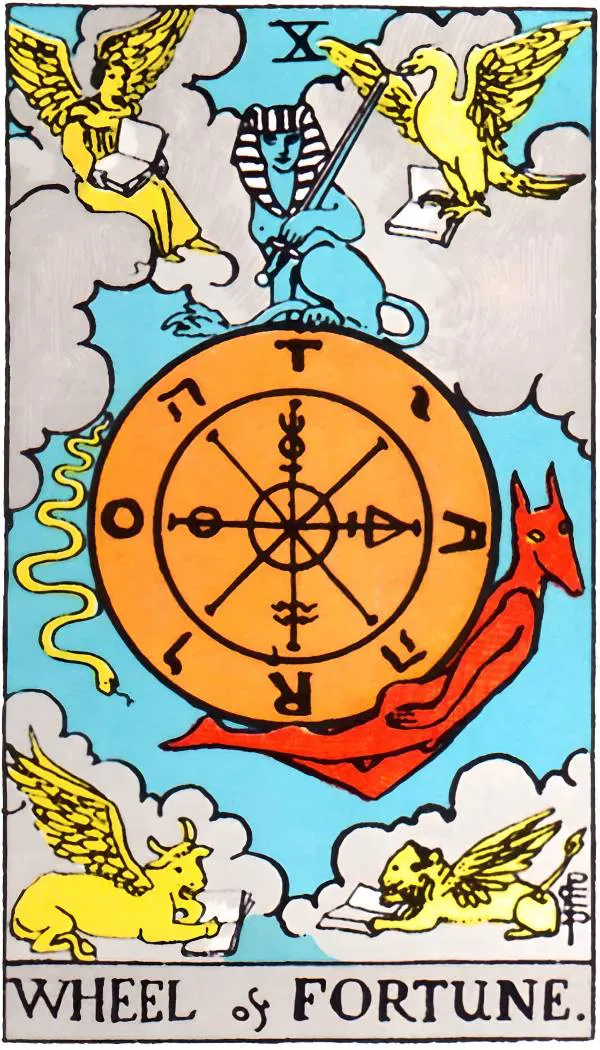
This card's overall composition perspective is a grand view, depicting the changes of fate from a cosmic macroscopic angle. The main subject of the image is the mysterious wheel that controls fate; it is a clock and also a compass. This wheel, in conjunction with the scenes and elements outside the wheel, expresses the mystery of fate and its regularity and unpredictability. To fully express the role of destiny, various philosophical systems are implied, and the card integrates a variety of complex mythological or esoteric systems.
The Wheel of Fortune is the embodiment of the force of fate, placed in the cosmic space, implying that this force is pervasive throughout the world and the universe, and is endless. The wheel itself has several circles, and the outside is layered with different mythological thoughts. The scenes around the four sides and other characters are all interlocking. The outermost layer is adorned with Christian system artifacts, while the Egyptian system artifacts are closely attached to the Wheel of Fortune. The outer circle of the wheel is surrounded by letters from different systems, connecting and echoing the inside and outside of the wheel, and the inner circle of the wheel is the alchemical system symbols. Let's start from the outermost scene of the picture and gradually enter the innermost layer of the Wheel of Fortune.
The four corners of the picture are densely covered with clouds, and each cloud has a divine creature, which are the faces of eagles, humans, bulls, and lions, all appearing in full body form and all with a pair of wings. These are the so-called 'Four Living Creatures', belonging to the Christian system artifacts. The 'Four Living Creatures' here are all in the same light yellow tone, and the images are not distinct. Their front limbs are hands, and each one is spreading open the book in front of them, as if they are reading or reciting. It can be any of the four Gospels or other scriptures, just as if they are constantly reciting or chanting, conveying messages and connecting with God, and also playing a role in making fate continue to move forward.
The greatest significance of fate in life is life and death, so the divine creatures closely related to the Wheel of Fortune are also related to this. These three divine creatures jointly operate and manipulate the Wheel of Fortune, and they all come from Egyptian mythology which has many insights into 'life and death'. In the center of the wheel, there is a sphinx balancing, controlling, and suppressing the Wheel of Fortune; another wolf-headed human is in the lower right corner, carrying and turning up the Wheel of Fortune; and the snake-shaped creature on the left is pulling the Wheel of Fortune downwards.
The sphinx is the Sphinx, holding the key to the riddle of life and the future, with a sword in his left hand leaning on his shoulder, as if it can affect the speed and direction of the wheel's rotation.
The wolf-headed human is Hermanubis, Anubis is the god of the dead in Egypt, leading the souls of the dead to the underworld, and in Greek mythology, Hermes also has this task, so the two images and names are often combined in later generations. Here it serves as a symbol of death and the operation of life.
The giant snake beside the wheel is named Typhon, which is actually the Egyptian god Seth in the form of a snake, equivalent to the original giant monster Typhon in the minds of the Greeks, and after Christianity, these names, images, and gods from different sources are combined together. Seth represents the destructive and destructive power of fate, giving people a sense of fear and seriousness about fate.
The designer Waite uses the names of the Egyptian gods, not the original names and images of ancient Egypt, perhaps to express the integration, and uses three divine creatures to surround this Wheel of Fortune, also wanting to connect with the three goddesses of fate in Greek and Roman mythology.
Now let's look at the structure of the wheel itself:
The outer circle of the wheel is engraved with two sets of different system text symbols, a total of eight letters, four in each set, one set is English letters, and the other set is Hebrew letters, the two sets of letters are interspersed. The four Hebrew letters are 'י', 'ה', 'ו', 'ה', which is the 'Tetragrammaton' representing the name of God, used to represent the supreme will.
The four English letters are 'T', 'A', 'R', 'O', related to the book of law and the mysterious connotation of Tarot, appearing in the form of palindromes. In the picture, these four Jewish letters, no matter how you read them, will be the same order. However, the four English letters, two directions will spell different words. Coincidentally, the use of these two letters, the reading and spelling order is opposite, which creates a magical palindrome effect. In the spelling of the English letters, there are many different permutations and combinations, producing many different meanings. The most important is the different direction of spelling starting from 'T', forming 'TARO' and 'TORA', similar and different sets of mysterious connotations - Tarot and the law of God. As for each letter as the starting point to spell in order, there are also many permutations and combinations: ATOR, ROTA, ...
The middle circle of the wheel is the eight-directional wheel spoke lines, which are superimposed and combined with several alchemical symbols.
The symbol on the upper right of the wheel represents the intermediary substance in alchemy - Mercury.
The symbol on the right of the wheel represents the important substance in alchemy - Sulphur.
The symbol on the left of the wheel represents the important substance in alchemy - Salt.
The symbol on the lower part of the wheel represents the substance in alchemy - solution, solvent.
Sulphur, mercury, and salt are the three elements or elements believed by later alchemy: sulphur in material refining, also represents the combustible part of all substances; mercury in material refining, also represents the volatile part of all substances; salt is the solid compound in material refining, also represents the residual solid part of all substances. And water or solution, represents the important liquid solvent in alchemy, and the basic process - dissolution.
The alchemical thought believes that all compositions can be analyzed into these elements. These three elements not only explain the material, but also represent other more complex compositions, including people can also be analyzed into these three elements. Of course, the indispensable liquid must also be added, and can be combined with the four elements of fire, earth, wind, and water.
As for the overall composition of a person, the three elements of alchemy, salt refers to 'the body', sulfur refers to 'the spirit', and mercury is 'the soul'. In terms of the pure spiritual composition, salt - subconscious, the unknown side; sulfur - self-awareness and will, action; mercury - super-consciousness and the transmission of consciousness. The water solution represents the transformation process of all these elements and the dissolution. These alchemical symbols are the symbols commonly used by the designer's group 'Golden Dawn', and their meanings are also related to their thoughts. In their Rosicrucian symbolic patterns, there are the three symbols arranged in order, representing the continuous transformation of consciousness.
The eight-directional lines radiating from the center of the wheel penetrate the two layers of the wheel, and these eight wheel spoke lines of course represent the eight spatial directions, but also represent the seasonal points on the timeline. The innermost layer of the wheel is divided into a small circle, surrounding the core of the wheel, and this circle only presents these eight lines, repeating and purely expressing the role of the intersection of time and space. The eight lines radiating from the core and the alchemical symbols are combined to form the main structure of the entire Wheel of Fortune, representing the temporal and spatial process and the transformation of matter and energy of fate changes.
The alchemical symbols in the inner circle of the wheel and the positions of the English letters in the outer circle are related, corresponding to each other in appearance, which is a kind of arrangement to connect the inside and outside layers: the circular symbol ~, corresponds to the outermost letter O in the same position; similarly, the sharp sulfur symbol ~, is also connected to the letter A; the symmetrical mercury symbol ~ is connected to the letter T; the curved water wave symbol ~ h, is matched with the curved letter R. As for the two sets of letters in the outer circle of the wheel, they have a corresponding meaning with the positions of the four living creatures outside the wheel. In this way, the various layers and the inside and outside of the entire 'Wheel of Fortune' are cleverly closely integrated into a whole.
The Wheel
The central symbol of the card, the wheel, represents the cyclical nature of life, destiny, and changes of fortune. It signifies the inevitable turning of tides, where sometimes we’re on top, enjoying good fortune, and at other times we find ourselves facing challenges. The wheel’s rotation reminds us that everything is transient and that situations will change, just as seasons do.
The Sphinx
Sitting atop the wheel is the Sphinx, a symbol of wisdom, mystery, and endurance. Its presence suggests that there’s a higher understanding or knowledge that oversees the turning of the wheel. The riddle of the Sphinx implies that life’s movements often come with their own sets of questions, and the answers are within reach if we seek wisdom.
The Four Creatures
In each corner of the card, there are four creatures: a man (or angel), eagle, bull, and lion. These represent the four fixed signs of the Zodiac – Aquarius, Scorpio, Taurus, and Leo respectively. They symbolize the stability amidst change, each holding a book to represent wisdom and the lessons learned throughout life’s cycles.
Tetragrammaton
The Hebrew letter ‘Yod’ (often repeated) or the Tetragrammaton is sometimes seen floating around the wheel, symbolizing the divine name of God. This reminds us of the divine intervention and the greater cosmic force that oversees the turning of the wheel of life.
Anubis and Set
Rising and falling on the sides of the wheel are the Egyptian figures of Anubis and Set. Anubis, the god of the afterlife and mummification, represents our journey through life and the transformation of our souls. Set, a god of chaos, reminds us of the unpredictability of life and the challenges we might face.

Interrupting Tutorial Hell: Wire the Filter, Ask What It Teaches

Always the Photographer, Never in the Photos: Try a Shared Rotation

Holding the Announcement: From Launch Pressure to a Measured Release

One Blank Checkbox, No Restart: Rethinking an Overloaded Routine

When an IC Goal Feels Like a Verdict: Letting the Draft Be Data
