

Seven of Swords Tarot Card Meaning
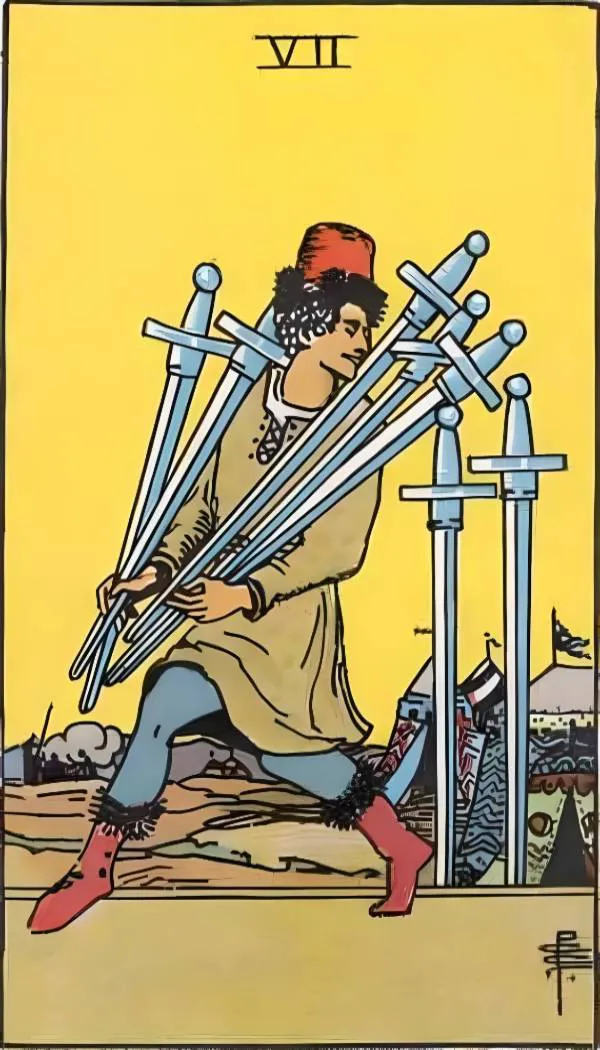
Seven swords are mostly pointing downwards, and the peculiar fellow in the scene has gathered five of them, while the other two stand upright on the ground.
This fellow is dressed comically, tiptoeing along, carrying away five swords. His right hand grasps the blades of two swords, while his left hand holds the blades of three swords. His left foot is bent and lifted forward, and his right foot is stretched back and on tiptoe. The tips of the swords are concentrated beside his left knee in front of him. On the path he has taken, two swords are left behind.
Behind him are several yurts or tents, and from the colorful sails and flags on the tips, it is known that the military is camping, indicating an opposing army is about to approach.
The fellow is walking on tiptoe, looking around furtively. However, he still looks back at the camp with a smile of complacency or luck. In fact, he has infiltrated the enemy camp for the safety of his own side, possibly to steal intelligence or set an ambush. Perhaps because he saw an opportunity, he momentarily came up with a plan to steal swords. He used some tricks to alleviate difficulties for his side and to escape.
Although carrying five swords is a bit inconvenient, his movements are still quick and agile, just more cautious. His smile is full of confident certainty. Perhaps because he couldn't carry all seven swords, he still gave up on two of them and left them standing on the ground. Contrary to the Five of Swords, the two parallel swords are facing down rather than up. These two swords form a barrier or checkpoint in front of the tents in the scene, to be used as a defensive tool against the enemy by discarding them along the way.
The clothing on the fellow is similar to that of the Fool, with many patterns. Blue trousers signify nimble action, and wearing a tall hat looks comical, which actually implies mental activity. Both the hat and shoes are red, indicating that action and thought are swift and high-spirited.
The background of the scene is very complex. In addition to the military camp, the left half is a natural landscape. The foreground is undulating land, the background is hills, trees, and a small house, and there are low clouds on the horizon. The deep yellow sky suggests dusk, and the time is at the boundary between day and night, which is a good time for secret actions.
Man Carrying Swords
The central figure of a man carrying five swords represents cunning or deception. He is stealing the swords, and by doing so, he thinks he gains an advantage, although not an honorable one. This symbolizes a tactical, albeit sly, approach to reaching one’s objective.
Two Swords Left Behind
The two swords left behind indicate that the man cannot take everything with him. This may symbolize incomplete victory or partial success, and it serves as a warning that not all is gained by cunning alone.
Tents in the Background
The tents in the background represent the context in which this action takes place, possibly a military encampment or a gathering of some sort. They stand for social structures or conventions that the central figure is acting outside of or in spite of.
Bare Feet
The man’s bare feet signify vulnerability and risk. While he is engaged in a precarious act, he is also exposed. His actions are risky, and the absence of shoes underlines this vulnerability.
The Backward Glance
The man’s backward glance signifies a lingering concern or apprehension about the ramifications of his actions. This action imbues the card with an element of tension, as it suggests that the individual is not entirely assured in his undertaking, and may be aware of potential repercussions or judgment from others.

From Therapy Performance to Honest Contact: Naming What Stalled

From Public Proof to Private Repair After Fights, Letting the Feed

Stuck Proving Growth to Old Friends: Letting Choices Speak

An Overground Text Edit: The Sentence That Held Truth and Privacy

Three Rewrites on the Northern Line: From Shame to One Honest Sentence
