Seven of Cups Tarot Card Meaning

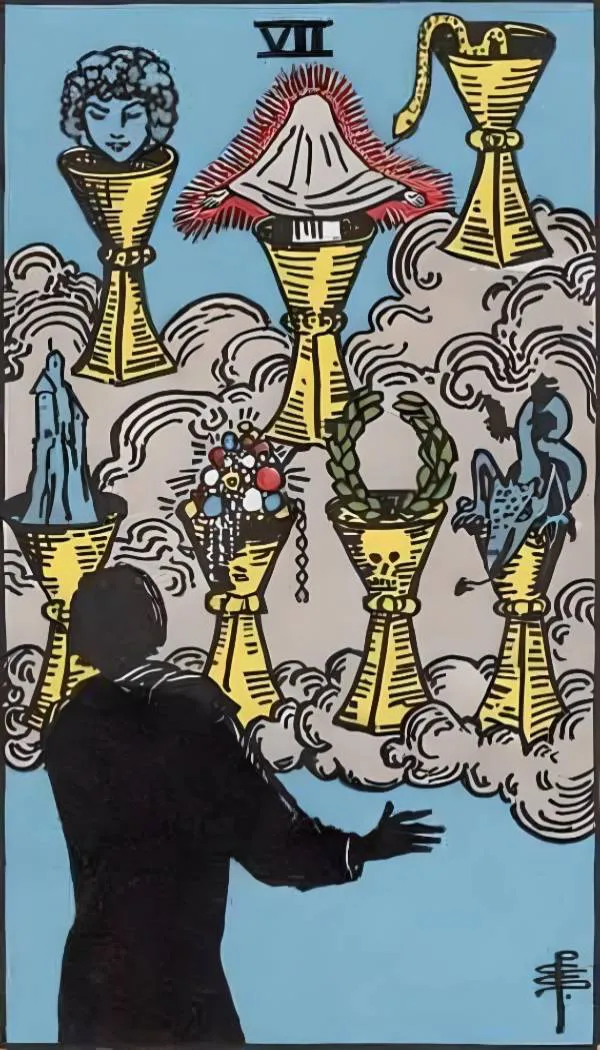
Seven chalices float in the misty air, each containing a castle (symbolizing adventure or home), jewels (material wealth), a laurel wreath (victory), a dragon (fear, or temptation/desire), a human head (mask), a glowing figure covered with a cloth (oneself), and a snake (wisdom, or jealousy/creativity).

Notice the inconspicuous skull beneath the laurel wreath, suggesting that success and death coexist, serving as a warning. A person faces these chalices, unsure of what to choose, with a posture that seems to convey slight fear.

This person gazes at the seven cups, contemplating how to balance life and achieve spiritual satisfaction. Each chalice represents an important aspect of a perfect life, but focusing solely on one may lead to an imbalance. Before fulfilling your deep spiritual needs (the white-covered chalice), your energy must be directed towards people (the chalice with a face), family (castle), material wealth (jewels), personal goals (wreath), subconscious desires (demon), and sexual life and creative power (snake).

This card depicts your pursuit of your true identity. The face in the top left chalice represents the mask or facade you sometimes use to face the world. The castle in the bottom left chalice represents home or the feeling of home, which you carry from one place to another.

The adjacent chalice contains jewels, symbolizing the power of material things, the force that attracts or repels things with a unified material nature. The fourth chalice holds a wreath, symbolizing personal power. The next chalice contains a demon, representing the demons you must constantly confront, which come from the depths of your subconscious.

The snake in the sixth chalice represents sexual and creative energy. The white cloth covering the seventh chalice hides your true or spiritual identity. Once you have made peace with the first six chalices, you will have the ability to recognize yourself more profoundly through the seventh chalice.

The card contains endless illusions and creativity, and the querent will face many choices or paths. Some choices may not bring the desired outcomes as imagined by the querent, but only one direction can lead the querent to success.

The Clouds

These billowing clouds act as the foundation for the cups, emphasizing the ethereal and transient nature of the visions within each cup. They signify that the dreams and desires presented might be illusions, distant from reality or grounded understanding.

The Seven Cups

These cups, floating amid the clouds, represent the multitude of choices or desires available. Each cup holds a different vision, highlighting the overwhelming emotions and confusion one might feel when faced with numerous tantalizing options or illusions.

The Shrouded Figure

This figure embodies mystery, the unknown, or something hidden from view. It suggests that not all that glitters is gold, and some choices may hide unforeseen challenges or deceits.

The Castle

A symbol of ambitions, dreams, and aspirations. The castle represents lofty goals or the desire for security and status.

The Jewels

Representing wealth, material gain, and treasures, the jewels are the allure of tangible riches and the temptations of unchecked materialism.

The Snake

A classic symbol of temptation and deceit, the snake warns of choices that seem appealing but may carry hidden dangers or consequences.

The Head

This could be seen as the embodiment of honor, respect, or even gaining a good reputation. It might also indicate the desire for knowledge or recognition.

The Dragon

A creature of power, transformation, and untamed passions. The dragon signifies overwhelming desires, dreams beyond one’s reach, or uncontrolled fantasies.

The Laurel Wreath

Often a symbol of victory, achievement, and recognition, the laurel wreath in this context can indicate the desire for accomplishment and public acknowledgment.

Psychological patterns in Seven of Cups
Analysis Paralysis
The silhouetted figure stands still in front of seven cups, arm raised but not committed to any one vessel. The eye has too many destinations, and the image gives no road, table, or grounding point that would make one choice physically easier than another. That suspended posture is the body of overanalysis. In social life, every invite or circle can become a mental simulation of who you might become, who might judge you, and what you might lose, until the act of choosing feels more threatening than the event itself.
Illusion of Control
The cups float like signals, but they do not form a map. The wreath promises achievement while the skull beneath it reminds the viewer that even the most attractive sign can hide cost. Illusion of Control emerges when the mind tries to master uncertainty by decoding every symbol until risk disappears. In timing questions, interpretation can become a control ritual: if the right sign is found, the person believes the outcome can be secured. You may be gathering signals, patterns, and forecasts because ambiguity feels too exposed. The card shows where the search for the perfect reading of the moment starts replacing contact with the actual conditions that would make action viable.
Idealization
The seven cups hover in mist rather than resting on solid ground, and each cup offers a charged image: beauty, status, danger, victory, mystery, and a hidden self. The figure does not touch any of them. He stands at a distance, looking at visions that are vivid enough to feel emotionally real but not grounded enough to be tested. That distance is the visual engine of Idealization. In love, the psyche can fill the gap between what is known and what is desired with projection, turning a partner into a carrier for hope, rescue, chemistry, or future possibility. The cup is not the person; it is the image your longing has placed over the person. When this pattern is operating, attraction can feel like recognition even before there is evidence of consistency. You may feel pulled toward what the relationship symbolizes while bypassing the slower work of seeing behavior, limits, timing, and emotional availability. The card exposes the moment where fantasy becomes more persuasive than contact.
Certainty Seeking
The cups present themselves as possible signals, but none of them offers final confirmation. The figure keeps looking, held at the edge of action by the hope that one image will become clear enough to remove doubt. Certainty Seeking is the defense that converts timing discernment into an endless search for permission. The mind wants a signal so complete that it can move without feeling the vulnerability of partial information. In timing questions, this pattern can make the next step depend on a level of confirmation life rarely provides. The card reveals where the search for clarity is valid, and where it has become a way to postpone contact with risk.
Timing Perfectionism
The laurel wreath appears as a symbol of achievement, but the small skull beneath it changes the psychological charge of the image. The promise of success is not clean; it carries cost, consequence, and the pressure of choosing when the stakes feel permanent. Timing Perfectionism grows from that exact tension. The mind tries to locate a moment where action will be ambitious but safe, decisive but consequence-free, visible but immune to loss. You may keep searching for a window that feels completely aligned before you move. The card shows why that window remains elusive: the psyche is not only assessing timing, it is trying to remove the existential risk that comes with any meaningful threshold.
Rumination
The figure's attention is caught in a field of images that all demand interpretation. Because the cups float without sequence, the gaze can keep moving from one to another without ever reaching completion. Rumination is the mental loop that mistakes repeated review for resolution. In this card, thought keeps circling the timing question because every option can be reinterpreted, every symbol can become another possible sign, and every imagined outcome can restart the cycle. You may feel as if you are preparing, but the pattern is consuming the very energy that would help you recognize the next real opening. The card makes the loop visible: the mind keeps scanning the mist because landing on the ground would require tolerating uncertainty.
Decision Deferral
The figure stands before the cups in a posture of interrupted movement. The arms lift, the gaze fixes, but the body never crosses the distance into contact; the whole scene becomes an unfinished gesture held in mist. Decision Deferral forms when the pause itself becomes the coping strategy. You may keep the decision alive because aliveness feels safer than consequence: no option is lost, no identity is tested, no cost is confirmed. The reversed texture of the card shows the trap inside the delay, where waiting stops being discernment and becomes a way to avoid the irreversible edge of choice.
Limerence
The cups do not show ordinary relationship evidence; they show charged images floating in mist. A face, a hidden figure, a dragon, a snake, treasure, victory, and a castle appear as if they are available for emotional possession. The atmosphere makes inner longing look like outer confirmation. That is the mechanism beneath Limerence. The psyche fuses uncertainty, desire, and projection until the imagined bond becomes more stimulating than the actual relationship. A text delay, a brief look, a memory, or an unfinished conversation can become a cup filled with meaning. In love, this pattern keeps attention magnetized to what has not been clarified. You may feel as if the intensity proves the connection, but the card shows a more precise audit: the intensity is being amplified by the gap between fantasy and reality, and the gap keeps feeding the fixation.
Shadow Projection
The Seven of Cups places the dragon, snake, jewels, castle, wreath, face, and veiled figure outside the body of the observer. The card makes inner material visible as separate objects, so desire, fear, envy, ambition, persona, and spiritual identity can be stared at without yet being owned. Shadow Projection begins in that distance. A charged part of the psyche is moved into an image, person, fantasy, or sign, which makes it easier to study but also easier to misrecognize as something external to the self. For introspective tarot, this is one of the card's sharpest psychological mirrors. You may be surrounded by symbols that seem to explain what is happening, but the deeper audit asks which cup is carrying a disowned part of you that has been made to look like fate, temptation, threat, or destiny.
Option Hoarding
The seven cups hover in cloud instead of resting on a table, so none of the visions has to touch the ground. The figure stands before them with attention spread across castle, jewels, wreath, creature, snake, mask, and veiled self, letting possibility stay expansive while consequence stays postponed. That visual structure mirrors Option Hoarding in friendship: every group chat, old bond, almost-friend, and backup circle remains psychologically available. You may keep collecting possible versions of belonging because choosing would force a sharper audit of reciprocity, emotional cost, and which connections are actually alive.
Core Struggles in Seven of Cups
Idealization-Reality Split
The visions sit inside cups but hover in cloud, presented with visual clarity and no physical route. A castle, jewels, victory wreath, serpent, dragon, face, and covered figure look complete as images, yet the scene gives no evidence of weight, cost, distance, or sequence. That split gives imagined futures a polished surface while withholding their real conditions. You may be drawn toward a direction because it feels vivid from a distance, while the card shows the gap between a future that can be pictured and a future that can actually be inhabited.
Belonging-Authenticity Split
A public head appears in one cup while a shrouded figure stands hidden in another. Around them sit symbols of recognition, status, desire, safety, and danger, all held at the same height as if every possible social self has equal claim. Belonging-Authenticity Split emerges from that exact arrangement. You are not simply choosing who to hang out with; you are measuring which version of yourself can survive being seen by the group. The card gives form to the pressure of fitting in without disappearing. Its social question is not whether you can be accepted, but whether the accepted self would still be connected to the covered self that needs to belong.
Inner Compass Overload
The shrouded cup is not absent; it is present, but it has to compete with jewels, a castle, a wreath, a face, a snake, and a dragon. The card does not hide the inner signal completely. It places it inside a crowded symbolic field where every other signal also has a claim. Inner Compass Overload is the struggle of having too many inputs to hear your own rhythm clearly. The figure's stillness matters because the body cannot convert a crowded sky into a felt sequence. In timing questions, this is the moment when signs, opinions, imagined futures, and milestone pressure become louder than your own sense of pace. The card gives that overload a boundary: the inner compass is not broken; it is surrounded.
Intuition-Reality Split
The cups look complete from a distance, but their foundations are cloud, not ground. In the reversed state, the floating display becomes so normalized that an unsupported image can start to feel like a reliable guide for how life should be arranged. This is where lifestyle intuition can split from reality. A routine may feel aligned, beautiful, aspirational, or spiritually correct while still ignoring the physical facts of your body, room, calendar, finances, commute, attention span, and recovery needs. The Seven of Cups reversed gives that split a precise shape. It shows a personal blueprint built from symbols that have not been pressure-tested against daily conditions, so clarity has to return through contact with what your actual life can hold.
Ambiguity Dependence
The cups become a closed weather system: mist below, visions above, and the figure oriented toward nothing except the suspended display. The longer the eyes stay there, the more the cloud starts to behave like a floor. Ambiguity Dependence appears when uncertainty becomes the structure that keeps romantic desire alive. You may keep returning to almost-love, mixed signals, or undefined connection because clarity would force one cup to become real and the others to disappear. The reversed pressure is not simple confusion; it is adaptation to the mist. The relationship stays psychologically active because it remains unchosen, untested, and unfinished.
Masked Self-Division
The visible head and the covered figure occupy the same clouded field without touching. In the reversed pressure of the image, the public-facing sign remains readable while the central self stays wrapped, protected, and unavailable. Masked Self-Division becomes especially sharp in social spaces where you can function, respond, laugh, network, and appear present while feeling unseen. You are not absent from the group; the part of you that is accessible to the group has been separated from the part that needs recognition. The card does not treat that split as a personality flaw. It shows a structure where social readability has become safer than self-contact, and where belonging cannot deepen until the covered self has a place in the room.
Abundance Overload
Seven cups hang in a clouded field, each carrying a complete promise: shelter, wealth, recognition, charged desire, reputation, hidden identity, and creative force. The visual problem is that all of them arrive with the same brightness and the same height, so no single cup naturally becomes the ground on which the rest can be arranged. In lifestyle terms, this is the pressure of too many valid upgrades asking to become the center of your life at once. You may not be lacking ideas, resources, or ambition; the strain comes from abundance arriving without sequence, container, or proportion. The card gives that overload a visible boundary. It shows a daily system where every module looks important, but the structure holding them is mist, so your attention keeps spreading before your life can consolidate into a rhythm you can actually inhabit.
Analysis Paralysis
The silhouetted figure stands before seven cups that are visually available but physically unchosen. The scene is crowded with futures, yet the body remains at the threshold, seeing everything and touching nothing. That suspended posture gives Analysis Paralysis its exact shape in a decision reading. The mind keeps expanding the comparison field because each cup contains a different promise, threat, identity, or consequence, but the body receives no grounded next move from that expansion. You are not looking at simple indecision here. The card locates the struggle in the gap between visual possibility and embodied commitment, where more information makes the choice field brighter but not more livable.
Achievement-Meaning Collapse
The laurel wreath rises as a clean symbol of victory, but the small skull beneath it makes the cup unable to hold achievement without consequence. In the Seven of Cups, success does not stand on solid ground; it hovers inside mist beside wealth, desire, fear, image, and the hidden self. You are not simply asking whether you want recognition. The card places recognition inside a crowded inner display where every visible win is pressured by a deeper question about what that win would cost, conceal, or fail to answer. For introspection, this is the point where ambition stops behaving like a plan and starts behaving like a mirror. The struggle is the collapse between achieving something and proving that the achievement can carry meaning once the cloud of fantasy clears.
Mental Bandwidth Depletion
The seven cups keep the gaze moving from one symbol to another without giving the body a stable place to land. When this field turns inward, the visions stop functioning as information and start functioning as a drain. Mental Bandwidth Depletion appears when the decision process consumes the very capacity needed to decide. The mind keeps revisiting the castle, jewels, wreath, dragon, snake, mask, and covered figure, but each pass adds more charge and less usable clarity. You are looking at a choice system that has stayed open too long under too many symbolic demands. The struggle is not that you failed to think hard enough; it is that thinking has become the loop that spends your agency.
Inner Emotions in Seven of Cups
Scattered Overwhelm
The upper half of the card is crowded with suspended cups while the lower body has no road, horizon, or single next step. The figure is positioned under a ceiling of images, each one vivid enough to pull attention away from the last. In friendship, this becomes the state of being flooded by group chat tension, private venting, subtle exclusions, competing loyalties, and half-spoken needs all at once. You are not lacking care; the card shows an attention field so crowded that your emotional system cannot find the one thread that belongs to you.
Existential Vertigo
The seven cups float without a road, floor, or horizon to organize them. The figure faces upward into a cloud field where symbolic futures are vivid, but none of them provides a stable reference point. Existential Vertigo rises from that loss of inner gravity. The problem is not a lack of options; it is the disorienting sensation that too many possible selves have appeared at once, making the idea of a true direction feel unstable. In direction work, this card captures the dizzy feeling of looking at your life from too many angles until meaning itself starts to wobble. The card gives that spin a shape, allowing the confusion to be seen as an overloaded symbolic field rather than a permanent loss of agency.
Social Vertigo
With no visible groundline, the seven cups hang like a social map without coordinates. The figure faces a sky full of options, but there is no floor, road, or horizon to help the body know what is near, what is reachable, or what is only projection. That is the inner weather of Social Vertigo: every group chat, invitation, scene, and possible circle seems meaningful, yet the more you scan them, the less oriented you feel. The problem is not a lack of options; it is the absence of a stable inner reference point while those options multiply. The card makes the spinning feeling legible. It shows a psyche trying to navigate social possibility while the environment keeps floating, and that recognition gives the disorientation a shape you can observe instead of being swallowed by it.
Directionless Urgency
The scene has no road, table, or horizon to tell the figure where movement should begin. The cups hover above ground level, so the whole field feels urgent to look at but difficult to enter. For lifestyle restructuring, this becomes the pressure to change everything while lacking a sequence the body can trust. You can feel time pushing, but the internal map is all suspended images, leaving urgency without direction.
Desire Anxiety
The jewels, snake, dragon, and castle glitter from separate cups while the figure stays at a distance, facing desire without contact. Each image carries pull, charge, and possible consequence, making wanting itself feel physically unsafe to admit. You may know which option draws you, but the attraction arrives tangled with caution, self-scrutiny, and the fear of being led by appetite rather than clarity. Desire Anxiety names the tense inner weather that forms when the most alive option is also the one you do not fully trust.
Analysis Paralysis
The figure keeps facing seven separate cups, each one carrying a different image and a different implication. There is no path, table, or grounded order to the display; the eyes can compare, but the body has nowhere definite to step. Within family pressure, Analysis Paralysis becomes the endless internal sorting of responses: what to say, how much to disclose, whether to visit, whether to accept help, whether to set distance, and how each move will be interpreted. Every option feels like it must be calculated against the family’s emotional weather. The reversed quality of the Seven of Cups shows thought losing its organizing power. The more the mind studies the cups, the less the body can move, because the problem is not a lack of information but an excess of emotionally loaded possibilities.
Wrong Choice Panic
The skull tucked beneath the laurel wreath makes reward and cost share the same cup, while the snake and dragon sharpen the sense that each attractive image may conceal a catch. With no ground line beneath the cups, the mind has nowhere to place a clean risk boundary. You may experience the decision as if one wrong move could contaminate the whole future, even when the real issue is unseen tradeoff density. Wrong Choice Panic names the inner surge that turns ordinary uncertainty into a catastrophic image of choosing the cup that ruins the rest.
Shadow Fascination
The snake, the dragon-like figure, the jewels, the mask-like head, and the veiled form do not sit in ordinary space; they glow from cups suspended in vapor. Their distance makes them unreachable, but their brightness makes them hard to ignore. This is the emotional atmosphere of being drawn toward the parts of yourself that are usually edited, managed, or explained away. The card holds attraction and caution in the same visual field, so the gaze keeps returning to what feels charged, private, and not fully admitted. Shadow Fascination captures the strange pull of inner material that is neither cleanly wanted nor cleanly rejected. You are not simply tempted by illusion; you are being confronted with how compelling the hidden self can become when it finally has symbols to speak through.
Cognitive Overwhelm
Seven chalices floating in mist create an information field with no table, ground, or ranking system. Each cup contains something vivid enough to pull attention, but the scene gives no ordinary sequence for what should be examined first. In academic life, that visual structure mirrors the moment learning stops feeling like a path and starts feeling like too many simultaneous portals. You are not simply distracted; your attention is being asked to evaluate readings, grades, research identities, and future options before any one of them becomes grounded enough to organize the rest. Cognitive Overwhelm fits this card because the pressure is not just volume, but symbolic density. The mind is full of meaningful material, yet the lack of hierarchy turns meaning into mental static.
Mixed Signal Dread
The laurel wreath promises recognition, yet the small skull beneath it places a quiet warning under the image of success. Around it, the other cups offer beauty, danger, status, mystery, and hidden identity without giving the figure a stable way to tell which vision can be trusted. In a reversed emotional field, the mist stops being spacious and becomes corrosive. Romantic signals do not simply feel unclear; they begin to feel loaded, as if every warm message might conceal withdrawal, every promise might carry a hidden limit, and every hopeful sign might ask you to ignore a warning. Mixed Signal Dread is the body learning to brace inside ambiguity. The card links this feeling to the coexistence of invitation and threat, showing why your attention keeps returning to tiny contradictions even when part of you wants the connection to feel simple.
Outer Contexts in Seven of Cups
Routine Collapse
The figure faces a crowded sky with no floor, no sequence, and no visible handhold. The cups are full, but they are disconnected from each other, so their contents do not flow into a workable day. Reversed, this image describes a lifestyle system losing its basic order. Sleep, meals, errands, cleaning, work blocks, messages, and recovery stop forming a chain; instead, each demand floats separately and competes for the same limited attention. The card gives collapse a map rather than a moral verdict. You can see where the hierarchy disappeared, where too many symbolic priorities are hovering at once, and where one grounded anchor has to be restored before the rest of the routine can reconnect.
Analysis Paralysis
The person in the Seven of Cups has not moved into the scene of any cup. The body stays below the visions, and the clouded space removes the practical markers that would turn one option into a route. In personal growth, this is analysis paralysis at the level of identity and strategy. You may be comparing methods, timelines, possible selves, and imagined outcomes so intensely that the act of deciding becomes a second life lived above the real one. The card holds up a clear mirror to the stuck point: observation has replaced selection. Its value is not in pushing a faster choice, but in showing where the field needs to be narrowed before disciplined action can re-enter the body.
Ignored Red Flags
The laurel wreath promises victory, yet a skull rests beneath it, and sharper symbols sit among the attractive cups rather than outside the offer. The warning is not separate from the prize; it is embedded inside the thing that looks most rewarding. That visual logic fits the relationship moment when concerning behavior is visible but wrapped in charm, chemistry, or future promise. The card links this context to the work of seeing the whole cup at once, including the cost hidden under the beautiful symbol.
Premature Launch Pressure
The castle and jewels float in mist, bright enough to attract action but not solid enough to hold weight. The figure is below them, arm raised toward a future that has not yet become a usable structure. Premature Launch Pressure appears when an opportunity looks ready from a distance while the real supports are still missing. You can reclaim agency by naming the gap between image and infrastructure, because the card's warning is about moving into a projected window before it has ground.
Situationship Ambiguity
The figure faces seven cups but holds none of them, and the whole scene floats in cloud without a road, table, or ground. The visual field is full of possible meanings, yet none has been converted into a stated position. That is the architecture of a situationship: emotional images, romantic access, and future hints exist, but the relationship has no stable container. The card links your question to the gap between being shown options and being offered a real role in someone's life.
Ignored Social Red Flags
The snake, dragon, and small skull sit inside the same display as the castle, jewels, and laurel. The warning signs are not outside the attraction; they are embedded in the same clouded offer. In a social circle, that structure shows how charm, status, intensity, or exclusivity can make risk look like part of the aesthetic. You may be reading signals that something is off, and the card gives those signals a physical location: they are not interruptions to the promise of belonging, they are part of the cup itself.
Premature Major Commitment
The figure is asked to face seven life-sized symbols from a position that has no ground path and no tested route forward. The cups loom above the body, turning choice into an identity decision before practical experience has sorted the options. That is the pressure behind Premature Major Commitment. A major, concentration, thesis path, or graduate direction can be treated as a fixed declaration before the student has enough evidence about workload, interest, skill fit, mentorship, or career reality. The reversed Seven of Cups exposes the timing problem. The issue is not that academic commitment is wrong; it is that the system may be demanding a long-range identity decision while the evidence is still suspended in mist.
Academic Risk Blind Spot
The laurel wreath looks like victory until the small skull beneath it becomes visible. Around it, the other cups also present their rewards in mist, showing the appeal of an option before its full cost has been inspected. That is the academic shape of a Risk Blind Spot. A prestigious supervisor, overloaded semester, ambitious thesis, elite program, or impressive course title can look like the winning cup while concealing the workload, assessment exposure, or support gap attached to it. The Seven of Cups brings the hidden cost into view. It asks the academic choice to be evaluated not only by how it looks from the outside, but by what it demands from your time, resources, feedback access, and capacity to produce real work.
Self-Help Content Spiral
The cups float like a sequence of attractive prompts, each one offering a different upgrade without giving the figure a usable handle. The person remains below the display, looking into a clouded field where stimulation is abundant and transfer into action is absent. That visual structure matches the self-help content spiral in personal growth. You can keep encountering new frameworks, methods, identity language, and productivity systems, while the actual behavior change remains suspended just out of reach. The card makes the loop objective: more symbolic input is not the same as movement. It shows where the growth environment has become a feed of possible selves, and where agency returns by noticing which cup has become a distraction from the grounded next step.
Wellness Optimization Trap
The seven cups appear like a complete menu of improvement, but they remain suspended, untested, and equally demanding. The figure is held in front of the display rather than released into a grounded sequence, making the act of choosing feel like another task. In lifestyle terms, this captures the trap of turning wellness into an expanding management system. Sleep tools, food rules, tracking apps, exercise plans, supplements, morning routines, and recovery rituals can begin as support, then become a second workload layered on top of the life they were meant to stabilize. The reversed structure points to a loss of boundary around optimization. You reclaim clarity by seeing which improvement demand is consuming more bandwidth than it returns, and which cup needs to be removed before the system can breathe.