

Knight of Cups Tarot Card Meaning
Overall Visual Structure
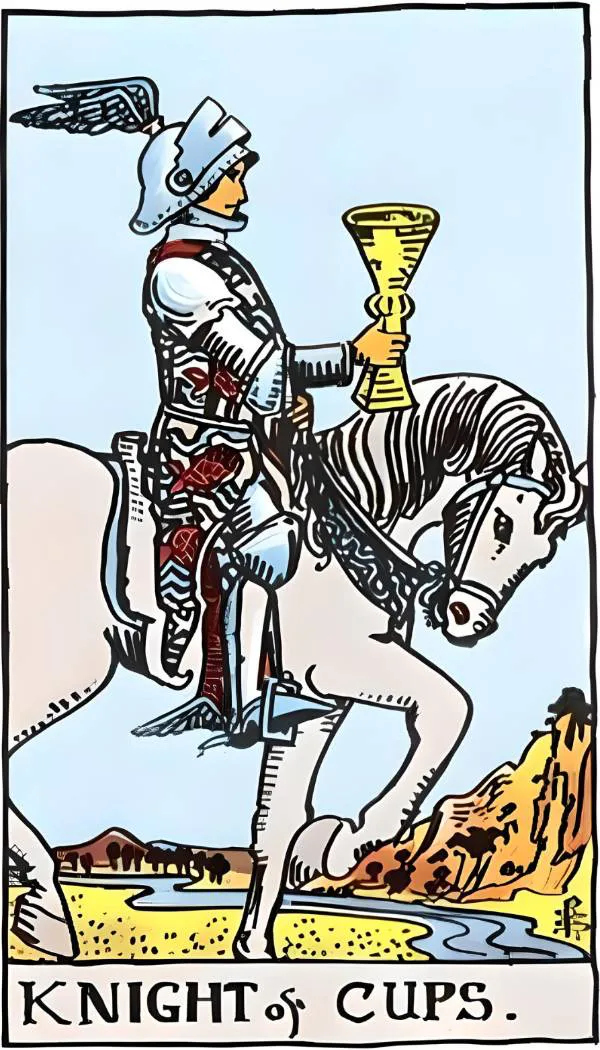
A gallant man is depicted riding a white horse, moving forward gracefully and leisurely. The Knight holds a chalice in his right hand, gazing intently at the object in his grasp; he is the Knight of Cups.
The Knight of Cups is clad in armor and a resplendent red fish-patterned robe, with a helmet adorned with wing-like ornaments on top. The white horse walks calmly, moving forward with its head lowered, and is equipped with light and crystal-clear tack.
The Knight is approaching a river, with hills visible on the opposite bank. The sky is clear.
This Knight has retrieved the Holy Grail, and his steps are no longer hasty. He treads gently along the damp riverbank, preparing to cross the river. Whether it's a heart returning home or one that yearns to travel far, there is an anticipatory mood.
Detailed Pattern Explanation
The Knight of Cups has a handsome face, exuding a refined and cultured aura. His elegant posture reveals his peaceful nature. He rides his horse softly, and despite being a knight, he is not at all warlike. He gallops in pursuit of the Holy Grail, dons his armor for his dreams, and strives forward for the goals in his heart. After an adventure and struggle, he has found the long-sought Holy Grail and is now carrying it forward.
This Knight's posture is the most graceful; his expression is joyful and serene, and his eyes are full of hope and light. He looks ahead but cannot help but be drawn to the gaze of the chalice in his hand. He holds the chalice carefully, naturally unable to move too swiftly forward, with his other hand firmly grasping the reins, controlling the horse's pace to be gentle. The horse ridden by the Knight of Cups is white, symbolizing gentleness, purity, and loyalty, also hinting that he is a knight of temperament (a prince on a white horse). The horse's tack is simple, with only a saddle and a blue bridle, matching the color of the Knight's attire, indicating a harmonious pairing.
The Knight's helmet is adorned with a pair of wings, and his iron boots also have wings, signifying a light figure and a racing spirit. These wings symbolize pure angels, representing the Knight's pure emotions within. The winged boots are reminiscent of the Greek god Hermes, indicating that the Knight, like the deity, is light and swift, moving as if he could fly, and is favored by God to convey divine will. The Knight of Cups' armor is blue and white, indicating a non-combative stance in favor of peace. Over his armor, he wears a coat with a white base and blue waves, embroidered with red fish, a symbol of the ocean, and representing passion and freedom.
This Knight crosses a field and is now approaching a river, with the horse's hooves gently treading on the damp riverbank. On the other side of the stream lies a hill; it is unknown whether there is a path to follow after crossing the river. He cherishes the holy object in his hand and, to protect the long-sought Holy Grail, he will carefully consider his future path. He may be about to cross the river, or perhaps he is contemplating taking a different route. Whether it's a heart returning home or one that yearns to travel far, there is an anticipatory and excited mood. The sky is clear and bright with no clouds, reflecting his mood.
Winged Helmet and Armor
The Knight of Cups, unlike other knights in the tarot, is adorned with wings on his helmet and armor, emphasizing the fluidity and changeable nature of emotions. Just as emotions can elevate us, they can also bring us down. These wings symbolize the ability to rise above challenges using intuition and emotional understanding.
The Cup
In his hand, the Knight holds a cup, representing the emotional offerings and messages he brings. This cup may contain love, feelings, intuition, or a dreamy aspiration. The knight’s focus on the cup suggests he trusts his heart and intuition in the quest he’s undertaking.
The Calm Stream
Below the horse’s hooves flows a calm stream, indicating the steady flow of emotion and the Knight’s connection to the fluidity of feelings. The stream’s peacefulness suggests a balanced approach to emotions, neither repressing them nor being overwhelmed by them.
The Horse
The Knight’s horse stands ready but not in full motion, highlighting the Knight’s approach to situations: deliberate and thoughtful, not rushing into things. The gentle demeanor of the horse suggests a careful and considered approach, especially in emotional or romantic endeavors.
The Desert and Verdant Hills
In the background, we see a landscape transitioning from a barren desert to lush, verdant hills. This depicts the transformative power of emotions and intuition. Emotions can transform barren landscapes into fertile grounds, emphasizing the potential of tapping into our feelings and intuition to bring about change.

A Question Deleted at 10:46 Became Two Dates and a Wednesday Plan

Intense Texting Isn't Lasting Security: Let Follow-Through Earn Trust

Post-Breakup Choice Paralysis: A Texting Pause Toward Self-Trust

A Vague Reply, a Kept Dinner: Letting the Slow Fade Speak for Itself

When Waiting for Proof Became Avoidance: One Honest Ask After Flirting
