Three of Pentacles Tarot Card Meaning

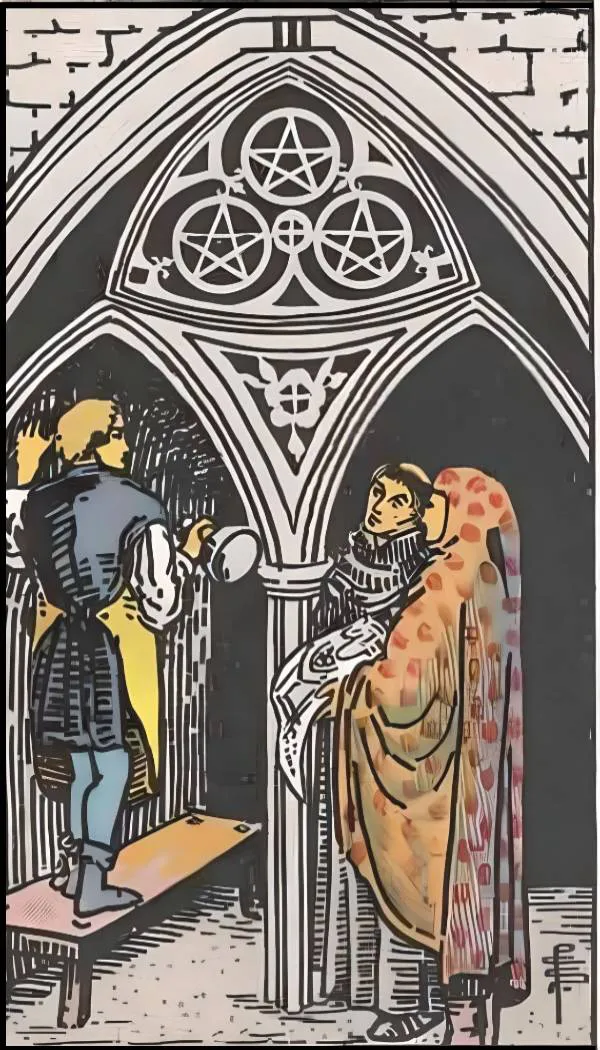
The central scene of this card depicts a typical medieval church architecture, viewed from the outside looking in. Three Pentacles are embedded at the top of the archway, though they do not show their golden color, as the entire scene is focused on the renovation of the building.

Three individuals are shown standing in front of the door, not inside the building. The person on the far left is a sculptor, wearing a work apron and standing on a bench-like worktable, holding a hammer and nail, about to strike the leftmost pillar.

Two other figures face him; the one on the far right is a bishop dressed in red robes, holding a design blueprint, who is the architect of the building. The monk, closer to the worker, is dressed in white robes. Both are looking at the sculptor, as if they are communicating with him.

This is a scene of decoration, indicating work or preparatory work in progress, and it is a collaborative task—three people are working together on a task, each with their own role. The design blueprint in the bishop's hand represents the blueprint of the building.

The architecture depicted is Gothic, featuring many triangular shapes with pointed tops at the center. In the middle height, three pentagram stars are installed, with a round cross between them. Above the pillars, in the inverted triangular area, there is a hollowed-out 'Tudor Rose' pattern.

The entire scene is symmetrical around the central pillar, with the sides of the pillars not shown in the scene. The church's design is very geometric.

The Craftsman

The central figure represents skill, craftsmanship, and attention to detail. This symbolizes the mastery that comes from hard work and dedication, often implying that you are becoming a master in your chosen field.

The Benefactors or Assessors

The other two figures indicate cooperation, expertise, and feedback. They are essential for the craftsman to realize his vision, emphasizing the idea that great accomplishments are often the result of teamwork and outside guidance.

Pentacles on the Arch

The three pentacles are often shown integrated into the arch that is being built. This symbolizes the fruition of collective creativity, investment, and labor. The physical manifestation of their skill is literally ‘set in stone’, signifying permanence, stability, and a job well done.

Tools

The tools in the hands of the craftspeople or the tools laid out before them, often including compasses, chisels, or hammers, symbolize the specific skills each person brings to the table. These tools not only signify the need for specialized skills but also the application of such skills in a practical, earthy endeavor.

Architectural Plans or Blueprints

Often, one of the figures is holding architectural plans or blueprints. These represent the concept, the dream, or the vision that serves as the guide for the actual building process. It emphasizes the need for a solid plan and vision to guide skilled labor toward the completion of a significant goal.

The Cathedral

The cathedral in the backdrop signifies a grand vision or a long-term project. It also brings in a spiritual element, suggesting that the task at hand is part of a larger divine plan or has a higher purpose.

Psychological patterns in Three of Pentacles
Competence Theater
The worker's craft is not hidden in private practice; it is being watched inside a formal architectural frame. The hammer, the bench, the blueprint, and the symmetrical stonework make effort visible, measurable, and open to evaluation. In a family context, this becomes the psychological stage where maturity must be demonstrated rather than lived. You may bring achievements, stability, emotional control, or polished plans to the family system because being seen as competent feels safer than being seen as uncertain, angry, hurt, or unfinished. Competence Theater turns capability into armor. The card's collaborative scene supports real skill, but it also shows how easily skill can become a performance when the family gaze feels like an assessment panel instead of a relationship.
Resource Alignment
The sculptor stands on a raised worktable with a tool in hand while the robed figures hold the plan and face the work, so the scene does not place all competence inside one body. Skill, vision, assessment, and material effort are physically separated into roles, then brought into contact at the pillar. That visual structure mirrors Resource Alignment because a sustainable lifestyle system has to match tasks with the right tools, timing, feedback, and energy budget. You can see the pattern when the blueprint, the labor, and the available resources are audited as one system instead of being forced through a single reserve of willpower.
Feedback Integration
The worker is not alone with the stone. Two figures face him, and one holds the plan close enough for the craftsperson to reference while the next strike is still being shaped. Feedback Integration turns that exchange into a timing mechanism. It shows You that input does not have to function as judgment; it can become the checkpoint that clarifies whether the next move needs force, revision, or patience. The card anchors this pattern through the visible circuit between hand, blueprint, and observers. The timing signal is not hidden in a mystical sign; it is distributed across the craft, the plan, and the people who can see parts of the work You cannot see from the bench.
Peer Co-regulation
The two standing figures face the craftsman while he stays engaged with the stone, creating a live circuit between feedback and action. No one is merged into one another; the bodies remain separate, but the attention is shared. Peer Co-regulation appears here as a nervous-system pattern of orienting through calibrated reflection, not through surrendering the compass. In a direction reading, the card shows how you may need grounded witnesses to steady the future signal while still keeping the tool in your own hand.
Overfunctioning
The craftsman is the body in motion, while the blueprint and institutional robes define the larger frame. The pentacles are already integrated into the stone above, suggesting value becoming part of the structure even as the person doing the work remains below it, still laboring at the threshold. This is the reversed ground of Overfunctioning. The pattern forms when doing more becomes the substitute for having clearer authority, cleaner boundaries, or explicit recognition. You keep carrying execution, coordination, and emotional steadiness because the system rewards usefulness while staying vague about power. In career terms, the card reveals the danger of becoming essential without becoming properly credited. The defense makes sense because competence can protect you from being overlooked in the short term, but the long-term cost is that the organization learns to absorb your extra labor as normal rather than treating it as leadership, scope, or value that must be named.
Parentification
The active labor sits in one body while the plan and the authority sit in other hands. The worker is the one repairing the structure, even though the structure is larger, older, and not personally authored by him. In family systems, that image becomes a precise map of being made responsible for emotional maintenance before true consent exists. You may become the translator, stabilizer, organizer, therapist-like listener, or practical fixer while the people with more power remain positioned as observers, planners, or beneficiaries. Parentification turns care into an assigned job rather than a mutual exchange. The card's unfinished cathedral shows why the burden feels endless: the task is not simply to help once, but to keep renovating a family structure that others still expect you to preserve.
Sunk Cost Fallacy
The pentacles are embedded into the arch as part of the stonework. They are not held loosely or traded in the hand; they are built into a structure that has already absorbed labor, planning, and symbolic value. That permanence becomes psychologically charged when a decision is no longer evaluated by future fit. You may keep choosing the path that protects the meaning of what has already been spent: time, money, identity, public commitment, or the version of yourself that the project was supposed to prove. Sunk Cost Fallacy appears when past investment starts impersonating present wisdom. The Three of Pentacles makes the trap visible by showing value set into stone: the audit asks whether the structure still deserves more of your life, or whether the weight of previous effort is quietly making the choice for you.
Inner Critic
The artisan stands on a raised bench with a tool in hand while two robed figures watch closely from the threshold. The scene is not private labor; it is work performed under observation, with the body exposed at the exact moment when a mistake could become visible. In the reversed psychological texture of this card, the observers stop functioning as collaborators and become an internal reviewing panel. The blueprint, the Gothic geometry, and the watching faces all compress into a single evaluative field, where every small movement has to justify itself before it is allowed to exist. That is the mechanism of Inner Critic: self-reflection becomes self-prosecution. In introspection, You may think You are being honest with yourself, but the card reveals a sharper structure underneath, where the psyche keeps inspecting its own unfinished work as if imperfection were evidence against the self.
Family Role Regression
The worker is physically elevated, but the scene still places him under the gaze of robed figures holding the plan. His body is active, yet the structure around him decides what the work is supposed to become. That tension captures the way family contact can pull an adult body back into an old psychological role. You may arrive with independence, language, and lived experience, then suddenly find yourself explaining, pleasing, defending, shrinking, or performing exactly as you did years ago. Family Role Regression is not a failure of adulthood; it is a learned nervous-system shortcut inside a familiar architecture. The card shows why the regression can feel so automatic: the old blueprint, the old observers, and the old task are all already in position before you speak.
Boundary Discernment
The three figures stand close enough to coordinate, but their roles remain physically distinct. The worker, the planner, the witness, the threshold, and the unfinished building each occupy a defined place within the scene. That spatial clarity becomes a model for family boundaries that do not require total cutoff. You can recognize input without surrendering ownership, accept help without absorbing another person's agenda, and stay in contact without letting the family structure decide who you are allowed to become. Boundary Discernment is the trained ability to tell the difference between connection and control. The card's architecture matters because it shows that shared work needs edges: without clear edges, collaboration turns into intrusion, and support turns into pressure.
Core Struggles in Three of Pentacles
Threshold Disorientation
The scene gathers around a doorway that is open to the eye but not yet functioning as a passage. The worker, the observers, and the blueprint all remain at the threshold, while the hammer hangs in the charged instant before contact. Threshold Disorientation is the confusion produced by that in-between geometry. You are close enough to the next phase to feel its pull, but the card shows that proximity is not the same as entry. For timing work, this is the card's sharpest boundary lesson: the moment before action has its own pressure, and that pressure can distort your sense of whether you are late, early, or exactly at the edge. The struggle is learning to read the threshold without forcing it to become a door before the structure can hold your weight.
Feedback Disconnection
The plan, the stone, the tool, and the observers are all present, but the correction loop has to pass through several separate bodies and reference points. No single part of the scene contains the whole signal. Feedback Disconnection appears when information reaches you but does not become usable adjustment. In personal growth, this can look like receiving advice, metrics, reflections, or criticism, then still feeling unable to locate what actually needs to change in the next repetition. The card gives the struggle a clear boundary: the problem is not the absence of input. It is the broken translation between input and embodied correction, where the signal stays outside the hand that has to make the next mark.
Performative Competence Split
The worker's elevated stance becomes more than a position of skill; it becomes a stage where competence must stay constantly legible. In the reversed card, the bench, tool, blueprint, and watching figures form a review loop that can keep the body performing precision while authority remains elsewhere. This is the career trap where being good at the work turns into having to keep proving that you are good at the work. You may become fluent in looking capable, responsive, polished, and useful, while the deeper claim to judgment, ownership, and direction is never fully absorbed into your role. The Gothic symmetry sharpens the bind because the institution's frame appears orderly and reasonable. Inside that order, your competence can be displayed as evidence for continued execution rather than as a reason to grant real scope, leaving you split between mastery and permission.
Resource Integration Strain
Three figures share one construction site, but the necessary capacities are held in separate places: one body brings the tool, one carries the plan, and one witnesses the work within the formal space of the church. The architecture is ordered, yet the human system still has to coordinate before the stone changes. Resource Integration Strain lives in that distribution. The resources are present, but presence is not the same as synchronization; skill, structure, feedback, and timing have to enter one working rhythm. In timing questions, this card shows why a move can feel blocked even when nothing obvious is missing. You may have enough pieces to begin, but the struggle is whether those pieces have found the phase relationship that lets action land without wasted force.
Performance-Competence Split
The craftsperson is not practicing alone in a private room. The body is elevated, the tool is active, and two figures are watching the work while the stone is still unfinished. That exposed arrangement turns competence into something that must be demonstrated before it has fully settled into the body. In personal growth, this is the moment when learning, experimenting, and becoming skilled start to feel like a public test of whether you are actually capable. The card marks the split between having a developing ability and needing that ability to look convincing. You are building something real, but the presence of observers can make the unfinished stage feel like evidence against your competence instead of part of its formation.
Unspoken Expectation Load
The blueprint sits in one person's hands while the hammer and tool contact sit in another's. The plan can be adjusted on paper with almost no cost, but the worker's mark on stone becomes part of the building. In a friendship, this is the pressure of trying to meet expectations that were never fully handed to you. You are asked to act as if the emotional plan is shared, yet the rules for loyalty, availability, response, and repair keep living somewhere outside your own grip. The card's collaboration is real, but it depends on translation. When the translation remains implicit, the friendship starts to feel like stonework guided by a blueprint you are only allowed to glimpse.
Timing Control Strain
The craftsperson stands on a temporary bench at the church entrance, hammer lifted toward stone while the plan stays in another person's hands. The image holds the body at the exact point where force must become contact, but only after balance, placement, and shared reference have been checked. That is the physical shape of Timing Control Strain: the move is possible, yet the window for a clean strike is narrow. You are not simply hesitating; the card shows action becoming expensive when the timing of effort, footing, and outside conditions all have to line up at once. For timing questions, this card locates the pressure in the gap between readiness and impact. The struggle is the need to act without pretending that effort alone can override sequence, friction, or the unfinished architecture around the decision.
Reciprocity Deficit
The worker stands elevated and engaged with the stone while the other two figures remain grounded in observation, mediation, and design. The shared threshold has become a worksite, and the body doing the most visible effort is also the one holding the most precarious position. In a relationship, this arrangement describes the ache of mutual language without mutual load. You may hear that the bond is a shared project, yet the practical weight of repair, emotional translation, and forward motion keeps landing on one side. Reciprocity Deficit is the reversed card's collaboration under strain: everyone may be present, but the exchange is not balanced. The struggle is not whether love exists; it is whether the relationship has enough two-way structure to keep love from becoming one person's maintenance job.
Mentor Approval Lock
The worker holds the instrument, but the blueprint belongs to the robed figure. The body doing the work is raised and exposed while the authority that defines the design stands apart on the ground. Mentor Approval Lock forms when the right to continue building feels stored outside your own system. In personal growth, this can turn coaches, teachers, creators, communities, or high-achieving peers into the hidden gatekeepers of whether your progress counts. The card fixes the struggle in the distance between hand and plan. You can have skill, effort, and momentum, yet still feel unable to trust the next strike unless an outside figure confirms that it fits the design.
Responsibility-Authority Split
The hammer touches the pillar, but the authority of the design sits in another person's hands. The card places responsibility and direction in separate bodies, so the person doing the visible work is not the same person defining what the work is supposed to prove. In love, this becomes a relationship structure where one person carries the emotional labor of fixing, explaining, softening, or adjusting, while the other controls the standard for whether the repair counts. The problem is not effort alone; it is the separation between who must act and who gets to define adequacy. Responsibility-Authority Split is the reversed Three of Pentacles locked into a relational form. It shows how repair turns exhausting when accountability is demanded from one side while the power to name the relationship's needs, pace, and success remains elsewhere.
Inner Emotions in Three of Pentacles
Grounded Agency
The worktable, hammer, pillar, and blueprint make inner change look physical. The card is not only imagining repair; it shows hands, roles, and material meeting in a place where something can actually be shaped. Grounded Agency is the felt shift from analyzing yourself endlessly to sensing where your hand can land. In introspection, it names the steady inner weather that returns when your patterns become workable material rather than a verdict on who you are.
Cautious Trust
The worker, monk, and bishop face one another at the threshold rather than disappearing into the church interior. The blueprint is visible, the tools are visible, and the conversation has a physical place to land. Cautious Trust grows from that kind of limited visibility. In family systems, you may not hand over your whole interior world, but a specific topic, a clear boundary, and a shared frame can make contact feel possible without surrendering your self-possession.
Approval Anxiety
The worker is not alone with the stone; he is being watched by two figures, one holding the blueprint that defines the intended form. The surrounding architecture is symmetrical and formal, so the scene can feel like craft placed inside an evaluative frame. Approval Anxiety grows when timing becomes something you try to receive from outside yourself. The card's visual system shows a worker looking for placement within a plan, which can mirror the inner habit of scanning for permission before trusting a move. In timing questions, this emotion surfaces when the next step feels less like a felt readiness and more like something that needs to be signed off by a person, a milestone, or a social standard. The card makes that dependence visible so the question can return to evidence, structure, and agency.
Performance Freeze
The sculptor's tool is lifted but not yet moving, and the two figures face him with the plan in hand. In reversal, that suspended moment can harden into a held breath, where the body knows the next action but cannot release it under the weight of being seen. Performance Freeze grows from the collision between skill and evaluation. The card shows a capable worker, yet the scene also makes the work public, measured, and attached to a larger structure that cannot be completed by impulse alone. For timing questions, this is the state where the right moment feels so important that action becomes difficult to access. You are not empty of capacity; the timing field has become so loaded with expectation that the first strike feels larger than the work itself.
Visibility Relief
Two figures look directly toward the craftsperson while the work takes shape in stone above them. The recognition is not abstract applause; it is attention placed on skill, effort, and visible contribution. Visibility Relief enters when family members briefly see the adult you have built, not just the role they assigned years ago. The relief comes from being witnessed in your actual form, with your labor and judgment allowed to exist in the room.
False Alignment Unease
The blueprint, central pillar, and symmetrical Gothic frame make the scene look orderly from the outside. Yet the figures stand at the threshold rather than inside the finished structure, and the worker's hand must translate someone else's plan into a living mark. In love, that produces the uneasy feeling of agreement without full contact. The relationship may have labels, plans, or promises that look aligned, while your body still notices the gap between what is drawn and what is actually being built.
Focused Confidence
The raised craftsman, the held tool, and the stone pillar create a scene where skill has somewhere concrete to land. The body is not floating in abstract ambition; it is positioned, equipped, and engaged with a specific part of the structure. In academic life, Focused Confidence emerges when the work stops feeling like a vague demand to prove yourself and becomes a visible task with a method, a surface, and a next mark to make. The two observers do not erase the craft; they give it a frame, turning feedback into orientation rather than noise. You can feel this emotion when a reading plan, draft outline, studio brief, or research method finally gives your attention a stable point of contact. The card holds confidence as something built through repeated contact with the material, not as a mood you have to manufacture before beginning.
Grounded Belonging
The worker is elevated but not floating; his feet are supported by the bench while his hands meet the stone. Around him, the arch, pentacles, and blueprint create a frame where individual skill can belong to something larger without becoming swallowed by it. For friendship, this visual balance becomes the feeling of having a place in the group that does not require self-erasure. You can contribute, speak, disagree, and still remain part of the shared structure because belonging is not being purchased through constant availability. Grounded Belonging is the emotional weather of a bond that gives you both room and reference points. The card holds closeness as a craft: stable enough to trust, practical enough to negotiate, and spacious enough for each person to remain distinct.
Disciplined Calm
The sculptor's hammer is raised but not frantic, held against the pillar inside a strict Gothic frame. The body, the tool, and the architectural plan all suggest precision that has not become panic. Disciplined Calm emerges when introspection has a rhythm sturdy enough to hold difficult material. You are not floating inside vague self-analysis; the card reflects the feeling of approaching the inner world with enough structure to keep the work honest and contained.
Synchronized Relief
Three figures stand at the threshold, each holding a different relationship to the same work: the tool, the plan, and the witnessing position. Their bodies do not merge into one another, yet the whole scene is organized around a shared point of attention. Synchronized Relief comes through when a decision is witnessed without being taken away from you. The card reflects the specific ease of receiving structure, feedback, or a second angle while still knowing that the final mark on the stone remains yours.
Outer Contexts in Three of Pentacles
Design by Committee Trap
Three figures gather around one piece of work, each attached to a different role, standard, or layer of the plan. The scene depends on collaboration, but in the reversed texture the same arrangement can overload the worksite with too many reviewers and not enough direct authorship. In introspection, this shows up when your inner life is being interpreted by too many external voices at once. Friends, creators, communities, mentors, family scripts, and wellness language can all claim a place beside the blueprint until the original signal becomes hard to hear. The card does not reject collaboration. It reveals the moment when the committee around your self-understanding has become louder than the craft itself, and the next clarity comes from identifying which voices belong on the worksite and which ones are distorting the design.
Stakeholder Timing Drag
The scene divides authority across three bodies: one performs, one holds the plan, and one stands between the two. When that arrangement tightens, timing gets dragged through everyone who has a piece of approval but not the whole responsibility. This is the outer context where the delay is not caused by a lack of intention. You may be dealing with a room, group, team, or support system whose alignment process has become the clock, turning a clear next step into a drawn-out negotiation.
Critique Panel Pressure
The worker is elevated, visible, and mid-action while two figures face the unfinished work. The scene is not private practice; it is work-in-progress placed inside a formal review frame. In academic settings, this becomes the pressure of class critiques, draft reviews, thesis panels, studio pin-ups, lab meetings, and presentation checkpoints. You are being asked to show something before it is complete, while the standards for improvement are held by other people in the room. The card gives the pressure a structure: exposure, evaluation, and craft are happening at the same time. It does not reduce the moment to performance; it shows how critique can become the temporary public chamber where unfinished work gains shape.
Friendship Repair Trial
The sculptor stands at the church threshold with hammer in hand, working on a structure that is not finished yet. Two figures face him with a blueprint, making repair visible as shared construction rather than a private feeling. In a friendship repair trial, the bond sits at the same doorway: there is enough structure to keep working, but the next step depends on whether both people can see the plan and contribute to the repair. You are not simply asking whether closeness still exists; you are auditing whether the friendship has a workable repair system.
Launch Window Readiness
The sculptor stands at the doorway with the hammer raised while the blueprint is still visible in another figure's hands. The scene is not a finished unveiling; it is the point where skill, plan, and threshold have to line up before the work can be carried into public form. For timing questions, that visual structure maps to a launch window that is close but conditional. You are not being asked to force momentum through friction; the card shows that the useful moment arrives when the tool, support, and standard are all ready to hold the next step.
Fixer Friend Dynamic
The worker holds the hammer, but the plan is in another figure's hands and the pentacles sit high above the actual labor. The scene separates the person expected to execute from the structure that defines what needs fixing. A fixer friend dynamic follows that same split. You may be treated as the person who smooths conflict, translates feelings, organizes repair, and keeps the group functional, while the authority to define the problem or receive recognition stays elsewhere.
Unspoken Expectations Gap
The blueprint is visible, but it is not in the worker's hands. Reversed, that image becomes a relationship where standards exist, but they are not being shared clearly enough for both people to build from the same design. This is the pressure of an unspoken expectations gap. One person may be trying to prove care through effort, while the other is silently measuring the relationship against a private idea of what commitment, communication, sex, money, time, or emotional availability should look like. The mismatch becomes painful because the relationship is being judged by a plan that has not been fully placed on the table. The card makes the hidden standard visible. It invites the relationship to move from silent grading into explicit design, where both people can see what is being asked before more work is demanded.
Invisible Domestic Labor
The worker's body carries the hammer, nail, bench, and physical risk, while the plan is held in another person's hands. In the reversed texture of the card, that division of labor can harden into a relationship structure where one person performs the maintenance and another person controls the standard. This is the visual root of invisible domestic labor in love. The issue may show up through chores, planning, emotional check-ins, remembering details, repairing conflicts, or keeping the relationship socially functional. The work becomes most draining when it only becomes visible after it is criticized or when it fails. The card gives the imbalance a concrete shape. You can see where effort is located, where authority is located, and whether the relationship is actually collaborative or simply dependent on one person's constant execution.
Executive Sponsorship Trial
The bishop holds the blueprint while the craftsperson performs visible work on the structure. The hierarchy is not hidden: one figure controls the plan, one figure witnesses the craft, and one figure has to make the work concrete in stone. At work, this becomes the pressure of proving value to people who can convert competence into access. You may have skill, output, and visibility, but the card shows that advancement also depends on whether someone with institutional leverage is willing to attach their name, attention, and standards to your growth.
Micromanaging Friend Dynamic
The worker's hand is ready to strike, but the observing figures and the blueprint dominate the moment before action. The craft is not isolated; it is being watched, measured, and implicitly approved. In a micromanaging friend dynamic, feedback stops functioning as care and becomes surveillance of how you speak, choose, date, dress, post, or spend your time. The reversed Three of Pentacles reveals the difference between supportive input and a friendship structure where your ordinary autonomy has to pass through someone else's review.