

Four of Cups Tarot Card Meaning
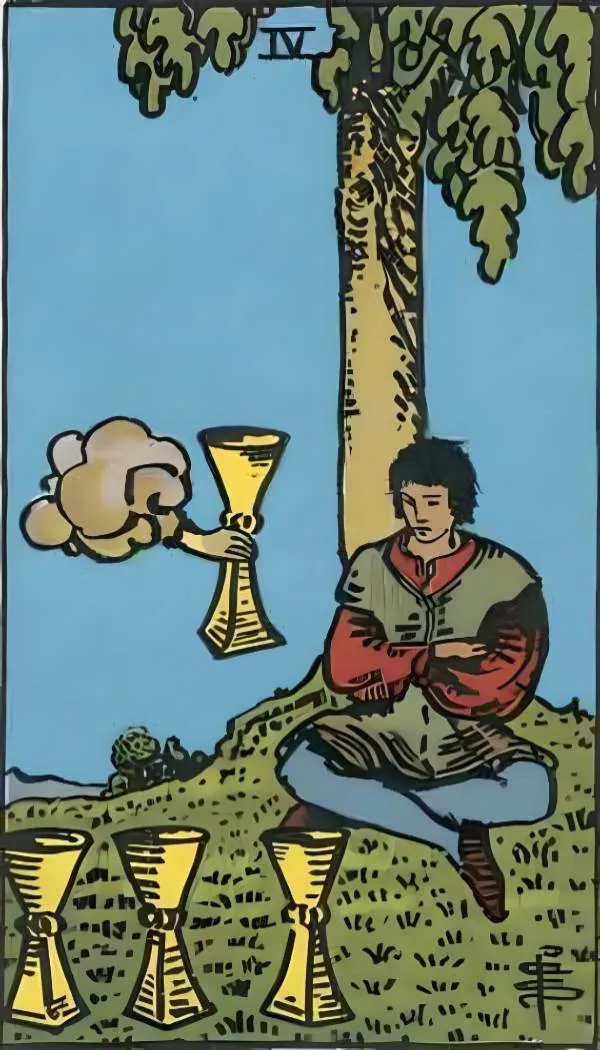
A man sits cross-legged under the shade of a tree, bored and disinterested, with his eyes closed and his hands and feet folded together in a defensive posture. In front of him, three cups symbolize his past experiences. A hand extends from the clouds offering him a fourth cup, which he ignores, lost in his own world.
Observe the fourth cup held by the hand in the clouds; isn't it similar to the cup in The Ace of Cups? This fourth cup represents new opportunities, possibly as significant as those in The Ace of Cups. However, the man, who is retreating into negativity, is not satisfied. He closes his eyes, perhaps not seeing, or perhaps rejecting the opportunity altogether. Life seems to hold no joy for him. It appears as if there is nothing in the world worth doing, no one worth caring about. No matter how good the opportunity presented to him, he shows complete indifference and disinterest.
The Four of Cups can be seen as a card of apathy or dissatisfaction. The man depicted cannot find satisfaction from the three cups or the opportunities before him, but as long as he is ready to look within himself, there are still many opportunities for fulfillment. He yearns for The Ace of Cups because it offers him opportunities from other aspects. The three cups standing before him hold real opportunities. The fourth cup is a reminder: unless your spirit and emotions connect with life, there will be few opportunities or satisfactions. This card tells us that you must combine yourself with the purpose of your soul to truly grasp the source of satisfaction.
Beside the man, a hand of the soul holds a cup. As he dreams of The Ace of Cups, his eyes are closed to reject the physical opportunities. The lesson to be learned in The Four of Cups is to maintain contact with the soul or remember the experiences gained in The Ace of Cups, while also staying connected with the physical world.
The man is depicted sitting in a meditative posture, opening the door to his soul, ready to welcome whatever comes. If he is only prepared to pursue external things, he will soon become bored with the things in his life, but if he intends only to explore his inner world, he may also lose the love clearly presented by the physical world. The man in the card is portrayed as sitting quietly, balancing his inner and outer needs.
The three cups before him are a direct reflection of his inner world. If he can combine with his inner or spiritual self and the needs of his heart, then it will be easier for him to relate to the people, states, and opportunities outside of him. And if he continues to alienate his spiritual needs, the opportunities outside will also fail to nourish him.
The Seated Youth
The central figure in the Four of Cups depicts a young man seated under a tree, seemingly in contemplation or meditation. His crossed arms and legs signify a defensive or closed off stance, indicating introspection, apathy, or perhaps dissatisfaction with his current circumstances. He appears disengaged from his surroundings, hinting at a period of introspection or a sense of being disconnected from the world around him.
The Three Cups
Before the young man are three cups, symbolizing the emotional experiences or opportunities he has already encountered or been offered. The number three often denotes completion or realization in the realm of emotions, but in this case, it may suggest that he’s feeling unfulfilled or is taking his current blessings for granted.
The Floating Cup
A fourth cup floats in the air, offered by an unseen hand. This represents a new emotional experience or opportunity being presented. Despite its proximity, the young man pays it no attention. This symbolizes missed opportunities, reluctance to accept what’s being offered, or simply being unaware of potential new experiences due to introspection or discontentment.
The Cloud
The cloud from which the hand presents the fourth cup can be seen as a symbol of divine intervention or the universe offering a new emotional beginning or realization. The cloud also indicates the ethereal or intangible nature of the offering, suggesting that it may require some level of spiritual or inner understanding to fully grasp.
The Tree
The tree under which the young man sits represents growth, stability, and grounding. The tree, being firmly rooted, can also suggest that his current state of mind is deeply entrenched, and change may require significant introspection.

Friendship Drift After University: One Invitation Toward Belonging

The Sunday Deadline Moves—Until Your Week Gets Its Space Back

Moving PTO to Next Month, Then Writing the Three-Line Handoff

Waiting for Interest Before Studying? Let One Page Offer Evidence

Calling Your Career Path a Dead End Before You Test the Next Door
