Six of Swords Tarot Card Meaning

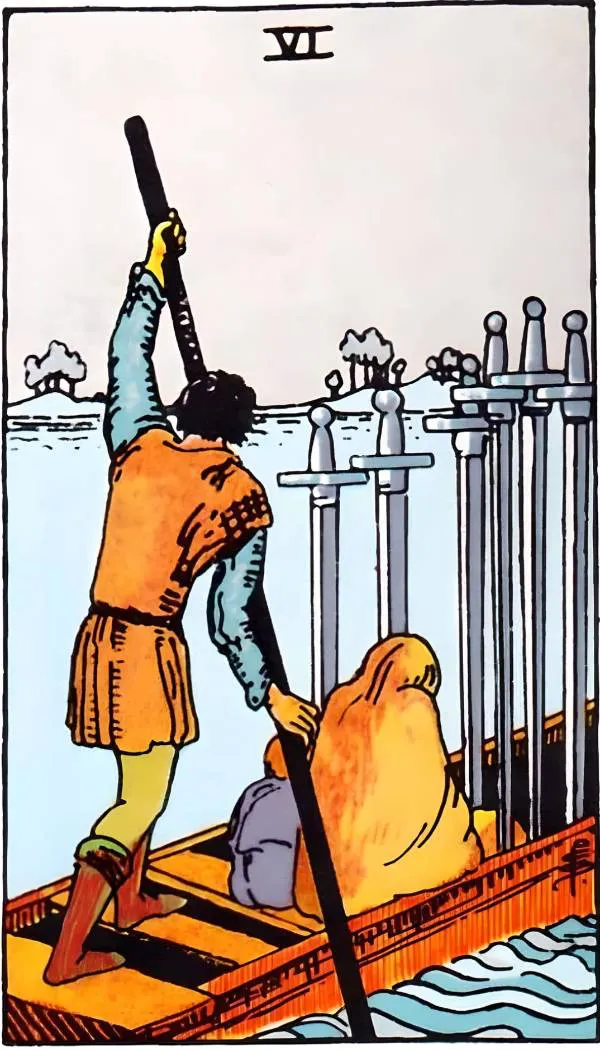
Six swords are neatly and regularly arranged, inserted on both sides of the front half of the boat, with three swords evenly spaced on each side.

This small boat carries a woman and a child, with a ferryman rowing behind them. Each figure on the boat has their back to the picture, looking down in the same direction. The woman is wrapped in a yellow-brown cloak, and the child's face is also obscured from view.

The ferryman is dressed in a dark blue garment, with a coat and shoes of varying shades of red-brown. The oar is very long, sliding to the right side of the boat. The ferryman has his right foot forward and his left foot back, seemingly about to push the boat up and just starting to leave the shore. The boat is tilted to the upper right at the bottom of the picture, sailing to the right out of the picture, going with the flow, wanting to reach the farther shore.

The swords are arranged in two rows, which can be said to form a protective barrier for the passengers on the boat. The neat arrangement of the swords also indicates order, symbolizing rational thinking and planned arrangement. The swords inserted are just a pictorial expression of the drawing, not saying that after pulling them up, the boat will leak. However, carrying six swords on the boat will also increase the overall weight of the boat, making it deeper in the water, and rowing forward will be more laborious and difficult.

The water on the left is calm and clear, and the water at the lower right of the picture where the oar slides is rippled with blue waves. The scenery on the other side, with slightly undulating terrain and a few trees, is a pale blue without color, representing that the distance is still very far away.

The Boat

The boat symbolizes the vehicle of transition, carrying the figures from a state of turmoil to a calmer, more peaceful space. The vessel represents the necessary means to make the journey, both literally and metaphorically.

Figures in the Boat

The adult and child inside the boat represent the facets of human experience, both mature and innocent, taking the journey together. They also symbolize the idea that change and transition are an inherent part of life, affecting people at all stages.

The Man with the Oar

The man wielding the oar is symbolic of guidance and the external forces that help us along our journey. He may represent a mentor, guardian, or the universe itself aiding in the transition from a troubled state to a more peaceful one. His purposeful rowing suggests a well-guided, intentional journey towards something better.

Swords in the Boat

The six swords placed in the boat symbolize the intellectual and emotional baggage that one carries even when moving towards better circumstances. While the journey is aimed at a more positive destination, the past experiences, represented by the swords, continue to shape us.

River

The river represents emotional currents and the flow of life. The calmness of the water in this card suggests that the journey will not be perilous, but rather a peaceful transition towards a more stable condition.

Distant Shore

The distant shore, often depicted as being more inviting than the point of departure, symbolizes the better circumstances that lie ahead. It is the promise of a more stable and peaceful environment after the struggle.

Psychological patterns in Six of Swords
Avoidance Coping
The woman and child face away from the viewer with their heads lowered, while the ferryman rows them out of the frame and the swords form a barrier across the front of the boat. The scene contains movement, but it also hides eye contact, conversation, and direct contact with what has been left behind. Avoidance Coping appears when departure becomes a way to bypass the confrontation that would make the pattern visible. At work, this can look like changing teams, going quiet after feedback, or planning an exit before naming what you need. The Six of Swords connects the pattern to a crossing that moves the body away while the unresolved mental cargo stays upright in the boat.
Analysis Paralysis
The swords stand in disciplined rows, but their order does not make the boat lighter. They create a narrow channel of thought inside the vessel while also adding weight to the crossing, so the ferryman must keep rowing through a mental structure that is both protective and burdensome. Analysis Paralysis forms when the mind keeps adding structure before it allows movement. In personal growth, this can look like one more framework, one more journal spread, one more theory of your limiting beliefs before taking the action that would actually test the new self. The card's reversed logic is not the absence of thought; it is thought becoming so orderly that it turns into drag. You may feel as if you are preparing responsibly, but the boat shows a different audit: the cognitive system has become heavier than the next step it is supposed to support.
Sunk Cost Fallacy
The six swords are not left behind on the shore; they are carried inside the boat. They stand upright in clean rows, giving the crossing intellectual order, but they also add visible weight to a vessel that must still move across the water. That is the exact logic of a decision distorted by previous investment. You may call the old effort evidence, loyalty, or responsibility, but the card shows how carried reasoning can become cargo: organized, defensible, and still heavy. Sunk Cost Fallacy fits the Six of Swords because the journey toward a better shore is slowed by what the mind insists must come along. The pattern asks whether the past is informing the crossing or quietly making the boat sit deeper in the water.
Strategic Surrender
The long oar does not split the river open; it makes measured ripples while the boat follows the water toward a distant shore. The movement is intentional, but it is not a conquest of the current. Strategic Surrender forms where direction and yielding work together. The psyche keeps a hand on the route while accepting that transition cannot be forced into instant resolution. In introspective tarot, You may be trying to pressure the inner world into a breakthrough because uncertainty feels intolerable. This pattern shows a more precise mechanism: the crossing requires participation, but the current is also part of the intelligence of the process.
Forced Progress
The ferryman's body is braced at the edge of departure, one foot forward and one foot back, while the long oar disturbs the water beside the boat. The image contains effort, but it is effort at the threshold, where too much force can create turbulence without meaningfully shortening the distance. Forced Progress emerges when the need to move becomes stronger than the ability to read the current. The boat is already angled with the flow, yet the mind can still interpret slow movement as failure and start adding pressure where leverage is needed. The result is not clean acceleration; it is more friction inside the same crossing. In timing questions, this pattern names the impulse to push a launch, decision, conversation, relationship phase, or career move before the conditions can hold it. You are not being asked to do nothing; the card is exposing where urgency has started to imitate strategy. The crossing becomes easier when force is reserved for the moment it can actually move the boat.
Timing Discernment
The ferryman does not attack the river; he plants his body between departure and destination, using a long oar to convert current into movement. The boat angles toward the far shore while the water stays mostly calm, so progress is created through leverage, pacing, and the ability to read the conditions around the crossing. That visual structure makes Timing Discernment more than simple patience. The six swords show that thought, planning, and past experience are onboard, but they also add weight; the mind has to organize the transition without pretending that organization removes friction. You are being shown a timing system where effort matters, but only when it cooperates with the current. In timing questions, this pattern names the difference between forcing a result and reading a window. The card's movement is real, but it is not rushed; the distant shore remains pale because the next phase is not fully available yet. Clarity comes from noticing where the river is already carrying you, where the boat is still heavy, and where one precise push does more than constant pressure.
Boundary Discernment
The swords are arranged evenly on both sides of the boat, creating a barrier that protects the passengers without forcing them off the journey. The water marks a clear separation between the shore being left and the shore not yet reached, so the crossing becomes an exercise in distinguishing distance from disconnection. Boundary Discernment shows up when You stop treating every social bond as equally available, equally owed, or equally safe. The card's container suggests a boundary that still allows movement: You can leave a mismatched circle, keep the lesson, and refuse to make belonging depend on total exposure.
Loss Aversion
The swords form a protective barrier, but they also make the boat heavier. Their neatness suggests reason, yet their placement inside the vessel means the crossing must carry every feared loss, every prior argument, and every imagined consequence. That image captures a decision process organized around loss avoidance. You may be measuring the options less by what they open and more by what each one might cost, until the safest-looking route becomes the one with the least immediate pain. Loss Aversion fits this card because the boat is trying to move forward while the mind keeps accounting for what cannot be taken from the old shore. The pattern turns risk assessment into a defensive enclosure, making freedom feel more threatening than familiar weight.
Intellectualization
The six swords stand upright in the boat like a portable framework of thought, arranged so neatly that the journey feels mentally organized before it feels emotionally processed. The figures do not look back, speak, or expose their faces; the passage is managed through containment, direction, and rational structure. That visual logic maps closely onto Intellectualization in academic life. You may turn the anxiety of being judged into outlines, reading lists, theories, citation systems, and clean explanations because thought feels safer than the raw vulnerability of producing work that can be evaluated. The card does not make that strategy wrong. It shows why it works and where it becomes costly: the swords help the boat hold form, but they also add weight. In study, the mind can become so skilled at organizing the journey that the emotional fear underneath never gets metabolized into an actual draft, submission, or conversation with a supervisor.
Relational Baggage Loop
The six swords are not left on the shore; they are carried inside the boat. Their arrangement is orderly, but their weight still presses the vessel deeper into the water, making the crossing harder than it looks. The passengers may be moving away from trouble, yet the mental cargo travels with them. That is the structure of a Relational Baggage Loop. The friendship changes form, location, group chat, apology script, or emotional tone, but the unresolved material keeps being transported into the next exchange. The mind mistakes movement for release because the boat is leaving, while the pattern remains intact because the swords are still onboard. In friendship, this can feel like trying to move past an old betrayal, a lopsided support dynamic, or a history of being used as the emotional container, only to find the same resentment appearing in every new conversation. The card exposes the hidden cost of transition without digestion. You can leave the old shore and still keep rowing with the same weight.
Core Struggles in Six of Swords
Threshold Disorientation
The small boat is already moving away from one condition, but the far shore is pale, distant, and barely formed. The figures face away from the viewer, wrapped into a shared forward passage that has not yet become a place they can inhabit. This is the physical shape of Threshold Disorientation: departure has begun before arrival has become psychologically available. You are not standing still, but the next life structure has not gained enough definition to become a trustworthy heading. For direction work, the card locates the strain in the in-between itself. The problem is not a lack of movement; it is the absence of a stable inner coordinate while the vessel is already crossing open water.
Belonging Drift
A small boat carries the cloaked passengers away from one bank while the far shore remains pale and unfinished in the distance. Their backs are turned, their faces are hidden, and the six swords travel with them, so the scene holds movement without a completed social landing. In a social ecology, that image becomes the feel of drifting between circles: You may have already outgrown one group, but the next form of belonging has not become embodied enough to trust. The card does not frame this as simple loneliness; it shows a passage where belonging is in transit, and the self has not yet found a stable shoreline.
Autonomy Guilt Bind
The ferryman’s body is braced between two directions: one foot set forward, one foot held back, the long oar dragging against the water as the boat begins to leave the bank. The card does not show a clean escape; it shows movement that must be generated through resistance, with the old shore still close enough to define the crossing. In a family system, that physical split becomes the shape of autonomy under emotional debt. You may be trying to build an adult life, set contact limits, or stop reacting like the child in the boat, while guilt keeps acting like drag in the water. The tension is not a lack of courage; it is the structural bind of needing distance from the family field while still feeling morally pulled by it. The swords make the crossing more precise and more burdened at the same time. They give the boat order, but they also add weight, naming the family struggle as a transition where clarity does not remove guilt and leaving does not instantly feel like freedom.
Direction Stagnation
The ferryman's body can look ready to push forward, but in reversal the same stance can also become a brace against drift. The oar moves water, the boat holds passengers, and the swords keep adding ordered weight to every stroke. Direction Stagnation is not the absence of effort. It is the condition where effort is absorbed by maintaining the crossing itself, so the life path appears active while the larger trajectory stays suspended. For direction work, the card identifies the stuck point as movement without arrival. You may be doing all the visible work of transition, but the vessel is still too weighted, too narrow, or too internally burdened to convert motion into a felt change of course.
Sunk Cost Paralysis
The swords do not stay on the bank; they travel inside the boat, upright, orderly, and heavy. The image shows movement without unloading, a passage where the past has been packed into the same vessel that must carry the future. You are not only deciding whether to leave, stay, or pivot. Sunk Cost Paralysis names the bind where prior effort, history, loyalty, and time become ballast, making a necessary exit feel like a verdict on everything already invested.
Unseen Cost Bind
The six swords stand in perfect order inside a boat that is already carrying three people. They look protective, but the same metal weight makes the vessel sit lower and makes each stroke more laborious. That visual tension maps directly onto career progress that requires you to carry old proof of worth, credentials, crisis skills, and survival logic into every new opportunity. Unseen Cost Bind names the moment when the things that helped you stay employable also increase the drag of moving toward a better role.
Mental Bandwidth Depletion
The six swords stand in clean rows, giving the boat a visible architecture of thought and protection. Yet those same blades are metal cargo inside a small vessel, so mental order becomes something that must be physically carried across the water. For daily life, this image locates the drain inside the systems meant to keep you functional: planners, rules, trackers, backups, and constant self-monitoring. The card shows a mind trying to create safety through structure while paying for that safety with the bandwidth needed to live inside the structure.
System Reset Overload
The reversed crossing turns the small boat into a compressed container where passengers, tools, old protection, and the demand for movement all compete for the same space. The ferryman's stance reads less like free travel and more like the effort of keeping an overloaded system from losing balance. This is the shape of a lifestyle reset that has become too total. You are not only changing a habit; the whole architecture of work, sleep, health, space, and self-trust has been packed into one crossing, making transition itself feel like the overload.
Transition Ambiguity Lock
The river opens outward, but the figures have no grounded place to stand. The boat points toward a pale shore that is visible but not yet reachable, while the departure point has already been disturbed by the oar and the vessel's angle. In a romantic bond, this geometry becomes the pressure of being neither fully together nor fully apart. You may have left the old shoreline of the relationship, but the new emotional location has not formed enough to be inhabited, so every message, silence, and almost-ending reactivates the same unstable coordinates. Transition Ambiguity Lock is the in-between becoming its own container. The card holds the exact shape of a connection that keeps crossing but never lands, where the relationship's status remains harder to bear than either staying or ending would be.
Social Exit Paralysis
The sword-lined boat becomes a narrow exit rather than an open crossing. The oar touches moving water, the ferryman is braced for effort, and the passengers remain compressed inside the same vessel that is supposed to carry them away. In a draining social circle, that structure names the paralysis of knowing a departure is necessary while the route out feels loaded with history, roles, guilt, and social replacement fear. You are not simply failing to leave; the card shows an exit channel crowded by the very material that made leaving necessary.
Inner Emotions in Six of Swords
Boundary Guilt
The swords form a clean barrier inside the boat, creating protection through separation. Yet they also take up the same limited space as the passengers, so the boundary is not weightless; it changes the atmosphere of the whole crossing. In family dynamics, this is the emotional shape of a boundary that works but still hurts. You may feel clearer after limiting access, refusing a demand, or stepping out of a role, while another part of you registers the silence, disappointment, or distance as a personal cost. Boundary Guilt fits the reversed Six of Swords because the protective structure starts to feel like something you have to justify. The card shows that the guilt is not evidence against the boundary; it is the pressure of learning to stay separate while still caring.
Adult Child Panic
The cloaked figures sit low in a narrow boat, surrounded by upright swords and moving away without showing their faces. The image compresses the body into a protected but cramped posture, where there is technically motion but very little visible agency from the seated passengers. In family contact, that cramped posture can mirror the moment your adult identity suddenly shrinks inside an old relational field. A message, visit, or familiar tone can make the nervous system return to the child seat in the boat before your rational mind has time to steer. Adult Child Panic belongs to the reversed Six of Swords because the crossing becomes emotionally jammed. The boat is moving, but the inner body is still packed with old roles, old fear, and the acute pressure of being treated as smaller than you are now.
Generational Sadness
The adult and child sit in the same boat with their faces hidden, both carried across the water by a movement they do not visibly initiate. Their shared direction makes the image feel less like a single person's departure and more like a family line traveling with unspoken material. In family readings, this visual arrangement turns inherited silence into a felt atmosphere. You may be sensing grief that belongs partly to childhood, partly to the adults who raised you, and partly to patterns no one in the system had the tools to name. Generational Sadness is anchored here because the Six of Swords carries more than one passenger and more than one time period. The crossing holds the adult self and the child self together, making visible the sorrow of realizing how much of your inner weather was learned before you had a choice.
Stalled Momentum Dread
The six swords make the small boat heavier, pressing it deeper into the water while the ferryman's long oar has to work before distance becomes visible. The destination remains pale and far, and the boat exits the frame without giving the eye a completed arrival. Stalled Momentum Dread forms when motion exists but does not feel like progress. In personal growth, this is the heavy inner weather of reading, planning, reflecting, and trying again, while some older load keeps making each step feel slower than it should be. The card's reversed texture does not erase movement; it makes the weight of movement unmistakable. You can sense the crossing, but the lack of visible arrival turns the process into dread that your growth may stay theoretical, delayed, or endlessly almost-started.
Bittersweet Release
Three hidden figures crossing water with their backs turned make departure feel quiet rather than victorious. The calm surface and pale shore suggest that the move toward a cleaner daily structure is real, but the six swords in the boat keep the past physically present. Bittersweet Release emerges when a lifestyle shift asks you to leave behind routines that were inefficient, cluttered, or draining, yet still familiar enough to feel protective. You are not simply getting rid of excess; you are carrying the imprint of the system that helped you get through the day until a better one became possible. The card gives that ache a shape: relief can travel beside tenderness. In lifestyle work, this emotion is the soft heaviness that appears when simplification finally starts, and part of you still mourns the old architecture of the day.
Liminal Grief
The passengers face away in silence while the boat carries its blades toward a shore that is visible but not yet vivid. The scene has left something behind, but it has not landed in a place that feels emotionally inhabited. Liminal Grief belongs to the reversed Six of Swords because the crossing can become a suspended mourning space. You may no longer fully belong to an old identity, defense, or inner story, but the next version of yourself has not become real enough to hold you. In introspection, this grief is not only about loss; it is about the strange emptiness between forms. The card shows a self in transit, carrying the weight of what shaped it while grieving the fact that transformation still has no solid shore under its feet.
Relational Fog
The figures face away from the viewer, and even the direction of their gaze is muted by cloaks, distance, and downward angles. The shore ahead exists, but it is pale and unresolved, giving the whole crossing the feel of a transition that has not yet found language. In friendship, Relational Fog appears when you cannot tell whether you are repairing, withdrawing, outgrowing, or quietly ending something. The bond is still in the boat with you, but the meaning of that bond has become hard to name. The Six of Swords captures this uncertainty without forcing a verdict. It shows that confusion can be part of an honest crossing, especially when old closeness no longer fits and the next form of connection has not arrived yet.
False Closure Unease
The boat appears to leave, yet the swords remain planted inside the vessel and the faces stay hidden. The departure has an external form, but the emotional cargo has not been unpacked; it is still upright, orderly, and carried into the next stretch of water. In love, False Closure Unease appears when You have named an ending, accepted a label, or agreed to move on, while something in the body still knows the landing has not happened. The image makes that unease concrete: the relationship may be in motion, but the unresolved material is still traveling with You.
Sunk Cost Grief
The six swords travel with the passengers instead of being left on the bank. Their order makes them manageable, but their weight still sinks the boat lower and turns the crossing into slow work. In friendship, Sunk Cost Grief appears when history, shared secrets, group memories, and years of mutual access make departure feel expensive. You are not grieving only the friend in front of you; you are grieving the amount of yourself already invested in keeping the bond alive. The reversed Six of Swords gives this grief its specific pressure: forward movement keeps being slowed by what you cannot simply drop. The card helps separate care from obligation, so the past can be acknowledged without being allowed to decide the entire route ahead.
Friendship Drift Grief
The boat does not crash away from the shore; it simply moves on, carrying its passengers across calm water toward a pale distance. No one turns back toward the viewer, and no visible exchange between the figures explains the departure. Friendship Drift Grief belongs to bonds that thin without a single dramatic break. In this card, the quiet crossing mirrors the ache of realizing that shared history, old routines, or mutual affection may not be enough to keep two lives emotionally aligned. The Six of Swords gives this grief dignity by showing it as passage rather than failure. You can mourn the fading shape of a friendship while still recognizing that movement away from the old shore may be the most honest form of care available now.
Outer Contexts in Six of Swords
Life Reset Phase
The small boat leaving the shore gives this card its clearest lifestyle signature: a person is not fixing everything in place, but moving an entire living system across water. The ferryman's oar, the shared direction of the passengers, and the pale far bank all point to a transition that has begun but has not yet become comfortable. In a lifestyle reading, that image maps to a reset phase where work rhythms, sleep, space, errands, and recovery are being relocated into a new pattern. The boat is narrow, so the reset cannot hold unlimited inputs; the crossing asks for a temporary reduction of noise while the new structure becomes stable. You are not being shown instant reinvention. The card frames the reset as a managed passage: enough direction to leave the old shore, enough distance to make the outcome uncertain, and enough structure to keep moving without pretending the old load has disappeared.
Strategic Exit Window
The small boat is already angled away from the near shore, and the ferryman's oar has begun to disturb the water. The image does not show a dramatic break; it shows a managed departure, with the old cargo still standing upright inside the vessel. For a high-stakes choice, that makes the exit window concrete. You are not being asked to romanticize leaving; the structure shows a moment where route, support, and timing are aligned enough to move before the bank you are leaving becomes the only available coordinate.
Decision Cliff Edge
The boat is just leaving the shore, with the far bank still pale and underdefined. The image captures the exact threshold where the old ground is no longer fully available and the next ground has not yet become solid. That is the pressure point of a decision cliff edge. You are dealing with a choice whose cost changes once movement begins, and the card makes the threshold visible before it turns into a rushed crossing.
Sunk Cost Exit Dilemma
The small boat is not empty; six swords add weight to the crossing, making every stroke of the oar more demanding. The ferryman still moves the vessel forward, but the cost of carrying everything is built directly into the image. Reversed, this becomes the relationship dilemma where leaving is not blocked by one simple question of love. Shared history, promises, social ties, routines, mutual investment, and the fear of wasting years all sit inside the boat, making the exit heavier than it looks from the outside. The card helps separate the weight of what has been carried from the direction the boat is actually moving. You may not need to deny the relationship’s significance in order to question whether continuing to carry it is still viable.
Social Circle Reset
The small boat moving away from shore gives the social reset a physical shape: departure has started, but the far bank is still pale and underdefined. The figures are not facing the old scene or the viewer; their bodies are contained, turned forward, and protected from further public exposure. In a social context, that image maps to the moment when a group, scene, or friendship web can no longer be treated as a default home base. You are not necessarily making a dramatic break; the structure shows a quieter repositioning, where distance becomes the tool that lets your social system recalibrate. The six swords are still on board, so the reset is not clean or weightless. Old conversations, loyalties, and group assumptions travel with the boat, but the direction of movement shows that your social energy is being moved out of a depleted ecology and toward a more selective one.
Pathless Social Transition
The far shore is visible but pale, and the boat has only just begun to leave the starting edge. In the reversed social frame, the crossing loses its clean sense of route: movement is happening, but the next place of belonging has not become concrete enough to organize around. That is the core of a pathless social transition. You may be outgrowing a circle, drifting after relocation, leaving a scene, or stepping back from old group dynamics, yet the next community has not appeared with enough shape to feel usable. The disturbed water around the oar gives the situation its friction. This is not simple solitude; it is a social threshold where the old shore no longer fits and the new one has not given you a stable coordinate.
Career Stability Lock-In
The boat is angled away from shore, yet the swords make it heavier and the far bank remains indistinct. The image holds movement and restraint in the same vessel: departure is imaginable, but the material cost of crossing is visible. That is the career logic of stability turning into a lock. A familiar role, salary, title, or team can provide real cover while also making the next move harder to justify because every alternative looks distant, less defined, and more effortful. The scene does not reduce the issue to hesitation. It shows a structural tradeoff between the safety of staying inside the boat as it is and the cost of carrying the same weight into a future that has not yet sharpened into detail.
Family Estrangement Threshold
The far shore is visible but washed pale, and the boat has not yet fully arrived anywhere. The old bank is no longer the center of the image, while the new ground has not become solid enough to stand on. Family Estrangement Threshold belongs to that suspended space. You may be close to no contact, a major distance shift, or a long silence, but the decision still carries people, history, and practical consequences in the boat. The card frames estrangement as a threshold with real structure, not a single dramatic moment.
Delayed Autonomy Negotiation
The long oar is the only working tool that turns the current into movement, and the boat depends on that tool to cross. The passengers are moving toward another shore, but the crossing still requires an outside mechanism of support. Delayed Autonomy Negotiation appears when independence is real but still routed through family resources, timing, permissions, or logistics. You may be trying to become your own adult while the boat still contains old roles and borrowed tools. The card shows autonomy as a passage that needs structure, not a switch that flips all at once.
Strategic Social Exit
The ferryman's long oar, the slanted boat, and the forward drift create a scene of controlled departure. Nothing in the image is explosive; the movement is quiet, planned, and physically supported by a tool that keeps the boat moving without direct contact with the shore. That is why this card fits a strategic social exit. In group dynamics, the cleanest departure is not always a speech, a confrontation, or a final verdict. Sometimes the structure that restores agency is a low-friction withdrawal, where access is reduced, replies slow down, and your energy is moved out of a circle that keeps costing more than it returns. The swords form a barrier as much as a burden. They show that the exit still carries history, tension, and remembered conversations, but their neat order gives the departure a boundary rather than a collapse.