

The Empress Tarot Card Meaning
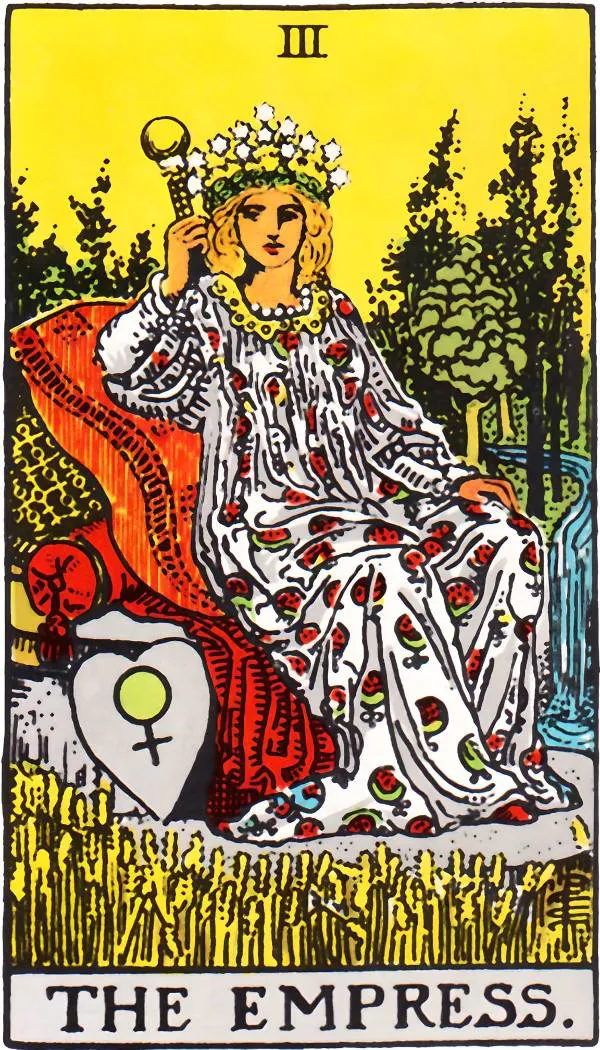
This woman is of the earthly realm, embodying maturity and beauty, she is the archetype of women in the material world. The beautiful woman depicted has blonde hair, blue eyes, and a fair complexion, with a slightly prominent nose, full lips, and clear, curved eyebrows, representing a very typical Western female image. The Empress sits comfortably on her throne, exuding a regal and luxurious aura, with the charm of a mature woman.
The Empress holds the Scepter of Sovereignty lightly in her right hand, raised beside her face, a gesture that seems to present herself to others and wave a greeting, showing the Empress's approachability. The scepter symbolizes power and nobility, and the orb at its top represents the Earth, symbolizing dominion over the material world and creativity.
On her head, the Empress wears a crown composed of twelve stars, representing the twelve zodiac signs and symbolizing the encircling of the entire sky. All twelve stars are hexagonal, symbolizing a complete world. Perhaps due to the biblical record of "a crown of twelve stars", Western culture has long been accustomed to this female image, especially in depictions of the Virgin Mary or positive female figures, many other legends, stories, or paintings also portray noble women with a crown of twelve stars.
Around the Empress's neck is a string of pearls, the adornment of the neck representing good communication skills, and a voice as charming as pearls. Pearls are associated with shells and water, representing the condensation of the subconscious, as well as feminine and gentle symbols, the ultimate creative feminine principle, and also symbolizing an inexhaustible source. Pearls, being jewelry treasures, naturally represent the nobility and temperament of the wearer, also hinting at narcissistic traits. The Empress's attire and appearance are very splendid, showing her emphasis on appearance and aesthetics, her robe is loose, indicating a relaxed and comfortable attitude towards life. The lace trim on the collar also represents a gentle trait.
The white robe is adorned with red and green flower-like patterns, representing romance and purity. The Empress wearing such attire indicates she is immersed in such an atmosphere. The patterns on the white robe resemble the astrological symbol of Venus, and Venus is equivalent to the goddess Venus who presides over love and beauty, indicating that the Empress's traits are like those of the goddess Venus. These patterns are also similar to the fruit of the pomegranate (which can further connect to the High Priestess), symbolizing the nurturing of life. The wreath on the Empress's forehead is made of myrtle leaves, a plant exclusive to the goddess Venus.
The throne is piled with layers of soft cushions, comfortable and soft to sit on, representing her enjoyment of comfort and a cozy life. The cushions the Empress leans on are red, with a red pillow and a red cloth underneath, all of which symbolize passion. These arrangements also represent the Empress's desire for an easy-going life, rather than a busy and mundane one. A brown cloth covering the back of the chair also has continuous Venus symbol patterns.
On the ground is a heart-shaped shield, leaning next to the Empress's throne. The shield is engraved with the symbol of Venus, the goddess of love and beauty, Venus, who presides over love and the soft feminine traits. This shield is in a very conspicuous position in the picture, but it is a fictional addition used to emphasize that this woman is the spokesperson for Venus. It also indicates that the Empress is in the "Garden of Venus", full of vitality and beauty and peace.
The Empress sits in an outdoor garden under the bright daylight, representing the natural and bright nature, showing the joy of earthly life, while the High Priestess is secluded from the crowd. In front of the Empress is a field of grain, a scene of mature harvest. Grain is a practical and beneficial product. Behind the Empress is a dense forest with delicate shapes, a garden under the Empress's control. The forest symbolizes the life of giving elements, and can also represent work and germination happening in the dark and unconscious. This forest is an evergreen coniferous forest, representing the continuous giving and support of the Empress, a spirit and physical abundance that never ceases, like the prototype of a mother. It is generally believed that the evergreen species that make up the forest are cypress trees, which are plants used in ancient Greece to worship the goddess Venus, symbolizing the life of giving elements.
Deep in the forest, there is a babbling stream that extends to the left rear of the Empress to form a waterfall. Water flow is a symbol of the subconscious and emotional flow, and the waterfall represents the fluctuation and release of emotions, representing the powerful creativity of the subconscious flow. The scene of grain surrounding the waterfall is a theme often used to represent abundance. The Empress has this piece of mountains, forests, and fields, representing the secular symbol, but cannot be without emotion, so a waterfall is needed beside it, and the flow of water must be visible.
The Crown of Twelve Stars
This crown upon her head, bedecked with twelve radiant stars, represents her dominion over the year — the twelve months or possibly the twelve zodiacal signs, emphasizing her connection with cycles and nature.
The Venus Symbol
This iconic symbol, representative of the planet Venus, can be found on her heart-shaped shield. It stands for love, beauty, desire, and all things feminine, connecting The Empress with the goddess of love.
Lush Forest and Waterfall
The verdant trees and the cascading waterfall behind her symbolize the fertile abundance of the earth. It speaks to The Empress’s connection with Mother Nature and her ability to nurture and create.
Golden Wheat
The fields of wheat in front of her represent fertility and the potential for growth. Just as crops need care to grow, The Empress suggests a time of nurturing or the possibility of conception, be it a child, idea, or project.
Her Throne
Amidst the nature, she sits on her elaborate throne, signifying her power and status. It’s a testament to her position as a ruler and the respect she commands.
Pomegranates
The pattern of the pomegranates on her robe signifies fertility once again, but on a deeper level, it also relates to the myth of Persephone, making it a nod to cycles of death and rebirth.
The River
Flowing water, such as the river meandering through the background, stands for fluidity, intuition, and the subconscious. It underscores The Empress’s connection to deep intuition and the ebbs and flows of emotion.
Cushions and Robe
Her luxurious cushions and flowing robe represent comfort and beauty. They suggest a strong connection to the senses and indulgence, emphasizing pleasure and the richness of life.

One Honest Note Became Detachment, Then Desire Became Information

From Uneasy Suspension to Grounded Belonging: One Corner at a Time

Apartment Listings Hid a Local Class Until Saturday Took Shape

One Mug Left the Kitchen Box, and the Kitchen Started Helping

A Print on the Floor: From Bracing for a Move to Present-Tense Care
