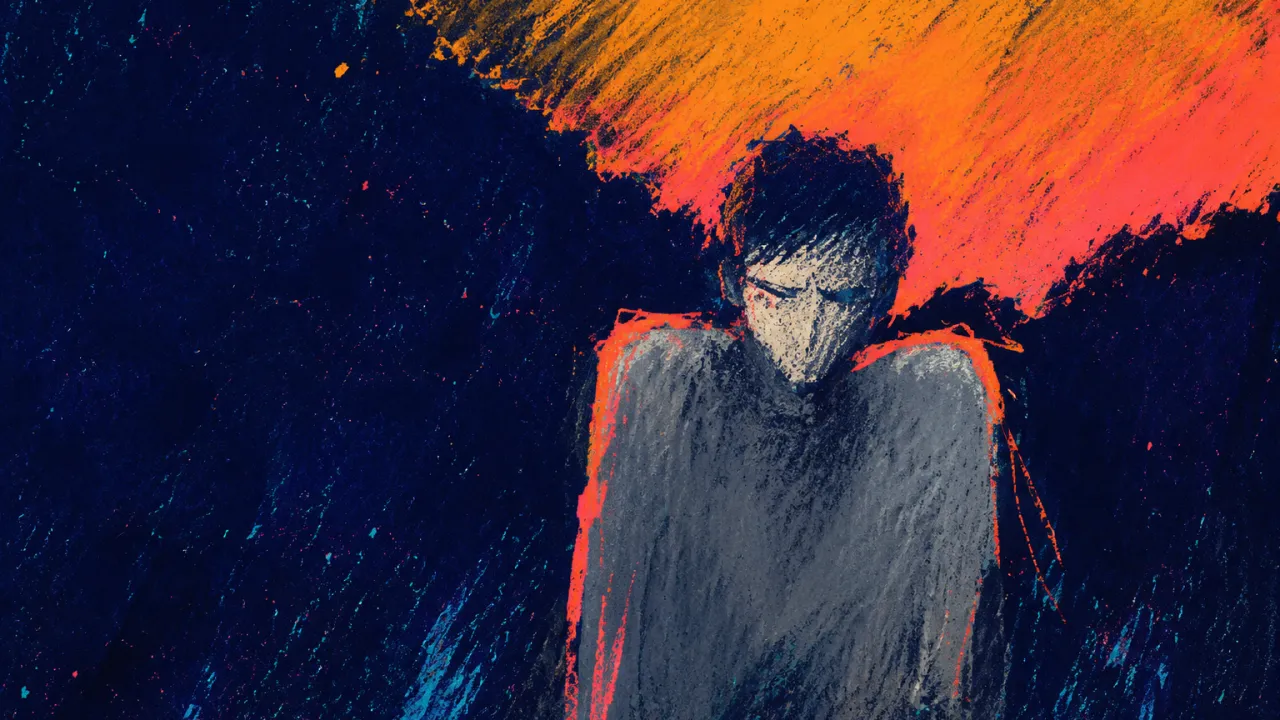
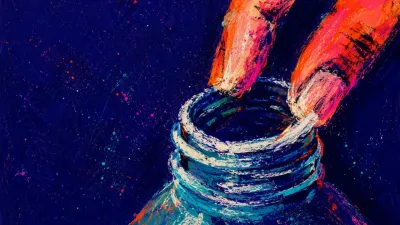
That tight, buzzing pause before you answer, book, send, leave, or stay is the felt shape of Decision Dread. It can sit in your chest and jaw like a decision held there too long, while every option seems to carry a cost you cannot fully see yet. This is a universal emotional experience: the moment choice stops feeling abstract and starts feeling embodied. The Tarot Cards below mirror the thresholds, blindfolds, blades, roads, and guarded spaces that often hold this kind of dread.
The High Priestess ReversedThe entrance is guarded by pillars, veil, and a still seated body; every symbol says threshold without giving the body a direct path through it. The scroll offers partial information, while the water behind the curtain makes the unseen consequences feel larger than the visible options. Decision Dread arises when choosing one path seems to activate every invisible cost at once. The card does not amplify the fear; it localizes it, showing that the dread is attached to hidden variables and forced binaries rather than to a lack of agency.
The Emperor ReversedThe red sky presses around the stone throne while the Emperor remains fixed at the peak. His posture is upright, but the body reads as locked; the height gives perspective while removing the comfort of easy movement. Decision Dread forms when choosing feels like stepping out of a protected pause and into consequences that cannot be fully controlled. You may keep searching for one more sign, one more model, or one more certainty point, but the card shows the pressure gathering around the moment where not choosing has become its own throne.
The Hierophant ReversedThe crossed keys sit at the threshold, but the temple gives no open horizon beyond the central figure and the dark space behind him. Decision Dread grows from that closed interior: the next step looks consequential, controlled, and difficult to reverse. The card does not say the door is locked; it reveals how your body reads the decision as a threshold with hidden terms.
The Lovers UprightTwo uncovered figures stand in the garden with open hands, close enough to belong to the same scene yet separated by a small but charged distance. Their bodies do not show battle or escape; they show exposure in the exact moment before a choice becomes embodied. The split gaze gives the card its pressure. One figure looks toward the human other, while the other looks upward toward the winged presence above the clouds, creating a triangle of attention where desire, conscience, and consequence all occupy the same frame. That is why Decision Dread belongs here. The card does not make the decision look simple; it makes it visible as a threshold where choosing one path means allowing a previous state of innocence, neutrality, or delay to end. You are not only afraid of the option itself, but of the version of yourself that will become real once you choose.
ReversedThe man's gaze moves toward the woman, the woman's gaze rises upward, the serpent points from the tree, and the mountain waits behind them as a hard central threshold. The scene is full of direction, but none of those directions fully converge into a single movement. Decision Dread forms inside that split field. In career life, the choice is rarely just practical; it carries questions of identity, visibility, loyalty to your own values, and the fear of closing a path too soon. A job offer, promotion track, leadership move, or industry pivot can start to feel too loaded for ordinary decision-making because every option seems to claim a different version of you. The Lovers makes that dread legible by showing choice as embodied pressure rather than abstract logic. You are not stuck because you lack intelligence; the card reflects a moment where multiple value systems are competing for your nervous attention. Naming the dread gives you a cleaner view of what the choice is actually asking you to weigh.
The Chariot ReversedThe black and white sphinxes sit before the chariot without reins, while the armored driver holds a command staff above a vehicle that has not moved. The picture concentrates opposing pulls into one sealed body, with no visible mechanism translating command into motion. Decision Dread grows from that gap between needing to steer and not trusting the steering link. In a crossroads reading, the dread is not simply fear of action; it is the heavy pressure of knowing that every option carries a cost, and that delay is also becoming a choice.
The Hermit ReversedThe Hermit stands high on an icy ridge where the path ahead is mostly swallowed by night. The lantern gives light, but only in a narrow radius, leaving the surrounding landscape cold, vast, and unresolved. Decision Dread grows from that exact geometry: enough awareness to understand that a choice matters, not enough visibility to feel protected from every consequence. In a decision reading, the card can mirror the heavy sensation of standing before options that all seem to carry a hidden price. You are not simply lacking information. The image reflects a deeper pressure around choosing itself, where the next move feels tied to exposure, loss, and responsibility. The lantern does not remove that weight; it shows where the weight is concentrated so it can be named instead of obeyed blindly.
Wheel of Fortune UprightThe Sphinx balanced above the rotating wheel, sword held at the shoulder, turns the whole image into a high-stakes pause. The wheel is already in motion, the serpent descends, the jackal-headed figure rises, and there is no ground line where a simple choice can rest. For a decision reading, that visual pressure maps onto the dread of choosing when every option seems to activate a different chain reaction. You are not just asking which option is better; you are trying to stay clear while the system keeps moving, and the dread comes from knowing that clarity may arrive only after the turn has already begun.
Justice ReversedThe sword stays upright like a verdict that cannot be softened, while the scales hang in front of a curtain that hides whatever remains behind the decision. The pillars rise beyond the frame, making the chamber feel larger than the body seated inside it. Decision Dread forms when a relationship choice stops feeling like a conversation and starts feeling like a trial. You may be trying to weigh every consequence perfectly, but the card exposes how the demand for absolute fairness can freeze the heart at the exact moment clarity is needed.
The Hanged Man ReversedThe bound ankle prevents the figure from stepping toward anything, while the inward face offers no outward path to follow. The body is visibly held inside the structure that supports it, making movement and restraint part of the same scene. That is the inner weather of Decision Dread. The fear is not simply that one option is bad; it is the weight of knowing that any real choice will close something, expose a cost, or end the comfort of postponement. The Hanged Man links to this feeling because it turns the crossroads into a suspended body. You can sense the choice asking for agency, but the mind keeps measuring what must be released before the next position can become real.
Death ReversedThe skeletal rider advances through a foreground where each figure responds differently: one turns away, one watches, one prays, and one lies still. The card gathers conflicting reactions into one compressed decision field where no single posture can make the threshold disappear. In a high-stakes choice, that compression becomes dread. You may feel the hidden cost of every option before any outcome has arrived, as if the act of choosing itself will reveal what can no longer be protected.
The Devil UprightThe chained pair stand beneath a horned figure on a black cube, with no horizon behind them and no visible path extending beyond the stage. The collars look loose, yet the whole composition makes the choice field feel formal, weighted, and difficult to step out of. Decision Dread grows from that split between possible movement and perceived consequence. In a choice reading, the card reflects the moment when every option seems to come with a hidden hook, and the body reacts to choosing as if the decision will define more than the decision itself.
The Moon UprightThe winding road begins at the waterline and runs toward two distant towers, but the endpoint never fully resolves. The Moon makes the route real without making it reassuring. Decision Dread is the heaviness of knowing that standing still is also a choice. In a crossroads question, this card captures the moment when the cost of not choosing starts pressing as hard as the risk of moving.
Eight of Cups ReversedThe moon covers the light, the water cuts across the route, and the path ahead is visible only in fragments. The cups behind him are orderly enough to make leaving them feel like a serious calculation rather than a simple exit. This card can hold the dread that appears when every option carries a cost and no amount of thinking removes the unknown. You are staring at a threshold where clarity has to be built from values, not from total certainty.
Knight of Cups ReversedThe knight’s attention can lock onto the chalice while the river waits in front of the horse. The body is equipped for movement, yet the scene concentrates on the delicate object that could spill if the pace or route is wrong. In decision work, this becomes the dread of choosing while every option seems to endanger something valuable. The card shows how fear gathers around the moment of crossing, not because you lack intelligence, but because the emotional cost of motion has become highly visible.
King of Cups ReversedA small boat crosses the distant waves while the King remains seated with gold objects in both hands. The sea stretches beyond the throne, and forward movement appears possible but exposed. Decision Dread gathers around that visual distance between holding value and entering motion. In a choice reading, the card captures the heaviness that comes when no option feels neutral and every path seems to ask for an emotional price. You may be searching for the choice that will not cost anything, but the image suggests the real work is seeing the cost clearly enough to choose consciously. The dread is not a command to stop; it is the signal that the decision has emotional gravity.
Five of Pentacles UprightWalking forward into snow while the church window glows to the side creates a decision field with no comfortable vantage point. The bodies keep moving, but the horizon is blurred and the door is not shown. For you, this is the inner weather of having to choose while still cold, tired, and missing key certainty. Decision Dread forms when the mind wants a clean map, but the scene only offers partial light, a hard path, and the pressure to keep going. The card frames the dread as information, not failure. It reveals where the decision has become fused with the fear of being unsupported after the choice is made.
Knight of Pentacles ReversedThe open field should offer distance, but the Knight's planted horse turns that distance into a hard threshold. The pentacle sits between him and the horizon like a weight that must be carried into whatever comes next. Decision Dread rises when every option feels capable of closing a different future. The card gives that feeling a visible structure: you are not simply scared of action, you are sensing the emotional cost of making one path real.
Ace of Swords ReversedThe sword is double-edged, bright, and exposed against open sky. Its point does not merely gesture toward the crown; it pierces the center, making the act of selection feel sharp enough to divide one path from another. Decision Dread comes from the emotional weight of that cut. In timing questions, choosing when to act often means accepting that another version of the timeline will not be lived in the same way. The blade makes that separation visible. You may be looking for a painless timing answer, but the card shows why the question feels loaded. The dread is not only about being wrong; it is about the clean edge of commitment and the inner recognition that clarity sometimes asks something to be left unchosen.
Two of Swords UprightThe blindfolded woman sits between two raised swords with no visible motion toward either shore. Her body has already entered the decision before the decision has become visible, holding still because movement would commit the whole self to one side. In family matters, Decision Dread forms when every option seems to carry an emotional invoice. Choosing yourself may feel like withdrawal, while choosing the family role may feel like self-erasure, so the pause becomes a charged place rather than a neutral delay. The card turns that freeze into a readable structure. You are not simply avoiding a choice; you are standing inside a system where the cost of choosing has been made emotionally expensive.
ReversedThe swords are crossed so close to the body that the decision becomes something held in the muscles. The blindfold removes the easy route of external confirmation, while the seated posture keeps the conflict from turning into movement. Decision Dread belongs here because the choice is not merely pending; it is physically braced. The image captures the feeling that if one sword drops, everything contained behind the pause may rush forward at once. In a choice reading, this emotion reflects the pressure of knowing that not choosing is also becoming a choice. The card does not shame the pause; it shows how dread accumulates when holding the decision starts to hurt more than naming what the decision is really about.
Three of Swords UprightThe heart in the Three of Swords has no face, no hands, and no way to look away from the blades approaching its center. The grey weather gives no landmark outside the wound, so attention is pulled again and again toward the point where impact will be felt. For a major choice, this becomes the dread of knowing that every option touches something vulnerable. The decision is not experienced as a clean fork in the road; it feels like a set of sharp routes aimed at the same inner place. Decision Dread is anchored in that convergence. The card mirrors the moment when the question is no longer what looks best on paper, but what kind of hurt you are willing to consciously carry in order to reclaim movement.
Eight of Swords UprightThe blindfolded woman stands inside a fence of swords, wrapped but not crushed, with open air still visible around the blades. The image does not show a locked door; it shows a mind surrounded by pointed possibilities, unable to trust what it cannot directly see. In a decision reading, that visual structure maps cleanly onto the dread of choosing while uncertain. You can sense that movement is possible, yet every option feels edged with consequence, as if the wrong step could turn a temporary restriction into a defining mistake. Eight of Swords holds this emotion because its danger is psychological before it is physical. The card names the moment when agency is present but not yet felt, and Decision Dread becomes the inner weather of standing before a choice while clarity is still covered.
Nine of Swords UprightThe bed forms a small protected island, but the swords have already crossed into the space above it. The figure is neither fully at rest nor fully in motion, held in a posture where waking up does not yet become action. A major decision can create the same suspended pressure. The dread is not attached to one single outcome; it gathers around the act of choosing, because the moment of selection will make one set of costs real. Decision Dread belongs to this card because the image turns choice into a night chamber. You can see the boundary, the pressure, and the absence of forward space all at once, which makes the emotional weight of choosing legible without surrendering agency to it.
Page of Swords ReversedThe Page's body twists across the ridge with the sword held in a rigid two-handed grip, as if the choice field has tightened around him. The clouds sit close to the mountaintop, and the uneven ground makes height feel exposed rather than secure. Decision Dread emerges when the mind turns every route into a possible cliff edge. In this card's reversed texture, the sword no longer feels like clean discernment; it becomes the pressure to cut correctly when the landscape refuses to offer a stable path. For a choice reading, this feeling is not simple hesitation. It is the weight of believing that one decision must protect you from every future consequence. The card gives that dread a visible structure so it can be examined instead of silently running the entire process.
King of Swords ReversedThe raised sword and throne form a scene of verdict: a seated body, a lifted blade, and a face that does not soften the moment. The lack of armrests leaves the figure exposed, as if the decision cannot be held casually once it has been named. Decision Dread gathers around the moment possibility becomes consequence. You may know that movement is necessary, but the inner atmosphere tightens because choosing will make one set of costs real and remove the shelter of indefinite openness.
Two of Wands ReversedThe globe concentrates the world into the figure's hand while the coastline, mountains, sea, and domain spread outward in several possible directions. His gaze has a target, but the path from the battlement into the wider terrain is not drawn. Decision Dread emerges when possibility becomes too condensed and too consequential. The card's two wands do not merely suggest options; they create a charged threshold where choosing one path means allowing other versions of the self to remain unlived. In personal growth, this emotion can turn self-authorship into pressure. You are not simply wondering what to do next; you are feeling the weight of what each choice might reveal about who you are becoming.
Three of Wands ReversedThe figure stands at the cliff edge with the sea spread out below, one wand in hand and two behind him like a threshold already crossed. The image is not crowded, but the height and the open drop make the pause feel consequential. Decision Dread comes from the body recognizing that the choice will change the ground under it. The wands are stable, yet they also mark the seriousness of what has already been built, chosen, or invested. Moving forward means the decision stops being theoretical. In a choice reading, this card gives dread a specific architecture: edge, distance, foundation, consequence. You are not merely afraid of choosing; you are standing where an option becomes a lived direction, and the emotional system is bracing for the cost of making it real.
Five of Wands UprightThe clear blue sky behind the Five of Wands makes the conflict feel exposed rather than hidden, but the foreground is still crowded by bodies moving from different angles. Each wand is intact and usable, yet none of them points toward a shared outcome. That is the emotional architecture of Decision Dread: the mind can sense that resolution exists, while the immediate field remains too contested to trust a move. The dread grows from viable options pressing against one another, not from total darkness. In a choice reading, this card names the specific pressure of knowing that every path will exclude another path. You are not simply afraid of movement; you are standing inside a live clash of priorities where the cost of choosing has become visible before the benefit has fully stabilized.
No cards available for this filter.