When Clarity Becomes Court

Explore the inner courtroom that keeps you stuck, with related tarot cards and tarot reading insights for this pattern.

Inner Tribunal Lock
What does this feel like?

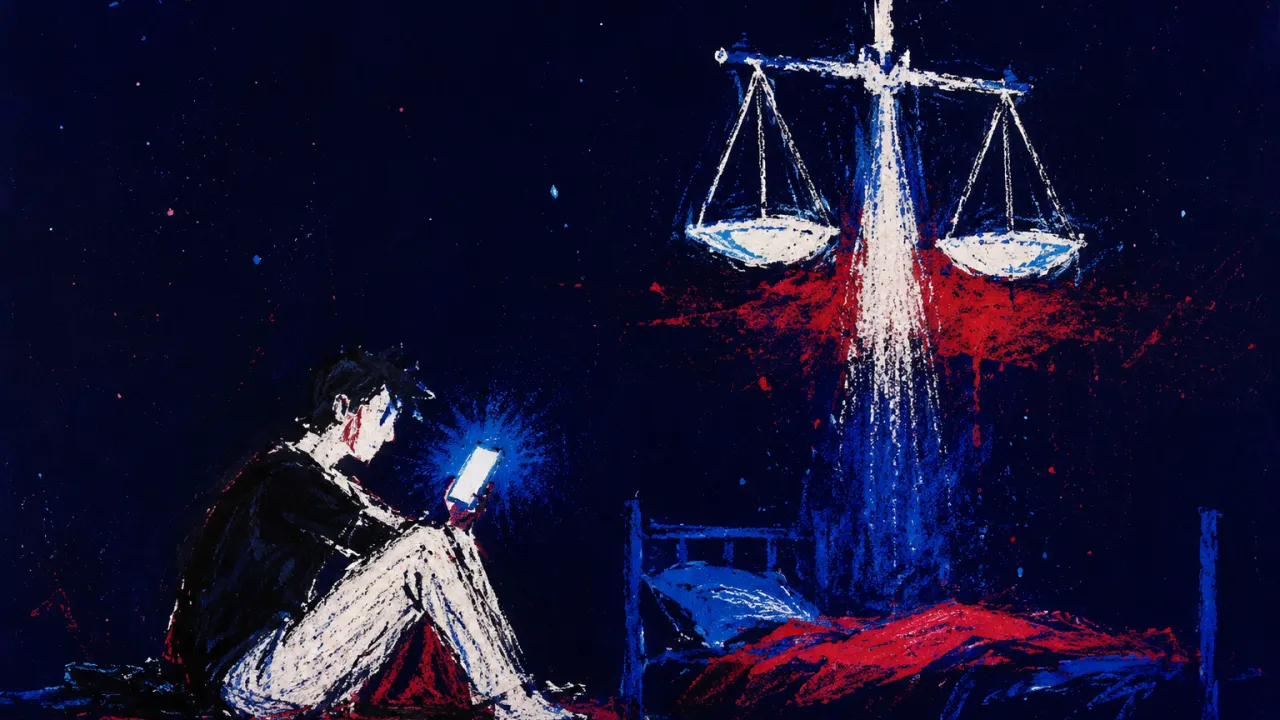
Inner Tribunal Lock — you catch yourself replaying one small interaction long after everyone else has moved on, not because there is more information to find, but because some part of you has turned the whole thing into a hearing. You are brushing your teeth, walking home from work, staring at a half-written text, and the same questions keep lining up in your head: was that fair, was that selfish, did I sound needy, did I overreact, did I prove something bad about myself without noticing? Your body goes still in tiny ways before your mind admits what is happening; your jaw locks, your shoulders rise, your breath gets caught high in your chest. You may call it being honest with yourself, being mature, taking accountability, doing the work, but inside it feels less like understanding and more like standing under fluorescent light while every feeling is asked to present evidence. Even rest has to defend itself. Even desire has to sound reasonable. Even a boundary has to arrive with footnotes, context, and a closing argument before you allow it to exist. The strange part is that the inner court can feel calm, even intelligent, which makes it harder to question; it tells you it only wants clarity, but the clarity never opens into movement, it just sends you back for another review. So you keep collecting proof, editing your motives, weighing your tone, revising the verdict, until your life starts to shrink around the need to be beyond reproach. The cost is not just stress; it is the slow loss of ordinary aliveness, the part of you that could try, want, speak, change, or make a mistake without first being called to the stand, much like the Justice card, seated between pillars with the sword fixed upright and the scales suspended, holding the room in a verdict that never fully releases.

What's pulling at you?

You're caught between the need to be honest with yourself and the need to stop putting yourself on trial. One part of you wants clean clarity, fair reasons, and a defensible choice; another part of you needs room to move before every feeling is weighed, questioned, and sentenced.

How It Shows Up?

  • You open your notes app after a tense conversation and start typing what happened like you're preparing a defense: the exact words, the timestamps, the reasons you did or didn't say something. Your shoulders creep upward, your throat gets dry, and your chest tightens as if every sentence needs to be entered into evidence before you can let yourself rest. The blank screen starts to feel like a bench, the cursor like a small raised blade. You can let the record stay incomplete for now; not every moment has to be argued into permission.
  • You're replying to a friend's message, and a simple boundary turns into a hearing inside your head: Is this too cold, too needy, too dramatic, too selfish, too late? Your thumb hovers over send, your jaw locks, and your stomach drops in that small, familiar way, as if one line of text could convict you of something larger than the situation. The scales never seem to settle because you keep adding more weight to both sides. It is acceptable to pause without turning the pause into another charge against yourself.
  • You're working on a draft, a deck, an application, or a class assignment, and you can't get past the first rough version because your mind starts grading it before it exists. Your eyes flick back over the same sentence, your forehead tightens, and your breathing gets shallow, like a row of swords has been hung above the page and every unfinished word is already under review. The task becomes less about making something and more about proving you deserve to make it. A rough version can stay rough; it does not need to defend its whole future today.
  • You're in a group setting, laughing at the right moments, but part of you is running a private transcript underneath the conversation: Did I talk too much, was that weird, did they notice, should I leave, should I apologize? Your face keeps performing ease while the back of your neck warms, your mouth goes slightly numb, and your hands look for something to hold. The room is normal on the outside, but inside it feels like a quiet panel has assembled above you. You can return to the room one breath at a time without cross-examining every second of being there.
  • You lie in bed at night with the lights off, and the day reopens itself piece by piece: the look from your manager, the unread text, the skipped workout, the thing you should have started earlier. Your body is tired, but your head feels lit from the inside; your chest is pinned between the mattress below and the hard line of verdicts above, like the Nine of Swords has moved into the room. Your hands may end up over your face before you notice. For tonight, noticing the trial is enough; sleep does not have to be earned by winning it.

Inner Tribunal Lock in Tarot Cards

Inner Tribunal Lock is the moment self-reflection stops being a place to listen and becomes a private hearing where every feeling has to defend itself. You can feel it in the locked jaw, the tight throat, the hand hovering over a message while the scales refuse to settle. From an existential perspective, the structural framework here is about clarity becoming a chamber you keep returning to instead of a threshold you step through. These Tarot Cards reflect the shape of that inner courtroom without turning it into a final verdict.

Justice Upright
The figure sits front-facing between the pillars, sword upright and scales level, with the crown placed directly above a still, watchful face. The body is not moving through the hall; it is installed as the hall's measuring center, holding judgment, truth, and consequence in the same fixed posture. In personal growth, that structure maps to the moment self-improvement stops feeling like experimentation and starts feeling like a hearing. You do not simply choose a habit, revise a belief, or test a new identity; each move is weighed as evidence for or against your worthiness to evolve. Inner Tribunal Lock is the struggle where the internal audit becomes so complete that it can no longer serve movement. The scales promise fairness, but the sword makes every verdict feel final, so clarity becomes a chamber you keep returning to instead of a threshold you step through.
Reversed
The seated judge turns the whole room into a held verdict: pillars on both sides, blade fixed upright, scales suspended, body hidden inside ceremonial fabric. The arrangement does not simply show fairness; it shows a system that can keep judgment permanently activated. When this structure turns inward, introspection becomes a trial that never adjourns. You are not only asking what you feel or why you reacted; you are forcing every inner movement to stand before an imagined bench, where evidence matters more than relief and self-knowledge becomes prosecution.
The Devil Reversed
The Devil raises a hand like a counterfeit blessing while the inverted pentagram fixes the command downward. The figures stand beneath that gesture as if judgment has become part of the room's architecture. For inner cleanup, this image names the authority that condemns before it understands. You may be trying to examine desire, rest, or shadow material, but the internal court speaks first, turning self-reflection into a sentence instead of a clear mirror.
The Moon Reversed
The Moon's face hangs above the scene with closed eyes and a solemn mouth, while the animals below turn their bodies upward as if answering an authority they cannot reach. The light that governs the road is indirect, yet every visible thing is organized around it. In family territory, that overhead presence becomes an internal tribunal, not a literal judge but a structure of borrowed standards, remembered tones, and anticipated verdicts. You may be away from the room, but the card shows how the family gaze can keep supplying the light by which you measure yourself.
Judgement Upright
The angel’s trumpet hangs above the scene like a verdict made audible, and the red-cross flag turns that sound into a formal sign. Below it, the figures rise with open arms, but their bodies are still placed inside coffins, so awakening and examination happen in the same physical frame. That structure mirrors the inner tribunal that can appear during deep self-reflection. You may be trying to understand yourself, but the moment of insight arrives with the posture of being called up for review, as if every hidden part of you has to stand and answer at once. The struggle is not simple self-criticism. It is the fusion of awakening with sentencing: the inner world receives a call toward truth, but the old container turns truth into a courtroom before it can become clarity.
Reversed
The bodies in Judgement rise into full exposure under a sound that comes from above. The trumpet, the flag, and the open coffins create a scene where every figure is visible at the exact moment of being summoned, as if awakening and evaluation arrive through the same channel. Inner Tribunal Lock forms when personal growth becomes a permanent hearing instead of a living process. You may keep trying to improve, but each attempt is immediately placed under review: good enough, healed enough, disciplined enough, evolved enough. The card gives that inner courtroom a precise image. The call is not only heard; it is watched, measured, and embodied as a fixed receiving posture, which is why growth can feel less like liberation and more like standing exposed before a verdict that never fully ends.
Three of Pentacles Upright
The craftsman stands on a raised bench while two robed figures face him with the plan in hand. His body is the one touching the stone, but the scene gives the watching figures enough visual authority to turn the act of making into an act of being assessed. That arrangement carries the shape of an inner tribunal: one part of you is doing the delicate repair work, while other internalized voices inspect whether the work is correct, impressive, or defensible. The hammer cannot simply strike the stone; it has to pass through the gaze of the imagined panel first. In introspective work, this struggle appears when self-awareness stops being a witness and becomes a courtroom. The card locates the pressure at the exact point where your inner repair turns into evidence, and where clarity is delayed because every feeling must first survive evaluation.
Six of Pentacles Reversed
The scale is held by the same figure who controls the coins, so judgment and relief come from one concentrated point. The kneeling bodies do not stand before a neutral baseline; they wait beneath a verdict that is physically attached to the giver's hand. When this structure turns inward, the psyche can become its own measuring instrument. Every feeling is weighed, every need is cross-examined, and every impulse toward rest or softness has to pass through an internal authority before it is allowed to exist. In an introspective reading, the card names the courtroom shape of self-judgment. You are not simply overthinking; the image shows a locked arrangement where the part that needs relief must appeal to the part that decides whether relief is deserved.
Eight of Pentacles Reversed
The hammer and chisel meet the pentacle at a point of judgment: every mark can be corrected, sharpened, or made more exact. The straight line of finished coins beside the worker creates a silent standard against which the current piece is measured. That visual standard becomes an internal tribunal when applied to the inner world. You are not only feeling your feelings; you are inspecting them for quality, maturity, and acceptability, which keeps the self under examination even when what it needs is room to be seen without another strike.
Ace of Swords Upright
The crown sits on the sword's point as if judgment, victory, peace, and legitimacy all have to be held in one exact position. Beneath it, the barren hills offer no human scale, so the raised blade becomes the only visible standard in the scene. Inside a family system, that kind of standard can become an inner court. Every choice is measured against inherited questions: whether you are loyal enough, grateful enough, independent enough, respectful enough, or finally too much. The struggle is not ordinary indecision. It is the internalization of a family verdict system, where even clear insight has to pass through an imagined trial before it feels allowed to become action.
Reversed
The crown sits on the sword point, so authority is held by the same object that can cut. The hand grips tightly below it, and the softer branches hang from a hard vertical line that leaves little room for anything unmeasured or unfinished. In introspection, that arrangement becomes the architecture of an inner court. You turn inward looking for order, but the mind's blade starts ranking, prosecuting, and sentencing every feeling before it can be understood. The lock forms when reflection cannot stay exploratory. The card shows the crown and the blade fused into one instrument, naming the place where your wish for clarity becomes a verdict machine inside your own head.
Two of Swords Upright
The blindfolded figure resembles a private judge holding two blades across the chest, with the moon, shore, and horizon arranged like competing standards of truth. Nothing in the image attacks her from outside; the pressure comes from the internal demand to assess before allowing movement. For personal growth, this is the chamber where every desire to evolve gets cross-examined. You measure whether the goal is pure enough, whether the timing is right, whether your discipline is real, whether the next self has earned permission to exist. The crossed swords make the trial self-held, which is why the struggle can feel so convincing. The card names the point where self-reflection stops serving growth and becomes an inner tribunal that keeps the future waiting for a verdict.
Reversed
The blindfolded figure sits like a private court, with two swords held in a formal cross over the heart. The posture looks balanced, but its balance depends on blocking sight, touch, and emotional reception at the same time. Inner Tribunal Lock appears when introspection becomes a trial instead of a listening field. You are not simply evaluating yourself; the inner system is demanding a verdict before any feeling is allowed to arrive without defense. The moon, sea, horizon, and blades each offer a different standard of orientation. The struggle is the internal courtroom created by too many standards at once, where every feeling has to prove its legitimacy before it can be held.
Three of Swords Upright
The three swords are not chaotic. Their angles are balanced, their points converge, and the wounded heart becomes the center of a harsh internal geometry. That order is what makes the struggle so convincing during introspection. You may hear several lines of self-judgment that seem separate, fair, and logically arranged, but the card shows them all pressing into the same vulnerable center instead of opening a path toward truth. This is not simple self-criticism as a habit. The image presents an inner tribunal: a structured system of verdicts where pain, logic, and accusation reinforce each other until the heart has no neutral witness inside the room.
Four of Swords Upright
Three swords hang over the figure in a precise, almost formal arrangement, aimed at the head, throat, and chest. Beneath them, the hands are clasped in a posture that reads as prayer, self-control, and silent appeal all at once. Inner Tribunal Lock appears when reflection stops being a room for truth and becomes a chamber of judgment. In this card, the mind is not merely thinking; it is positioned under a set of internal verdicts that hover over thought, voice, and feeling. For introspection, this matters because the search for clarity can harden into private prosecution. The card gives that pressure a boundary: the judgment is a structure above you, not the whole truth of you.
Five of Swords Upright
The central figure stands like a prosecutor over a cleared field, holding the blades while the other figures lower their heads and withdraw. No one in the image faces anyone else, so the aftermath resembles a courtroom with no witness who can safely speak. During private self-audit, this arrangement becomes Inner Tribunal Lock: one part of the psyche collects evidence, another part carries defeat, and the rest of the inner field goes silent. You are not simply thinking too much; the card shows a closed adjudication system where every feeling is cross-examined before it is allowed to exist. The lock becomes visible because the swords remain active even after the battle. They mark the ground, the chest, and the boundary between parts of self, turning introspection into prosecution instead of contact.
Reversed
The scene divides one conflict into three positions: the holder of the blades, the figures who withdraw, and the evidence left on the ground. The planted sword creates a vertical line of judgment while the scattered blades point in different directions, as if the field cannot agree on one stable standard. In personal growth, that divided field becomes an inner tribunal. You can try to evolve, choose differently, or audit yourself honestly, but the structure keeps demanding a verdict: one part must be right, another part must be defeated, and the whole self-system remains locked inside judgment instead of integration.
Seven of Swords Reversed
The backward glance keeps the camp active inside the escape, even as the feet move away. In reversal, the watched space no longer has to catch up with the figure; it becomes an internal reference point that measures each step before the step can fully land. Inner Tribunal Lock names the personal growth strain where evolution is forced to pass through an imagined court of evaluation. You may be trying to change, but the card shows the deeper bind: every move is treated as evidence, so growth becomes something to defend instead of something to inhabit.
Eight of Swords Reversed
Eight upright swords form a silent perimeter around a blindfolded figure whose hands are hidden behind her back. The blades look less like active attackers than fixed standards, each one standing as a rigid line the body must avoid crossing. Inside a personal growth process, that arrangement becomes an internal court where every attempt to change is judged before it can become an experiment. You are not simply hesitating; the card locates a judging structure that turns becoming into a trial, making self-trust feel inaccessible until the invisible verdict is favorable.
Nine of Swords Upright
The figure sits upright in bed while nine swords cross the space of the head, throat, and heart, and the hands close over the face as if the body has become its own witness stand. The card does not show a simple problem to solve; it shows judgment occupying the same physical zone where sight, speech, and self-trust would normally return. In personal growth, this structure becomes the inner tribunal that wakes up whenever you try to change. A missed habit, a slow result, or an imperfect attempt stops being information and becomes evidence against your identity, so self-improvement turns into prosecution instead of movement. The lock is not that you lack insight. The lock is that insight has been placed under a blade grid, where every new awareness is immediately cross-examined before it can become agency.
Reversed
The nine swords are painfully orderly, lined up like evidence on a dark wall. Under them, the figure covers her face, leaving no outside witness and no open channel for the body to contest the verdicts forming inside the room. Inner Tribunal Lock is the shape of a mind that has become court, judge, and accused at once. The swords do not merely represent thoughts; they behave like rulings suspended over the head and heart, precise enough to feel authoritative and sharp enough to keep the self folded inward. In introspection, You may keep reviewing the same inner evidence without ever reaching release. Nine of Swords identifies the lock: the problem is not that You lack self-awareness, but that awareness has been organized into a closed trial with no new witness allowed in.
Ten of Swords Upright
The fallen man’s face is turned away, while the swords stand above him like fixed verdicts already delivered. He is not speaking, arguing, or defending himself; the card gives the visual authority to the blades and leaves the body carrying their conclusion. That arrangement is the architecture of Inner Tribunal Lock. In introspection, You can become trapped in an internal court where every memory, motive, mistake, and desire is entered as evidence, and the self is forced to absorb the sentence before it can fully tell its side. The small sacred gesture in the hand sharpens the struggle because it suggests a remaining wish for meaning, order, or absolution inside a scene ruled by judgment. The card names the place where self-examination stops being witness and becomes prosecution.
Page of Swords Reversed
The Page's blade can protect, clarify, and cut through confusion, but in this reversed structure it becomes an instrument of constant internal examination. The guarded grip tightens, the gaze keeps checking the field, and the young figure is held inside the authority of the sword before any movement can be completed. In personal growth, this appears when self-awareness turns into a private trial. Every desire needs evidence, every mistake becomes a case file, and every next step is cross-examined until the self has to prove it deserves permission to move. The card places the struggle inside a judgment structure, not inside personal weakness. Your clarity has become a courtroom, and the work is to see where discernment stopped serving direction and started delaying life.
Knight of Swords Upright
The knight's sword is not lowered for inquiry; it is raised for verdict. Armor seals the body, the gaze hardens forward, and the shout turns the scene into an act of prosecution before any visible opponent has been shown. During self-reflection, that same structure can turn inner truth into a courtroom. You may enter the process looking for clarity and find a prosecutor already mounted inside it, ready to convert every observation into evidence against you. Inner Tribunal Lock gives that shape a boundary. The problem is not that you can see too much; it is that the seeing position has been fused with judgment, impact, and punishment before the inner material has been fully heard.
Queen of Swords Reversed
The raised sword and high stone throne can turn into a private courtroom when the card is reversed. The Queen's posture stays upright, but the blade no longer only clarifies; it organizes the whole scene around verdict, standard, and silent sentencing. In personal growth, this points to self-audit becoming prosecution. You may keep trying to improve, but every step is brought before an inner bench that asks whether you are disciplined enough, healed enough, consistent enough, or worthy enough to move.
King of Swords Upright
The King sits front-facing on a bare stone throne, with the sword lifted like a verdict that has already found its courtroom. His body does not lean toward the world or soften into contact; it organizes itself around judgment, elevation, and the pressure to remain unquestionably correct. That visual structure mirrors the moment when personal growth stops feeling like discovery and starts feeling like prosecution. You are not simply trying to improve; you are standing before an inner authority that weighs every unfinished habit, imperfect decision, and delayed breakthrough as evidence. The struggle is not discipline itself. It is the lock that forms when clarity, authority, and self-evaluation become fused so tightly that every attempt to evolve must first survive a sentence from the mind that was supposed to guide it.
Reversed
The sword, crown, throne back, and frontal gaze form a closed system of judgment. In reversal, that system stops functioning as clear discernment and becomes an internal court where every movement is measured against an invisible standard. Family pressure often survives this way after the conversation ends. You may leave the room, move out, or build an adult life, but the old verdict still sits inside the body as a voice asking whether you are selfish, ungrateful, too much, too cold, or wrong for wanting your own life. This card locates the struggle inside the inherited tribunal rather than inside your character. The issue is not that you lack clarity; it is that clarity has to pass through a family-made courtroom before it can feel like yours.
Five of Wands Upright
Five young figures crowd into one small field, each raising a wand from a different angle while no single body controls the center. Their feet spread for balance on uneven ground, but the force above them converges into a noisy knot rather than a shared direction. For personal growth, that image becomes the experience of trying to evolve while several inner authorities argue over what evolution should mean. You may have ambition, caution, discipline, comparison, and fear all speaking with equal force; the card makes the lock visible as an internal tribunal rather than a simple lack of clarity.
Seven of Wands Reversed
The six opposing wands have force, direction, and pressure, but the people holding them remain outside the image. The figure fights a visible impact from invisible sources, which makes the opposition both concrete and unlocatable. In personal growth, that structure mirrors the way judgment can become internalized after repeated pressure. You may find yourself defending every choice against an unseen court of standards, comparisons, past voices, or imagined future criticism before you have even acted. Inner Tribunal Lock names the point where self-improvement becomes a trial instead of an experiment. The card gives the struggle a boundary: the pressure is real in your system, but its source has become diffuse, which is why no single achievement can fully dismiss it.

Inner Tribunal Lock in Tarot Card Reading Insights

When self-reflection becomes a private hearing, many people bring that same locked inner court into readings: the unsent message, the unfinished draft, the verdict that follows them home. The shift from cards to readings shows how this struggle appears when someone asks for clarity while feeling under review. Tarot Reading Insights for Inner Tribunal Lock sessions.
Psychological struggles related to Inner Tribunal Lock