Six of Wands Tarot Card Meaning

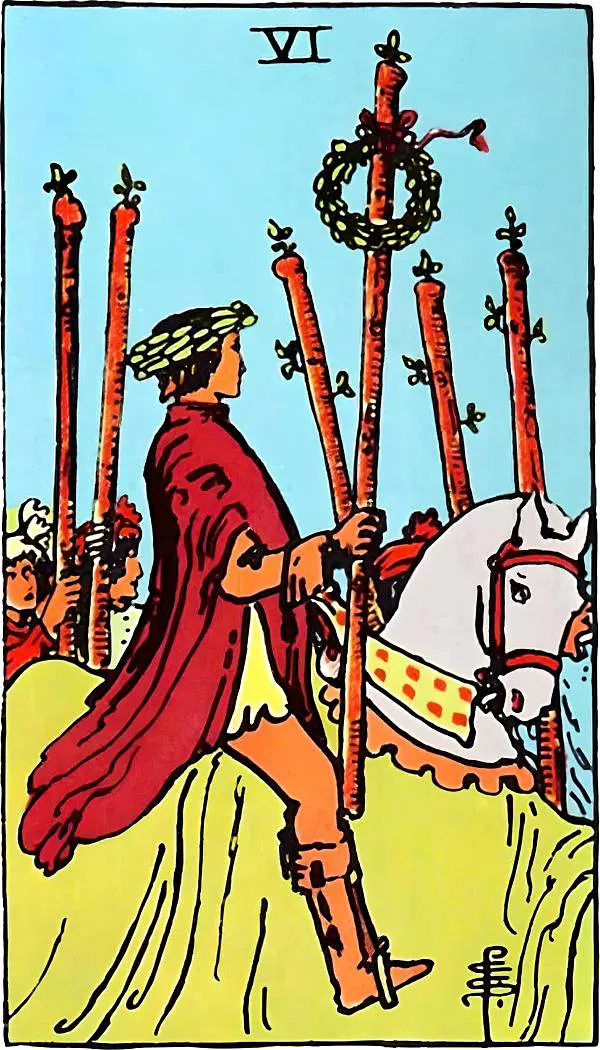
Six wands are held by different people, all raised high, creating a lively scene with many figures.

The protagonist is a handsome man riding a white horse, his right hand firmly gripping a wand adorned with a laurel crown signifying victory, and his head is also encircled by a wreath of laurel. The other five wands are in the hands of the crowd on the inside of the horse, who raise them high, but it is unclear who is holding the wands because many people are cheering. They are the protagonist's like-minded companions, celebrating his glory and triumph, with all the wands raised high, surrounding the proud and radiant rider.

The white horse moves forward slowly, with people lining up on both sides to welcome him. The wands are paired, with two wands closely aligned behind the handsome man, and two others slightly slanted and parallel in front. The wand in his hand is slightly tilted forward, crossing with the wands on either side of him right in the center of the scene. This arrangement forms a V-shape, also conveying a sense of support from both front and back.

However, this celebration is not just for a triumphant victory; it is more like a parade, actually a special ceremony, because of the announcement of significant news, a declaration from the royal authority. The rider has been crowned. Originally a follower, the handsome man has now been promoted to the rank of knight, becoming a royal guard, very different from before.

The handsome man is draped in a red cloak, and even the white horse is adorned with green brocade, indicating a celebratory parade after the coronation, a feeling of returning home in triumph. Of course, the green cloth represents peace and joy. The handsome man's attire symbolizes enthusiasm and jubilation, also matching the color of the wands, suggesting that he and the wand in his hand are one, and similarly adorned with laurel wreaths.

The blue sky is a symbol of clear weather.

Raised Wand

The wand raised high by the central figure represents power and authority, indicating that the person has gained a position of leadership or dominance. The wand, like a standard in battle, marks a cause for celebration and the culmination of efforts.

Wreath of Laurels

The wreath of laurels symbolizes victory and accomplishment, echoing the sentiment of triumphant return after a battle well-fought. It also signifies the achievement of one’s aims or the realization of one’s ambitions.

Riding Horse

The figure on the card rides a horse, a powerful symbol of strength and speed, elements that have contributed to the victory. The horse symbolizes the vehicle of willpower and determination that has carried the figure to this point of achievement.

White Horse

The color of the horse being white is symbolic of purity and nobility. It signifies that the victory was achieved through honorable means, maintaining integrity throughout the process.

Horse’s Decorative Harness

The harness and regalia worn by the horse are not merely ornamental but signify the nobility and honor associated with the quest or struggle that led to this point of victory. These decorations further emphasize the dignified and honorable nature of the triumph, suggesting that it was not just a win, but a win worthy of celebration and respect.

Supporting Crowd

The crowd of people with wands in the background symbolizes community support, social approval, and also perhaps the competition that has been surpassed. Their presence amplifies the theme of triumph and validation from society.

Psychological patterns in Six of Wands
Approval Seeking
The rider's wand is held high like a standard, and the laurel turns achievement into something the crowd can approve. Every surrounding wand repeats the same upward gesture, making the scene feel coordinated around being witnessed. In reversal, that ceremony can stop feeling like support and start functioning like a performance that must be kept alive. In family life, Approval Seeking often works through small calibrations: softening a decision before announcing it, over-explaining your choices, waiting for a parent to sound okay before you relax, or presenting success so no one questions your independence. The raised wand becomes the emotional posture of someone still trying to prove that their separateness is acceptable. This pattern fits the Six of Wands because the card makes approval visible as a social mechanism. The difficulty is not wanting family warmth; it is the exhausting loop of needing that warmth to authorize your own life.
Achievement Fusion
The rider sits above the crowd with a laurel on his head and another laurel fixed to the wand he carries, so the body, symbol, and public gaze all point to one message: achievement has become the central organizing identity. The white horse keeps moving forward, but the scene is less about private satisfaction than about a visible role being confirmed by everyone around him. That structure maps directly onto the way Achievement Fusion can take over a lifestyle system. You may start using discipline, routines, wellness, productivity, or aesthetic order as proof that you are doing life correctly, until ordinary recovery begins to feel like a loss of status rather than a human need. The Six of Wands does not only show success; it shows success being staged, witnessed, and absorbed into the self-image. In lifestyle terms, the audit point is where your daily structure stops serving your body and starts serving the image of being impressive, capable, and always on track.
External Validation
The rider's victory is surrounded by raised wands and cheering figures whose individual faces and hands are not clearly defined. Recognition comes as a collective field of approval, and the laurel symbols reflect achievement back at him from both body and object. External Validation appears when that outside field becomes the regulator for inner certainty. You may know that progress happened, but the nervous system waits for applause, metrics, comments, or visible confirmation before it can believe the change is real. In personal growth, this turns self-evolution into a performance loop where recognition is mistaken for integration.
Secure Visibility
The rider's body is upright, visible, and carried forward by a white horse rather than hidden in the crowd. His hand grips the laurel-crowned wand without shrinking from attention, while the wreath on his head makes recognition physically visible on the body. That posture gives achievement a container instead of letting it become a threat. The public signal is held, not denied; the self does not have to disappear just because other people are watching. In an academic setting, this maps to Secure Visibility because your work can be seen without turning every grade, presentation, or tutor comment into a referendum on your worth. The card shows visibility as a regulated state: recognition enters the system, but it does not hijack the whole identity.
Strategic Visibility
The rider is visible without being swallowed by the crowd. He is centered, elevated, and separated by the horse's body, while the surrounding wands create a public frame rather than a collapse of boundaries. That composition shows visibility being organized rather than merely craved. You may be learning to let recognition, reputation, and public positioning become tools for orientation, while still preserving enough separation to ask whether the role is aligned with the actual path. In direction work, Strategic Visibility matters because hiding and performing are not the only options. The card points to a third structure: allowing your earned visibility to clarify the next route without letting the audience become the route itself.
Status Defense
The rider's upright posture and laurel crown can harden into a public pose that has to keep looking victorious. The crowd is close enough that the image of success presses against the private space where doubt, revision, or honest preference would normally appear. That pressure creates Status Defense. A decision is no longer evaluated by fit or consequence alone; it is defended because changing direction would threaten the visible rank, role, or story attached to the previous win. For You, the question may be less about what option is best and more about what it would cost to be seen changing your mind. The pattern reveals where reputation protection is masquerading as certainty, keeping a choice alive because exiting it would feel publicly destabilizing.
Relationship Performance
The white horse moves slowly through a ceremonial lane while the crowd raises its wands around the rider. Nothing in the scene is hidden, messy, or unfinished; the relationship between figure and crowd is organized around display, reception, and the maintenance of a victorious image. Relationship Performance emerges when intimacy is managed like that parade. You may keep proving that the relationship is happy, stable, desirable, or impressive before checking whether the private emotional structure can actually hold that image. The card's raised standards show how performance can begin as celebration and become a defense. The couple image stays polished, but the parts that need repair are pushed out of sight because they do not fit the victory route.
Milestone Idealization
The laurel-crowned wand sits at the visual center of the scene, with the other wands angled around it like a corridor of attention. The whole procession moves as if one public moment has gathered the meaning of the journey into a single emblem. That concentration of attention is the cognitive mechanism behind milestone idealization. You may load one future marker with too much psychological weight, expecting it to resolve identity, purpose, confidence, and direction all at once. In a direction reading, the Six of Wands makes this pattern visible because the finish line is already being celebrated. The audit question is whether the milestone is truly a compass, or whether it has become a bright symbol that narrows the field until every other route temporarily disappears.
Competence Theater
The wands cross through the center of the image, guiding attention toward the crowned rider and the role he now represents. His posture stays composed inside a public ceremony, while the cheering crowd leaves little visual room for hesitation, uncertainty, or private ambivalence. The scene rewards the version of the person that looks victorious. In a family system, Competence Theater forms when appearing capable becomes safer than being known honestly. You may show the promotion, the plan, the stable relationship, the polished answer, or the emotionally controlled version of yourself because the family responds better to competence than complexity. The performance protects you, but it also keeps real needs offstage. The reversed Six of Wands supports this pattern because the public image becomes more important than the inner state. The victory posture is still visible, but it has hardened into a mask that prevents the family from seeing where you are conflicted, tired, or not actually okay.
Imposter Syndrome
The rider is crowned, elevated, and publicly confirmed, yet the recognition is so visible that it creates pressure to keep matching the image. The laurel and raised wand become support structures, but in the reversed texture they can also become a fragile costume the body has to keep wearing. The defense forms when public success cannot be privately inhabited. Praise lands on the image, while the inner system keeps scanning for the moment the image will fail. In academic life, Imposter Syndrome appears when You are recognized for work that still does not feel internally owned. The Six of Wands connects this pattern to the burden of visible achievement: the more the crowd confirms the role, the more exposed the self can feel behind it.
Core Struggles in Six of Wands
Performative Intimacy
The parade can keep its shape even when every symbol has become maintenance: the wand stays high, the laurels stay visible, and the horse keeps moving through the public lane. The ceremony does not need private truth to continue; it only needs the signs to remain upright. In romance, that reversed structure describes a bond that still looks coherent while the inside has stopped breathing. You may be holding the couple image together through posts, routines, smiles, or public reassurance, while the real relationship waits behind the performance for an honest point of contact.
Masked Self-Division
The rider sits high on the white horse with a laurel on his head and another laurel fixed to the raised wand, so the person and the proof of success occupy the same visual register. The surrounding wands create a corridor of attention, giving him forward motion only through a space already shaped by public recognition. That structure gives Masked Self-Division its exact shape: the visible self has to remain legible as the victorious self. You may be moving through inner work with a polished face already in place, where the part that receives applause is overlit while the unprocessed, contradictory, or tired part has no obvious place in the scene. The card does not reduce the mask to vanity. It shows how a successful image can become a physical container that keeps the parade moving, even when the inner self needs to step outside the role long enough to become real again.
Achievement-Meaning Collapse
The laurel wreaths, raised wands, and decorated horse all gather around one completed message: the rider has achieved something that can be publicly named. The scene does not show a new landscape opening; it shows a ceremonial return, with forward movement slowed into display. Achievement-Meaning Collapse appears when the container of success remains intact while the inner reason for continuing loses pressure. You may have the milestone, the title, the proof, or the praise, but the meaning that once pulled you forward no longer automatically follows. In a direction reading, this card gives shape to the strange vacancy that can arrive after a win. The parade marks the end of one pursuit, while the clear sky above it exposes the unanswered question of what is worth wanting now.
Joy Performance Fatigue
The crowned rider is already victorious, yet his body must keep presenting victory while the horse carries him through the crowd. The raised wand stays lifted, the posture stays composed, and the celebration continues as a moving demand rather than a finished moment. In family dynamics, that image becomes the fatigue of having to look grateful after meeting an expectation. You may have achieved the thing, survived the visit, accepted the praise, or played the successful adult child, but the family system still requires the correct expression on your face. The struggle lives in the gap between what the ceremony displays and what the body has to keep holding. Recognition does not end the performance; it can become the next form of emotional labor.
Recognition-Containment Split
The rider's arm has to stay raised while the horse continues beneath him, and the decorated harness turns movement into polished display. The scene can receive the victorious surface, but it gives little room for the strain of holding that surface in place. That is how recognition can fail as a container. You can be supported, praised, or publicly welcomed, while still having no social space where uncertainty, fatigue, awkwardness, or unfinished feelings can be placed without disturbing the ceremony. The split is carried by the difference between applause and holding. The group can acknowledge the part of you that looks complete, but your fuller experience may remain outside the frame of what the social field knows how to receive.
Peer Validation Lock
The rider’s crowned posture can become a position that must be held, not a moment that can pass. The laurel and raised wand still mark victory, but the crowd’s gaze turns the symbol into something that must keep being confirmed. Peer Validation Lock appears when direction cannot feel real until it is mirrored back by other people. The inner compass gets routed through applause, likes, approval, family pride, peer comparison, or public proof, so movement feels unsafe without an audience signal. In this reversed structure, the parade no longer simply celebrates the rider; it trains the rider to remain legible to the parade. The card gives shape to the exhaustion of needing visibility before you can trust your own next step.
Visibility-Execution Split
The rider's raised wand creates a clean public image, but the same upright display reduces what his hand can actually do while the horse moves through a narrow parade path. Visibility demands posture, symmetry, and composure before it allows practical adjustment. In the reversed current of this card, being seen consumes the motor system that would normally experiment, steer, and correct. You are placed in front of the crowd before the action can stay messy enough to learn. For personal growth, this is the moment where declaring the goal, showing the process, or becoming the person others expect makes execution freeze. The block is not laziness; it is the structural split between performing progress and doing the imperfect work that progress requires.
Metric-Compass Fusion
The raised wand is held like a standard, not like a walking staff or steering instrument. Around it, other wands repeat the same vertical signal, multiplying visible markers of approval without producing a separate navigational line. Metric-Compass Fusion forms when the sign that proves progress is mistaken for the faculty that chooses direction. You can start treating applause, promotion, numbers, titles, or visible momentum as if they were the same thing as inner orientation. This card makes that fusion visible through its crowded symbols of success. The wand can announce that something worked, but it cannot by itself answer whether the path still belongs to you.
Status-Belonging Fusion
The Six of Wands places the rider inside a public field where the crown, the raised wand, the decorated horse, and the cheering crowd all point toward visible status. The same symbols that honor him also make his place in the scene depend on being seen as victorious. In a family system, this becomes the fusion of belonging with status. You may be welcomed most warmly when your life supplies the family with proof of success, stability, respectability, or upward movement. The card gives shape to the painful uncertainty beneath that applause: whether the family is meeting you, or meeting the version of you that reflects well on them.
Victory-Compass Split
The Six of Wands gives the rider many external reference points: raised wands, laurel wreaths, a decorated horse, and a crowd arranged around the path. These symbols confirm that something has been achieved, but none of them can reveal whether the achievement still points toward the rider's inner direction. Victory-Compass Split lives in that gap between proof and orientation. You may have evidence that you are doing well, improving, or becoming impressive, while the deeper inner compass remains oddly quiet, as if the parade can confirm success but cannot confirm meaning. The horse still moves forward, but the movement is slow and ceremonial. In introspection, the card marks the moment when progress is visible from the outside while inner direction needs to be recovered from beneath the noise of being celebrated.
Inner Emotions in Six of Wands
Focused Confidence
The white horse moves forward at a controlled pace, neither charging nor collapsing, while the rider keeps the raised wand steady in his hand. The surrounding wands create a rhythm around him, turning movement into something paced and directed. That procession mirrors the academic state where the work stops scattering into panic and starts becoming navigable. You can face a seminar, deadline, critique, or revision cycle without every signal pulling your attention apart. Focused Confidence is not loud certainty. It is the felt ability to keep moving with your own line of attention intact, even while the room is watching and the outcome still matters.
Grounded Belonging
The white horse moves through an aisle made by raised wands, and the rider stays upright inside a clearly held social field. The crowd is not collapsing into him; it lines the path, giving the central figure room to pass while still marking him as part of the procession. That spatial order is what gives Grounded Belonging its shape. In friendship, it describes the feeling of being held by the group without being swallowed by it, where support has enough structure to feel real and enough distance to preserve your own outline. The card's emotional logic is not merely social approval; it is a visible arrangement of place, boundary, and recognition. You can feel connected because the circle does not require you to blur yourself in order to be included.
Status Anxiety
The slow horse keeps the rider visible for longer than a simple arrival would. The laurel crown, raised wand, ceremonial fabrics, and crowd-lined route make status a physical atmosphere, something carried on the body and watched from both sides. In direction work, Status Anxiety emerges when the future starts to feel measured against the image of your last success. The next move becomes loaded with the fear of losing rank, disappointing witnesses, or stepping away from a path that looks impressive from the outside. The Six of Wands holds that pressure without turning it into a verdict. It shows how recognition can become a mirror that clarifies your influence, but also how easily that mirror can start steering the compass if you stop checking what direction actually feels true.
Approval Anxiety
The rider's body is displayed at the center of a crowded ceremonial route, with wands raised around him and the laurel marking him as someone expected to succeed. The scene gives recognition, but it also creates a visible standard that must be carried in front of many eyes. In love, that visual pressure becomes Approval Anxiety: the sense that affection depends on staying impressive, desirable, composed, or easy to celebrate. Instead of resting inside the bond, you may keep checking whether your image is still strong enough to hold your partner's attention. The reversed Six of Wands carries this feeling because its symbols of validation can tighten into a performance field. The card reveals how romantic reassurance becomes unstable when being loved starts to feel inseparable from being approved of.
Visibility Relief
The upright rider, the raised wand, and the laurel wreaths make recognition visible in the body before it becomes an idea. Nothing in the scene hides the achievement: the figure is elevated, the crowd is oriented toward him, and the symbols of completion sit openly on his head and staff. For direction work, that visibility can create a specific kind of relief. You no longer have to keep proving that your path exists, because the outer world has begun to mirror back the effort, coherence, and movement that were already building inside you. Visibility Relief does not mean the whole future is solved. It names the moment when being seen reduces inner static enough for you to hear the next part of your compass more clearly.
Hollow Recognition
The rider is crowned, displayed, and surrounded by raised wands, but the visual field gives him very little private space. The symbols of recognition sit on the body like proof, while the crowd’s attention keeps the scene oriented around being seen. For direction work, Hollow Recognition names the ache of being acknowledged for a version of your path that does not fully match your inner coordinates. The outside world may be clapping for an identity you have outgrown, a milestone that felt necessary, or a role that now feels too narrow. The card’s emotional logic lives in that pressure between visibility and inner mismatch. You are not rejecting recognition; you are noticing that recognition alone cannot tell you where to go next.
Synchronized Relief
The white horse moving forward beneath a clear blue sky gives the scene its emotional timing: progress is no longer being dragged out of a resistant environment. The rider is still active, still holding the wand, but the crowd, the path, and the symbols of completion are moving with him instead of against him. For timing work, that visual alignment becomes a felt release from constant forcing. You can sense the difference between pushing a dead season and entering a window where the field itself has begun to cooperate. Synchronized Relief belongs here because the card does not show isolated victory; it shows momentum being socially, spatially, and symbolically carried. The relief is not passive comfort. It is the body recognizing that effort has finally met a usable moment.
Hollow Victory
The wreaths, red cloak, decorated horse, and raised wand make the victory legible before the rider says anything. The scene is full of proof, yet the layers of regalia can become so complete that the actual person beneath the symbols is visually harder to reach. In the inner world, that over-readable success can leave no room for the private self to feel met. You may have the outer evidence of progress while the inner register stays flat, as if the win happened to your image but not to the part of you that needed to feel alive.
Earned Satisfaction
The white horse moves slowly through the open route, and the laurel does not flare like a sudden reward; it rests on the rider as a completed marker. The whole image has the pace of effort that has accumulated enough weight to be carried without rushing. In lifestyle terms, this is the emotional texture of seeing small systems finally hold. A routine followed, a room reset, a body cared for, or a week planned with enough realism can create satisfaction that feels calm rather than performative. Earned Satisfaction belongs here because the card does not show a shortcut. It shows the body after a sequence of effort, receiving evidence that the discipline was not empty labor but a structure capable of returning steadiness.
Grounded Agency
The rider's hand closes around the central wand while the white horse advances at a controlled pace. The scene is public, but the physical point of contact stays simple: one body, one grip, one forward line. In a decision spread, that grip becomes the emotional signature of agency returning to the body. Instead of being thrown around by competing options, you can feel the choice reorganizing around what you are willing to hold, carry, and make visible.
Outer Contexts in Six of Wands
Public Mask Maintenance
The crowned rider, red cloak, white horse, and raised wand turn the body into a public emblem before any private reality can be seen. The parade does not simply show success; it stages a version of the self that has to remain composed, legible, and worthy of applause. That visual structure maps directly onto the maintenance of a public mask. You may have earned real recognition, but the scene shows how recognition can harden into a role that must be carried in front of others, especially when your identity has become attached to being capable, impressive, or unbothered. In introspection, this card names the pressure of staying visually aligned with the successful image while the private self asks for room to be less polished. The useful mirror is not whether the applause is fake, but whether the public role has become the only version of you that is allowed to enter the room.
Social Performance Loop
The crowned rider, red cloak, decorated horse, and raised wands create a scene where the body must remain presentable while the crowd keeps watching. The ceremony does not offer privacy; it keeps the visible figure moving inside an applause corridor. In a social performance loop, the network rewards the version of you that can stay bright, impressive, and endlessly available. The card reveals the loop as an external stage, which helps locate the pressure in the crowd-facing structure rather than treating it as a personal defect.
Main Character Friend Dynamic
The rider's elevation, wreath, decorated horse, and raised wand pull every surrounding body into his orbit. In this configuration, the crowd is present, but its individuality is visually flattened into applause. As a reversed friendship context, the image exposes a social structure where one friend repeatedly becomes the event and everyone else becomes the audience. Their wins, crises, crushes, conflicts, and updates dominate the shared space until support stops being mutual and starts functioning as a status supply line. You are not being asked to resent visibility itself. The card points to the imbalance created when one person's need to be witnessed consumes the group's emotional bandwidth and leaves little room for anyone else's interior life.
Personal Brand Performance
The rider’s cloak, laurel crown, decorated horse, and raised wand make success visually coherent, almost branded. The body is not simply moving forward; it is moving through a watched corridor where every symbol has to keep communicating victory. In personal growth, that visual pressure maps onto the outer environment where becoming better has to look good, post well, and read as a coherent narrative. The work of changing can be quietly replaced by the work of appearing changed. The reversed card shows how self-development becomes distorted when every habit, insight, and milestone must function as proof. It gives you a clean way to separate genuine integration from the performance layer that keeps asking to be witnessed.
Status Anxiety Circle
The raised wands, laurel crowns, and central rider create a clear status field: one figure is marked, watched, and publicly ranked as successful. In reversal, those same markers become comparison instruments, measuring the rider against the crowd's expectations and against every future version of the performance. This is the status anxiety circle as an external environment, not a private weakness. You are moving through a field where visible success creates more visibility, and more visibility creates more chances to be evaluated, compared, copied, or surpassed. For introspection, the card identifies the loop that keeps the inner system scanning the room. The way out begins with seeing that the pressure is produced by a social ranking architecture, not by a permanent defect inside you.
Post-Achievement Plateau
The white horse moves slowly beneath a rider who has already been crowned, making the scene less like the battle itself and more like the structured aftermath of success. The laurel wreath and decorated wand show that the achievement has landed, while the forward motion shows that life has not stopped at the win. In personal growth, that creates a very specific plateau. You have evidence that you can do the thing, but the old push toward proving yourself no longer provides enough momentum, and the next stage requires a quieter architecture of habits, standards, and direction. This card links the plateau to the gap between achievement and integration. The real work is not extracting more applause from the same win; it is seeing what kind of self-management system can carry you after the peak moment has passed.
Community Leadership Trial
The rider is not walking with the crowd; he is mounted, crowned, and holding the laurel wand at the center of the procession. The body has been moved into a public role, while the surrounding wands make that role visible to everyone around him. In a social network, that structure resembles a leadership trial: invitations, organizer roles, group chats, and community events begin to orbit around your visible position. The card does not glorify constant availability; it shows the moment when recognition becomes a responsibility that has to be consciously bounded.
Executive Presence Test
The rider sits above the crowd on a white horse, holding a laurel-topped wand like a visible standard. His body is not hidden in the work anymore; it is placed where everyone can read posture, timing, authority, and steadiness at once. That is the exact architecture of an executive presence test in career life. The work may already be strong, but the next gate is social legibility: whether senior people, peers, and stakeholders can recognize you as someone who can carry the room without borrowing authority from the room. Six of Wands makes the pressure public rather than private. You are not only being measured by what you delivered, but by whether your visible role can hold under attention, applause, comparison, and expectation.
Community Approval Test
The rider is central, but the scene only works because the surrounding figures raise their own wands in response. Their bodies create the corridor that lets the horse move forward. This is the logic of an approval test rather than simple applause. For your timing question, the issue is whether the group around the move can offer real lift, or whether the cheering is too thin to carry the next stage.
Approval Bottleneck
The rider's wand is raised, but the scene around it is crowded with other raised wands. Recognition moves through the group before the procession can feel complete, turning progress into something witnessed, echoed, and socially confirmed. In a decision context, that same structure can become a bottleneck. You may already have enough information to choose, yet the move stays suspended because legitimacy has been outsourced to approval, consensus, praise, or one last person saying the option is acceptable. The reversed Six of Wands sharpens the social mechanics of delay. The issue is not a lack of intelligence or effort; it is a decision channel clogged by the need for external confirmation before agency is allowed to move.