One Self-Help Video Went on Hold, and Five Quiet Checkmarks Followed

Six Tabs, One Untouched Notebook
I often meet people who can explain habit stacking, time blocking, and minimum viable habits with complete fluency, yet still reach for YouTube the moment a five-minute action becomes ordinary. Jordan, a 27-year-old junior UX designer in Toronto, brought me that exact contradiction: “I know what to do, so why am I still not doing it?”
Our video consultation began at 10:45 on a wet Sunday night. Jordan tilted their laptop camera toward a shared kitchen table where six productivity videos glowed beside an untouched notebook. The radiator clicked behind them, a streetcar hissed over rain-dark rails outside, and the blue screen light made the room look several degrees colder. I watched their fingers flick from tab to tab while their jaw tightened and their shoulders crept upward.
“One video is about habit stacking, two are morning-routine breakdowns, and I think one is basically a forty-minute argument for waking up at five,” Jordan said. “I was going to plan one realistic routine tonight. Then I downloaded another tracker. Planning makes me feel capable until the routine actually starts.”
They paused, pressing both palms against the edge of the table. “If I make the habit too small, it feels like it doesn't count. But if I try properly and stop after three days, then what does that say about me?”
I heard the frustration in that room like too many fragrances sprayed into the same strip of air: each one arrived with a bright promise, but together they left no clean space in which to breathe or choose. Hope kept flashing through the content, guilt followed when the notebook stayed blank, and the actual moment of action seemed to pour wet cement into Jordan's arms.
“That brief hope is real,” I told them. “The content is giving you relief, not because you're lazy or unserious, but because preparation postpones the moment when your plan can become imperfect. Planning can feel like progress because it postpones the part that might disappoint you.”
I named the loop carefully: self-help consumption had become productive procrastination. Jordan was working hard around change while avoiding the only part that could create evidence. “I'm not going to use tarot to predict whether you'll finally become consistent,” I said. “I want us to use it as an objective map of the loop. We'll look for where your attention gets redirected, what the redirection protects, and which next step is small enough to survive an actual Wednesday.”

Choosing the Switchback Map
I invited Jordan to put both feet on the floor, lower their shoulders without forcing them, and take one ordinary breath while holding the question: “Why do I keep consuming self-help instead of changing my routine?” I shuffled slowly. I treat this preparation as a shift in attention, not a mystical performance; it helps me separate the question itself from the noise already surrounding it.
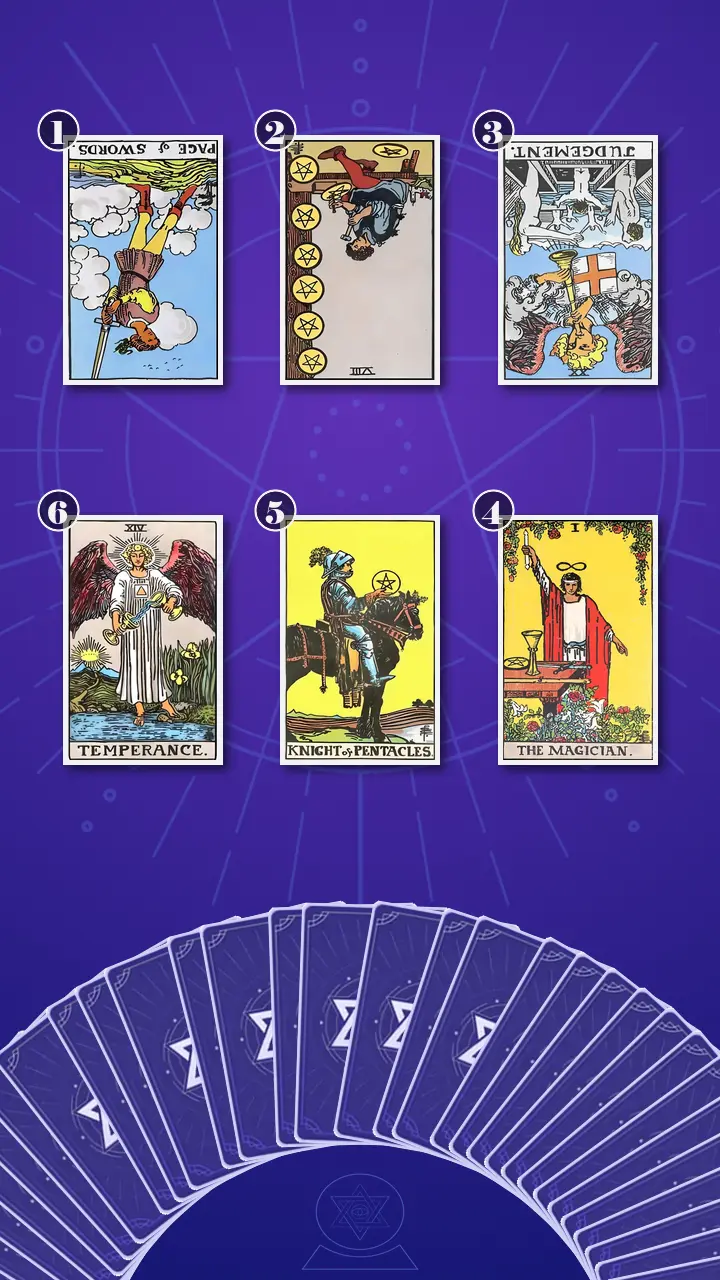
I chose the six-card Transformation Path Grid · Context Edition. For anyone curious about how tarot works in a problem like this, I use card meanings in context to make a behavioural system visible. A broader Celtic Cross could have generated ten interesting observations, but Jordan did not need a complete audit of their life. They needed the smallest spread capable of showing a self-reinforcing loop and its leverage point.
I arranged three cards across the top row for the visible pattern, the active blockage, and the underlying fear. Beneath them, I laid three cards that would lead us back in the opposite direction: the catalyst, the repeatable practice, and the integrated state. The route resembled a switchback trail. I would follow Jordan's habit-system hopping to the end of its current level, drop into the root mechanism, and then return with a route they could actually walk.
“The first card will show what you visibly do when the routine is supposed to begin,” I explained. “The third will ask what an imperfect attempt seems capable of proving about you. The fourth is the hinge: the point where another saved idea either becomes action or returns to the queue.”
I also made the boundary explicit. “These cards are not a verdict. If an interpretation does not fit your lived experience, we examine it rather than forcing it. You remain the person with the calendar, the body, the household, and the right to decide what happens next.”
Reading the Wind Around the Habit
Position One: The Page Looking Sideways at YouTube
“Now I'm turning the card for the observable current pattern: opening, saving, and comparing self-help resources instead of completing the routine action.” I revealed the Page of Swords, reversed.
I pointed to the Page gripping an oversized sword while glancing sideways into a wind-bent landscape. Upright, I often read this card as alert curiosity and active information gathering. Reversed, its Air had moved into excess and blockage. Jordan's mind was stimulated from every direction, but no idea was staying still long enough to become an experiment.
I connected the card to a morning Jordan had already described. At 8:12, with seven minutes before a remote stand-up, they had intended to stretch for three minutes. The kettle clicked off and Slack chimed. Instead of stretching, Jordan opened YouTube to confirm whether movement was the optimal first habit, scanned three thumbnails, saved two videos, and joined the call without having moved.
“The sentence underneath the card is: ‘I was about to begin, but first I need to check...’” I said. “Your curiosity is not the enemy. The question is whether curiosity supports the scheduled action or repeatedly redirects it at the exact moment uncertainty appears.”
I ran a brief Sensory Overload Audit with them. I counted the kettle, Slack notification, cold tile, video thumbnails, streetcar noise, work laptop, and phone within the same few minutes. None was dramatic alone. Together, they were quietly spending Jordan's psychological bandwidth before the routine had a chance to start.
Jordan gave one short laugh, but there was no amusement in it. “That is so accurate it feels a little brutal. I was literally searching for the best stretch while not stretching.” Their fingers stopped over the trackpad, then curled into their palm.
“Accuracy should not become accusation,” I replied. “The Page also tells me you have plenty of intelligence and curiosity available. We're identifying where that energy goes, so you can redirect it. I am not asking you to become less interested in learning.”
Position Two: The Beautiful Tracker With No Event Data
“Now I'm turning the card for the active blockage: the process that makes learning substitute for repetitive practice and makes a modest action feel insufficient.” I revealed the Eight of Pentacles, reversed.
The upright artisan normally learns by returning to a bench and completing one unit after another. Reversed, the workshop looked like Jordan's beautifully formatted Notion dashboard: colours, formulas, linked databases, and almost no behavioural data. I read the card as blocked Earth, with an excess of perfectionistic infrastructure and a deficiency of ordinary repetition.
Jordan had spent one Sunday designing a seven-part morning routine. They completed the full version once, slept badly on Monday night, missed Tuesday, and stopped recording. Rather than use a two-minute version, they rebuilt the system. The workshop looked busy, but the craft never received enough repetitions to teach them anything.
“I hear the inner rule as: ‘If the five-minute version barely counts, I should build the proper version first,’” I said. “But the polished tracker cannot produce evidence on your behalf. It can only record evidence you create.”
I saw Jordan's shoulders tense again. They looked away from the spread toward the notebook on their table, where the first pages contained headings but no daily marks. “I've redesigned that dashboard four times,” they said. “I keep thinking the next version will remove the part where I have to do something boring when I'm tired.”
“That is the blockage,” I said. “The ideal routine offers an impressive launch. A repeatable routine offers information. Those are different rewards. The reversed Eight asks whether you are willing to choose the less cinematic reward long enough for skill to form.”
Position Three: When One Empty Box Becomes a Verdict
“Now I'm turning the card for the underlying fear: what an imperfect attempt seems capable of proving about your identity, reliability, or control.” I revealed Judgement, reversed.
I centred the angel's trumpet and the figures who would ordinarily rise to answer it. Reversed, I did not see an absent call. I saw a call made frightening by the belief that the response would be graded as a final statement about the self. The energy of honest review was blocked because self-assessment had become self-sentencing.
I returned with Jordan to a Monday morning when pale winter light pressed through their blinds. Their planned 45-minute routine no longer fitted before work. The two-minute option was technically available, but it did not feel meaningful enough to count. Jordan stayed under the duvet, searched for a more realistic system, and silently changed “the plan did not fit this morning” into “I have already ruined the week.”
“That translation happens very fast,” I said. “‘I missed it’ becomes ‘This proves I cannot trust myself.’ Another expert framework then feels safer because it delays the quieter review of what actually interrupted the cue.”
I let the radiator clicks fill the pause before I added, “A missed day is a data point, not a character reference.”
Jordan's breathing stopped for a beat. Their index finger remained suspended above the notebook as their gaze lost focus, and I could see them replaying a recent morning rather than looking at me. Then their hand lowered. A long breath left their chest, but their mouth tightened as if the relief had brought something painful with it.
“I called myself flaky,” they said quietly. “The actual problem was that I had an early design review and didn't eat breakfast until ten. But I decided the whole thing proved I couldn't stick to anything.”
“I can hear why more advice became protective,” I replied. “If every attempt is allowed to testify about your character, research gives you somewhere to remain capable without entering the courtroom. Our work is not to make you fearless. It is to remove your worth from the experiment.”
When the Magician Directed One Hand Downward
Position Four: One Tool Crosses Into the Calendar
The room on Jordan's screen seemed to become unusually still as I reached the lower row. Even the radiator stopped ticking for a moment. “Now I'm turning the card for the leverage point: the shift that converts existing knowledge into one bounded experiment and restores personal agency.” I revealed The Magician, upright.
I saw the raised wand, the hand pointing toward the ground, and all four suit tools already arranged on the table. Upright, the Magician brought focused, balanced agency. The card did not promise total control or perfect consistency. It showed available resources receiving one deliberate direction.
At 10:45 p.m. in a Toronto apartment, six productivity videos were still glowing beside an untouched notebook. Jordan's fingers could keep saving fixes while their shoulders went heavy, because tomorrow's perfect reset felt safer than testing one tiny action tonight. The Magician interrupted that split: phone timer, calendar, saved note, and kitchen counter were already present.
Jordan's work gave me the clearest analogy. “You would not keep a UX project in permanent discovery because the first prototype might reveal friction,” I said. “At some point, one hypothesis has to meet one user. Right now, your routine is a product with excellent research and no usability test.”
When I looked again at the Magician's table, my mind flashed to my perfumer's bench. I can have dozens of exquisite materials within reach, but a composition only begins when I choose proportions, create separation, and let one accord take form. Adding another ingredient to an already crowded atmosphere does not create clarity. It often creates olfactory fatigue.
I used my Spatial Boundary Scenting lens to show Jordan what had remained invisible. Their work atmosphere, self-improvement atmosphere, planning atmosphere, and recovery atmosphere all occupied the same laptop, table, blue light, and set of notifications. The atmospheres were overlapping until the body had no reliable signal for when high-pressure input ended and embodied practice began. The problem was not only time management. Their environment had no breathable boundary.
“I am not choosing the perfect method,” I offered as the Magician's new inner line. “I am choosing what I can test today.” Then I gave Jordan the central message without softening it.
You do not need another hidden answer; choose one tool already on the table and let the Magician's directed hands turn knowledge into a scheduled action.
Jordan froze. Their lips parted, and their pupils widened before their gaze dropped to the phone, notebook, and kettle visible around them. Their right hand closed into a fist against the table, then slowly released one finger at a time. I watched their shoulders descend, but the relief did not look simple; their eyes reddened, and for a few seconds they seemed almost dizzy in the space left behind by the search. “But then I don't have the excuse that I'm missing the right system,” they said, their voice low and slightly unsteady. “Does that mean I've wasted all this time?” A streetcar bell sounded through their microphone, clean and singular against the quiet. I told them, “No. It means your strategy gave you hope and protected you from a verdict until its cost became too high. You were not wrong for needing protection. You are now responsible for choosing a gentler kind.” Their next exhale trembled, then settled.
I restated the shift in plain language: “Agency does not begin when you find the perfect system; it begins when one tool you already have becomes one action on your calendar.”
“Now, using that perspective, think about last week,” I said. “Was there one moment when this insight could have changed how you felt?”
Jordan looked toward the untouched notebook. “Wednesday before stand-up. I could have closed YouTube, set a three-minute timer, and stretched beside the counter. I didn't need the video to approve it.”
That recognition marked the first movement from guilt-tinged frustration and preparation mode toward grounded confidence and flexible self-trust built through lived evidence. It was not confidence that the routine would work forever. It was confidence that Jordan could run one honest test without making the result a referendum on who they were.
Position Five: The Checkbox Too Ordinary to Post
“Now I'm turning the card for the concrete practice: the deliberately small behaviour that can interrupt the input loop and generate direct evidence.” I revealed the Knight of Pentacles, upright.
I drew Jordan's attention to the motionless horse and the Knight studying one pentacle above a cultivated field. I read this as balanced Earth: patient, dependable attention expressed through repetition. The Knight was not rushing toward novelty. He was tending one object long enough for effort to leave a trace.
In Jordan's week, this meant doing the same three-minute stretch after breakfast and marking one paper box beside the kettle. On a rushed office day, the action could become one minute rather than disappear. Nothing about that practice would be dramatic enough for a #morningroutine video, but every repetition would provide information another podcast could not.
“If the habit is too small to impress anyone, it may finally be small enough to teach you something,” I said. “The experiment succeeds by producing evidence, not by producing content.”
Jordan nodded, then pushed back in a way I respected. “But I genuinely don't have five minutes before stand-up some days.”
“Then five minutes is not the floor,” I replied. “One minute can be the floor. We choose a version that respects your body, workload, and shared household. We do not hide an ambitious routine inside the phrase ‘tiny habit,’ and we do not double tomorrow's action to punish today's miss.”
Their hand moved at last. Jordan wrote “one to three minutes” on the previously blank page. I noticed that they did not decorate the heading or open Notion. They simply drew seven small boxes.
Position Six: Temperance Meets an Actual Tuesday
“Now I'm turning the card for integration: the way advice, action, reflection, and adjustment can share a sustainable rhythm without requiring a total self-help ban.” I revealed Temperance, upright.
I watched water pass continuously between the figure's two cups, one foot on land and one in water. I read this as balanced, regulated flow. Jordan did not need to reject books, podcasts, creators, or apps. They needed to prevent incoming advice from outranking direct experience.
I translated the two cups into a simple sequence: one resource, one test, one reflection, one adjustment. Jordan could keep a single 20-minute advice window, but place it after at least one routine repetition. On day seven, they could write three lines: what worked, where friction appeared, and the one adjustment worth testing next. Every new recommendation would wait until the current idea had touched daily life.
“The question between the cups is: ‘Did this resource support the routine, or did it replace the routine?’” I said. “Temperance is moderation, but it is also relationship. I want you to change your relationship with input, not manufacture a rigid purity rule that becomes another all-or-nothing system.”
Jordan looked visibly relieved. “So I don't have to unsubscribe from everything and become a person who never watches productivity content?”
“No,” I said. “Rigid abstinence could recreate the same perfectionism in reverse. Self-help becomes useful when it enters a feedback loop with your actual Tuesday. You learn, test, notice, and adjust. Your evidence earns a place beside the expert voice.”
I could see the whole spread settle into coherence. Scattered Air had become focused choice. Blocked Earth had become a repeatable practice. The fear of Judgement had softened into review without moral labels. The Magician initiated, the Knight tended, and Temperance adjusted. The cards had not handed Jordan a better identity. They had made a sequence of choices visible.
The Seven-Day Boundary Between Input and Action
I gathered the reading into one concise story. Jordan's curiosity had kept scanning because new information delivered a burst of hope. Perfectionism then made modest repetition feel too insignificant, so the routine produced almost no evidence. Judgement turned that missing evidence into a personal verdict, which sent Jordan back to research for relief. They had been collecting maps while never leaving the station, or, in UX terms, keeping their life in permanent discovery because testing might reveal friction.
The blind spot was not simply “I need more discipline.” It was the assumption that a small action could only matter if it proved control. That made five minutes feel insulting and a missed day feel catastrophic. The transformation direction was more practical: filter the input, ground one action, and adjust from experience. Jordan did not need certainty before beginning. They needed one bounded experiment capable of producing evidence without claiming to define them.
I gave Jordan two pieces of actionable advice. I kept both deliberately plain so there would be nothing new to optimise.
- The One-Tool-on-the-Table ExperimentDuring the next planned routine window, take eight minutes to turn on Do Not Disturb, close every recommendation feed, and choose one action from notes you already have. On a phone note or index card, write: “After I finish breakfast, I will stretch beside the kitchen counter for one to three minutes, for seven days.” Schedule only the next occurrence. Create one note called “After the Seven-Day Test” and send every new recommendation there unopened.Tip: This is a seven-day boundary, not a permanent ban. Choose a low-risk action that requires no purchase or public announcement. If one minute creates pressure or distress, stop and record that response as information rather than a verdict.
- The Physical Boundary and Five-of-Seven Evidence LoopWithin 72 hours, use my Physical Boundary Protocol to create an absolute sensory partition between high-pressure input mode and embodied practice. Jordan chose the kettle clicking off as the trigger: the phone goes face down in a kitchen drawer, the mug lands on one wooden coaster, and the stretch begins. Keep seven paper boxes beside that cue. After each attempt, mark only a check, a dash, or “smaller version.” On day seven, spend ten minutes writing what worked, where friction appeared, and one adjustment to test next.Tip: Five completions out of seven are enough to learn from. Do not raise the floor midweek, add a second tracker, or compensate for a missed day. On office mornings, use the one-minute version; if the cue repeatedly fails, change the cue instead of applying a harsher label.
Jordan read both actions back to me. “One cue, one small action, five out of seven, and no new system until I review the test.”
“Exactly,” I said. “The spread gives us a map, but you create the route by walking it. Your check marks will come from you, not from the Magician.”

A Week Later, Five Quiet Marks
Seven days later, I received a message from Jordan with a photograph of the paper beside their kettle. It showed five checks, one dash, and one box labelled “one minute.” The page was not aesthetic. There were no formulas, streak graphics, or colour-coded categories.
“I wanted to search for a better stretch on day three,” Jordan wrote. “I put the video on the waiting list instead. On the office day, I did one minute. The weird part is that the smaller version felt more honest, not less.”
Their three-line review said that breakfast worked as a cue on remote days, the phone drawer reduced distraction, and office mornings needed a different location. Their next experiment kept the same stretch but moved the cue to brushing their teeth. Jordan had not solved routine change. They had learned how to adjust without declaring a reset.
Jordan also told me they slept through the night after scheduling the next test. Their first waking thought was, “What if I drop it next week?” They smiled at the question, made breakfast, and returned to the cue. The doubt remained; it no longer controlled the calendar.
I did not read those five marks as proof that tarot had made Jordan consistent. I read them as proof that Jordan had used a six-card Transformation Path Grid to see a loop, choose a boundary, and reclaim authorship of one ordinary week. The cards supplied perspective. Jordan supplied the action.
For me, that is the real Journey to Clarity: not a perfect system arriving from outside, but the movement from collecting methods to testing one, from imagined certainty to lived feedback, and from self-judgement to flexible self-trust. Clarity did not require Jordan to know how every future morning would unfold. It only required enough clean air around the next choice.
When saved tabs keep multiplying while your shoulders go heavy at the moment of action, I understand why searching can feel safer than letting one small attempt become evidence about control. I also know that noticing the search as a protective pattern means the pattern is no longer invisible.
If this week did not have to prove anything about you, which tiny action would you place on the Magician's table, pair with the same sensory cue, and repeat for seven days just to learn what your actual Tuesday has to say?