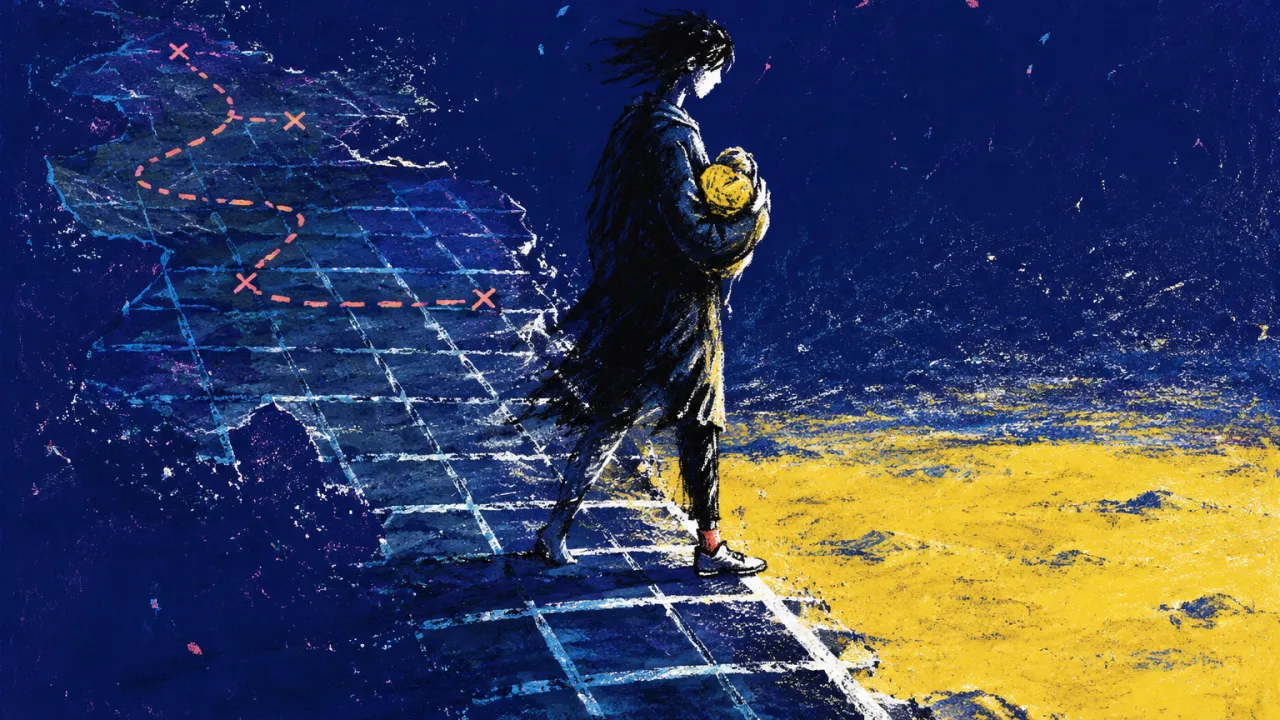
Life Reset Phase is the stretch where your old schedule, space, roles, and routines keep asking for decisions even after they have stopped fitting the life in front of you. The tight chest you feel when the calendar, the inbox, and the half-finished to-do list all point in different directions is part of the body's contact with the reset. This is an environmental, structural dynamic: the outer scaffolding has changed before the new daily system has had time to stabilize. These Tarot Cards reflect the visible outline of that threshold, where movement arrives before the road is fully mapped.
The Fool UprightAt the cliff edge, the young traveler carries only a small bundle while the sun and mountains open a larger terrain behind the immediate ledge. The scene holds the exact physics of a reset: enough vitality to move, not enough road to make the next stage fully legible. In personal growth, this maps to the external moment when an old routine, identity, or support system has been left behind before a stable replacement exists. You are not looking at a completed transformation; you are looking at the public edge of a new chapter where agency has returned faster than structure.
The Magician UprightThe raised wand, the downward hand, and the full table of tools create a picture of potential becoming usable again. The Magician is not wandering through an empty field; he is positioned in front of a prepared surface where different parts of life can be sorted, named, and brought back into contact with action. That structure fits a reset phase because the issue is not total absence of capacity. You may have skills, access, past experience, or a hard-won sense of what no longer works, but those pieces still need a new operating frame before they become a direction. The card holds the reset at the moment before momentum becomes visible. It shows a life stage where the next chapter is not found through more noise, but through arranging existing resources into a course that can actually carry weight.
The Chariot UprightParked at the riverbank with the city wall behind him, the Charioteer occupies a threshold rather than a finish line. The vehicle is built for movement, the sphinxes are positioned in front, and the command staff is raised, but the scene holds the charged pause before a new route becomes real. That pause is the outer shape of a reset phase: the old coordinates are still visible, while the next field cannot be entered through momentum alone. In introspective work, You may already know that the previous operating system has expired, but the new one has not yet stabilized into daily life. The card frames the reset as structural, not random. It shows a moment where movement depends on reorganizing the forces that will pull the vehicle, not simply pushing harder from the driver's seat.
The Hermit UprightThe solitary figure on the ice peak carries only a lantern and a staff, with the gray cloak filtering the whole body down to its essentials. The scene has no crowd, no city, and no extra supply; it is a stripped-down operating field where only the tools that still support orientation remain. That visual logic fits a Life Reset Phase because the outer world has become too noisy or overbuilt for your inner system to keep sorting. The card frames the pause as structural: you are reducing inputs, routines, and social performance until the hidden backlog can be seen without distortion.
Wheel of Fortune UprightThe eight spokes radiate from the wheel's center, while the upper figure holds a visible point of command above the moving structure. The image gives change an axis, so the motion is not just disruption; it is a system entering review. In an introspective context, this fits the period when several parts of life start asking to be reorganized at once. Old roles, habits, relationships, and ambitions may still be present, but they no longer sit in the same order. The card frames the reset as a real stage with coordinates. You are not required to force a total reinvention; the work is to see which part of the wheel has completed its usefulness and which center can organize the next turn.
Death UprightThe skeletal rider crossing the field, the fallen crown, and the distant sun between the towers create a scene where the old organizing system has already lost its central position. The card does not frame change as a mood; it shows a whole social arrangement being rearranged under a force that keeps moving. In personal growth, that maps to a reset phase where the old routine, identity, or success template no longer coordinates your choices. You are not dealing with a small motivation issue; the structure that used to tell you what matters has stopped functioning, and the next passage has to be built from a cleaner set of rules.
The Tower UprightThe Tower has no visible staircase, doorway, or planned descent. The figures are returned to ground level by the collapse of the very structure that kept them above it, while the old vertical order breaks into flame, smoke, and falling stone. For personal growth, this is the stage where gradual optimization is no longer the right frame. The old system of routines, goals, identity claims, and coping architecture has lost structural integrity, so the reset arrives as a forced reorientation rather than a clean rebrand. You gain agency here by identifying what actually fell: a schedule, a belief about who you had to be, a version of success, or a life design that required too much height and too little ground. The card turns the reset into a map of what must be rebuilt at human scale.
The Sun UprightThe wall cuts across the lower card as a firm boundary, while the horse and child appear in the landing moment beyond it. Above them, the sun's rays are ordered and direct, giving the scene a clean structure rather than a blurred transition. That combination speaks to a reset phase because the old container is still visible but no longer enclosing the movement. The card does not show collapse; it shows a boundary crossed with enough light to see what belongs to the previous chapter and what can be carried forward. In a direction reading, this context points to rebuilding from a cleared field. You may be between systems, routines, or identities, and the useful question is not how to recreate the old map but how to let a simpler, brighter structure organize the next one.
Judgement UprightOpen coffins float on uncertain ground while the mountains close the horizon around a cold transitional field. The old containers are open, but the figures have not yet walked into a finished landscape. That image fits a life reset phase because personal growth often begins after an identity structure has already cracked open. You may still be surrounded by old routines, roles, or self-descriptions, but the card frames the reset as a real threshold where the next structure has to be built rather than imagined.
The World UprightThe laurel wreath creates a finished doorway around the dancer, and the four corner figures hold the wider field in balance. Completion is not shown as an empty ending; it is a contained threshold with enough order to support a new arrangement. For personal growth, this points to the external stage after an old operating system has done its job. You may have outgrown the previous schedule, identity, or success metric, and the real work is naming the new frame before the old one quietly becomes a cage.
Ace of Cups UprightThe cup does not move by force; it receives, fills, overflows, and reconnects with the pool beneath it. The hand's role is to keep the vessel steady while a new current enters, not to drag the scene toward a visible road. That makes this card a strong image for a life reset phase in a direction question. The old organizing system has loosened, and a new source of meaning is beginning to redistribute attention across the wider field of your life. You may not yet have a concrete destination, but the structure is already shifting from performance to receptivity. The card points to a reset where the first task is not speed, but identifying what kind of vessel your next chapter needs in order to hold more than a temporary burst of motivation.
Five of Cups UprightThe riverbank and bridge place the cloaked figure between an exposed foreground and a distant house that still looks structurally stable. The scene does not show instant repair; it shows a crossing that has to be made after the containers in front have already failed. This fits a life reset phase because you are dealing with the outer architecture of rebuilding, not just a private mood. The card makes the reset tangible: a damaged current setup, a stable baseline in the distance, and a practical route that becomes visible once the foreground loss stops taking up the whole map.
Eight of Cups UprightThe red-clothed figure does not stand beside the cups debating them; his body is already in motion, staff in hand, crossing water at dusk. The foreground holds the completed emotional structure, while the higher ground ahead makes the reset physical rather than theoretical. A life reset begins when the old arrangement can no longer function as the main container for your inner life. The card's landscape gives that reset a concrete shape: leaving the visible structure, entering a low-light threshold, and moving toward terrain that demands a different view of what matters. In introspection, this context is not about dramatic reinvention for its own sake. It is the stage where routines, roles, aesthetic identities, and familiar self-descriptions are being cleared because they no longer match the quieter truth that has started to organize your attention.
Six of Swords UprightThe cloaked passengers sit with their backs turned, moving across water inside a small vessel that carries both people and swords. Their faces are not available for public reading, and the far shore has not yet gathered color. The reset is visible as a protected transfer, not as a clean blank page. This image gives form to the part of a life change that often looks quiet from the outside. You may be rebuilding before the new identity has language, moving away from an old structure while still transporting the lessons, responsibilities, and mental files that cannot simply be dropped at the bank. In direction-seeking, the card makes the reset concrete. It shows that the next phase is not proven by immediate confidence or public clarity; it is proven by whether the crossing is reducing exposure, preserving essential support, and creating enough distance for a truer route to become visible.
Ten of Swords UprightThe calm river and thin yellow horizon sit behind the fallen figure, not as instant rescue, but as proof that the world has not ended with the foreground impact. The ten swords strip the scene down to what can no longer be denied, while the landscape keeps a clean line of passage beyond the damage. A life reset phase begins when the growth system you were using has been emptied of credibility. You are not being asked to decorate the old structure with another method, mantra, or tracker; the card shows a stripped field where the next phase has to be built from observable facts. The reset is difficult because it starts after the performance of progress has stopped. Its leverage is precision: what failed, what remains, what still has a path, and what no longer deserves energy.
Ace of Wands UprightThe wand is not a polished tool; it looks like a cut branch still alive with leaves, held above land that is green but not yet built into a road. That combination makes the scene feel like a restart with real fuel but no settled lifestyle around it. For a direction question, the reset is external as much as internal: routines, roles, and environmental supports have to be rebuilt around a new energy source. You are standing in a phase where the old map no longer organizes the next move, but the new structure is still forming.
No cards available for this filter.