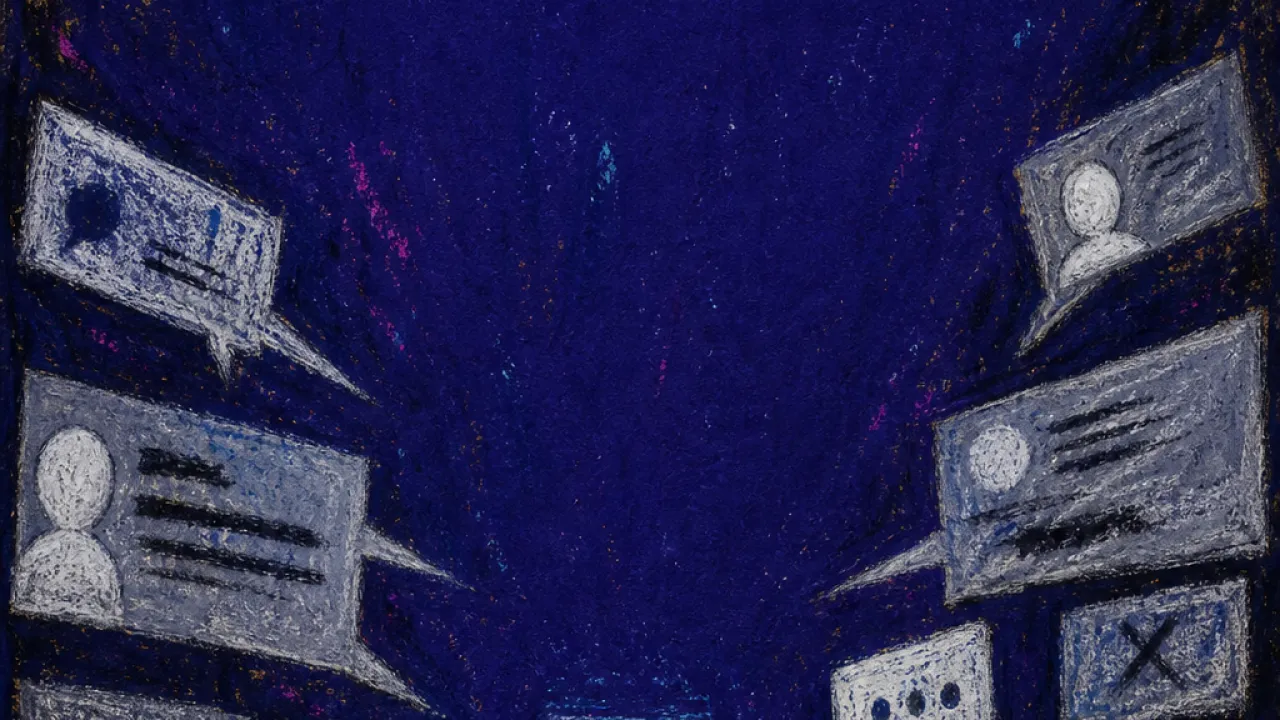
In a Group Chat Tribunal, the private rupture becomes a watched event: screenshots, side chats, selective timelines, and silent observers turn the room into something larger than the original conversation. The body often registers it before the mind can sort it, with shoulders locked, phone in hand, and the stomach tightening as new replies land. This is an environmental, structural dynamic shaped by speed, visibility, and group pressure, not by one person's ability to explain perfectly. These Tarot Cards reflect the outline of that social courtroom and the pressure it places on the person standing inside it.
Justice ReversedThe curtained hall places judgment in the foreground while hiding the machinery behind it. Reversed, that image fits the modern friend-group conflict where screenshots, side chats, selective timelines, and silent observers turn a private rupture into a social hearing. The pressure comes from being seen and assessed without knowing the full process. Justice reveals the group chat as an informal courtroom: not legally real, but socially powerful enough to shape belonging, reputation, and who gets to speak last.
The Tower UprightFlames pouring from the windows turn the tower's interior into a public signal. Nothing stays contained: heat, smoke, bodies, sparks, and status all move outward at once, replacing privacy with exposure. That is the architecture of a group chat tribunal, where a friendship conflict stops being a conversation and becomes a spectacle of screenshots, witnesses, reactions, and implied verdicts. You are not simply managing messages; You are standing inside a social courtroom built out of visibility and pressure.
ReversedThe figures falling from the tower are not given a private exit or a stable landing. Fire, smoke, and lightning turn the whole structure into a public stage where the rupture is visible before anyone has time to regain footing. In a group chat or social network, that visual pressure becomes the tribunal effect: a conflict stops being a conversation and turns into a watched event. Screenshots, reaction chains, subtweets, side chats, and sudden demands for a stance can make the room feel like it has already reached a verdict before the facts are fully visible. You are dealing with a social container that has lost proportion. The card highlights how speed, visibility, and collective judgment can distort the original issue, so the first layer to audit is not who is loudest, but how the group turned conflict into spectacle.
Judgement ReversedA trumpet above a crowd can become a single broadcast that gives everyone the same cue at once. In reverse, the open space turns into exposure: bodies are visible, response is expected, and private context has nowhere to land. That is the architecture of a group chat tribunal, where a friendship issue is processed through screenshots, pile-ons, or collective verdicts instead of direct repair. You are dealing with a social stage that rewards public alignment, so clarity begins with seeing the difference between accountability and performance.
The World ReversedThe exposed dancer is centered inside a ring while faces occupy the edges of the scene. Visibility is not private here; the body is framed, watched, and interpreted from multiple directions. In a friend group, that visual pressure becomes the group chat tribunal: one conflict turns into a shared audience, and the audience changes the stakes. You are no longer dealing with a single conversation; you are dealing with a social frame where screenshots, reactions, silence, and side comments become part of the verdict.
Three of Cups ReversedThe card gathers the whole social scene into one visible circle. In a blocked state, that circle becomes an arena where gestures are watched, compared, and judged by the group rather than held in mutual celebration. For friendship, this maps directly onto the group chat as a private court. Tone gets examined, screenshots become evidence, silence becomes suspicious, and the collective reaction can start to matter more than the original repair needed between people. The Three of Cups anchors this context through its publicness inside intimacy. The same circle that can affirm belonging can also turn a personal friction into a consensus event, leaving you to manage not just one relationship but the group's entire approval system.
Three of Pentacles ReversedThe worker stands exposed on a raised platform while two figures face him with the plan and the authority of review. The stone frame turns the doorway into a public evaluation space rather than a quiet workshop. A group chat tribunal forms when a private friendship issue is converted into a social hearing. You are no longer dealing with one friend and one problem; you are dealing with an audience, a script, and a pressure to defend yourself inside the group's chosen frame.
Ace of Swords ReversedThe crown is lifted on the sword in full view, with no room, table, or shared body around it. Judgment becomes vertical and exposed: one sharp object carries the symbol of authority while the rest of the social field is absent. That is the architecture of a friendship issue that leaves the private bond and becomes a group verdict. Screenshots, receipts, side chats, and selective summaries can turn clarity into a public instrument, where the goal shifts from understanding what happened to deciding who holds the crown of being right. You are facing a social stage where the process may be shaping the outcome. The card asks you to notice whether the friend group is creating truth together or simply sharpening a narrative until someone has to stand under it.
Three of Swords UprightThe heart hangs alone under three blades while grey rain fills the surrounding field. Nothing in the image softens the impact or offers a private corner, which mirrors a group chat where several voices arrive at once and turn a friendship issue into a visible proceeding. You may be inside a communication space that has stopped behaving like support and started behaving like a panel. The card names the pressure created when speed, screenshots, reactions, and audience dynamics make a conflict feel judged before it has been understood.
Five of Swords ReversedThe open shore gives the conflict nowhere private to land. The swords remain visible, the defeated figures are exposed, and the foreground figure looks back as if the aftermath itself has become evidence. In modern friendship, that visual field becomes the group chat tribunal: screenshots, side comments, and collective verdicts replacing direct repair. The card reveals how a private rupture can turn into a public social hearing, where being understood matters less than being positioned as right, wrong, loyal, or disposable.
Nine of Swords ReversedThe nine swords sit in a strict stacked register, like repeated lines laid out above someone who has no visible shield from the room. The bed becomes an exposed surface, and the pressure arrives as accumulation rather than dialogue. A Group Chat Tribunal works through that same visual logic. Screenshots, interpretations, receipts, and moral verdicts can stack up until a friendship issue becomes a collective case file instead of a repairable exchange between people. The card's value is in showing how quickly private conflict can become public evaluation inside a small circle. It gives you language for the structure, so you can see the difference between accountability and a social court with no fair process.
Ten of Swords UprightTen swords point down with the rigid sameness of a verdict, and the fallen body has no visible face with which to answer. The scene concentrates too many sharp points into one person, creating the visual logic of a pile-on rather than a balanced exchange. In a friendship setting, this is the moment when a private conflict gets converted into group judgment. Screenshots, reactions, and aligned replies can turn a messy relational issue into a public hearing where the goal becomes consensus, not understanding. The Ten of Swords does not sanitize that social weight. It shows how a group can use language as pressure, and it helps you separate accountability from collective overkill.
Page of Swords ReversedThe Page stands exposed on high ground, sword in hand, while the sky fills with movement above him. The scene has the feeling of language becoming visible, portable, and difficult to take back once it enters the open air. That visual field matches the moment when a friendship conflict stops being private and becomes group material. Screenshots, reactions, quote replies, and side commentary can turn a messy interpersonal issue into a collective review of who was right, who overreacted, and who deserves loyalty. The card reveals why this context feels heavier than a normal disagreement. The real pressure is not only the conflict itself; it is the conversion of private words into social evidence inside a friend group that now has an audience.
Knight of Swords ReversedThe wind-flattened trees and backward clouds make the whole background look dragged by a single force. Nothing in the scene creates a private chamber for nuance; the knight's shout rides through exposed space at full speed. You can see Group Chat Tribunal in that public momentum. A friendship issue becomes harder to repair when it is processed through screenshots, side-taking, and rapid reactions from the wider circle. The card names the danger of letting speed and audience replace context, because the social field can start deciding the story before the people involved have understood what actually happened.
Queen of Swords ReversedThe Queen’s throne and sword create the image of a formal judgment seat, with speech filtered through authority rather than mutual ease. Reversed, that judgment energy becomes social theater: who said what, who gets believed, and who is allowed to stay inside the circle. In a friendship group, this looks like a private conflict dragged into the group chat, where screenshots, tone policing, side commentary, and public verdicts replace direct repair. The issue stops being the original boundary and becomes a managed spectacle of approval and blame. Group Chat Tribunal fits because the Queen of Swords shows language becoming a social instrument. The card helps You see when a conversation has stopped seeking clarity and started staging a trial.
King of Swords ReversedThe frontal throne and upright sword create the visual grammar of a verdict. Under pressure, the same directness hardens into a judging surface: one elevated position, one blade, and very little room for side context. For you, this maps onto the moment a private friendship issue becomes a group chat hearing. Group Chat Tribunal names the outer context where screenshots, pile-on logic, and collective certainty replace direct repair, leaving the actual relationship flattened into evidence and reaction.
Five of Wands ReversedFive young men crowd one ground plane, each armed with a visible position and no central judge to slow the exchange. The scene has the shape of a public pile-on: many angles, quick reactions, and no stable place to stand outside the knot. That structure fits the moment when a private issue is brought into a group chat and becomes something everyone weighs, interprets, or challenges at once. You may have wanted perspective, but the format turns reflection into a tribunal where every reply becomes another raised wand. The card does not blame the need for feedback. It shows the difference between a contained mirror and an exposed arena, making it possible to see when collective input has stopped clarifying your inner world and started taking control of it.
Seven of Wands ReversedSix unseen hands become six pointed wands, and the central figure can only see the pressure lines, not the full people behind them. The absence of faces matters: the scene turns social force into a cluster of impacts arriving from below. A group chat can reproduce that exact structure when a private friction becomes a multi-person verdict. You are not facing one clean conversation; you are facing stacked replies, side agreements, screenshots, and a sudden public frame around your behavior. The high ground does not remove the pressure, but it lets the structure become visible. This card links the tribunal context to the moment when group attention stops being support and starts functioning as a coordinated demand for compliance.
No cards available for this filter.