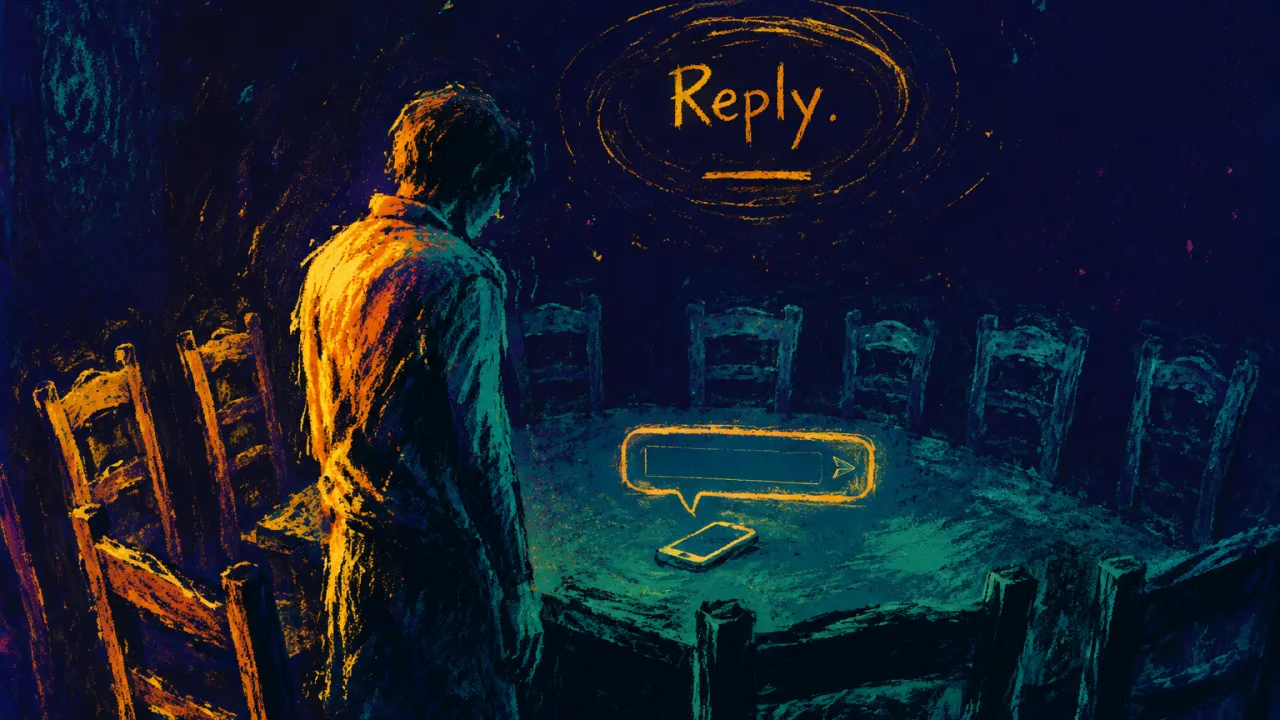
Intergenerational Control Loop lives in the gap between wanting an adult life of your own and feeling the old family rules move through your reactions before you can choose. You may notice it in the jaw lock, the tightened ribs, or the phone still in your hand after the screen goes dark. From an existential perspective, the structural framework here is about agency being pulled back into an inherited circuit that keeps asking you to perform the old role. These Tarot Cards make that loop visible without reducing it to one person, one argument, or one moment.
The Magician ReversedThe snake biting its tail and the infinity sign above the Magician's head make the image run on loops, not straight lines. In the reversed texture, the raised wand becomes a command channel that keeps moving through the same circuit while the other tools sit unused. Family control can enter the self in exactly that way. You may be trying to get free from pressure, monitoring, comparison, or emotional command, yet the system's logic starts reappearing inside your own reactions, self-policing, and attempts to manage everyone before they manage you. Intergenerational Control Loop is the moment agency begins repeating the structure it wanted to exit. The card gives that loop a boundary: the control is not your entire identity, but a learned circuit that becomes visible when the old family field activates the same axis again.
The High Priestess ReversedThe black and white pillars create a powerful coordinate system, and the High Priestess sits where that system controls entry. Behind the patterned veil, the water remains present but cut off, suggesting a deeper field that cannot easily alter the visible rules at the gate. Family control loops often survive in that same way. The inherited map decides what counts as respect, conflict, closeness, privacy, and betrayal before anyone has a chance to examine whether those categories still make sense. The struggle is the repetition of a system that feels older than the current argument. You may resist the family script, but the route through the room still runs between the same pillars unless the hidden structure becomes visible.
The Empress ReversedThe crown of twelve stars, the repeated Venus markings, the scepter, the wheat, and the evergreen forest all place the Empress inside a system of cycles. Her seated authority is surrounded by natural growth, but the symbols of rule and care occupy the same visual axis. In family life, that fusion names a loop where control arrives dressed as protection, concern, or inherited wisdom. You are meeting more than one person's opinion; you are meeting a repeated structure that has learned to pass authority through love.
The Emperor UprightThe bearded ruler sits inside a square stone throne that is larger, harder, and more geometrically fixed than the body it holds. Ram heads repeat at the corners, armor hides beneath the robe, and the narrow stream is pushed behind the throne instead of flowing through the center of the scene. That arrangement turns family authority into a coordinate system rather than a single personality. In a household shaped by inherited command, You may feel the old hierarchy enter the room before anyone names it: posture tightens, speech narrows, and every conflict starts following the same track. The struggle is not simply that someone is controlling. It is that the family system has learned to reproduce control as structure, so adult autonomy keeps getting routed back through the same throne, the same rules, and the same defended version of belonging.
The Hierophant ReversedThe Hierophant's lesson moves downward through gesture, staff, rank, and ritual, while the receiving bodies remain in the same posture. Nothing in the image requires the structure to change in order for the transmission to continue. Reversed, that closed teaching circuit becomes the Intergenerational Control Loop. In a family system, the content may sound like advice, concern, tradition, or protection, but the deeper pattern repeats the same choreography: authority defines the terms, younger members adapt, and belonging is granted through compliance. The card's power is in showing how the loop can feel normal from inside it. You may be reacting to a current conversation, but your body is also meeting a much older pattern that has learned how to reproduce itself through tone, ritual, guilt, and inherited definitions of respect.
The Lovers ReversedThe same paradise contains a guardian above and a serpent below, and both forms of influence operate inside one protected field. The scene does not separate care, command, desire, and consequence into clean categories; they circulate through the same garden. That is the structure of a family control loop when protection, guilt, comparison, and belonging keep reappearing in new forms. You may think the current argument is about one decision, but the card shows a deeper circuit: the system repeats because control has been taught to speak in the language of care.
The Chariot ReversedThe charioteer holds a wand of command, but no reins bind his hands to the sphinxes. The vehicle depends on an invisible act of coordination, and the two opposing figures at the front remain seated in their split positions. In reverse, this becomes Intergenerational Control Loop: the old family polarity keeps asking to be mastered again, only with better language, better self-control, and more adult composure. You may be trying to escape the pattern by becoming the one who finally manages it, but the card shows how that effort can keep the same system in motion. The struggle is not a lack of insight. It is the hidden repetition of control itself, where healing the family field starts to resemble running it, and every attempt to rise above the conflict pulls you back into the driver's position.
Strength ReversedThe lemniscate above the woman's head and the garland around her body turn the scene into a circuit. Force does not simply move from lion to woman and end there; it appears redirected, refined, and kept in motion through a symbolic loop. In a family system, that loop can become intergenerational. You may recognize the old script and still find yourself speaking through it, appeasing it, resisting it in its own language, or becoming forceful in exactly the way you once wanted to escape. The card locates the struggle in the looped transfer of power. The family pattern is not only something done to you; it is a structure that can keep circulating through your reactions until it is seen as a pattern rather than mistaken for personality, loyalty, or fate.
The Hermit ReversedThe elder stands above the field with a staff planted into the ground and a lantern raised as the reference point. The posture creates a one-way geometry: age, height, light, and authority all point from the same elevated position. In a family system, that geometry can become a loop when inherited rules present themselves as wisdom, concern, or realism. The older standard keeps defining what counts as safe, respectful, or acceptable, and each new decision is pulled back to the same old summit for approval. This struggle is not simply disagreement with relatives. It is the structural recurrence of an old authority pattern inside your present choices, where the family past keeps using the language of guidance to remain in control of the future.
Wheel of Fortune ReversedThe wheel is built as a repeatable mechanism: letters circle the rim, figures hold their stations, and the same rotational path keeps returning to itself. Even the open books in the corners do not interrupt the motion; they sit as witnesses to a pattern that continues to turn. Reversed, this structure becomes a family control loop that has been normalized. The pattern may not announce itself as control; it can arrive as a familiar tone, a repeated comparison, a ritualized expectation, or a conversation that always bends back to the same hierarchy. The card locates the exhaustion inside the loop rather than inside your character. You are not simply overreacting to one visit or one sentence; you are meeting a system where movement is real, but the route has been engineered to return to the old center.
Justice ReversedThe figure is framed by pillars, crowned by formal authority, backed by a curtain, and equipped with the same instruments that have judged across generations of images. The scene looks open from the front, but the architecture compresses every action into a chamber of inherited order. That is how family control often survives without needing to announce itself. Rules about respect, silence, comparison, obligation, money, and emotional access can pass down as if they are simply how the family works. Reversed Justice names the loop where inherited control presents itself as fairness, tradition, or common sense. The card gives You a way to see the pattern as structure, not as proof that your reactions are too much or your desire for autonomy is wrong.
The Hanged Man ReversedThe living tree stands upright while the human body hangs inverted against it, making the tree's axis stronger than the body's natural orientation. Leaves grow from the same structure that holds the rope, so the frame reads as both life-source and restraint. Family patterns work in the same way when they become the reference system before you have a chance to choose one. You may be responding to a parent's tone, a repeated comparison, an inherited conflict style, or an old rule about who gets to need what, yet it can feel normal because the structure has been standing longer than you have. Intergenerational Control Loop is not about blaming the past. It is the moment the old family axis keeps defining what counts as balance, even when your own adult body is being turned against its natural direction.
Death ReversedThe horse advances through a field where every figure has a different response, yet the scene as a whole keeps the same direction. Collapse, prayer, aversion, and watching become a choreography around the rider rather than a true interruption of the force. That is how a family control loop can survive without needing one obvious controller in every moment. Each person inherits a posture, repeats it under pressure, and unknowingly helps the old mechanism complete another cycle. Intergenerational Control Loop is the structure that keeps moving through the family line because every response has already been rehearsed. You are not only facing a current argument; you are standing inside a motion pattern that learned how to use everyone's role as part of its continuation.
Temperance ReversedThe liquid moves between the cups, but the card holds the action in a looped exchange rather than a completed arrival. Behind the figure, a road rises toward the mountains, yet the eye keeps returning to the repeated transfer in the foreground. In family systems, that is the shape of inherited control when old material keeps being poured into new containers. A parent calls it care, a relative calls it tradition, a sibling calls it just how the family is, and the same emotional logic keeps circulating under different names. Intergenerational Control Loop names the failure of transformation inside an exchange that looks calm from the outside. The card's reversed texture shows why trying to heal the family can still keep you inside the family pattern if the contents are never actually changed, only passed along more gently.
The Devil UprightThe chained pair stands at the Devil's altar with collars that are visible, loose, and still connected to one central ring. Their horns and tails show that captivity is not only imposed from outside; the ruling shape has already begun to reproduce itself inside the people standing beneath it. That is the exact architecture of an intergenerational control loop in family life. You may enter a conversation as an adult, but the old hierarchy, the old role, and the old emotional script can pull the body back into a younger position before you have time to choose a new response. The card does not frame the loop as a personal weakness. It locates the struggle in a structure where power, imitation, and inherited reflex are chained together, so clarity begins by seeing which part of the pattern was built before it ever belonged to you.
The Tower ReversedTurned upside down, the tower's falling bodies can read less like a single impact and more like figures caught in a suspended circuit around the same burning structure. The windows still vent fire, the crown still loses its place, and the dark space around the tower offers no alternate road that the bodies can use. Intergenerational Control Loop is the family version of that suspended circuit. You may leave one conversation, set one limit, or win one argument, yet the system routes you back through guilt, hierarchy, comparison, or withdrawal until the same control pattern reappears in a new form. The reversed card gives the loop a body: motion without exit, fire without release, and a tower that keeps defining the path even while it is failing.
The Moon ReversedThe dog and wolf are different creatures, yet both raise their heads toward the same moon and answer it with the same physical reflex. Above them, the lunar cycle and falling drops create repetition in the sky while the road below remains difficult to exit. In a family system, that repeated call becomes the shape of inherited reaction. You may enter a conversation intending to choose differently, but the card locates the loop in a field of learned signals, old instincts, and cyclical pressure that can activate before conscious choice has room.
Judgement UprightThe figures do not rise as one isolated seeker; they appear in mirrored family units, repeated across the cold graveyard. The same arrangement returns at a different distance, as if the scene is showing a pattern moving through more than one generation. That visual repetition fits the family control loop: comparison, silence, guilt, emotional withdrawal, approval tests, and authority habits can be inherited as choreography before anyone consciously chooses them. You may be trying to make a different move, but the family field keeps reorganizing everyone back into the familiar formation. Judgement gives the loop a hard edge because the awakening is collective. The card shows that breaking a pattern is not only about seeing yourself clearly; it is also about noticing the repeated structure that keeps calling each person back to their assigned place.
Ace of Cups ReversedDove, cup, streams, and pool form a complete circuit where the source of feeling, the receiver of feeling, and the return path are visually fused. The arrangement looks harmonious, but it leaves very little lateral space for a separate interpretation of what the flow means. In a family system, control often works through that kind of fusion. Concern, love, sacrifice, tradition, and guilt can all arrive through the same channel, so the pressure to comply feels emotionally sacred rather than openly coercive. The Ace of Cups anchors this struggle in the language of care. The card does not deny that love is present; it shows how love can become the carrier signal for an inherited loop that keeps directing you back into the same role.
Six of Cups ReversedThe manor, the guarded boundary, and the older figure in the background frame the children's exchange as part of a larger household system. The cup looks like care, but the territory around it quietly defines where care is allowed to move. Intergenerational Control Loop lives in that protected choreography. You are not only responding to one family moment; You are meeting a repeated script where control is softened by memory, tradition, and concern, so the old pattern keeps entering the present through gestures that look harmless from the outside.
Ten of Cups ReversedThe children move in a small dance beneath the same emotional sky that frames the adults and the house. Their motion is lively, but it stays inside the family field rather than opening a separate route away from it. Reversed, the circular movement becomes the inherited choreography of a household: gestures, roles, comparisons, apologies, silences, and reactions repeating because everyone learned the same map. You may feel older than the pattern and still find your body returning to it the moment family contact begins. Intergenerational Control Loop names the way family scripts can outlive the specific people who first enforced them. The Ten of Cups holds this struggle through its completed domestic circuit, where belonging, home, and emotional weather are so tightly linked that stepping out of the pattern feels like stepping out of the family itself.
Knight of Cups ReversedThe rider approaches the stream as though the crossing must be handled with extreme care. In the reversed structure, the cautious route stops looking like one choice among many and becomes the inherited map itself. Family control often survives by presenting itself as care, timing, concern, or emotional wisdom. You may find yourself moving through decisions according to rules that were never stated directly, because the family system trained caution to feel like belonging. Intergenerational Control Loop names the repetition of that map across time. The Knight of Cups links it to a gentle image rather than an obviously forceful one, showing how control can travel through tenderness, emotional pacing, and the quiet expectation that every crossing must be approved by the family current.
King of Cups ReversedThe crown, cup, cloak, and scepter repeat the same gold, making care, authority, and display visually merge. The king seems composed, but the symbols around his hands and head show how easily tenderness can be routed through control. In a family system, that arrangement names the loop where older rules travel under the language of concern. You may resist the control and still find its grammar moving through you, because the card's authority signs show care and command using the same channel.
Two of Pentacles ReversedThe infinity cord does not simply connect the two pentacles; it makes their movement recursive. Each coin returns through the same pathway, and the figure’s task is to keep reenacting the circuit before either side loses momentum. Intergenerational control often works like that loop. A parent’s expectation, a grandparent’s rule, a family story about loyalty, or an old conflict can travel forward as a practical demand in the present, even when nobody names it as control. This struggle is the moment you realize the pattern is larger than one conversation. The Two of Pentacles gives the inherited loop a visible mechanism: repeated exchange, repeated adjustment, repeated guilt, and a rhythm that can feel like yours only because you were trained to keep it moving.
Ten of Pentacles ReversedThe elder, the crest, the guarded household, and the gathered generations form a closed circuit of authority in the Ten of Pentacles. Movement is present in the bodies and animals, but the scene keeps returning attention to the inherited center. That circuit gives the reversed struggle its shape: control does not always arrive as open force. It can arrive as tradition, loyalty, financial access, family reputation, or the repeated claim that this is simply how the family works. You are caught where the old structure keeps reproducing itself through every attempt to negotiate with it. The card names the loop in which individuation is pulled back into inherited authority, making each new boundary feel like a trial against the whole family order.
Knight of Pentacles ReversedThe horse that could carry movement becomes a platform for holding the same pentacle in the same guarded position. The field is open, but the route collapses into repetition: display stability, protect the object, wait, remain aligned. That is how intergenerational control often operates in the body. You may recognize the script intellectually, but family contact can still pull you into the old track of monitoring, proving, preserving, and obeying the inherited rhythm before a new response can form.
Queen of Pentacles ReversedThe throne is carved before the Queen sits on it. Its symbols of children, earthly force, and formal authority are already built into the seat, while her hands continue to hold the pentacle as if the central object must be inspected again and again. Reversed, this image turns family care into a repeating control structure. The pattern may speak in the language of concern, tradition, sacrifice, or practical help, but the old seat keeps deciding who has authority and who must adapt. You may change your response from compliance to argument to distance, yet the same loop can still reactivate. The card locates the struggle in the inherited structure itself, where every move is pulled back into an older script about care, power, and belonging.
King of Pentacles ReversedReversed, the King's seated command hardens into a closed control system. The throne carries the body, the sceptre stays active, the pentacle remains guarded, and the estate turns inherited stability into the only visible coordinate map. In family dynamics, control can become difficult to name when it wears the costume of competence, provision, or common sense. The structure may look successful from the outside, yet inside it every choice is measured against rules that were established before you had a voice in them. You may feel pulled back into old roles even after building an adult life elsewhere. This card identifies the loop as intergenerational control: a repeated transfer of authority through resources, expectations, and definitions of safety that keep the family system steering your inner compass.
Five of Swords ReversedThe scene holds a truce that still looks armed: one figure keeps the swords, two figures leave, and the bleak weather presses the whole shoreline into the same direction. Nothing in the image suggests a new pattern has arrived; the field has only reorganized around the last conflict. In an intergenerational family system, that is how control survives. A parent, elder, sibling, or inherited role may not need to announce authority every time, because the room has already learned where the blades are kept and which direction people are expected to move. The reversed Five of Swords gives this loop a precise boundary. It shows a family climate where control is not a single incident but a repeated choreography of dominance, retreat, silence, and return, leaving you to fight for autonomy inside rules you did not design.
Eight of Swords ReversedThe upright swords are planted like repeated markers in the ground, while the castle behind them turns the scene into inherited architecture rather than a random obstacle. The cloth restraint is soft, but it organizes the body as effectively as metal. In family life, this is the control loop that feels normal because it has been repeated long before the current conversation. The card positions your struggle inside a system of old rules, emotional pressure, and role expectations, so the question becomes visible as a structure rather than a personal weakness.
Ten of Swords ReversedThe ten swords are arranged with disturbing precision, almost like a system rather than a random attack. In the reversed texture, that order becomes the key: the damage no longer appears only as an event, but as an internal map the body has learned to organize itself around. Family control often works this way after years of repetition. Rules about who may speak, who must apologize, who absorbs blame, and who gets protected can become so familiar that you reproduce the structure before anyone says a word. The card names the loop by showing control as something lodged along the spine, not merely imposed from outside. You can begin to see which family coordinates are inherited instructions and which parts of your direction still belong to you.
Knight of Swords ReversedThe sword stays activated while the horse keeps charging, so the tool of clarity becomes locked into use even when the field ahead is unclear. Force continues through the same channel because the whole scene is built to keep moving, not to check whether the strike can actually repair anything. That is how an inherited control loop behaves in a family system. Correction, pressure, counterpressure, and defensive explanation repeat because each person is using the role they already know, even when everyone claims to want the argument to end. The struggle sits in the loop, not in a single person's intention. You may be trying to break from the pattern while still being pulled into the exact architecture that taught everyone how to control, resist, and restart the fight.
King of Swords ReversedThe reversed King concentrates the whole scene into a single axis of authority: crown, sword, throne, and frontal command. The living background still exists, but the route through the card is controlled by the judgment seat. Family control often repeats through that kind of structure. A person may consciously reject being controlled, yet still learn the same posture of verdict, distance, emotional discipline, or final authority because it was the only model of power available in the system. This card does not reduce the struggle to blaming the older generation. It shows the loop itself: the inherited control pattern that keeps moving through the family unless someone can see where the sword has become the default language of safety, respect, and belonging.
Five of Wands ReversedThe raised wands become less like a contest and more like a grid the bodies have learned to move inside. The figures keep adjusting to each other's angles, but the formation itself does not change, so effort circulates without creating a new path. That is the reversed texture of an inherited family control loop. You may arrive intending to speak differently, stay grounded, or refuse an old role, yet the field has already trained every body to navigate by the same familiar obstructions.
Seven of Wands ReversedThe six opposing wands rise from below, but the people holding them are absent from the image. Pressure has direction without a face, force without a single accountable source. That visual absence is essential to the family loop. You may be reacting to a parent's comment, a relative's expectation, a comparison, a silence, or an inherited rule, but the controlling force keeps shifting shape before it can be named cleanly. Seven of Wands reversed shows control as a system rather than a single opponent. The struggle becomes clearer when the question changes from which person is wrong to how the same family pattern keeps recruiting different voices to push you back into position.
Eight of Wands ReversedThe wands behave like tools after the hands have vanished. They move with precision, but the card refuses to show who launched them, who is steering them, or who will receive them. That missing operator is the core of the family loop. You can feel an old script moving through the room even when nobody openly names it, because the force has become procedural rather than personal.
Ten of Wands ReversedThe reversed image shows a bent axis functioning as if it were normal. The upright trees and distant building remain visible, but the carrier's body has adapted to the bundle's geometry instead of recalibrating around the wider field. That is how intergenerational control can operate inside a family: not always as a visible command, but as the inherited posture through which choices are made. Duty, comparison, guilt, silence, and approval can become the default route long after their original source has disappeared. The Ten of Wands gives the loop a concrete shape by showing a body moving forward while still organized by an old load. You are not trapped by destiny; the card identifies the repeated structure so it can be seen as inherited, not natural.
Page of Wands ReversedThe Page wears symbols of fire and transformation across his clothing, yet the desert around him stays bare and the pyramids remain fixed in the distance. In the reversed structure, the image of change can be absorbed into an older landscape without altering its coordinates. Family systems can do the same thing with growth. New plans, therapy language, career pivots, boundaries, or confidence can be recognized only when they are translated back into the family's existing map of loyalty, comparison, and control. The card's pressure sits in that conversion process. Your change is not absent; it is being routed through inherited coordinates that keep turning movement into another proof that the old system still gets to define what progress means.
Knight of Wands ReversedThe same rein that proves skill also turns the horse's force back into a vertical loop. With minimal tack and a high center of gravity, the rider's control depends on repeating a narrow correction at the exact point where movement wants to break open. The launch point has hardened into a family circuit that keeps resetting to the same roles. You push, someone pulls, the system rears, and the energy that could carry you forward is converted into another round of control, resistance, and return.
Queen of Wands ReversedThe throne repeats lions, sunflowers, and royal emblems around the Queen while her own hands hold living versions of the same symbols. Authority is not only possessed by the figure; it is patterned into the furniture, the background, and the distant monuments behind her. Intergenerational Control Loop takes shape when control is resisted and then unconsciously repeated as a way to feel safe. A family system can teach you to hate being managed while also teaching your body that managing everyone else is the only available route to stability. The card places that loop outside personal shame. The repeated symbols show a structure moving through time; seeing the pattern clearly is what separates inherited control from chosen agency.
King of Wands ReversedThe throne is covered in repeated fire emblems: lions, salamanders, red cloth, gold heat, and a living salamander at the step. The system does not simply contain fire; it reproduces the same element across surfaces until rule, vitality, temperament, and identity start to share one visual language. That repetition maps directly onto family control patterns that feel older than the current argument. The content may change, but the structure remains familiar: command replaces dialogue, comparison replaces recognition, and intensity is mistaken for care. Intergenerational Control Loop appears where the living salamander no longer feels separate from the carved ones. The card shows how a family can pass down a control style as if it were climate, leaving you to ask whether you are responding to the present moment or reenacting the throne you inherited.
No cards available for this filter.