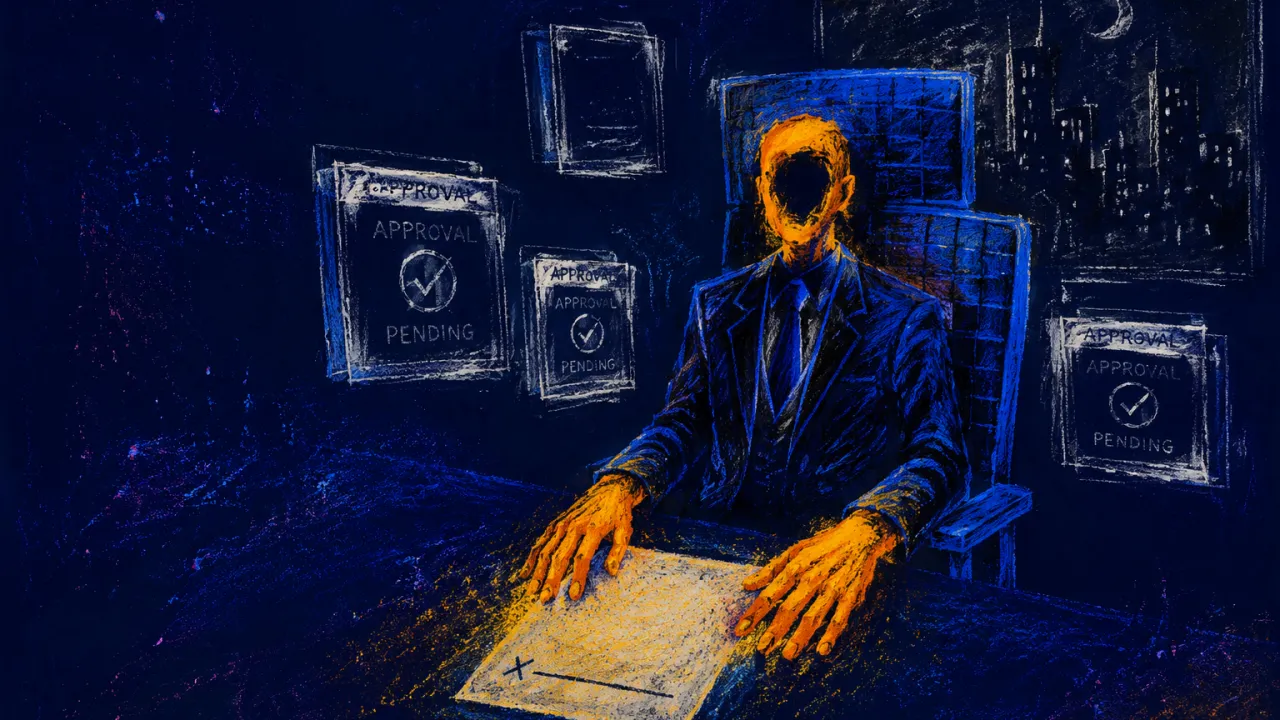
Internal Authority Collapse lives in the moment when you look capable from the outside, but every choice still searches for a structure that can authorize it. You can feel it in the tight jaw, shallow breath, and cold hands that show up after one comment, one email, or one old voice pulls you off-center. From an existential perspective, the structural framework of this struggle is about losing the inner seat that tells you what counts as yours to choose. The Tarot Cards below mirror that outline without turning it into a verdict.
The Emperor ReversedThe crown, throne, scepter, and armor build a reference system around the body before the body itself has to choose a direction. The structure can hold authority from the outside so convincingly that inner balance becomes secondary to rank, rule, and visible control. In personal growth, that picture captures the collapse that happens when external systems stop answering the deeper question of where You are going. The card does not describe laziness; it shows inner command outsourced to frameworks, mentors, rules, and identities until self-trust cannot stand without the throne.
The Hierophant ReversedThe temple's vertical axis is dominated by the crown, staff, throne, and pillars, while the acolytes' own faces are turned away from view. Their direction is readable only through the authority they face. In the reversed structure, that alignment becomes an internal reference failure rather than a simple lesson scene. Internal Authority Collapse appears when personal growth is organized so completely around expert voices, rules, and sanctioned frameworks that You can no longer feel your own judgment as a valid compass.
The Lovers ReversedThe vertical line of sun, angel, cloud, and mountain dominates the frame while the human figures stand separated below it. The woman's gaze moves upward, the man's gaze moves sideways, and the decision center never settles inside either body. You may look to signs, experts, algorithms, partners, or an idealized future self until your own authority feels too weak to carry a choice. The reversed structure shows direction being displaced upward and outward, leaving personal growth dependent on reference points that cannot walk the path for you.
The Chariot ReversedThe charioteer looks like a commander, but the command channel is visually strange: no reins run from the hand to the sphinxes, and the signs of mastery sit on the vehicle more clearly than the mechanism of steering. The image preserves authority as costume, posture, and symbol while leaving the actual line of control unresolved. Internal Authority Collapse emerges when self-growth still looks intentional from the outside, but the inner author of direction has gone quiet. You may keep choosing frameworks, mentors, metrics, or systems to tell you where to go; the card shows the deeper fracture as a loss of contact between command and inner steering, not a lack of ambition.
Strength ReversedThe mountain gives the image a vertical future marker, but no road connects it to the figures in the foreground. The woman's attention stays inside the charged exchange with the lion, so authority over direction is held within a private circuit rather than anchored to an outward route. In reversed Strength, that circuit can become too closed to guide the future. You may keep checking your instincts, your discipline, your values, and your readiness, yet none of those signals feels authorized to lead. The card names the collapse of inner authority through a visual paradox: there is power in the scene, there is a horizon in the scene, but the system cannot decide which signal has the right to become the path.
The Hermit ReversedThe lantern, staff, bowed head, and isolated summit form a closed coordinate system. When that system turns inward too tightly, the light no longer opens the path; it becomes the only reference point the body is allowed to trust. Family criticism can create the same collapse when an older voice becomes louder than your own internal measure. After a call, a visit, or a loaded comment, your choices may stop feeling like choices and start requiring permission from a standard you did not consciously choose. The reversed structure names a loss of inner orientation rather than a lack of intelligence. The card marks the boundary where the family reference point has replaced your own, because a borrowed compass can feel like certainty while quietly displacing your self-trust.
Wheel of Fortune ReversedThe card offers no stable floor. Direction comes from the wheel's spokes, the sword, the surrounding figures, and the repeated symbols, but none of them becomes a simple grounded axis. Reversed, that crowded reference field mirrors the collapse of inner authority inside a family system. A parent comment, an old household rule, a comparison, or a long-standing family narrative can suddenly become louder than your own present-tense knowing. The struggle is not confusion in general. The card shows a specific loss of orientation: your adult compass is still present, but the family field floods it with older coordinates until self-trust becomes hard to locate.
Justice ReversedThe vertical sword, pillars, crown, and throne create a powerful external grid, while the figure's own lower body is mostly hidden under the robe. Alignment is supplied by the hall before it is felt from within. That is the personal growth crisis of outsourcing your direction to metrics, frameworks, feedback, or comparison until your own felt sense becomes faint. You may look disciplined and self-aware from the outside, while the inner source of judgment has gone quiet behind the curtain. Internal Authority Collapse is not simple insecurity. It is a structural loss of center, where the scale still moves but no longer knows which standard is truly yours.
The Hanged Man ReversedThe upright tree and inverted body define two incompatible verticals. The tree says one direction is stable; the body experiences another, with no ground contact to settle the dispute. In personal growth, that geometry appears when external frameworks become the new baseline and your own felt direction becomes harder to trust. Advice, methods, and self-improvement systems may keep offering orientation while quietly displacing your internal one. The card does not frame this as confusion alone. It shows a reference-system collapse: the map is bright, the head is lit, but the body no longer knows which way counts as up.
Death UprightThe ruler lies face down beneath the horse, while the crown and scepter sit apart from the body that once gave them force. Death's rider does not need to strike with a visible weapon; the black standard itself is enough to reveal that the old command system has stopped working. In personal growth, Internal Authority Collapse appears when the rules that once organized your self-discipline, ambition, and worth no longer generate real movement. You may still recognize the symbols of control, but they no longer attach to a living center of decision. The card makes this collapse concrete by separating authority from function. It does not ask you to obey a new external rule; it shows the moment when borrowed command falls away and inner authority has to be rebuilt from a deeper source.
The Devil ReversedThe collars are loose enough to be removed, yet the figures continue to stand as if the altar still owns the room. Above them, the inverted pentagram and downward torch turn the scene's entire reference system toward the ruling image. In a reversed family pattern, Internal Authority Collapse is the moment the outside command no longer needs to speak. You may be alone in your apartment, choosing a job, ending a call, or deciding what you want, while the family voice still acts as the inner judge of what is allowed. The card does not make this about weakness. It shows how a long-standing authority field can become an internal coordinate system, and how reclaiming clarity begins by distinguishing your own signal from the inherited one.
The Tower UprightThe lightning tears the crown away from the tower before the falling figures can orient themselves. The highest point of command is struck first, so the structure loses its organizing signal at the same moment the bodies lose contact with any stable surface. For personal growth, that image describes the moment when an old self-command system can no longer authorize the next version of you. You are not simply lacking confidence; the card shows an inner authority structure being removed before a replacement has been embodied, which is why leveling up can feel like losing the voice that used to tell you who you were.
ReversedThe Tower keeps its vertical outline even as its signs of authority scatter: the crown falls, the figures invert, the windows burn, and the strike has already passed through the highest point. The structure still exists, but it can no longer tell anyone inside it what is reliable. Internal Authority Collapse in career does not mean you lack judgment. It means the external systems that used to calibrate your judgment, manager approval, promotion timing, title logic, performance signals, have become too unstable to serve as reference points. The card gives shape to the disorientation that follows a bad call from leadership, a denied advancement, or a public work shock. You are not simply second-guessing yourself; your inner compass is trying to operate after the tower that defined up, down, value, and legitimacy has been hit.
The Moon ReversedThe moon dominates the sky, but its light is borrowed, indirect, and filtered through a closed face. Below it, the path, water, towers, and animals all become reference points, yet none of them settles the question of where reliable judgment should come from. In reversed form, that landscape becomes Internal Authority Collapse. You can keep looking upward for confirmation while the ground-level evidence of your own work grows harder to feel, measure, or trust. In study, this appears when grades, supervisor tone, rubrics, and peer comparison become the only light source. The card does not shame that dependence; it shows the cost of navigating academic work when your inner standard has been replaced by reflected signals.
The Sun ReversedThe child is surrounded by reference points: the sun above, the wall behind, the sunflowers standing upright, the horse carrying the body forward, and the red flag signaling vitality. Yet the rider has no reins in hand, so the scene's direction is held by surrounding symbols more than by a visible act of self-steering. In the reversed texture, that absence becomes the shape of Internal Authority Collapse. Personal growth can fill your field with frameworks, signs, mentors, metrics, and external confirmation, while the inner steering function remains underdeveloped. The Sun does not frame this as a lack of light. It shows a different problem: so much outside clarity can gather around you that your own authority becomes quiet, outsourced, and harder to locate when the next move has to be chosen from within.
Judgement ReversedThe clouded angel, the ambiguous water-ground, and the coffin platforms create a scene where the highest signal is easier to locate than the ground beneath the body. The figures orient upward before the local surface has become trustworthy, so the outside call becomes the clearest reference point in the whole composition. In academic life, that structure appears when rubrics, grades, supervisor reactions, and institutional standards become the only way to know whether work has value. You are not simply seeking feedback; the internal scale for judging your own thinking has lost its footing, so every assignment has to borrow gravity from somewhere else.
The World ReversedThe figure has no floor beneath her. The wreath, the corner witnesses, and the balanced wands become the reference system that tells the body where it is, because ordinary ground is absent. In academic life, that reversed structure can appear when your judgment depends almost entirely on external frames: grades, rubrics, supervisor tone, institutional prestige, acceptance rates, or comparison with peers. Without those signals, it becomes hard to know whether an idea is strong, a draft is ready, or a direction is yours. The card gives form to a collapse of internal authority. It shows how a student can keep moving within an impressive academic frame while losing the grounded inner reference needed to decide, evaluate, and trust their own work.
Ace of Cups ReversedIn reversal, the cup is still held and the symbolic input still exists, but the axis of authority feels displaced. The hand stabilizes the vessel while the activating force no longer lands as a coherent direction. Internal Authority Collapse is the struggle of not knowing which part of the self has the right to decide. Desire, caution, old commitments, imagined judgment, and external advice all compete to become the final voice, leaving the decision center hollowed out. The reversed Ace of Cups shows this as a vessel that can still receive input but cannot organize it into sovereign movement. For choosing, the card points to the hidden problem beneath repeated readings, lists, and second opinions. The missing piece is not more information; it is a stable inner seat from which information can be weighed without handing the whole decision away.
Eight of Cups ReversedThe moon crosses the sun above the figure, so the path is guided by a dimmer and less publicly verifiable light. Behind him, the cups remain orderly and visible, making the old emotional arrangement easier to explain than the need to leave it. Internal Authority Collapse fits the reversed family pressure of this scene. When a household has trained you to doubt your own reading of events, your inner signal may keep checking itself against the family version of what is reasonable, loving, or allowed. The card shows movement under uncertain light because reclaiming authority often begins before certainty arrives. Your struggle is located in the unstable reference point between what the family system can validate and what your own deeper perception keeps insisting is true.
Queen of Cups ReversedThe crown and throne give the Queen formal authority, yet her gaze is absorbed by a closed cup whose contents cannot be checked from the outside. The wall behind her narrows the horizon, making the sealed object feel like the main source of reference. In personal growth, that reversed structure describes a collapse of inner authority into unreadable signals. You may keep waiting for the right feeling, sign, or certainty before acting, while the part of you that can choose becomes dependent on a private test it can never fully verify. The struggle is the loss of a stable inner command center: intuition is still present, but it has become the gatekeeper of agency instead of its guide.
Three of Pentacles ReversedThe blueprint remains in another figure's hands while the worker's body carries the physical contact with the stone. The visible order of robes, geometry, and plan can look complete even when the working hand has lost its own reference point. In reversed form, the scene shows authority draining away from the body that is actually doing the work. The plan becomes louder than touch, the grid becomes louder than balance, and the inner system starts treating an external standard as more reliable than direct self-knowledge. This is Internal Authority Collapse in an introspective field. You can analyze yourself, name the pattern, and understand the ideal, but the question of what is true inside keeps slipping toward someone else's blueprint.
Ten of Pentacles UprightThe coat of arms, pillars, wall, and arch give the scene its coordinates before any single figure speaks. Authority sits in the architecture and emblems as much as in the people, making the household feel measured by standards that predate the immediate moment. Internal Authority Collapse emerges when your inner compass keeps deferring to those old reference points. In introspection, the struggle is not simply confusion; it is the loss of trust in your own direct signal because legitimacy has been outsourced to inherited rules, visible proof, or what would look coherent from outside. The Ten of Pentacles gives this struggle a material frame. Its walls and symbols show how inner order can become dependent on externalized authority, and how reclaiming clarity begins with noticing which standards are actually holding the room together.
Page of Pentacles ReversedThe pentacle is raised to the Page's eye line like a portable horizon, replacing the wider landscape as the reference point. His balance, sight, and hands all answer to the object in front of him rather than to the ground beneath him. Internal Authority Collapse appears when the decision field is organized around external signs, metrics, or permission signals. You may be searching for the thing that will tell you what to choose, while the card locates the real fracture at the point where your own inner reference has been displaced.
King of Pentacles ReversedReversed, the throne's stability can become a substitute for inner orientation. The crown, sceptre, pentacle, castle, and wall create such a complete authority field that personal judgment has little open space in which to register. Around family power, this can feel like losing access to what you know the moment you enter the old system. You may function with clarity elsewhere, then suddenly defer, freeze, overexplain, or doubt your own read because the inherited structure speaks louder than your adult self. The card identifies the collapse of internal authority, not as incompetence, but as a spatial problem: your inner compass is being crowded by a family map that presents itself as reality. Seeing the map as a map is the first boundary the card makes visible.
Ace of Swords ReversedThe sword offers a brilliant reference line, but in the reversed structure that line can become the only axis left. The hand still grips and the blade still looks clean, yet there is no grounded body beneath it and no wider landscape of feeling to correct its angle. In family systems, this is how an inherited voice can start posing as inner wisdom. The logic may sound clear, mature, or responsible, but it keeps returning you to standards that were built to preserve the family structure rather than your self-trust. The collapse happens quietly. You still make decisions, still explain yourself, still sound reasonable, but the authority behind the choice has shifted away from your own center and back into the family's old ruling line.
Two of Swords ReversedThe blindfolded figure sits like a judge who can no longer use the room as evidence. Moon, tide, shore, stone, and blades all offer different reference points, but the posture gives final authority to the symmetry of the swords because it is the only thing the body can directly maintain. In career life, this becomes the collapse of inner authority under contradictory signals. Manager feedback, performance metrics, peer comparison, promotion timing, and office politics can all claim to be the true standard, until your own judgment stops feeling like a usable compass. The card frames the struggle as a reference-system failure: you are not empty of judgment, you are surrounded by competing authorities that have not been integrated.
Three of Swords ReversedThe card has no face, no body, and no ground; the only stable axes are the swords. When the usual reference points disappear, the sharpest external structures begin to define orientation. In career pressure, manager opinions, performance ratings, peer comparison, and institutional language can become those axes. You may still have skill and judgment, but the inner reference system loses force when every direction is measured against someone else's blade. The reversed structure is a collapse of internal authority into external evaluation. The card witnesses the point where professional self-trust is no longer absent by choice; it has been crowded out by sharper, louder, more measurable forms of judgment.
Eight of Swords ReversedThe figure's eyes and hands are both removed from the work of orientation, so the surrounding swords become the dominant reference points. In the reversed field, the enclosure does not need to tighten; the body has already learned to navigate as if the blades are the map. Inside family dynamics, this marks the collapse of inner authority after too many moments of checking your reality against the family's version of events. You can leave the room and still second-guess your own read, because the card locates where external judgment has been internalized as the default compass.
Nine of Swords ReversedThe swords form a false horizon above the bed, and the figure's face is covered beneath it. The normal reference points of room, rest, and self-orientation are replaced by a fixed grid of pressure. Reversed, this becomes Internal Authority Collapse in the family field. The judging voice of the system can become so internalized that your own assessment of what happened arrives already filtered through their tone, their rules, and their version of what counts as acceptable. The card's structure does not erase your agency; it shows why self-trust feels hard to reach. The reference point has been displaced upward into the sword grid, and the work begins by noticing that the pressure has been mistaken for inner truth.
Ten of Swords ReversedThe swords are arranged with an unsettling order, as if judgment has become systematic rather than chaotic. They occupy the spine, the body's line of self-support, so the figure cannot rise from an internal center even though the riverbank still suggests a path beyond the scene. In personal growth, this is the collapse of inner authority under too many imported verdicts. Frameworks, mentors, metrics, productivity systems, and self-improvement rules may have started as tools, but the card shows the moment they become fixed above the body, deciding what counts as progress before your own compass can speak. The nearby crossing intensifies the struggle because movement is not blocked by lack of information. It is blocked by a displaced authority structure, where the mind has learned to wait for another blade of certainty instead of trusting the first small motion from within.
Page of Swords ReversedThe raised sword and twisted stance settle into a closed circuit: the hands keep holding readiness, the eyes keep searching the opposite side, and the rough ridge becomes the body's normal baseline. Instead of helping the Page orient, the environment trains the body to trust pressure more than its own center. Inside a career path, that structure shows how repeated reviews, mixed signals, or manager approval loops can hollow out self-trust. You may still produce competent work, but the inner reference point keeps sliding toward whatever external signal feels loudest that day.
King of Swords ReversedIn the inverted image, the crown, sword, and throne no longer sit as a grounded chain of command; they hang as heavy symbols above the body. The very objects that should stabilize judgment become the pressure system the figure must keep obeying. Inside introspection, that turns self-authority into an unreliable reference point. A thought may sound absolute because it carries the tone of law, but its source no longer feels calmly anchored in your lived reality. This struggle is the collapse of trust in your own inner court. You are not simply unsure; the part of you that issues verdicts has lost calibration, so clarity and coercion begin to feel dangerously similar.
Ace of Wands ReversedThe wand descends from the cloud with the visual authority of a sign, while the river and layered ground below hold quieter information about movement, timing, and terrain. In the reversed structure, the top-down signal can overpower the ground-level cues that would normally help a body navigate. You encounter this when outside expectations, signs, or charged opportunities begin to outrank your own knowing. The card does not deny the signal; it locates the collapse that happens when a symbol becomes louder than your internal authority.
Five of Wands UprightEvery figure in the Five of Wands is equipped with the same basic instrument, but no shared axis tells the group what the instrument is for. The wands could support, train, build, or defend; inside this composition, their purpose breaks down because no position is strong enough to coordinate the field. That collapse of coordination becomes an introspective struggle when the inner life has many active systems but no trusted authority. You may be able to name what you feel, generate explanations, and see several sides of the issue, yet still feel unable to decide which inner signal deserves leadership. The uneven ground sharpens the point: each stance is locally reasonable from where it stands. Internal Authority Collapse is the condition where every inner part has a partial truth, but the self loses the central reference point needed to turn those truths into order.
ReversedNo leader, referee, or central axis appears inside the Five of Wands. The horizon is clear, but the human foreground has no organizing line strong enough to decide which wand, stance, or movement should govern the field. In personal growth, that becomes the collapse of internal authority under too many frameworks, metrics, teachers, and rules. You may keep seeking the right system, but the card exposes the deeper problem: the deciding center has been crowded out, so every new standard arrives as another wand in the same clash.
Six of Wands ReversedThe raised wand and laurel crown make authority visible, but they do not show the rider's inner steering mechanism. In the reversed state, the public signs of legitimacy can become so dominant that the grounded reference points for choosing are pushed out of view. This is the decision space where a person looks powerful from the outside but cannot locate the authority to choose without another sign, vote, reading, reaction, or confirmation. The card's structure makes that collapse visible through the mismatch between displayed command and obscured navigation. The struggle is not a lack of intelligence or effort. It is the loss of an internal reference system after too many decisions have been routed through external proof, making clarity feel impossible unless something outside you grants permission first.
Seven of Wands ReversedThe figure stands above the conflict, but the higher ground is not a stable platform. His feet are separated by broken terrain and water, while the wand, the cliff edge, and the pressure from below all demand different forms of balance. Internal Authority Collapse is the inward version of that unstable geometry. In deep self-inquiry, the mind may lose track of which signal deserves trust: intuition, fear, shame, protection, old conditioning, or a real value trying to speak. The card's reversed structure places the struggle in the baseline itself. When the ledge starts to feel normal, every inner voice can sound urgent and every self-assessment can feel suspicious, leaving you with pressure but no dependable axis from which to read it.
Knight of Wands ReversedThe knight appears equipped and upright, but his stability depends on a horse balanced on hind legs and a single hand controlling the reins. Adult armor is present, yet the ground of action is unstable, and the nearest point of control sits outside the rider's center. Around family, that visual arrangement can mirror the moment your own authority drops out from underneath you. You may arrive with competence, language, and boundaries, then find your inner reference point pulled back into a smaller role the system already recognizes.
Queen of Wands ReversedThe Queen's crown, throne, lions, and distant pyramids stack several forms of authority into one scene. Personal command, institutional scale, inherited knowledge, and living vitality all appear at once, but the card does not show a clear mechanism for choosing which reference point should lead. Under academic pressure, that layering can turn into a collapse of inner judgment. Rubrics, supervisor tone, grades, peer comparison, prestige, and future expectations crowd the same internal space until your own sense of what is true, enough, or worth pursuing becomes hard to locate. The struggle is held in the card's competing axes of authority. You are not simply looking for confidence; you are trying to recover the reference point from which academic decisions can feel like yours again.
King of Wands ReversedThe throne sits at a slant, but the crown, wand, and gaze keep the scene ceremonially composed. The image preserves the appearance of command while the underlying reference point is subtly unstable. In personal growth, this becomes the feeling that you need one more framework before you can trust your own direction. The outer posture may look decisive, but the inner plumb line keeps searching for confirmation outside itself. The card identifies a collapse of internal authority rather than a lack of intelligence. You are not short on concepts; the unstable point is the place from which concepts are being judged, chosen, and acted on.
No cards available for this filter.