The Quarter That Kept Moving: Sunk-Cost Career Waiting
I often meet people who can call a role a dead end out loud but still write "review next quarter" beside every saved vacancy. Maya brought me that exact contradiction at our London session: a career crossroads disguised as tidy career admin.
At 10:40 p.m. after a quarterly planning call, she had sat at her kitchen table with six job tabs open and cold tea beside the trackpad. The laptop fan hummed against the flat's silence, blue-white light warmed her face, and she copied two links into a spreadsheet before typing "review after next quarter" and closing the lid. I could feel the relief in that action, the small exhale of keeping her salary safe, followed by the heavier knowledge that she had delayed the same test again.
"I just need to see what next quarter looks like," she told me. She knew the title, ownership, training, and daily tasks had barely changed through several cycles, yet each new roadmap gave hope another temporary lease. Her apprehensive hope felt to me like waiting in a departure lounge where the gate number changes every three months but nobody posts a boarding time. I recognized the pattern as sunk-cost career waiting: hope that the role would improve held against the fear of accepting that the role was already a dead end.
I did not hear a foolish person refusing to face facts. I heard someone protecting stability in a city where rent, council tax, and an employment gap have real consequences. "Let's look at the pattern without shaming you," I said. "We can use the cards as a clear, grounded map, then let you decide what to do with what we find. Today's Journey to Clarity is about giving your hope criteria and your next move a smaller doorway."

The Map Beneath the Forecast
I asked Maya to put both feet on the floor, take one slow breath, and name the question without trying to solve it. I shuffled slowly while she focused on the difference between what had been promised and what had actually changed; the ritual was a transition into attention, not a performance of supernatural certainty.
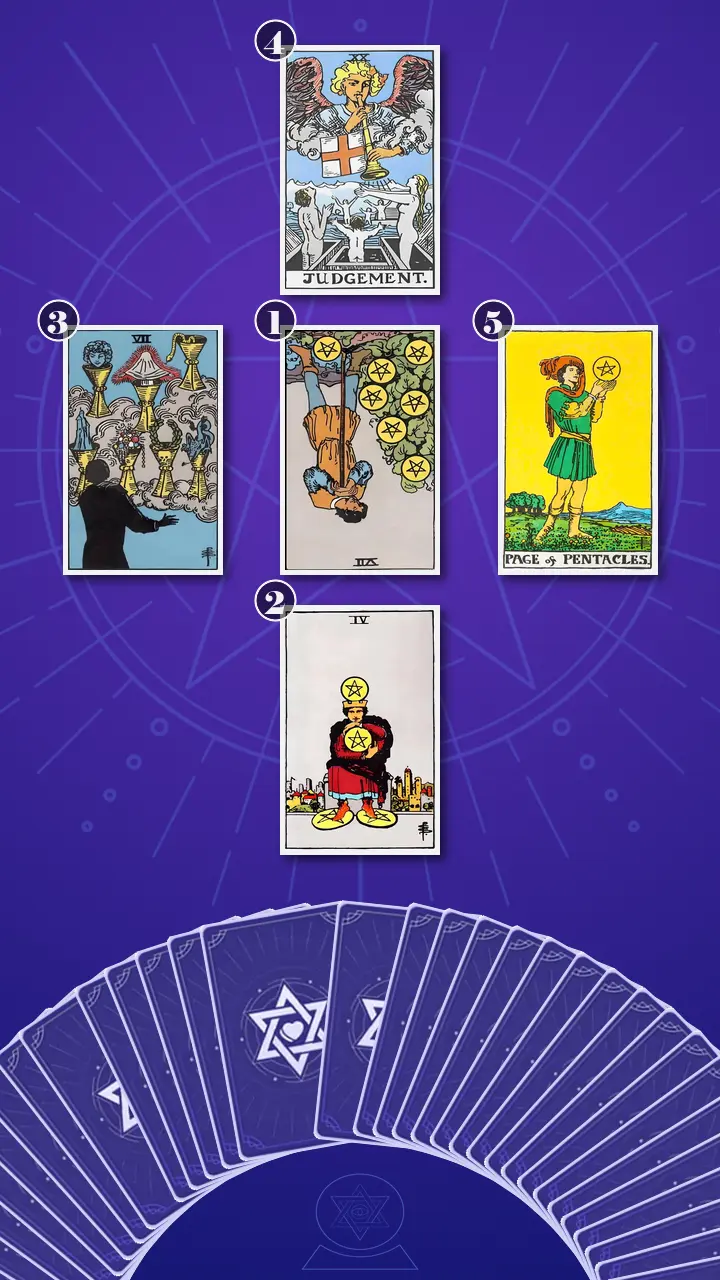
For this reading, I chose the five-card Shadow Spread. For readers wondering how tarot works in a career question, I use the images as a structured psychological tool: each position gives a different job to the same pattern, so emotion, evidence, and choice can be examined together rather than turned into a prediction.
This spread suited Maya because it was an Inner Excavation issue, not a request to forecast whether management would suddenly deliver a promotion. The five positions move in a clean symptom-to-root-to-protection-to-clarity-to-action chain. The first card shows the visible habit, the second reveals the fear beneath it, the third explains the short-term comfort of imagined improvement, the fourth brings the repeated evidence into conscious view, and the fifth turns insight into a small, reversible experiment.
I told her, "We are not asking the cards to decide whether you stay. We are asking what keeps the decision suspended, what that suspension protects, and what information you can gather next."
What Sunk-Cost Career Waiting Hides
The Spreadsheet That Kept Becoming Patience
I turned over the card representing the diagnostic symptom: repeatedly extending the role's evaluation horizon and treating another quarter as a substitute for observable career development. It was the Seven of Pentacles, in reversed position.
The worker in the image leans heavily on the hoe while studying a crop that has consumed time and effort. Reversed, the patient pause has crossed into an overdue return-on-investment review. I saw the blocked Earth energy immediately: effort remains present, but it is compacted into waiting instead of producing a decision, a skill, or a new option.
I returned us to the 10:40 p.m. kitchen-table scene. Six warm job tabs glowed above a carefully formatted spreadsheet, two links had been moved into a future column, and zero applications had been sent. The private sentence underneath the activity was, "I know nothing material changed, but maybe this quarter was only preparation for something better." That is where patience becomes postponement and investment begins to outweigh observable return.
Maya gave a short, bitter laugh. "That's uncomfortably specific," she said. "I have the saved jobs, the spreadsheet, and the next-quarter date. I keep calling that preparation."
I met her eyes and said, "The card is not accusing you of wasting time. It is showing you where the evaluation date itself has become the habit." Her shoulders stayed heavy for a moment, then her fingers stopped rearranging the edge of the paper. The recognition was uncomfortable, but it did not require shame.
The Salary That Became a Pair of Handcuffs
I turned over the card representing the underlying fear that acknowledging the dead end would threaten control and force engagement with career uncertainty. It was the Four of Pentacles, in upright position.
The figure holds one pentacle tightly against the chest while two others pin the feet to the ground. I translated that image into Maya's payday routine. At 8:03 a.m., her salary landed in the banking app; rent, council tax, energy, and TfL costs waited beneath it. When an interview invitation appeared, the same predictable income that protected her also made movement feel physically unsafe.
The upright Earth energy was not a deficiency of responsibility. It was an excess of preservation. Stability was being held so tightly that it could no longer be used as a platform for gathering information. The role genuinely protected material needs, but Maya had quietly turned that true statement into a larger one: because the salary was dependable, the entire role must be safer to remain in than to question.
Her inner sentence was, "I am not saying this job is good; I am saying I cannot afford to be wrong." Her jaw tightened as she said it, and I let the financial reality stand in the room without trying to talk her out of it.
"Stability can be real without being a reason to stop gathering information," I said. "We can set a boundary around resignation, protect the income you need, and still allow one hour or one application to move." Maya nodded slowly. Her chest remained guarded, but one hand opened from a fist onto the table. That was the beginning of separating safety from stillness.
The Roadmap Made of Clouds
I turned over the card representing the protective function of the pattern: the imagined improvement that preserves hope and postpones the grief and uncertainty of reassessment. It was the Seven of Cups, in upright position.
The seven cups floated inside grey clouds, each holding a different projection. I saw the quarterly roadmap slide beside them: "more strategic exposure," "potential ownership," and "future resourcing." The language was attractive, but it had no named owner, budget, responsibility, or date underneath it. Maya's mind supplied those missing pieces before anyone had committed to them.
She had not been promised a title change, exactly, but it could mean a workstream. The workstream could mean visibility. Visibility could mean a specialist role by the next review. By the time the thought reached the end of its chain, a possibility had become a complete future. I said, "Possibility is not a plan until it has an owner, a resource, and a date."
The Seven of Cups showed uncontained Water: imagination moving everywhere because clear criteria were missing. This was not a failure of intelligence. It was a protective story doing a useful short-term job. If the next quarter could still become the version she needed, she would not yet have to grieve the time already invested or face an interview before certainty was available.
Maya looked down at the card, then caught herself mentally finishing the phrase "more visibility" into a full promotion narrative. Her expression changed from defence to recognition. "They didn't promise it, exactly," she said. "But I keep building the rest." I watched her thumb stop scrolling through an imaginary list of future scenarios. The clouds had not disappeared, but she could now see where they began.
When Judgement Turned the Planning Deck Into a Signal
The Trumpet Above the Timeline
The room became unusually quiet when I reached the fourth position. I turned over the card representing the key transformation: replacing moving forecasts with an honest evidence review and a self-defined response threshold. It was Judgement, in upright position.
The trumpet sounded above open-armed figures rising from their old enclosures. I did not read it as management arriving to rescue Maya or as a promise that a new job would appear. I read it as the clear signal created when repeated quarterly promises are placed beside repeated outcomes. Judgement brought Air and Fire back into the spread: name what happened, decide what it means, and choose how to respond without demanding complete certainty.
It is 10:40 p.m. after planning week: six job tabs glow above the spreadsheet, while "review after next quarter" goes into the last column. The laptop closes, relief arrives first, and disappointment follows. Her shoulders drop because deferral restores safety, then tighten because the same future has been postponed again.
A new quarter is not proof of renewal; answer Judgement's trumpet by comparing facts with your own criteria and responding through one concrete career experiment.
Maya's breath stopped. Her fingers hovered above the edge of the table, and her face went still. Then her eyes lost focus as if the dates were replaying: the same development goal, the same vague promise, the same unchanged work. Her jaw moved once. "But if the repetition is already information, doesn't that mean I was wrong all along?" The question came out sharper than she expected, more grief than anger. I let the silence hold for a beat, then said, "No. It means your patience made sense when it began. You are allowed to update it when the evidence changes, and updating is not self-indictment." Her clenched hands loosened by degrees; her shoulders dropped, then rose in a shaky breath. A small "oh" arrived with the exhale. Relief came first, followed by the light dizziness of having a clear path and responsibility for choosing it. "Now use this new perspective to remember last week," I invited. "Was there a moment when seeing the repetition as information, rather than a verdict on you, would have changed what you did?"
I explained that a new quarter is a date on the calendar, not evidence of change. Self-trust starts when hope has criteria and the next response does not require complete certainty. This was the first step from apprehensive hope and certainty-seeking delay toward evidence-based self-trust and grounded career agency. Judgement did not promise rescue; it restored Maya's ability to respond.
The Audit Between Competence and Fear
I brought in my signature diagnostic lens, Imposter Syndrome Auditing. I asked Maya to separate two things that had become tangled: her objective professional competence and the subconscious fear that an external application might expose her as less capable than her current role suggested. In one column, she could list the work she had actually completed, the processes she had kept moving, the decisions she had supported, and the skills she could describe without borrowing a manager's future promise. In the other, she could write what the frightened part predicted an interview would reveal. The second column was a hypothesis, not evidence.
As I made that distinction, I remembered something I had learned travelling across cultures: the same word can sound like a promise in one room and a possibility in another. In career planning, "exposure" is not the same as ownership. I also used my Authority Archetype Integration lens, not to tell Maya to perform seniority, but to help her reclaim the authority to set criteria for her own progression instead of waiting for a vague sponsor to name her next level.
One Pentacle Held in the Open
I turned over the card representing integration through one small, reversible external career experiment. It was the Page of Pentacles, in upright position.
The Page studies a single pentacle at eye level, standing in a cultivated field with distant mountains beyond it. After Judgement's broad awakening, this was healthy Earth: focused curiosity, practical learning, and a bounded beginning. The card did not ask Maya to abandon her salary, announce a dramatic career pivot, or prove that leaving was right. It asked her to collect information that another internal forecast could not provide.
I asked her to choose one suitable vacancy from the spreadsheet, keep the scope to twenty-five minutes of CV tailoring, and treat the application as data rather than a verdict. "I do not need to prove that leaving is right," she said, reading the Page's single coin as if it were a small, usable tool. "I can collect one piece of information that waiting cannot give me."
She did not reach for the other five tabs. Her hand rested beside one open vacancy, and the tension in her face softened without disappearing. That mattered. Curiosity had not replaced fear; it had become strong enough to work beside it. The Page made the next step small enough to begin and real enough to teach her something.
The 30-Day Evidence Gate: From Insight to Action
I gathered the five cards into one story. The reversed Seven of Pentacles showed an overdue review being converted into another waiting period. The Four of Pentacles explained why: salary, routine, and familiar competence were being protected so tightly that exploration felt like a threat. The Seven of Cups showed how vague workplace language became a complete imagined future. Judgement interrupted the loop by turning repetition into evidence, and the Page of Pentacles returned control to the ground through one focused experiment.
The role had become a departure board that kept changing its gate number. Maya had built a polished Notion-style dashboard around the uncertainty, complete with saved roles, colour-coded skill gaps, salary notes, and future review dates. It looked like movement, but it did not yet produce new information. The cognitive blind spot was not caring about stability. It was treating delay as the only available form of control and treating a predictable salary as proof that staying was the best use of that stability.
The transformation direction was clear: replace forecast-based waiting with a two-quarter expected-versus-observed review, a 30-day evidence gate, and one reversible external career experiment. Hope could stay, but it had to become conditional on observable change. The next steps were actionable advice, not a demand for an irreversible decision.
- Set the evidence gate.On one evening this week, spend thirty minutes opening the last two quarterly plans and making a two-column note titled "Expected" and "Observed." Record only responsibilities, training, resources, title, pay, decision-making authority, and dates. Then write one measurable condition for waiting another thirty days, including an owner, a resource, and a date. Add a calendar event called "Evidence review" and ask your manager, "What specifically would change in my ownership next quarter, who needs to approve it, and by what date can we confirm it?"Cap the review at thirty minutes. The minimum version is one expected change, one observed result, and one dated condition. No resignation decision is required.
- Run one vacancy market probe.Choose one suitable vacancy from your existing spreadsheet. From a personal device, spend twenty-five minutes tailoring the top third of your CV and submit one application, or send one former colleague a bounded request for a twenty-minute conversation about how they moved into a specialty. Record what you learn, what remains unknown, and what you might test next.Define success as information, not an offer. Choose one option only, keep your financial boundaries visible, and do not turn the result into a stay-or-leave verdict that evening.
- Anchor competence before judgment.Use my Competence Anchoring Exercise for ten minutes before or after the external test. Write three verifiable achievements or responsibilities in one column, the fear of exposure attached to each in a second, and one bounded next action in a third. Finish by writing one stability boundary, such as "I am not resigning without another offer" or "I will explore for one hour each Wednesday, then stop."If the exercise turns into another elaborate spreadsheet, shorten it to three lines. Anchor self-worth to what you can verify, while allowing the next experiment to teach you what you do not yet know.
I reminded Maya that these actions protect choice rather than remove it. She could value her regular salary and still gather evidence. She could be careful without making certainty the price of movement. The cards had not chosen her future; they had helped her choose a better question and a smaller, more honest test.

A Small Signal, Not a Perfect Exit
A week later, I received Maya's message: "I did the review, set a Friday condition, and applied for one role." She slept through the night, woke with the thought "What if I'm wrong?", and smiled because the question no longer cancelled the action. The application had not solved her career; it had made the map less imaginary.
I call that finding clarity in motion. The Journey to Clarity did not end with a guaranteed promotion, a perfect exit plan, or a verdict from the cards. It ended with Maya owning the criteria, protecting what she genuinely needed, and becoming curious enough to collect evidence outside the role that had kept her waiting.
When another planning cycle gives your chest a brief lift even as your jaw tightens, remember that the hardest part may not be that you cannot see the dead end. It may be that naming it makes your grip on stability feel less secure. Being understood there is not the same as being told what to do; it is the moment your own pattern becomes clear enough to meet with care.
If you did not need your next move to prove anything yet, what is one small piece of external evidence you would be curious to gather: one owner, one date, one application, or one honest conversation?
This story is adapted from psychological research, written so that those in a similar struggle can see their own pattern in it — and find their next step clearly.These insights are not a substitute for professional psychological, medical, legal, or financial advice.
Learn more about our Journey to Clarity.
How did this insight land for you?
🫂 This Resonates Deeply
🌀 Living This Story
✨ Now I See Clearly
🌱 Seeing New Possibilities
🧰 Useful Framework
🔮 The Confirmation I Needed
💪 Feeling Empowered
🚀 Ready for My Next Step
Author Profile
 AI
AI“Having traveled across cultures... I've learned that what we often lack isn't a simple answer, but a moment of being truly understood. I use a Jungian psychological lens to help you deconstruct your subconscious patterns—not to prove anything, but to be the gentle companion who helps you unravel your knots, free of judgment, so you can reconnect with your inner wisdom.”
In this Career Tarot Reading :
Core Expertise
- Imposter Syndrome Auditing: Separating your objective professional competence from deep-seated subconscious fears of exposure.
- Authority Archetype Integration: Diagnosing the psychological friction hindering your transition from individual contributor to leadership.
Service Features
- The Competence Anchoring Exercise: A structural journaling prompt to logically anchor your self-worth to verifiable achievements rather than external validation.
Also specializes in :
Explore Related Patterns:
Sunk Cost FallacyAcross several planning cycles, Maya moves the review date forward while the role's title, ownership, training, and daily work remain nearly unchanged. The next quarter protects her from having to recognize immediately that the return on years of patience may not arrive, so previous investment begins influencing the next decision more than current evidence does. When you have already spent significant time making a role work, changing course can feel like declaring that the investment was a mistake. Sunk Cost Fallacy keeps waiting emotionally coherent by asking the future to justify the past. The pattern becomes visible when an additional quarter is chosen because of what has already been invested rather than because new, measurable evidence supports staying.
Certainty SeekingMaya's sentence, "I cannot afford to be wrong," turns another quarter into a request for certainty before she tests the market. Because each roadmap can generate one more possibility, the current role never has to provide a final answer and the threshold for action keeps moving. When certainty becomes the admission price for a reversible step, postponement can continue indefinitely. Certainty Seeking promises protection from regret and exposure, but career information usually arrives through action rather than before it. A bounded application changes the rule from "I must know before I move" to "I can move far enough to learn without making an irreversible choice."
Control CopingMoving two vacancy links into the next-quarter column lets Maya close the laptop with an immediate exhale. The decision remains unresolved, but the spreadsheet and future date make the uncertainty feel contained for the evening, so the relief reinforces the same response at the next planning cycle. When a plan creates relief without producing evidence, control may be operating as a coping strategy rather than as effective agency. Control Coping concentrates on dates, categories, and forecasts because they are easier to manage than exposure to an unknown market. The pattern loosens when structure is redirected toward an observable experiment that can teach you something instead of merely postponing discomfort.
Potential ProjectionThe roadmap offers phrases such as "more strategic exposure" and "potential ownership," but it provides no named owner, budget, responsibility, or date. Maya mentally supplies the missing sequence: exposure becomes a workstream, the workstream becomes visibility, and visibility becomes a future specialist role. When you complete ambiguous workplace language with the future you need, possibility can acquire the emotional force of a promise. Potential Projection protects hope and postpones disappointment, but it also blurs the boundary between what management communicated and what your mind constructed. Clarity returns when each appealing possibility is translated into an owner, resource, responsibility, and date.
Boundary DiscernmentThe reading separates an application from a resignation and separates management's promises from Maya's own criteria. Management must identify the owner, approval, resource, and date behind proposed development, while Maya decides what evidence is sufficient and how much exploration fits within her financial limits. That distinction is Boundary Discernment in action. You can protect income without granting the employer indefinite control over your timeline, and you can gather external information without committing to leave. Clear boundaries return each responsibility to its proper owner, reducing the cognitive dissonance created when someone else's vague possibility governs your next move.
Loss AversionAt 8:03 a.m., Maya's salary arrives beside the real costs of rent, council tax, energy, and transport, while an interview invitation introduces an uncertain outcome. The income genuinely protects her, but its protective value expands until even gathering information outside the role feels like a threat to stability. When you mentally bundle exploration, rejection, resignation, and financial disruption into one possible loss, the downside of movement becomes disproportionately vivid. Loss Aversion then makes the documented cost of staying feel less urgent than the imagined cost of testing an alternative. Separating an application from a resignation decision allows stability to remain a boundary without turning it into a ban on inquiry.
Reality TestingThe two-quarter review places promised development beside observed changes in responsibility, training, resources, title, pay, and authority. Asking for an owner and date prevents another planning deck from being treated as evidence simply because it describes an attractive future. When you distinguish a forecast from an outcome, Reality Testing interrupts projection and confirmation bias without requiring cynicism. The external application adds a second evidence source that the current employer cannot control. This does not force a stay-or-leave verdict; it gives your hope observable criteria and lets new information update the decision.
Uncertainty ToleranceA week after the session, Maya has completed the review, set a condition, and applied for one role, even though she still wakes with the thought "What if I'm wrong?" The fear has not vanished; the action has simply been made small and reversible enough to proceed beside it. When you allow uncertainty to remain present without giving it veto power, Uncertainty Tolerance replaces the impossible demand for total reassurance. One application can be data rather than destiny, and one conversation can be exploration rather than commitment. This restores movement without dismissing financial reality or forcing confidence you do not yet feel.
Explore Related Struggles:
Golden Handcuff BindAt 8:03 a.m., Maya's salary lands above the rent, council tax, energy, and transport costs waiting in her banking app; when an interview invitation appears, the same income that protects her also makes movement feel physically unsafe. The role is carrying two opposing functions at once: it is her material safety platform and the object she feels unable to question. When you need stability and progression at the same time, exploring can feel less like gathering information and more like threatening the structure that keeps daily life intact. Golden Handcuff Bind names the point where legitimate financial protection becomes fastened to one role so tightly that even a reversible career test carries the weight of losing your security.
Ambiguity-Promise FusionThe quarterly roadmap offers “more strategic exposure,” “potential ownership,” and “future resourcing,” but it names no owner, budget, responsibility, or date. Maya completes the unfinished sequence herself, turning possible exposure into a workstream, visibility, and eventually a specialist role, so possibility begins carrying the weight of a commitment that was never made. When you have already invested in a role, ambiguous workplace language can preserve hope without giving you anything concrete to evaluate. Ambiguity-Promise Fusion describes the resulting bind: your detailed future and the employer's limited wording become difficult to separate, while asking for an owner, a resource, and a date gives you a way to distinguish projection from commitment.
Certainty-Safety FusionMaya says, “I cannot afford to be wrong,” while another vacancy waits in her spreadsheet and another quarter offers a chance to postpone the test. Her need to protect a real salary becomes entangled with a demand to know the correct career outcome before she gathers the information that could clarify it. When you make certainty the condition for movement, every experiment can feel too consequential to begin and waiting can appear to be the only responsible choice. Certainty-Safety Fusion captures that lock: the proof you need is located beyond the action, while your sense of safety insists that the proof must arrive first.
Insight-Integration GapMaya can call the role a dead end, list the unchanged title, ownership, training, and daily tasks, and still type “review after next quarter” beside the vacancies she has saved. Her recognition is accurate, but the spreadsheet turns that recognition into another internal review instead of a bounded encounter with the external market. When you can see the pattern clearly but cannot convert that clarity into a proportionate response, insight and agency remain in separate compartments. Insight-Integration Gap names the friction between knowing and using what you know; the next useful movement does not have to settle the whole career decision, but it must allow one verified fact to change what happens next.
Moving Finish Line TrapAt 10:40 p.m., Maya moves two vacancy links into a future column, types “review after next quarter,” and closes the laptop without submitting an application. The review date that should test the role has become the mechanism that protects it from a conclusion, because every deadline generates another deadline before the existing evidence has to shape a response. When you keep relocating the decision threshold, the calendar moves while your actual position remains fixed. Moving Finish Line Trap describes this self-renewing delay: the next quarter feels like a fresh source of information even though the repeated act of postponement prevents the decision from reaching an evidence gate that cannot move again.
Sunk Cost ParalysisSeveral quarterly cycles pass while Maya's title, ownership, training, and daily tasks barely change, yet each new roadmap gives the existing investment another extension. Acting on the evidence would mean more than reviewing the role; it would also require her to update the meaning of the time and patience she has already put into it. When past investment becomes part of the reason to invest again, leaving the loop can feel like declaring the earlier effort mistaken or wasted. Sunk Cost Paralysis names that structure: the accumulated cost raises the emotional threshold for reassessment, even as the observable return remains unchanged, and each additional quarter makes the next review harder to judge on present evidence alone.
Explore Related Emotions:
Investment AmbivalenceMaya can call the role a dead end while still translating 'more visibility' into a possible workstream, then into recognition, and finally into an imagined specialist position. The role has not delivered the title, ownership, training, or daily change she expected, but it still contains her salary, familiar competence, and years of accumulated effort. You can therefore feel pulled in opposite directions without being confused about the facts. Investment Ambivalence is the emotional strain of knowing that continued waiting may cost more time while acknowledging that stepping away from the investment could expose money, identity, and professional history to reassessment. Neither side of that feeling is trivial, which is why another quarter can appear easier to tolerate than the conflict itself.
Certainty Hunger'I am not saying this job is good; I am saying I cannot afford to be wrong' is the sentence beneath Maya's repeated deferral. Each new roadmap offers a possibility that can be inspected from inside the safety of her existing salary, while an application introduces information she cannot control in advance. Certainty Hunger develops when you feel unable to permit movement until the outcome is already known to be correct. Another quarter then becomes emotionally attractive because it appears to preserve both stability and the possibility of improvement without forcing either to be tested. The difficulty is that the workplace forecast cannot satisfy the hunger it keeps extending, so the need for certainty remains active even as the dates move.
Standby Mode AnxietySix vacancy tabs glow above Maya's spreadsheet, but the only completed action is moving two links into a future column. Closing the laptop gives her a brief exhale because the decision has been contained for another quarter, yet her body tightens again as soon as she recognises that the same test has been delayed. When you repeatedly prepare for movement without allowing preparation to become contact with the outside world, you can feel permanently poised at the edge of action. Standby Mode Anxiety names that suspended inner weather: you are neither settled in the role nor actively leaving it, and every new quarter temporarily resets a decision that remains emotionally present.
Sunk Cost GriefThe same development goal, vague promise, and unchanged work replay in Maya's mind when the quarterly dates are finally viewed together. Her question, 'Doesn't that mean I was wrong all along?', arrives with more grief than anger because the evidence touches not only the current role but also the future she expected her patience to produce. Sunk Cost Grief is what you may feel when acknowledging a stalled investment also means acknowledging the version of your career that did not materialise. Another quarter can postpone contact with that loss by keeping the imagined future technically open. Naming the grief does not turn the earlier decision into a personal failure; it lets you recognise that the evidence and the emotional cost have changed since your patience began.
White-Knuckle SecurityAt 8:03 a.m., Maya sees her salary land above rent, council tax, energy, and transport costs. When an interview invitation appears, her jaw tightens and her chest remains guarded because the dependable income is not an abstract comfort; it is the structure holding immediate expenses in place. You may begin gripping that structure so tightly that even gathering information feels like putting it at risk. White-Knuckle Security captures the bodily intensity of protecting what is necessary while losing the sense that security could also support careful exploration. The feeling does not come from failing to value growth. It comes from experiencing one wrong move as capable of disturbing the entire platform beneath you.
Cautious HopeMaya replaces 'review next quarter' with a 30-day evidence gate, one measurable condition, and one external application. Her salary boundary remains intact, while any continued expectation of improvement must now connect to an owner, a resource, and a date. Cautious Hope is the feeling of allowing a better future to remain possible without asking possibility to substitute for evidence. You do not have to force optimism or pretend the risk has disappeared. You can keep the future open through conditions that protect your needs and through small actions that reveal more of the landscape, letting hope become something you can evaluate rather than something you must continuously renew.
Cautious Self-TrustA week later, Maya wakes with the thought 'What if I'm wrong?' and notices that the question no longer cancels the application she has submitted. She has set her own evidence condition, kept a boundary around resignation, and gathered information without demanding that the action guarantee an exit. Cautious Self-Trust is not the feeling of being certain that your choice will work. It is the quieter experience of relying on your criteria while uncertainty remains present. You protect what you genuinely need, allow new evidence to alter your view, and trust yourself to make another bounded decision when more information arrives. Confidence grows through that responsiveness rather than through eliminating every possibility of error.
Clarity ReliefMaya's clenched hands loosen after she hears that patience can make sense when it begins and still be updated when the evidence changes. Her shoulders drop, a shaky breath leaves her chest, and a small 'oh' appears when revision is separated from self-accusation. Clarity Relief is the release that comes when you can recognise a pattern without turning recognition into a punishment. The evidence still asks something of you, but it no longer has to prove that your past self was incompetent. You gain room to respond because changing your conclusion can be understood as present-day discernment, not an indictment of the person who once chose stability.
Grounded CuriosityMaya leaves five tabs alone, chooses one suitable vacancy, and limits the CV task to 25 minutes. The application is framed as one piece of information rather than a referendum on whether she must leave, whether she is good enough, or whether the next role will solve everything. Grounded Curiosity is what you can feel when the next step is small enough to approach and real enough to teach you something. Fear does not have to disappear before interest becomes usable. By asking what one external response might reveal, you shift from constructing complete futures inside your head to meeting a limited part of reality with attention, boundaries, and room to revise.
Clarity ShockMaya's breath stops and her fingers hover when the same development goal, vague promise, and unchanged work become one visible sequence. Until that moment, every quarter could be treated as a separate forecast. Seeing the repetition as information changes the meaning of the entire timeline at once. Clarity Shock is the internal jolt that can arrive when scattered facts suddenly form a coherent pattern. You are not learning that you were foolish; you are taking in a larger picture than any single planning cycle allowed you to see. The stillness, replayed dates, and brief dizziness reflect the amount of meaning being reorganised as your own evidence threshold becomes more authoritative than the moving forecast.
Explore Related Contexts:
Career ROI ReckoningMaya places the last two quarterly plans into 'Expected' and 'Observed' columns, then compares title, pay, training, resources, responsibilities, authority, and dates. She also records the work she has completed and the processes and decisions she has supported, giving her contribution an evidence base that does not depend on the next roadmap. This review turns repeated planning language into a measurable exchange between your labour and the role's actual return. The point is not to declare every unfulfilled expectation a failure; it is to distinguish benefits already delivered from value that exists only as a forecast. With that distinction in view, you can decide what another month or quarter must concretely produce before further waiting earns its cost.
Golden HandcuffsAt 8:03 a.m., Maya's salary reaches her account while rent, council tax, energy, and TfL costs wait beneath it. The income is not imaginary comfort; it is the material infrastructure supporting her life in London, and an employment gap would carry consequences that cannot be dismissed as simple reluctance to change. That dependable income also gives the current employer unusually strong retention power when an interview or application introduces uncertainty. You can therefore know that a role is stagnant and still treat its salary as evidence that remaining is safer. Seeing the financial mechanism clearly preserves your agency: stability can remain protected while carefully bounded market tests show whether it is supporting your choices or silently narrowing them.
Promotion Criteria Black BoxThe planning deck offers Maya 'more strategic exposure,' 'potential ownership,' and 'future resourcing,' but supplies no accountable owner, budget, defined responsibility, approval route, or date. Her title and daily work then remain substantially unchanged through several cycles, leaving the language impossible to test as a genuine progression commitment. In that environment, you are asked to keep contributing in the present while constructing the missing career path yourself. A possible workstream can become imagined visibility, and imagined visibility can become an expected promotion even though the organisation has committed to none of those steps. The black box becomes visible once each phrase is translated into ownership, resources, approval, and timing; anything still missing belongs to the employer's uncertainty rather than your career evidence.
Promotion Criteria ResetMaya replaces 'see what next quarter looks like' with a 30-day condition and a direct question: what ownership will change, who must approve it, and by what date can it be confirmed? The role's future is now being tested against an accountable person, a required resource, a defined responsibility, and a visible deadline. That reset changes your position inside the progression process. You no longer have to complete management's vague language with your own assumptions or wait for a sponsor to decide what counts as enough progress. Your criteria create a boundary between a real development pathway and another planning-cycle possibility, allowing hope to remain only where observable organisational commitment supports it.
Sunk Cost Exit DilemmaSix vacancies glow on Maya's screen, two links move into a future column, and 'review after next quarter' closes another evening without an application. Several cycles of time and competent work already sit behind that decision, while the role's predictable salary continues to deliver an immediate material return. The exit question is therefore carrying more than a comparison between two jobs. You are being asked to decide what the accumulated years mean, whether earlier patience was justified, and whether leaving would expose that investment as unrecoverable. Another quarter temporarily postpones all three judgments. Recognising the dilemma allows you to update a past decision without treating the update as proof that your earlier choice was foolish.
Cost-of-Living PressureMaya's salary sits above recurring charges for rent, council tax, energy, and TfL, and she explicitly recognises that an employment gap in London would have real consequences. Those costs recur regardless of whether her title, training, or ownership develops, so the current income performs an essential protective function even while the job remains stagnant. This urban cost structure raises the threshold for every career experiment by making a wrong move appear connected to housing, transport, and basic continuity. You are not assessing the role in a vacuum; you are assessing it inside a monthly system of non-optional expenses. Separating an application from a resignation decision creates room to gather evidence without denying the economic conditions that make stability valuable.