Sunday-Night Spreadsheet Spiral to One Small Test Beyond Degree Regret

The Sunday-Night Spreadsheet Spiral
When Jordan sat down with me, I recognized a pattern I hear from late-20s city professionals all the time: if you’ve ever opened a job listing in a new field, started tailoring your résumé, and then talked yourself out of applying because your own background suddenly looked like disqualifying evidence, you know this freeze.
She told me about 7:18 p.m. on a Sunday in her small Toronto condo kitchen: leftovers turning in the microwave, the fridge humming under an overhead light that felt too bright, a Google Sheet called ‘career ideas’ open beside a half-touched résumé. Her laptop was warm against her wrists. Every tab promised practicality. None of them ended in apply. From where I sat, she looked like a competent project coordinator doing sensible research, but her body told a different truth: one degree line could turn curiosity into shutdown in under thirty seconds. She had already searched every version of how to switch careers with an unrelated degree, and still the same wall kept appearing.
‘If I leave this path now, what was the degree even for?’ she asked me. Underneath that question, I could hear the real split: she wanted work that fit who she is now, and she also wanted the degree to prove the past had not been a mistake. That combination creates a very specific kind of sunk-cost career paralysis. It doesn’t look dramatic from the outside. It looks like color-coded tabs, polished competence, and one more night of research.
Inside the body, though, it is harsher. Her frustration felt like a subway door trying to close on her chest while her stomach dropped three floors ahead of her. She was not lazy. She was not failing. This isn’t lack of ambition. It’s sunk-cost panic wearing a practical outfit.
I told her, gently, ‘You don’t need to defend yourself in here. Let’s make a map of the fog and see what is fact, what is grief, and what is just an old verdict talking.’

Choosing the Compass: A Four-Card Spread for Career Pivot Anxiety
I asked Jordan to put both feet on the floor and take one slow breath before I shuffled. I always keep the opening ritual simple; the point is not theater, it’s focus. A reading works best when the nervous system gets a moment to stop scrolling and name the real question.
For her, I chose the Situation-Obstacle-Advice-Outcome · Context Edition. When people ask me how tarot works for career change, or whether tarot can help with career pivot anxiety, this is one of the cleanest small spreads I use. It is the smallest map that can still hold the full logic chain: the visible freeze, the root block underneath it, the reframe that changes the story, and the grounded next step. Anything more elaborate would have given Jordan more symbols to overthink.
I also told her I was treating the last position as integration, not prediction. I did not need to tell her who she would become in five years. I needed to help her see where the paralysis lived, what she was really protecting, where the release point sat, and what kind of tiny real-world experiment could return movement. So I watched four places closely: where the freeze appears between curiosity and action, what the degree is being asked to protect, which card could loosen the old verdict, and what next step could build evidence instead of more analysis.
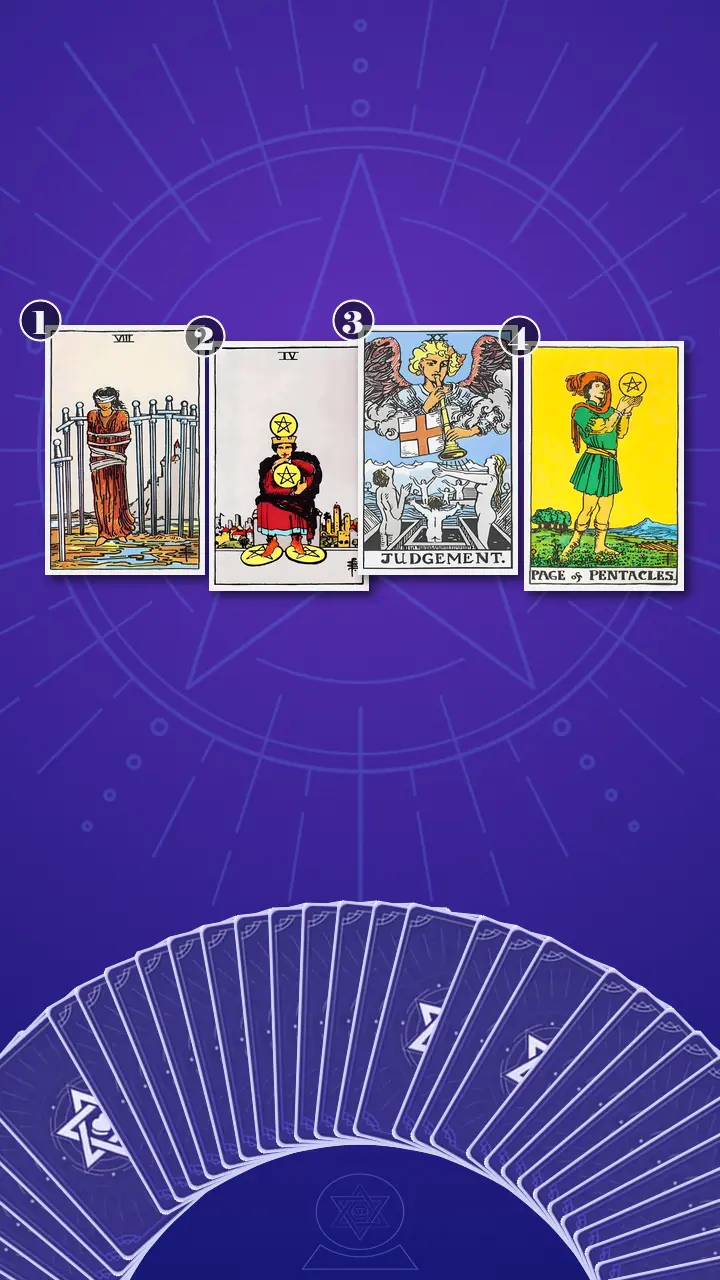
Reading the Blockage Pair
Position 1: Where Curiosity Turns Into Self-Cancellation
‘Now I’m turning over the card for the present symptom,’ I said, ‘the place where the career-switch freeze becomes visible in real life.’ The card was the Eight of Swords, upright.
I pointed to the blindfold and the loose ropes. ‘This is exactly the moment you find an adjacent role you’re genuinely curious about, open your résumé, and mentally disqualify yourself before the employer ever can. The trap isn’t only external competition. It’s the split second when your interpretation of the degree turns possibility into self-rejection.’
The energy here was blockage: Air with nowhere healthy to go. Thought kept circling until one line under Education became a full-screen pop-up she could not click out of. Maybe not yet. Maybe I need a better explanation. Maybe this doesn’t count. I told her that the impossible feeling was emotionally real, but not the same thing as having no options. That is the Eight of Swords in career-change language: pre-rejecting yourself before the market gets a chance to answer.
Jordan gave a quick laugh that landed with a bitter edge. ‘Wow,’ she said. ‘That’s painfully accurate.’ Her fingers hovered over the rim of her mug, then gripped it. The nod came a second later, sharp and involuntary—the kind that says a folder full of unfinished drafts has just been named out loud.
Position 2: The Degree Held Like Body Armor
I turned to the next card. ‘Now I’m opening the one that shows the root obstacle—the deeper mechanism behind the block, especially the way sunk cost and self-worth have attached themselves to the degree.’ The card was the Four of Pentacles, upright.
‘This isn’t only about jobs,’ I told her. ‘It’s about what changing would seem to say about you.’ In the image, the figure clutches the pentacle over the chest and plants the feet so firmly that nothing can move. In modern life, it looks like guarding the degree like a high-cost asset that must keep paying emotional rent. Every new path gets filtered through loss prevention: tuition, years, respectability, the image of being sensible in a city where professional momentum gets discussed like rent and transit delays.
The energy here was excess Earth—security hardening into rigidity. Research can feel productive while still protecting you from evidence. Her spreadsheet, the salary columns, the course comparisons, the urge to read one more job post before messaging one real person: all of it made sense. It gave temporary relief from regret. It also kept the loop alive. I asked her quietly, ‘When did using your degree start meaning obeying it?’
Her whole body answered before her mouth did. First her chest lifted and stayed there, like she had forgotten the second half of an inhale. Then her eyes went slightly unfocused, replaying some private Sunday-night scene. Then the breath left in a long, tired stream. ‘Yes,’ she said. ‘That’s exactly it. I keep calling it being practical, but it feels more like I’m guarding something.’
When Judgement Broke the Old Verdict
Position 3: The Trumpet Over the Old Contract
When I turned the third card, the room changed. The rain at the window had been hissing against the glass all evening; then it thinned, and the gold in the card caught the lamplight so clearly that Jordan leaned forward before I even named it. This was the antidote card. Whenever Judgement appears in a career reading, something in me goes still in the best way. After ten years of watching people mistake a low tide for a failed life, I know this card as the moment a sky opens.
‘Now I’m turning over the card for the key reframe,’ I said. ‘Judgement, upright.’
I told her this card shows the moment a person stops asking whether the next role can perfectly justify the old degree and starts asking what kind of work actually feels alive now. The trumpet is present tense. The open coffins are not about erasing the past; they are about leaving identities that have become too small. The energy here is release from blockage into honest balance: a self-authorized re-evaluation instead of a self-punishing verdict.
This is where I used one of my own working lenses, what I call Void Phase Identification. I told Jordan that she was not in a failure phase. She was in a void phase—the stretch between one professional orbit losing gravity and the next one not yet having enough real-world evidence to feel solid. Through my Macro-Orbital Projection lens, her degree belonged to a completed orbit: valuable, expensive, formative, yes—but no longer entitled to govern the whole sky. The void had made her blame herself for being between identities, when the truth was simpler and kinder: transition had been mistaken for personal deficiency.
At 10:41 p.m., when the spreadsheet tabs are multiplying, the résumé bullet is still half-edited, and one degree line feels louder than your actual curiosity, it can seem like your future was decided years ago.
Your past is not a coffin you have to keep living in; answer the trumpet of what fits now, and let that call guide your next step.
I let that sentence sit between us for a beat. Then I translated it into plain career language. ‘Your degree can be part of your history without being given veto power over your next identity. A degree is history, not handcuffs.’
Jordan reacted in a three-part wave I have learned to respect. First, she went physically still—breath paused, thumb frozen on the paper edge, jaw set. Then her gaze slipped past me and lost focus, as though she were replaying every abandoned application draft at once. Then the surprise came, not as relief but as resistance. ‘But if I stop making the next move prove the old one was worth it,’ she said, voice tight and a little angry, ‘doesn’t that mean I picked wrong?’
I shook my head. ‘No. It means your 21-year-old self is no longer the hiring manager for your adult life.’
Something visibly unlatched. The muscles around her mouth softened first. Her shoulders followed a second later, dropping as if she had been carrying grocery bags in both hands for years without realizing it. She took one deeper breath, then another, and the second one trembled on the way out. Relief was there, but so was that strange thin feeling that comes when a familiar burden leaves and the body has to adjust to open space. I asked softly, ‘With this new lens, think back to last week. Was there a moment this would have changed how you felt?’ She nodded immediately. ‘The customer success posting,’ she said. ‘I would have left the tab open.’ In that moment I could feel the real shift: not from fear to certainty, but from self-judgment to self-trust, from proving the past to exploring the present.
Position 4: The Small Step That Builds Gravity
I turned the last card. ‘Now I’m opening the one for practical integration—the card that shows how this insight lands in real life, without requiring a grand reinvention tonight.’ It was the Page of Pentacles, upright.
‘I love this here,’ I told her. ‘Because it brings practicality back, but in a healthier form.’ In modern terms, this is where you stop trying to solve the whole pivot in theory and make one grounded move instead: one informational chat, one short workshop, one sample project, one adjacent application. The Page studies the pentacle instead of clutching it. That difference matters. The energy is balanced Earth—no hoarding, no fantasy leap, just constructive investment.
I pointed out how different this was from the Four of Pentacles. ‘Both cards care about value. One guards value so tightly that life stops. The other grows value by touching the real world. You do not need a whole new identity to test one next step.’
Jordan sat straighter at that. The tightness in her face did not disappear, but it changed texture. Less locked. More thoughtful. ‘So I don’t need a two-year master plan before I do anything?’ she asked. I smiled. ‘Exactly. You need one real data point. Not a life decision. Just a test.’
From Sunk-Cost Career Paralysis to Grounded Experimentation
When I looked across the whole spread, the story was clean. The Eight of Swords showed the visible symptom: curiosity collapses the moment the degree line enters the chat. The Four of Pentacles showed the hidden driver: the degree has been treated like a non-refundable ticket that must determine the whole trip. Judgement broke the old contract by separating the value of the past from the authority to define the future. Then the Page of Pentacles brought practicality back in its healthier form: not guarding the old orbit, but building the next one.
The blind spot was not that Jordan lacked options. It was that she kept mistaking preservation for safety. Her mind had been asking, ‘Which move proves I didn’t waste my degree?’ The reading asked a better question: ‘What move gives me real evidence about what fits now?’ That was the transformation direction every card pointed toward. The next move does not have to defend the past. You don’t need retroactive certainty to take a present-tense step.
I gave her three small next steps. None of them were about forcing a total career reinvention. They were about interrupting the Evidence Over Verdict loop with actionable advice simple enough to use in real life.
- The 7-Minute Degree History List During your next job-search session, open Notes and make two columns: ‘What my degree gave me’ and ‘What it does not get to decide anymore.’ Write three bullets in each column in under seven minutes, then stop. If grief or self-criticism spikes, close the note at three bullets. The goal is to loosen the verdict, not audit your whole life.
- One Message, Not a Referral This week, send one low-pressure LinkedIn or email message to one person in a target field and ask for a 15-minute conversation about their actual day-to-day work, not for a job. If sending feels too exposed, draft it in Notes tonight and send it tomorrow. Small is the design.
- The Research Cap with Cosmic Redshift Observation Set a 20-minute timer for career research. When it ends, either take one outward action or close the laptop for the night. For one week, track what feels redshifted—roles, tasks, industries that visibly drain or fade—and what feels blueshifted, the signals that keep pulling you closer with real curiosity. The moment you catch analysis pretending to be action, ask for one new data point instead of one more comparison tab.
I told her this last practice is how I keep people honest in a void phase. Not by demanding certainty, but by observing motion. Interest fades. Energy approaches. Clarity often starts there.

A Week Later, the Quiet Proof
A week later, Jordan sent me a short note. She had done the two-column list, moved her Education section lower on her résumé after one edit instead of seven, and messaged someone in customer success for a 15-minute chat. After sending it, she sat alone in a café by the window with her coffee going cold. Not triumphant. Not shattered. Just steadier.
She told me she had slept through the night afterward, and when the old thought showed up in the morning—What if I picked wrong?—it no longer sounded like a judge. It sounded like a scared part of her catching up. That is often what finding clarity looks like in a career pivot reading: not a perfectly solved future, but enough inner room to make one grounded move.
That is the journey I try to protect in every four-card career guidance reading I do. Tarot did not hand Jordan a new identity. It gave her a cleaner way to see the one choice in front of her, and she did the rest.
When every possible next step feels like it might expose your old choice as too expensive to revise, of course your chest tightens before your fingers ever hit apply.
If your degree were allowed to stay in your story without sitting in the hiring-manager chair, what one small, just-a-test experiment would you be curious to try next?