The 7:10 p.m. Notes App Spiral
When Jordan, a 28-year-old account coordinator in Toronto, joined me after work, I recognized a pattern I hear from young city professionals all the time: people who can juggle client requests all day and then go blank the second a 7 p.m. Notes app opens. Her agency tote was still by the door. The microwave hummed behind her. The overhead light in her west-end apartment was too white, and the blue of her phone spread across the kitchen counter like cold water. She peeled back the lid on reheated leftovers, opened a checklist called “Tonight,” and I watched her shoulders sink before she even read it out loud.
“I waste the whole night recovering from the pressure of trying not to waste the night,” she said.
She wanted her evenings to help her catch up. Her body wanted only to switch off. That contradiction sat on her like an invisible backpack of bricks: dishes, laundry, groceries, texts, tomorrow’s prep—all ordinary things, yet somehow they landed as one heavy block. By the time she saw six bullets on a screen, her limbs felt as if someone had quietly filled them with wet sand.
I nodded. “That makes sense to me,” I told her. “This is not laziness. It is overload in civilian clothes.” I use tarot as a mirror, not a verdict, and I told her that my job tonight was simple: to help her see why this after-work shutdown kept happening, and to help her leave with a kinder, clearer map of what her evenings could actually hold.

Choosing the Map for an After-Work Shutdown Loop
I asked her to put both feet on the floor and take one unforced breath before we did anything else. Not as a mystical performance—just as a way to let the nervous system catch up to the conversation. Then I shuffled slowly and asked her to hold only one question in mind: “What really happens to me between walking in the door and disappearing into the couch?”
For her, I chose the Transformation Path Grid · Context Edition. When people ask me how tarot works for something as ordinary and frustrating as doomscrolling through an evening to-do list, this is the answer: I use a spread that separates the symptom, the mental trap, the root fear, and the practical lever that changes the cycle. Jordan did not need a vague mood reading. She needed a clean picture of a repeating loop—workday depletion, list pressure, shutdown, backlog, then more shame the next night.
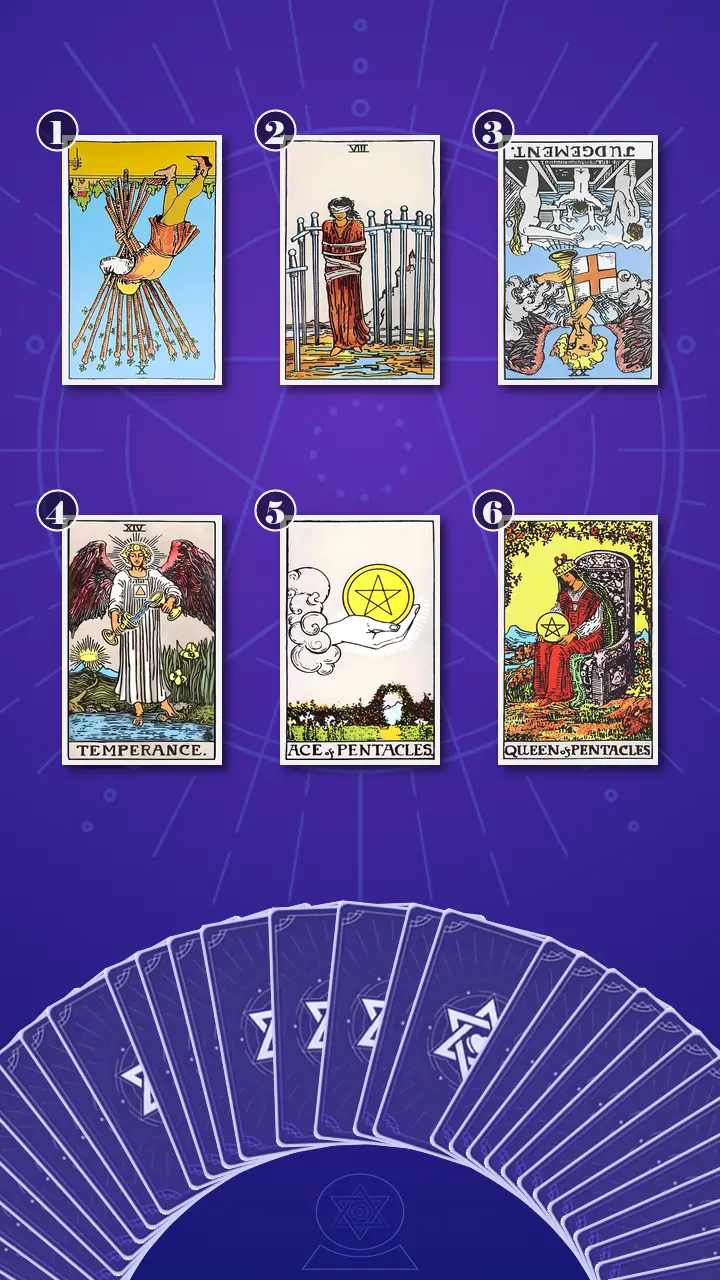
I showed her the structure. The top row would diagnose the pattern: the visible after-work freeze, the immediate mental blockage, and the deeper fear underneath it. The bottom row would show the medicine: the regulating energy that interrupts the loop, the small grounded experiment, and the sustainable evening rhythm that becomes possible when the list stops acting like a verdict.
Reading the Diagnostic Band
Position 1: The Bundle at the Door
I turned over the card that showed the visible after-work shutdown pattern described in her question. It was the Ten of Wands, reversed.
I told her this was exactly the image of getting home already carrying the emotional residue of a workday spent answering other people’s asks, then opening an evening list and feeling all sequence disappear. Dishes, laundry, messages, groceries, tomorrow’s outfit—her mind no longer read them as separate tasks. It read them as one giant demand. In modern life, this card is a Notes app turning into a second Slack inbox in a different font. It has that Severance feeling, except the outie still brought the client inbox home.
In energy terms, this was excess pushed past capacity until it flipped into collapse. The problem was not that the tasks were impossible. The problem was that they landed on a body already overloaded, so the whole bundle looked heavier than it was. Jordan gave a short, almost offended laugh and shook her head. “That’s annoyingly accurate,” she said. “I don’t even choose not to start. I just... drop.”
Position 2: When Every Bullet Turns Bold
I turned the next card, the one revealing the immediate mental trap that activates the second the list is seen. It was the Eight of Swords, upright.
I asked her to notice what this card does so well: the feeling of being trapped by a system that is not fully sealed. This is what her evenings looked like in plain English. She would glance at Apple Notes and instantly assume every bullet point was urgent, equally loaded, and somehow a test of whether she was handling adulthood correctly. The trap felt closed, even though there was still room to choose one small next step. It was like Google Maps zoomed so far out that every route looked blocked, when in fact one street was still open.
“The hidden sentence,” I told her, “is not ‘there are tasks.’ It’s ‘if I only do one thing, I’m still behind.’” That is blockage energy: constricting air, pressure mistaken for reality. Her jaw tightened; I could see it even through the screen. Then came the sharp nod I had been expecting. “Yes,” she said. “If I only do dishes, the laundry is still there. If I only answer one message, I’m still behind. That’s the exact trap.”
Position 3: The Apartment as a Witness Stand
I turned the card uncovering the deeper fear underneath the freeze: Judgement, reversed.
This was the quiet root of the whole loop. Laundry, dishes, and unanswered texts were no longer neutral maintenance. They had become evidence. I told her that this card often appears when a person hears an ordinary reminder as an accusation. The list stops helping when it starts acting like a verdict. In Jordan’s small apartment, with the fridge humming and the hamper in view, the room itself had started to feel like a witness stand. The chore was not what hurt first. The meaning attached to it hurt first: If I were more together, this would not be hard.
That is a shame-based blockage, not a motivation failure. In older language I might call it the Inner Judge; in modern terms it is a Tuesday night to-do list turning into a personal performance review. Jordan went very still. Her fingers tightened around her mug, then loosened. “These are basic tasks,” she said quietly, “which is exactly why not doing them feels so embarrassing.” That was the moment the reading went from surface frustration to truth.
When Temperance Stood in the Doorway
Position 4: The Landing Strip
When I turned the fourth card, the air in the call changed. This was the card introducing the regulating energy that breaks the overload-to-freeze cycle, and it was the heart of the reading: Temperance, upright. After sixty-seven years of seasons, I have learned that the body keeps a truer clock than guilt does, and Temperance is one of the clearest reminders of that I know.
Before I explained the symbolism, I used one of the lenses I rely on most, what I call Somatic Fatigue Diagnosis. I asked Jordan not what she thought about the list, but what her body did in the first breath after she walked in the door. Her answer came fast: shoulders dropped, eyes glazed, jaw went slack, limbs felt heavy, and the couch started calling before dinner was even over. That told me more than any productivity app could. Her nervous system had not arrived home. She was trying to go straight from client deadlines to dishes, from Slack-brain to self-management, with no landing strip in between.
At 7:10 p.m., with the microwave humming and her bag still by the door, the Notes app was not landing like a helper. It was landing like the night had been assigned homework before she had even arrived.
Your evening does not shut down because you are weak. It shuts down when the list stops being a menu and starts demanding proof.
Your worth is not measured by how many boxes fit into one night; pour your energy between the cups with intention, and let balance, not guilt, decide what tonight can truly hold.
First, she froze. Even the hand that had been absently tapping her phone case stopped mid-motion. Then her gaze slipped past the camera, unfocused, as if she were replaying a row of identical Wednesdays: the tote by the door, the cold light on the counter, the tiny private sentence that said if you could not do it properly tonight, you should not start at all. When she looked back, her eyes were bright, but not soft. “So what,” she said, with a flare of resistance that made me like her even more, “I’m supposed to lower the bar?” I shook my head. “No,” I told her. “Lower the accusation. Keep the bar tied to reality.” The anger broke first, then the breath came—a long one, low in the chest, the kind that lets the shoulders unclench without permission. By then even the microwave had gone quiet, and the apartment behind her looked less like fluorescent evidence and more like a room again. There was relief in her exhale, and also that brief, dizzy feeling people get when the old rule stops making sense and a better one asks to be lived instead. I asked her to try the new question on last Tuesday: not What should I finish? but What can tonight realistically hold? She closed her eyes for a beat and nodded. “Honestly?” she said. “I probably would’ve done the dishes and stopped hating myself.”
That was the shift right there: from verdict-driven overwhelm and couch paralysis to the first fragile ounce of steadier self-respect. Not certainty. Not a perfect routine. Just more room inside the same evening.
Position 5: One Coin in the Hand
I turned the fifth card, the one translating the shift into a small, grounded after-work experiment. It was the Ace of Pentacles, upright.
I smiled when I saw it, because it answered the first card beautifully. The spread had begun with an unmanageable bundle. Now it offered one coin in one hand. I told Jordan this was the antidote to couch paralysis after work: Do not clear the night. Touch one real thing. One visible task, under fifteen minutes, physically finishable. Load the dishwasher. Lay out tomorrow’s clothes. Take out the recycling. Answer one practical email. This is balanced earth—an action small enough that the nervous system can trust it.
She exhaled, and some humor came back into her face. “So not the full reset routine from TikTok?” she asked. “Not unless TikTok is volunteering to do your laundry,” I said. That made her laugh for real.
Position 6: A Home That Stops Grading You
I turned the final card, the one showing the more sustainable rhythm available when the list stops acting like a verdict. It was the Queen of Pentacles, upright.
This is one of my favorite cards for modern burnout because she does not sell fantasy. She shows a home life built on enoughness. Dinner, a basic tidy, tomorrow prep, a text answered, lights lowered—that kind of thing. I told Jordan that the Queen of Pentacles was not asking her to become a perfectly optimized woman with a color-coded midweek reset. She was asking for a home that feels like a soft landing, not a quarterly review. In my own language, this is Organic Routine Restructuring: building the evening around the tired body that actually walks in the door, not the ideal self who lives in habit-tracker screenshots.
That is balanced earth: steady, warm, repeatable care. Jordan’s face softened when I said that. “I think I’ve been designing nights for a version of me who gets home with 70 percent battery,” she said. “Exactly,” I told her. “And the woman who walks in is on low power mode. That is not failure. That is information.”
From Verdict to Menu: Actionable Advice for the Next Three Evenings
Once all six cards were on the table, the story was clean. The top row showed how the loop formed: too much carried home, then a mental trap that said partial effort did not count, then an inner judge that turned ordinary chores into character evidence. The bottom row answered each point directly: regulate first, choose one grounded task, then build a home rhythm based on support instead of self-audit. In other words, why chores feel impossible after work is not a mystery of character. It is a system problem. Her body was meeting pressure, not just tasks.
I told Jordan the blind spot was this: she had been treating the emotional intensity of the list as proof that she needed more discipline, when it was actually proof that her evening container was too large and too moralized for the energy she had left. The transformation direction was simple and radical at once: shift from using the list as a measure of worth to using it as a menu of realistic options. An evening plan is a menu, not a moral test.You do not need a stricter night. You need a smaller container.
- Grounding Disconnect Protocol For the next three worknights, before Apple Notes comes out, spend 10 minutes arriving: change clothes, drink a glass of water by an open window, and let one full song play with no scrolling. If work is still buzzing, say out loud what you are setting down from the day. If 10 minutes sounds impossible, do 3. The goal is not to feel serene; it is to lower the nervous system one notch before the list appears.
- Two-Musts Menu When you do open the list, rewrite it under only four lines: 2 musts, 1 maybe, and not tonight. If a task starts sounding like an accusation, relabel it as Care, Maintenance, or Optional in plain language. Keep the wording neutral. “Laundry” works better than “finally do laundry like a functional adult.” You are lowering accusation, not pretending the task vanished.
- One Real Thing Reset Pick one visible task that can be finished in under 15 minutes—load the dishwasher, lay out tomorrow’s clothes, take out recycling, or answer one practical message—and do only that before deciding whether there is room for more. After it’s done, ask, “Do I genuinely have room for one more, or am I done?” Let done be a valid answer. The win is rebuilding trust, not stacking gold stars.

A Week Later, the Quiet Proof
A week later, Jordan sent me a photo of the sticky note she had put by her door: Arrive first. Plan second. Under it was a single text: “Did dishes, left laundry, went to bed anyway.” It was such a small sentence, and that was exactly why I loved it. The night had not become perfect. It had become humane.
When she wrote again two days later, she admitted the old thought still visited her in the morning—what if I slip again?—but this time she noticed it, smiled, and made tea instead of drafting a stricter life plan. That is how I know a reading has done its work. Tarot did not rescue her evening. It helped her stop treating her own tiredness like a character flaw and start listening for the steadier rhythm underneath it.
When ordinary evening stuff starts feeling like evidence instead of tasks, of course the body goes still before the mind can talk you out of it. If tonight were allowed to be a landing strip instead of a performance review, what would feel like one kind, realistic thing to pour into the first cup—and what can wait without becoming a verdict?
This story is adapted from psychological research, written so that those in a similar struggle can see their own pattern in it — and find their next step clearly.These insights are not a substitute for professional psychological, medical, legal, or financial advice.
Learn more about our Journey to Clarity.
How did this insight land for you?
🫂 This Resonates Deeply
🌀 Living This Story
✨ Now I See Clearly
🌱 Seeing New Possibilities
🧰 Useful Framework
🔮 The Confirmation I Needed
💪 Feeling Empowered
🚀 Ready for My Next Step
Author Profile
 AI
AI“As the seventh generation of a Highland healing family, I see modern anxieties as a simple, temporary disconnection from nature's rhythm. I bring 67 years of lived seasons not to instruct you, but to hold space for you. Using tarot as a mirror, I want to gently guide you out of the chaos, helping you breathe deeply and rediscover the organic, steady heartbeat of your own life.”
In this Lifestyle Tarot Reading :
Core Expertise
- Somatic Fatigue Diagnosis: Bypassing mental rationalization to listen strictly to your body's burnout signals and physical friction in your daily environment.
- Organic Routine Restructuring: Rebuilding your lifestyle architecture based on natural biological needs rather than artificial societal clocks.
Service Features
- The Grounding Disconnect Protocol: A nature-based somatic practice to physically discharge accumulated daily stress, immediately lowering nervous system hyperarousal.
Also specializes in :
Explore Related Patterns:
Boundary DiscernmentJordan's breakthrough is the question, 'What can tonight realistically hold?' That question separates real responsibility from the list's accusatory pressure, and it gives her permission to do dishes while leaving laundry without turning the unfinished task into a verdict. Boundary Discernment fits because she is learning to draw a line around capacity. The boundary is not against care; it is against the cognitive distortion that says every ordinary task has equal claim on the same depleted evening. You can see the healthier pattern in the later text: 'Did dishes, left laundry, went to bed anyway.' That sentence is small, but psychologically precise. It shows a boundary where partial care counts, rest is allowed, and tomorrow's tasks no longer get to invade tonight as evidence of failure.
Self-Judgment LoopJordan's apartment begins to feel like a witness stand: the hamper, the fridge, the unanswered texts, and the Notes app all seem to testify against her. The chore is no longer just a chore; it becomes evidence in a private trial about whether she is together enough. Self-Judgment Loop fits because the list triggers an internal audit before it triggers a practical plan. The mind attaches character meaning to ordinary maintenance, then the shame from that meaning increases pressure, and the pressure makes action harder. You can see the loop in her embarrassment over basic tasks. Because they are ordinary, not doing them feels more damning, which makes the body shut down faster the next time. The pattern keeps feeding itself until the list stops being a tool and starts acting like a verdict.
Black-and-White ThinkingJordan reads the Notes app as if every bullet is urgent, equally heavy, and morally loaded. Instead of seeing dishes, laundry, texts, and prep as separate choices, her mind compresses them into a single pass-fail demand. Black-and-White Thinking fits because the list becomes all done or not enough. The cognitive distortion erases gradations: one task completed does not register as progress, and an unfinished task becomes evidence that the whole evening has failed. You can see why this makes shutdown more likely. When the only acceptable outcome is a complete reset, the realistic option of doing one grounded thing feels almost insulting, even though it is exactly the action that would loosen the loop.
Emotional RegulationJordan's useful shift begins before the Notes app opens: feet on the floor, one unforced breath, changing clothes, drinking water, and letting the nervous system arrive. The intervention starts with the body because the shutdown starts in the body too. Emotional Regulation fits because the new pattern is not about forcing discipline through guilt. It is about lowering physiological pressure enough for choice to return, then asking what the evening can realistically hold. You can see the regulation working when 'lower the accusation' lands harder than 'lower the bar.' The goal is not to abandon responsibility; it is to stop using shame as the engine. Once the body is less flooded by demand, one grounded task becomes possible without turning the whole night into a trial.
Freeze ResponseJordan's shoulders sink before she even reads the list, and later she names the experience plainly: she does not choose not to start, she just drops. The checklist arrives after a workday of answering other people's requests, so her nervous system is already loaded before the first domestic task appears. Freeze Response fits because the shutdown is not framed as laziness or a missing productivity hack. It is a defensive immobilization pattern: when the mind reads six ordinary tasks as one giant demand, the body protects itself by going still, dulling initiation, and pulling toward the couch. You can see the pattern most clearly in the gap between objective task size and subjective body reaction. Dishes, laundry, texts, groceries, and tomorrow's prep are manageable in isolation, but once they land as proof that the whole night must be solved, your system treats the list like pressure rather than a menu.
Perfectionism-Driven AvoidanceJordan's list does not ask for one visible task at first; it feels like it asks for the whole night to be cleared. The imagined standard is a full reset, even though the person walking in the door is already on low power after a day of client deadlines. Perfectionism-Driven Avoidance fits because the avoidance is powered by a standard that is too total to begin. If only a properly handled night counts, then dishes alone feel like failure, and the nervous system chooses no action over an action that will not meet the ideal. You can see the pattern soften when the experiment becomes one real thing under fifteen minutes. That works because it breaks the perfectionistic rule underneath the freeze: the night does not have to be fully redeemed before one grounded task is allowed to count.
Action ParalysisJordan can juggle client requests during the day, yet the second the 7 p.m. Notes app opens, sequencing disappears. The issue is not that she lacks a next action; it is that the whole list turns into one blocked field where every route looks closed. Action Paralysis fits because her initiation system stalls under perceived total demand. The mental trap says that doing one thing will not matter because the rest will still be there, so the body withholds movement until a perfect plan appears, and the perfect plan never becomes available at 7:10 p.m. You can feel the mechanism in her line, 'If I only do dishes, the laundry is still there.' That sentence turns partial progress into failure, which makes starting irrational from inside the trap. The paralysis is the mind trying to avoid an unwinnable performance standard, even though one small action would be available in reality.
Resource AlignmentJordan realizes she has been designing evenings for a version of herself who gets home with far more battery than she actually has. The list only becomes workable when it is resized around the tired person walking through the door. Resource Alignment fits because the repair is a match between demand and available bandwidth. Instead of asking the list to express an ideal self, she asks it to hold two musts, one maybe, and a clear not tonight. You can see why this directly answers the shutdown. When the container is too large, the nervous system reads it as threat and stalls. When the container fits the real energy available, one grounded action can rebuild trust without requiring the whole evening to become a productivity performance.
Conditional Self-WorthJordan's line, 'If I were more together, this would not be hard,' shows the list carrying more than logistics. Basic chores become a proxy for adulthood, competence, and whether she is allowed to feel okay about herself at the end of the day. Conditional Self-Worth fits because self-respect becomes contingent on performance. The Notes app does not simply ask what needs doing; it quietly asks whether she has earned the right to feel functional, disciplined, and unashamed. You can see why the evening becomes so heavy. When worth is attached to completion, rest feels suspicious and partial effort feels invalid. The list then stops helping you care for your life and starts demanding proof that you deserve to feel at home in it.
Productivity as SafetyJordan tries to move straight from client deadlines into dishes, laundry, texts, and tomorrow prep, with no landing strip between work pressure and home maintenance. The list becomes a way to prove she is still in control after a day spent responding to other people's asks. Productivity as Safety fits because completion is being used as emotional reassurance. If the boxes get checked, she can feel temporarily more together; if they do not, the night feels unsafe, exposed, and personally incriminating. You can see why this strategy backfires. A list used for safety has to keep proving enoughness, so it becomes more demanding exactly when your body has the least capacity. The way out is not a stricter night, but a smaller container where care can replace proof.
Explore Related Struggles:
Inner Tribunal LockThe list stops acting like a menu and starts demanding proof, and that is the moment the chores change character. Dishes and laundry are no longer maintenance; they become evidence in a private hearing about whether you are keeping up. Once basic tasks read like a verdict, hesitation makes sense. The shutdown is not only about fatigue anymore; it is also a refusal to keep sitting in a room that grades every unfinished box.
Capacity MisalignmentThe moment six bullets appear on the screen, dishes, laundry, groceries, texts, and tomorrow's prep stop feeling like separate chores and turn into one heavy block. The problem is not that each task is impossible on its own; it is that the remaining evening capacity is too small for the shape of the demand. You are trying to hold a full menu with a nearly empty battery, so the body refuses the load before the mind can sort it. The shutdown is the cleanest answer available when the load and the container do not match.
False Recovery LoopYou want the evening to help you catch up, but your body only wants to switch off, and those two needs hit the same night at the same time. The story keeps showing the missing landing strip between work mode and home mode, where neither recovery nor action can fully start. The pressure to use the night well becomes the thing you spend the night recovering from, so the handoff stalls and the couch wins by default. What looks like wasted time is really the cost of trying to make one exhausted stretch of time carry both repair and progress.
Systemic DepletionYou get home after a day spent answering other people's asks, and the first glance at the 7 p.m. Notes app lands on a body that is already running thin. The shoulders drop, the limbs go heavy, and the evening starts from a spent state rather than from a clean reset. That is why the list does not feel neutral. It arrives after the day's output has been used up, so even ordinary chores ask for energy you no longer have, and the shutdown becomes the body's way of refusing one more drain.
Explore Related Emotions:
Chronic OverwhelmSix bullets on Apple Notes stop being six separate things. Dishes, laundry, groceries, texts, and tomorrow prep land as one dense block, and Jordan's limbs feel as if someone quietly filled them with wet sand. The problem is not the size of any single task; it is the way the whole list arrives all at once. Chronic Overwhelm fits because the pressure is not contained inside one bad evening. The story names a repeating loop: workday depletion, list pressure, shutdown, backlog, then more shame the next night. You can see how the list keeps inheriting the emotional weight of every previous night that felt unfinished. This emotion explains why a small after-work checklist can feel impossibly large. The mind may know the chores are ordinary, but the body is responding to accumulation, not just to the six items on the screen.
Life Admin ShameJordan says the tasks are basic, which is exactly why not doing them feels so embarrassing. That line matters because the shame is not attached to a dramatic failure. It is attached to dishes, laundry, texts, groceries, and tomorrow prep, the ordinary maintenance that people are supposed to handle without needing a whole emotional negotiation. Life Admin Shame appears when small domestic tasks start speaking in the voice of personal deficiency. You may be competent all day in a demanding job, then feel exposed by a hamper or an unanswered message because it seems to reveal something about your ability to manage yourself. The shutdown makes more sense when the list is carrying embarrassment as well as logistics. Starting one task would not only mean doing the chore; it would mean touching the private belief that needing effort for basic life maintenance makes you less together than you should be.
Performance FreezeJordan's tote is still by the door, the microwave is still humming, and her shoulders sink before she even reads the checklist. The freeze starts before a decision has been made, which is why the shutdown does not look like a simple refusal to do chores. It looks like a body stopping at the threshold because the next step has already been loaded with too much meaning. When every bullet becomes urgent and morally charged, the list stops being a set of tasks and starts behaving like a performance review. You are not just choosing between dishes and laundry; you are entering a test of whether you are handling adulthood correctly, while the body that has arrived home is already in low power mode. Performance Freeze names that suspended state where action is physically close but internally unreachable. The useful clarity is that the blockage is not a character verdict. It is a signal that the evening is asking for execution before it has given you room to arrive.
Rest GuiltJordan's sentence is the whole weather system: she wastes the whole night recovering from the pressure of trying not to waste the night. Her body wants to switch off, but the plan for the evening keeps asking her to prove that the time after work was used correctly. Rest Guilt sits in that contradiction. You are depleted enough to need recovery, yet the idea of recovery feels suspicious until the list has been satisfied. The couch calls before dinner is over, but lying down can feel like failing a test that no one else is even grading. That guilt helps explain why the night disappears. Rest cannot replenish much when it is being taken under accusation. The body may stop, but the inner audit keeps running, which makes recovery feel less like landing and more like getting away with something.
Verdict DreadLaundry, dishes, and unanswered texts stop being neutral maintenance in Jordan's apartment. The fridge hums, the hamper is in view, the phone glows on the counter, and the room starts to feel like a witness stand. The chore is not what hurts first; the verdict attached to it arrives before the task even begins. Verdict Dread names the bracing that happens when a reminder feels like an accusation. You open a list expecting information, but the list seems to ask whether you are together enough, disciplined enough, adult enough. That turns a practical tool into a private tribunal. The emotional logic is precise here: when the evening plan becomes evidence of worth, starting one task no longer feels safe or sufficient. The dread is not about dishes by themselves. It is about what unfinished dishes have been made to prove.
Guilt-Free RestA week later, Jordan sends the smallest possible proof: she did dishes, left laundry, and went to bed anyway. Nothing about the night became perfect. What changed is that unfinished laundry did not get to turn the whole evening into a failure. Guilt-Free Rest is the feeling that becomes possible when done is allowed to mean enough for tonight, not everything forever. You can stop after one real task without needing the remaining list to disappear, because rest is no longer being treated as a reward that must be earned by total completion. The sticky note by the door gives this emotion a concrete shape: arrive first, plan second. Rest becomes cleaner when the evening has a smaller container. It is no longer a collapse away from responsibility; it is a valid endpoint inside a humane rhythm.
Quiet Self-RespectWhen Jordan tries the new question, the answer is not glamorous: she probably would have done the dishes and stopped hating herself. That is the turn. The evening does not suddenly become optimized; it becomes less hostile to the person living inside it. Quiet Self-Respect shows up in the lowered accusation, not in a perfect routine. You keep the bar tied to reality instead of letting the list measure your worth. The breath comes back, the shoulders loosen, and the apartment looks more like a room than a case file. This emotion is quiet because it does not need a dramatic self-reinvention. It is the steadier regard that appears when your tiredness is treated as information, and when a small, realistic night is allowed to count as care.
Explore Related Contexts:
Catch-Up ParalysisYou wanted the evening to help you catch up, but the moment the list opened the night turned into a test of whether you could recover lost ground. That pressure makes each item feel loaded with the rest of the night that has not happened yet. When the only acceptable outcome is catching up, partial effort starts to look like failure before you begin. The body picks the simpler option and switches off, because a frozen night hurts less than another round of trying to outrun the backlog.
Invisible WorkloadYou spend the day handling client requests, then come home to dishes, laundry, groceries, texts, and tomorrow's prep. None of it is dramatic on its own, but together it sits on the evening like a second shift. That hidden load explains why the checklist can feel heavier than the hours left in it. The problem is not one bad chore; it is a full day that has already used up the spare capacity the night was supposed to have.
Life Admin BacklogYou open a checklist called Tonight and see dishes, laundry, groceries, texts, and tomorrow's prep lined up in one place. The list turns ordinary upkeep into a backlog the moment it asks to be done all at once. Once the queue is read as a backlog instead of a menu, the night stops feeling like open time and starts feeling like unfinished inventory. That is the point where starting one task no longer feels like progress and the whole evening goes still.
Work Life Boundary CreepYou spend the workday answering other people's asks, then the agency tote stays by the door and the phone throws the same blue light across the kitchen counter at 7 p.m. The workday does not really end; it just changes rooms. That spillover is what makes the evening list land with extra force. When work syntax is still in the air, the home side of the day has to compete with residue that never got cleared, so the first checklist already feels like a second inbox.