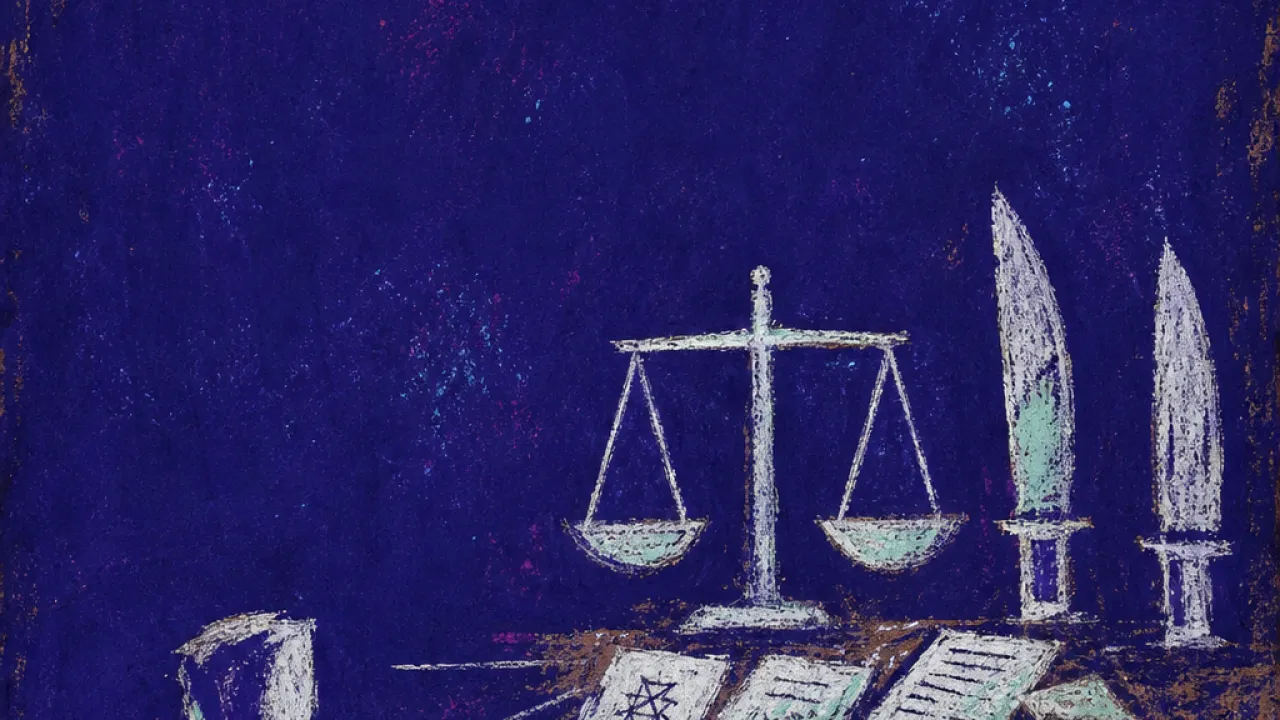
When Accountability Reckoning arrives, the pressure is in the room itself: the review meeting, the hard conversation, the shared record, the deadline that no longer lets things stay blurred. That tight, braced feeling in your shoulders comes from an environmental and structural dynamic where evidence, standards, and consequence have become visible at the same time. The Tarot Cards below do not decide who is right or wrong; they mirror the shape of this reckoning and the way it asks for clarity before movement.
Justice UprightThe balanced scales held in one hand and the upright sword in the other turn the card into a room where claims are weighed against evidence. The seated figure is not moving toward a feeling; the figure is holding a process still enough for consequences, promises, and facts to be placed on the same surface. In personal growth, that visual grammar maps to the moment when your identity claims meet an external audit: habits, results, feedback, and skipped commitments stop being vague. You are not being reduced to a score; the structure is showing where agency returns when the evidence is finally allowed to speak.
The Tower UprightThe lightning hits the crown, the highest and most authoritative point of the Tower. The impact does not stay private; fragments scatter outside the walls, and the building can no longer keep its inner condition separate from the surrounding world. In a personal growth context, this describes the moment when claims of maturity, discipline, clarity, or transformation meet evidence. Feedback, consequences, inconsistency, or public results expose whether the growth structure was actually integrated or merely asserted. You recover agency by treating the reckoning as data instead of humiliation. The card shows where the system is being audited: at the point where authority was claimed, where protection failed, and where the scattered evidence now makes denial harder to maintain.
Judgement UprightThe angel’s trumpet cuts across the cold blue field while the figures rise from open coffins with their hands raised. The scene is built around a signal that cannot be treated as background noise; it turns private stasis into a visible response moment. For personal growth, that visual logic maps onto an accountability reckoning: a review, result, conversation, or deadline that forces your stated standards to meet observable behavior. You are not being handed a ready-made answer; the card shows the external call that makes avoidance harder to maintain and gives you a point from which to reclaim agency.
Three of Swords UprightThe swords do not scatter randomly across the card; their lines converge on one precise point. That geometry turns pain into evidence, showing a moment when separate actions, choices, or omissions gather into a single visible consequence. For personal growth, the pressure comes from being confronted with what a pattern has produced outside your private intentions. The card does not frame the reckoning as punishment; it frames it as contact with reality, where the next layer of agency begins only after the evidence is allowed to stay visible.
Five of Swords UprightThe figure in front does not simply walk away with the swords; he looks back at the people leaving the scene. The posture keeps the outcome visible, as if the win cannot fully detach itself from the people affected by it. In a personal growth context, this is the moment when insight, boundaries, or self-protection has produced consequences that now require an audit. The three swords held close show ownership of the tools used, while the two left behind show what remains outside the winner's control. You may be facing an external reckoning where the question is no longer who was right. The card points to the harder structure beneath the conflict: impact has become visible, and growth now depends on whether the aftermath can be examined without turning accountability into another performance of control.
Seven of Swords ReversedThe tiptoe step is still mid-motion when the two swords remain planted like markers at the camp's edge. The figure's attention is split between escape and exposure, while the organized tents behind him remain close enough to register what has been bypassed. For work, this describes a hidden shortcut, informal decision, or partial handoff being pulled back into the official record. You may be entering a phase where the issue is no longer tactical cleverness, but whether the missing pieces can be named clearly enough to restore clean accountability.
Ten of Swords UprightThe neat line of blades along the spine makes the impact look recorded rather than random. The body cannot argue with the arrangement; the evidence is visible, ordered, and placed where support used to be. In a personal growth context, this is the external moment when missed commitments, ignored feedback, or postponed decisions become observable. You may have had reasons, context, and private complexity, but the card shows the stage where consequences are no longer abstract. This reckoning is not moral punishment. It is the point where the system stops accepting vague intention as proof of change, which gives you a harder but cleaner basis for rebuilding agency.
Knight of Swords UprightThe raised sword cuts a clean line through the air, and the knight's entire armored body is organized behind that line. The image has no soft edges: weapon, posture, horse, and wind all compress the scene into a single test of follow-through. That is why this card fits an accountability reckoning in personal growth. It exposes the gap between the identity you claim and the behavior that can be observed, measured, or repeated when the initial excitement has passed. You are not being asked to perform perfection. The structure reveals where vague self-improvement language has to become a visible standard, a kept promise, or a direct admission that the current system is not carrying the goal.
King of Swords UprightThe King's sword is not hidden in his lap; it is raised where the whole scene has to answer to it. His frontal posture and stern face make the card feel like an external review point rather than private rumination. In personal growth, that review point becomes the moment when a mentor, deadline, tracker, or public commitment exposes the gap between declared values and lived routines. The pressure is useful when it turns vague aspiration into evidence, because You can finally see which promises have structure behind them and which were only performance.
Seven of Wands UprightThe six wands rising from below turn the clear, open scene into a testing ground, while the central wand has to meet them in real time. The body cannot stay vague here; grip, stance, and position all become measurable under pressure. In a personal growth context, accountability turns intention into something that can be challenged by dates, check-ins, routines, and witnesses. The card reveals the moment when a declared standard meets the external structures that expose whether it is being lived. This is not about being judged into shame. The image gives you a way to distinguish a useful challenge that stabilizes your growth from a crowd of demands that only keeps you bracing.
No cards available for this filter.