The 10:07 a.m. Slack Tab
If you can sound thoughtful in a one-on-one but freeze the second a public channel says "Any ideas?", you already know a very specific kind of workplace self-censorship.
When Jordan sat down with me, she was not asking for a mystical forecast. She was asking a painfully modern question: why do I type a Slack reply, reread it three times, and delete it before hitting send? She told me about a Tuesday at 10:07 a.m. at her small condo desk in downtown Toronto, when a campaign thread lit up, her coffee went lukewarm beside the keyboard, and the laptop fan hummed under her wrists. She typed two solid sentences, trimmed them into one, watched the cursor blink, watched two coworkers answer without drama, then highlighted the whole draft and deleted it. Her fingers hovered over Enter like the key might burn her.
"I had an idea," she told me, "but it probably wasn't strong enough yet. I always find the right wording after the moment is gone." What hurt was not a lack of ideas. It was the split between wanting to contribute and fearing what it would mean if the idea sounded wrong, obvious, or weak. Her self-consciousness had a body: a throat that tightened like an elevator door closing on her own voice, a held breath, shoulders quietly climbing while a casual brainstorm started to feel like a performance review. People search phrases like "why do I delete my ideas before sending them in Slack" or "how to speak up in Slack without sounding dumb." In the room with me, it felt even simpler and more human: she wanted to help, but the second her thought became visible, her body treated it like a test.
I know that feeling more intimately than my old Wall Street bio usually suggests. In the dead hours on a trading floor, uncertainty can make a blinking message feel heavier than it objectively is. "That makes sense," I told her. "And it doesn't mean you're fragile or secretly unqualified. It means your nervous system is protecting you from exposure in a clumsy way. Let's make a map through the fog and find the rule underneath it. That's how we get to clarity."
Choosing the Compass: Finding Clarity with a Five-Card Cross
I asked Jordan to take one slow breath and hold the question in plain language, without dressing it up: why do I delete my ideas before sending them in Slack? Then I shuffled. Not for theater. For focus. The ritual matters because it gives the mind a bridge from spiraling to observing.
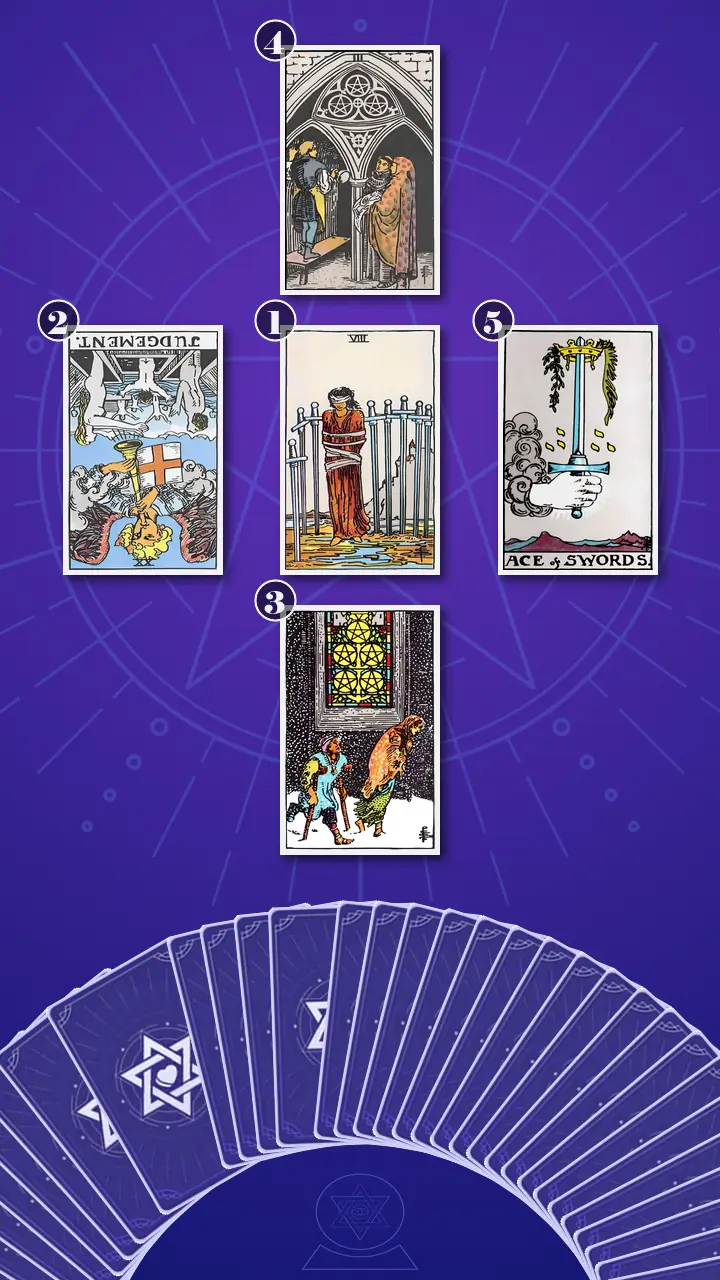
For anyone who wonders how tarot works in a career communication reading like this, this is how I use it: as a structured mirror. I chose the Five-Card Cross · Context Edition, a career communication tarot spread I use when the issue is narrow, emotionally charged, and painfully repeatable. This question did not need a sprawling forecast. It needed a precise map: the live symptom, the conditioning behind it, the hidden root, the perspective that could reorganize it, and the next embodied step. That is exactly what this Five-Card Cross tarot spread for workplace self-censorship in Slack brainstorms is built to do.
As I laid the cards into the cross, I told her what mattered most. The center card would show the freeze itself. The card to the left would reveal the conditioning that turns "Any ideas?" into an internal performance review. The card below would surface the deeper belonging fear. The card above would offer the reframe strong enough to interrupt the pattern. And the card to the right would translate insight into one practical next move she could actually try this week.
The Loop That Calls Itself Professionalism
Position 1: The Cursor That Turns Into a Cage
Now I turned over the card representing the live symptom: the moment Jordan types an idea, second-guesses it, and deletes it before sending. The card was the Eight of Swords, upright.
It was almost uncomfortably accurate. In modern terms, this is Jordan staring at a drafted Slack reply during a fast-moving brainstorm, convinced there is only one safe wording that will not make her look basic. She keeps tightening the sentence until the act of sending feels more dangerous than the idea itself. It is like rewriting a Slack message until it is so optimized it no longer sounds like a human thought. The blindfold in the card matters because it shows narrowed perception: her options are not actually gone, but once self-editing takes over, she can no longer feel that.
"There has to be one version of this that no one can question," I said, giving the card its real sentence. "That is the trap." Upright, the Eight of Swords is blocked Air. Too much mental control. Too little movement. Not a shortage of intelligence, but a rule that says participation is only allowed once the thought is criticism-proof. Silence can feel safe and still cost you visibility.
Jordan let out a short laugh with a bitter edge. "That is rude," she said, then shook her head. "But yes. That exact split second." Her jaw tightened and released. She looked at the card, then away from it, like someone watching her own browser history appear on a projector.
Position 2: When an Invitation Sounds Like a Grading Rubric
Next I turned over the card representing the conditioning pattern that turns a simple Slack prompt into an internal performance review. Judgement, reversed.
In real life, this card looks like a casual message such as "Any ideas?" landing in Jordan's body like she has just been called on in class. Before anyone else can evaluate the thought, she is already grading it for originality, polish, and whether it sounds senior enough. Her team typed an invitation, but her nervous system heard a grading rubric. That is why she sounds thoughtful in one-on-ones yet freezes in group chat: the audience changes the stakes in her body before the facts have changed at all.
Reversed, Judgement shows blocked self-trust. The call is there, but she does not answer it until certainty arrives. On the trading floor, I used to watch highly competent adults get a two-line ping from a managing director and immediately start editing themselves from the inside out. Speed can make the body invent a tribunal. That memory flashed through me as I looked at the trumpet on the card. "A brainstorm is not a verdict," I told her. "Your body learned to hear one there anyway."
She rubbed her thumb over the edge of the table and exhaled. "I really do act like every thread is an exam," she said. The sentence came out with an uncomfortable little smile, the kind people make when the truth has just embarrassed them into freedom.
Position 3: The Winter Story Under the Draft
Then I turned over the card representing the deeper fear beneath the behavior: that being off, ignored, or corrected would mean she does not truly belong. The Five of Pentacles, upright.
This is where the reading dropped below communication tactics and into the wound under them. Under the wording anxiety is a colder fear: if her idea sounds weak, gets ignored, or needs correction, she will feel visibly outside the circle of competent people on the team. Slack silence becomes winter. Other people's quick emoji reactions become warmth behind glass. I could see the TTC scene instantly as I held the card: Jordan on the train home at 6:18 p.m., the doors hissing open, her phone screen warm in her palm, seeing a coworker get reactions for an idea no more polished than the one she deleted, and translating that into, "Of course that works for them. They already belong here."
Upright, the Five of Pentacles does not prove exclusion. It exposes the scarcity story. The thread goes quiet, and her mind does not think, people are busy. It thinks, I may have just proven I was never really in the room. That is why being ignored on Slack feels so personal. It is not just about the message. It is about belonging.
Her reaction came in three waves. First, her breathing paused so sharply I could see it in the hollow of her throat. Then her eyes lost focus, as if she were replaying old threads and private drafts at high speed. Finally she let out a long exhale and said, very quietly, "I don't think I'm scared of sounding dumb. I think I'm scared it will confirm something." That was the real root, and once it was named, the room felt more honest.
When Three of Pentacles Turned the Channel into a Workshop
Position 4: The Antidote Above the Cross
When I turned over the card representing the key reframe that could challenge perfectionistic self-protection and restore collaboration, the room went noticeably still. Outside the window, a streetcar bell rang once and disappeared into the afternoon. The card was the Three of Pentacles, upright.
Before I interpreted it, I gave the moment its proper shape. At 10:07 a.m., the thread opens, the coffee is cooling, and Jordan's draft is already understandable. Then someone else posts a rougher version of the same idea, and her stomach drops not because her thought was bad, but because it never reached the room.
This is not a solo audition for genius; place one honest stone on the shared bench and let the work become stronger together.
I let that sit for a beat, then I brought in one of my own diagnostic lenses: Pseudo-Growth Eradication. If a habit looks mature and responsible but produces almost no real execution, its ROI is terrible. Jordan's over-editing had the aesthetics of diligence and the output of avoidance. The Three of Pentacles cut through that immediately. In career readings, this is the heart of the card's meaning for collaboration: the channel is a workshop bench, not a TED Talk stage. It is closer to a Figma review or a shared blueprint than a final performance. You do not need a finished thought to enter the work. Belonging at work is built in unfinished moments too.
Her reaction unfolded exactly the way real breakthroughs do: not cleanly, but truthfully. First her hand froze around the paper cup. Then her gaze drifted past the cards, replaying old threads. Then anger flashed across her face. "But if that's true," she said, voice tight, "then I've been deleting myself out of rooms that weren't even shutting me out."
"Yes," I said. "And that does not make you foolish. It means an old protection strategy has been running on outdated math. We update the algorithm; we do not shame the part that built it." Her shoulders dropped, then dropped again. She inhaled, exhaled too fast, and gave a small, almost disoriented laugh, the kind that comes when relief arrives before your body has made space for it. I asked her, "Now, with this new perspective, think back over last week. Was there a moment when this would have changed the feeling in your body?"
"Thursday," she said immediately. "I had the idea. It was fine. I just treated it like proof."
That was the hinge of the whole reading: a move from self-conscious tension and belonging fear toward collaborative self-trust and clear participation. Not instant confidence. Something more durable than that. A workable frame.
Position 5: One Clean Sentence Under Open Sky
Finally I turned over the card representing the first clear, low-stakes communication move she could practice this week. The Ace of Swords, upright.
As advice for clear communication at work, this card was almost surgical. After all that private tangling, the Ace asks for one clear thought expressed without defensive padding. In modern terms, it is the difference between ten messy local drafts and one clean commit message. Or an email subject line that says exactly what it means without apology fluff. Jordan's next move was not a personality transplant. It was one direct sentence in the actual channel: useful enough to respond to, short enough to outrun the edit spiral, honest enough to let the team do the next layer.
Upright, the Ace restores Air in its healthy form. Not trapped analysis, but clarity. Not over-explaining, but signal. "Clear beats over-defended," I said, and this time she nodded before I finished the sentence.
From Insight to Action: The One-Sentence Contribution Rule
Once all five cards were down, the story was clean. The live problem was real-time workplace self-censorship: typing the thought, rereading it, deleting it, then calling the silence safety. The conditioning beneath it was an inner review panel that mistakes casual collaboration for evaluation. The wound under that was not actually, I need better wording. It was, If this lands badly, maybe I do not belong. The antidote was relational, not cosmetic: stop treating the channel like a stage and re-enter it as a workshop. Only then does the final card make sense, because clear expression becomes possible after belonging stops feeling under attack.
The cognitive blind spot, I told her, was this: she had been trying to solve a belonging alarm as if it were only a writing problem. That is why more polishing never truly helped. The transformation direction was equally clear. She did not need to become louder, bolder, or magically unbothered. She needed to move from performance pressure to collaboration, from over-defended to clear, from proving worth through polish to building trust through usable participation.
I called that shift the Workshop Not Verdict Reframe. Then I ran it through my other lens, Potential Actionability Assessment, because insight only counts if it survives a Tuesday morning Slack thread. Jordan responds well to structure, so I wrapped the next moves inside my Evolution KPI Framework: for the next 30 days, we were not measuring brilliance. We were measuring visible participation. One appropriate sent idea counted. The KPIs were simple: one message sent within five minutes, one sentence without disclaimer-padding, and one post followed by regulation before reaction-checking.
- Use the Five-Minute Send Window In one low-stakes Slack thread this week, reply within five minutes using the opener, "One angle we could test is..." Do it in the actual brainstorm channel, not in Apple Notes, and keep it to one useful sentence. Expect the thought "This is too unfinished." That is the old rule talking. Use a two-read rule: draft it, reread once for clarity, then send or consciously choose not to. If five minutes feels too exposed, try the same move in a smaller channel or DM.
- Build a Tiny Opener Bank Save three reusable starters in a Slack snippet or phone note: "One angle we could test is..." "A rough thought here..." and "Could be worth trying..." Use them in medium-stakes moments when your brain wants to spend all its energy sounding polished. The goal is not to sound original in the opener. The goal is to lower the cost of starting so your actual idea can enter the room before the thread moves on.
- Send, Then Regulate Before You Check After you post, keep both feet flat on the floor and take three slow breaths before looking for replies, reactions, or read receipts. If you catch yourself adding apology-padding such as "this might be dumb" or "not sure if this is helpful," delete the disclaimer and keep the idea. Clear beats over-defended. If your body is still buzzing, step away for ten minutes. You do not owe instant emotional recovery just because you pressed Enter.
I was not asking her to become a different person in a week. I was asking for one measurable piece of evidence that her place in the work could be built through participation, not pre-earned through perfection.

A Week Later, the Thread Stayed Open
Six days later, Jordan sent me a message. "Used the opener," it read. "One angle we could test is speaking more directly to first-time users. Sent it before I could overcook it. Got a follow-up question. Did not, in fact, die." I laughed when I read it, but what stayed with me was the ordinariness of the outcome. Not applause. Not a career miracle. Just collaboration doing what collaboration does when someone finally lets the room meet the thought.
The next morning, she told me she had slept through the night. Her first thought on waking was still, What if I sounded basic? Then she smiled, made coffee, and opened Slack anyway.
That is the kind of Journey to Clarity I trust most. Not the dramatic breakthrough people can perform in the session itself, but the quiet proof afterward: one sent sentence, one less deletion, one nervous system learning that visibility is survivable. Tarot did not hand Jordan a new personality. It gave her a cleaner map, and she used it.
If a tiny Slack prompt makes your throat close like your place on the team is suddenly up for review, staying silent can feel safer than being seen half-formed. But noticing that pattern is already the beginning of leaving it.
So when the next channel opens and your cursor blinks over the shared bench, what one sentence might you be willing to let the room meet-not polished enough to defend your worth, just useful enough to join the work?
This story is adapted from psychological research, written so that those in a similar struggle can see their own pattern in it — and find their next step clearly.These insights are not a substitute for professional psychological, medical, legal, or financial advice.
Learn more about our Journey to Clarity.
How did this insight land for you?
🫂 This Resonates Deeply
🌀 Living This Story
✨ Now I See Clearly
🌱 Seeing New Possibilities
🧰 Useful Framework
🔮 The Confirmation I Needed
💪 Feeling Empowered
🚀 Ready for My Next Step
Author Profile
 AI
AI“I spent years in the intense, high-stakes world of Wall Street. I know exactly how isolating and heavy the weight of uncertainty can feel in the dead of night. I use strategic, commercial logic not to be cold, but to protect you from unnecessary friction. Think of me as a fellow traveler who has walked the same rocky path—offering sharp but deeply supportive wisdom to help you clear the fog and confidently win your narrative back.”
In this Personal Growth Tarot Reading :
Core Expertise
- Pseudo-Growth Eradication: Stripping away 'self-help fluff' to audit the actual ROI and execution rate of your personal development efforts.
- Potential Actionability Assessment: Translating abstract cognitive upgrades and inspirations into ruthless, disciplined strategic milestones.
Service Features
- The Evolution KPI Framework: A 30-day strict execution challenge that forces a philosophical realization into a measurable, real-world behavioral change.
Also specializes in :
Explore Related Patterns:
Visibility Shame LoopYou can sound thoughtful in a one-on-one, but the second a public channel says 'Any ideas?', the draft stops feeling private and starts feeling exposed. That is why you tighten it, hesitate, and delete it before anyone can react. The relief comes from making the thought disappear, even though the cost is that your voice never reaches the room. The loop is not about lacking ideas, it is about the shame that shows up when an unfinished thought has to be seen.
Perfectionism-Driven AvoidanceYou type the reply, reread it three times, and keep trimming it because it probably is not strong enough yet. The message starts to behave like something that has to pass a quality bar before it is allowed to exist. That makes refinement a way to postpone exposure. The more you search for the right wording, the more the moment moves on without you, and the edit cycle does the work of avoidance.
Self-Judgment LoopA casual brainstorm starts to feel like a performance review, and the draft gets graded before the team has even answered. Your attention shifts from the actual idea to the imagined scorecard in your head. Once that internal reviewer is running, the channel is no longer a place to contribute. It becomes a place to pre-empt criticism, which is why the thought gets vetoed from the inside first.
Conditional Self-Worth'I don't think I'm scared of sounding dumb. I think I'm scared it will confirm something' is the rule speaking out loud. The idea does not just need to be useful, it has to prove something about your standing. That is why a weak or rough draft can feel heavier than it should. When expression is conditional on sounding strong enough, every message carries identity weight, not just work value.
Explore Related Struggles:
Inner Tribunal LockA casual Slack prompt says, "Any ideas?", and Jordan's body receives it like being called on in class. Before anyone on the team can react, she has already started grading the draft for originality, polish, and whether it sounds senior enough. Inner Tribunal Lock captures the way the audience gets installed inside the send button. You are not only deciding whether the idea is useful; you are trying to survive an imagined review panel that arrives before the real team has done anything. That is why two coworkers can answer without drama while your own message still feels like evidence waiting to be used against you. In this structure, the problem is not feedback itself. It is the pre-feedback trial that drains the action before collaboration can begin. The channel becomes less a place to build with others and more a courtroom inside your attention, where the safest move looks like deleting the witness before it speaks.
Voice-Safety FusionJordan types two solid sentences into a Slack campaign thread, trims them into one, watches the cursor blink, and deletes the whole draft while coworkers answer without drama. The idea exists, the room is explicitly asking for ideas, and the block appears exactly where her voice would become visible to the team. Voice-Safety Fusion names the structure underneath that split. You may be able to think clearly in private or one-on-one, but the moment your contribution can be seen by the group, safety starts getting negotiated through silence instead of participation. The body treats a visible thought like a live test, even when the actual channel is only asking for a rough angle. The cost is subtle but real: silence lowers the immediate heat, while also keeping the room from meeting your thinking. Your place in the work then has to be defended internally instead of built through ordinary, visible contribution.
Perfect Readiness TrapJordan's draft is already understandable, but she keeps tightening it as if there must be one version no one can question. Two solid sentences become one, one sentence becomes a blinking cursor, and the right wording only appears after the thread has moved on. Perfect Readiness Trap is the rule that participation has to be earned by becoming criticism-proof first. You do not wait because there is no idea; you wait because the idea is treated as unfinished until it can defend your competence on its own. In a fast-moving brainstorm, that standard quietly converts preparation into disappearance. The trap is especially convincing because it looks professional from the outside. Careful wording, responsible restraint, and high standards all seem mature, but in Jordan's case they produce almost no shared action. The work does not need a flawless sentence from her; it needs a usable thought early enough for the room to build with it.
Welcome-Perfection BindUnder Jordan's deleted Slack draft is a colder calculation: if the idea sounds weak, gets ignored, or needs correction, it may confirm that she is not really inside the circle of competent people on the team. When a coworker gets reactions for a rougher version of the same idea, she does not read it only as collaboration; she reads it as proof that they already belong. Welcome-Perfection Bind names that conditional doorway. You can enter the shared room, but only if you arrive polished enough to prove you deserved the welcome in the first place. Rough contribution then stops feeling like a normal part of teamwork and starts feeling like a threat to your place. This is why more editing cannot fully solve the problem. The draft is carrying a belonging question that no sentence can permanently answer. The shift begins when participation is allowed to build evidence of belonging, instead of perfection being required as the entry fee.
Explore Related Emotions:
Conditional Belonging FearJordan does not stop at 'I might sound dumb.' She gets closer to the root when she says she is scared the moment will confirm something. In that sentence, the Slack draft stops being only a communication problem and becomes a belonging alarm. Conditional Belonging Fear is the feeling that your place in the room depends on never offering anything weak, obvious, unfinished, or easy to question. You can want to help and still feel as if one imperfect contribution might expose you as someone who was only temporarily allowed inside the circle. That is why another coworker getting reactions to a rough idea hurts so specifically. It is not just missed visibility. It can feel like warmth happening behind glass, as if other people are allowed to be unfinished while you have to earn the right to appear. Seeing that condition clearly is the first move toward loosening it.
Exposure DreadJordan's idea is safe while it stays private. The charge arrives when the thought could become visible in a public channel, where coworkers can read it, ignore it, question it, or build on it without her controlling the frame. Exposure Dread names the moment when being seen feels more threatening than being wrong. You can have a useful contribution and still feel your body tighten around the possibility of leaving a trace in the room. The draft is no longer just a message; it becomes a visible piece of you. That dread explains why deletion feels so relieving in the short term. It removes the exposure before anyone can respond, but it also removes the chance to discover that the room can meet an unfinished thought without turning it into a verdict. The work begins at the edge where private clarity asks to become shared.
Micro-Performance ShameJordan's draft is already understandable, but the public channel makes one sentence feel like a tiny stage. She is not preparing a formal presentation; she is answering a brainstorm prompt. Still, the message has to sound smart, useful, original, and not basic before it can leave her hands. Micro-Performance Shame lives in exactly that mismatch between the smallness of the task and the intensity of self-surveillance around it. You are not ashamed of having an idea; you are bracing against the possibility of being seen trying, being seen half-formed, or being seen as less sharp than the version of yourself you want the team to know. The shame stays powerful because it can disguise itself as professionalism. Tightening the sentence looks responsible, but when polish becomes the price of participation, the draft turns into a private audition. Naming the micro-performance lets you ask whether the moment actually requires a performance at all.
Performance FreezeAt 10:07 a.m., Jordan types two solid sentences, cuts them down, watches the cursor blink, and deletes the whole draft while her fingers hover over Enter like the key could burn. The issue is not an empty mind. The idea is present, but the public channel turns the act of sending into a body-level stop sign. That is the shape of Performance Freeze: movement remains possible in private, but visibility converts participation into a test. You can sound thoughtful one-on-one because the thought still has room to breathe; in the group channel, the same thought gets trapped under imagined scrutiny until silence feels like the only clean exit. The emotional logic is brutally efficient. Deleting the message lowers the immediate heat, but it also trains the room to never meet your contribution. Naming the freeze gives you a map: the goal is not to force instant confidence, but to notice the exact moment your body mistakes contribution for danger and return one small piece of movement to the thread.
Verdict DreadA casual Slack prompt says 'Any ideas?', but Jordan's body receives it like being called on in class. Before anyone has reacted, the invitation has already become a grading rubric: Is this original enough, senior enough, polished enough, safe enough to send? Verdict Dread names that inner courtroom feeling. You are not simply nervous about wording; you are bracing for the message to be used as evidence about you. That is why a brainstorm can feel heavier than its actual stakes and why two coworkers answering without drama does not automatically make your own body feel safer. The useful distinction is that a channel can ask for input while your body hears judgment. Once you separate the thread from the imagined tribunal, you regain enough agency to treat the prompt as collaboration rather than a ruling on your competence or belonging.
Grounded BelongingThe channel changes shape when Jordan stops treating it like a solo audition and starts seeing it as a shared workbench. One honest sentence can sit beside other people's ideas without having to defend her entire worth. Grounded Belonging is the felt shift from proving your place to participating from your place. You do not need the idea to be genius-level before it enters the room; you need it to be clear enough for the team to touch, question, adjust, or build on. That groundedness matters because it returns belonging to something repeatable. It is not secured through perfect wording, and it is not lost through one imperfect sentence. It is built through visible, usable participation that lets the room meet you in the work itself.
Cautious Self-TrustSix days later, Jordan uses the opener, sends one sentence before she can overcook it, and receives a follow-up question. The change is modest on purpose: not a personality overhaul, not instant boldness, just one contribution allowed to leave the draft box. Cautious Self-Trust is the feeling that a thought can be useful before it is fully protected. You still notice the old question, 'What if I sounded basic?', but it no longer gets total control of the next move. Trust arrives as a small behavioral receipt: I sent it, the room stayed open, and I can open Slack again. That makes this emotion sturdy rather than flashy. You are learning to trust the part of you that can participate while still activated, still imperfect, still checking the room. The self-trust is cautious because it is earned through contact with reality, one sent sentence at a time.
Missed Window GriefJordan says she always finds the right wording after the moment is gone. That sentence carries its own quiet loss: the idea was there, the timing was there, the room was open, and then the thread moved on without her. Missed Window Grief is the ache that follows self-censorship when the chance was real but unused. It shows up when another coworker posts a rougher version and receives engagement, not because their idea proves yours was worthless, but because it proves yours could have lived in the room too. This grief matters because it turns silence from a neutral absence into a cost you can actually feel. You are not mourning applause. You are mourning the small, repeated disappearance of your own participation, and that recognition can make the next open channel feel worth entering sooner.
Visibility ReliefThe follow-up question after Jordan's sent idea is ordinary, and that ordinariness is the emotional evidence. No dramatic applause, no collapse, no public takedown: just collaboration doing what collaboration does when the room finally meets the thought. Visibility Relief is the release that comes when being seen turns out to be survivable at a normal scale. You still may wake up with the old worry, but the body now has a competing memory: I posted, someone engaged, and I did not have to disappear. That relief does not erase sensitivity. It gives sensitivity a cleaner reference point. The next Slack prompt can still feel charged, but it is no longer built only from imagined consequences; it also contains the lived proof that visibility can lead to contact rather than exposure alone.
Explore Related Contexts:
Conditional Belonging PressureJordan is not short on ideas; what slows her down is the meaning attached to visible contribution. The minute her thought becomes public, it starts to carry a social test about whether she sounds wrong, obvious, or weak. That turns a normal brainstorm into a gatekeeping moment, where belonging appears to depend on how polished the idea is before it leaves draft mode. The pressure is structural because it ties entry into the team conversation to proof of competence. She wants to contribute, but the room feels like it will only hold her place if she arrives already validated. In that setup, participation is never just participation; it is a claim on standing, and that claim has to be defended before the send button even gets pressed.
Conditional Participation PressureYou can see the pattern in the Tuesday 10:07 a.m. Slack thread: Jordan writes the idea, trims it, rereads it, and deletes it before the team ever gets to meet it. The workplace here is not just asking for collaboration; it is making ordinary contribution feel like something that must clear an internal gate first. The moment a public channel says “Any ideas?”, the channel stops behaving like a shared workspace and starts behaving like a test environment. That structure matters because it shifts participation from available to conditional. The idea is not blocked by lack of thought, but by a requirement that it arrive polished enough to avoid scrutiny. In that kind of setting, visibility is treated as a risk event, so the safest move becomes withholding. The result is a workplace where speaking is technically open, but practically gated by the pressure to prove worth before entering the room.
Evaluation Pressure LoopJordan can sound thoughtful in a one-on-one, but the second a public channel asks “Any ideas?”, the interaction changes shape. The same person, same job, same thread becomes a visible assessment space, and her body responds as if the stakes just moved from conversation to grading. That is the core of this context: routine collaboration gets loaded with evaluative weight before the idea has even left draft form. The pressure is not abstract. It shows up in the rereading, the sentence trimming, and the deletion of a reply that was already good enough to be understood. The team is inviting input, but the social frame around the invitation has turned participation into something that feels pass-fail. In that environment, silence can look efficient while actually serving the logic of constant self-scoring.