Finding Clarity in the Neon PDF
If your PDF is basically neon by page three and you still feel like you missed the point, you may already know the question Maya brought into my reading room: “Why do I highlight every sentence when I study, like one missed line will tank me?”
Maya was twenty-four, in Toronto, moving between a demanding graduate program and a part-time policy internship where dense briefs arrived with the emotional temperature of urgent weather alerts. When she described her previous night, I could almost see the small kitchen table at 12:40 a.m.: a laptop throwing blue light across sticky tabs, a half-cold coffee going bitter beside the trackpad, the fan humming while her hand hovered over the same paragraph for the third time.
“I don’t know how to study unless I can see every sentence glowing,” she told me. Her jaw set hard around the sentence. She wanted to feel prepared enough to trust herself, but one missed line felt like future proof that she was careless, underqualified, or not quite allowed to belong in the room.
The anxiety had a very specific texture. It was not a dramatic storm; it was more like trying to make a flood map by coloring in the entire city. Everything became urgent, so nothing became useful. I told her I would not scold her for caring about grades, work quality, or money pressure. I would treat the habit as Research Bottleneck Analysis: not a personal failure, but a signal that her method needed deeper excavation. “Let us use tarot as a map,” I said, “not a verdict. Our work today is finding clarity, not predicting disaster.”
Choosing the Compass: The Shadow Spread for Over-Highlighting Anxiety
I asked Maya to put the highlighter out of reach for the length of the reading and take one ordinary breath with both feet on the floor. I shuffled slowly, not to make the moment mysterious, but to give her mind a threshold between panic-capture and reflection.
For this question, I chose The Shadow Spread. I use it when the issue is not a romance forecast, a full life audit, or a grand cosmic announcement, but a repeated behavior that keeps tightening around a person’s attention. In plain terms, this spread asks how tarot works as a structured reflection tool: it starts with the visible habit, digs down to the hidden fear, names the protective strategy, locates the underused strength, and then grounds the insight into next steps.
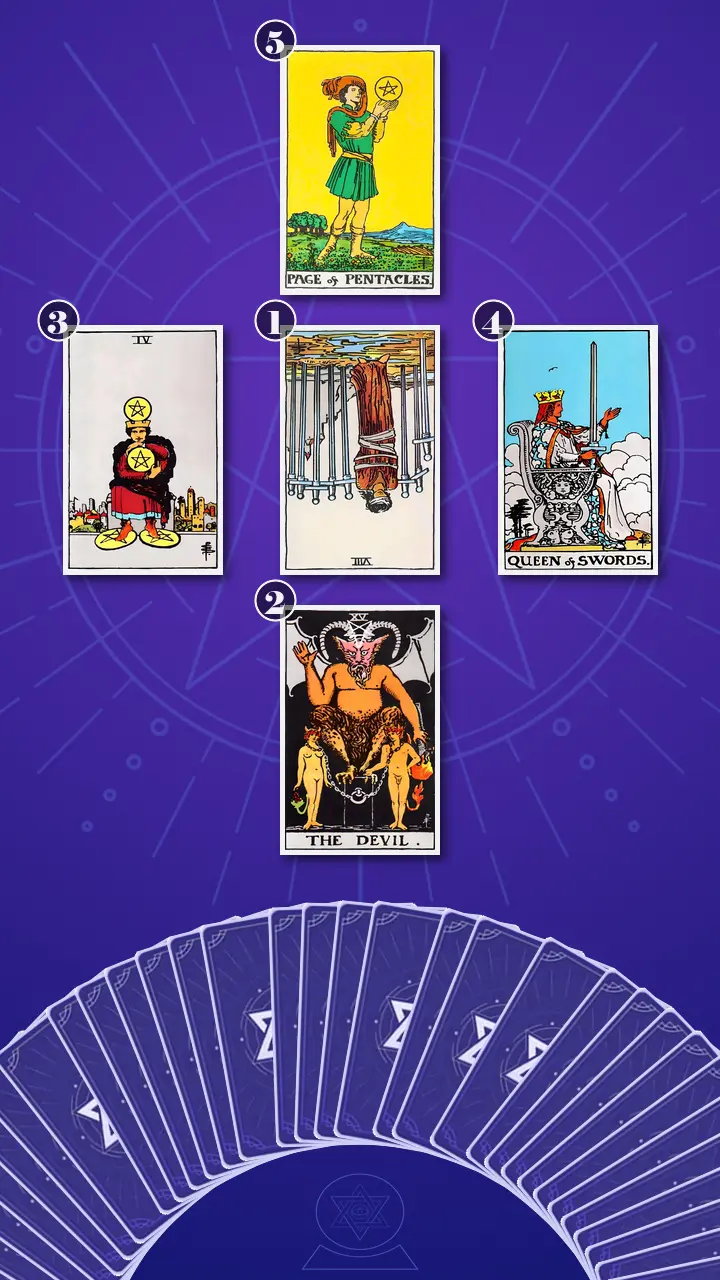
Its shape is a cross. The center card shows the presenting problem: marking nearly every sentence and feeling trapped by threat-scanning while reading. The card below it reveals the root fear: that one missed line could tank the outcome and threaten self-worth. The left card shows the old protection, the right card shows reclaimed capacity, and the top card shows the small experiment that can bring the pattern into conscious practice. A larger spread would have widened the context, but Maya did not need more noise. She needed precision, like a desk lamp redirected from a crowded page toward one clean margin note.
Reading the Map: Card Meanings in Context
I turned the cards in the order of the spread: center, root, old protection, reclaimed strength, integration. I kept reminding Maya that card meanings in context are not labels placed on a person. They are mirrors held at angles, so the person can notice which part of the room they have been avoiding.
Position 1: The Yellow Fence
Now I turned over the card representing the visible shadow pattern: marking nearly every sentence and feeling trapped by threat-scanning while reading. It was The Eight of Swords, in reversed position.
On the card, a blindfolded figure stands inside a loose ring of swords. The reversed position mattered. It suggested that the enclosure was real in her body, but not absolute in the world. Maya’s modern version was painfully clear: she opens a dense policy article at midnight and highlights the first paragraph, then the caveat, then the example, then the transition sentence, until the page becomes a yellow enclosure. The problem is not the text itself. The problem is the belief that an unmarked line could become a blade pointed at her performance.
The energy here was Blockage: Air, the element of thought, trapped inside a rule too rigid to breathe. Every sentence had to be treated as potentially dangerous, so no hierarchy could form. I said, “A page can glow and still leave you in the dark.” Maya did not nod. She gave one small, bitter laugh and looked away from the cards. “That is too accurate, which feels kind of rude,” she said. I smiled gently. “Accurate is not an indictment. It is just the first layer of the excavation.”
Position 2: The Proof Machine Under the Table
Now I turned over the card representing the hidden fear beneath the shadow: one missed line could tank the outcome and threaten self-worth. It was The Devil, in upright position.
I watched Maya’s shoulders rise before I spoke. The Devil is often misunderstood as a frightening omen, but I do not read it that way. Here it showed attachment, compulsion, and the moment a coping tool starts running the room. The loose chains around the figures’ necks were important. They looked binding, but they were not locked tight. That is the image of a habit that feels compulsory while still being interruptible.
In Maya’s life, the highlighter was not just a tool; it had become a tiny proof machine. At 12:40 a.m., under the kitchen fan and the laptop glow, the inner monologue was not simply, I want to understand this. It was closer to, If I miss this, then they will know I was never serious enough. That is the chain The Devil named: learning versus proving worth, preparation versus self-punishment.
The energy state was Excess: the natural wish to prepare had swollen into a contract with fear. Exhaustive preparation promised safety, but the cost was freedom of thought. Maya went quiet. Her hand moved to the center of her chest, thumb pressing once against her collarbone, as if checking whether the pressure I had named was physically there. “This is the part I did not want to admit,” she said. I answered, “Then we will be careful with it. We can honor why this pattern tried to protect you without letting it run the room.”
Position 3: Hoarding Highlights Like Rent Money
Now I turned over the card representing the protective strategy: hoarding information through highlights, notes, and rereading to create temporary control. It was The Four of Pentacles, in upright position.
The figure on the card clutches one pentacle to the chest, pins two under the feet, and wears another like a crown. The body says, I cannot let this go, because I might need it later. Maya’s study version was almost identical. Highlights, sticky tabs, screenshots, and color-coded notes piled up until the reading looked technically captured but mentally frozen. She saved every line like rent money in a crisis.
This was Excess Earth: control hardening into immobility. The Four of Pentacles was not mocking her. It showed a strategy that once helped. When life feels high-stakes, collecting information can give ten minutes of relief. But when every line is saved, the larger argument disappears behind the storage system. It becomes like a Notion database where every field is required, so adding notes takes longer than learning the material.
I told her, “White space is not carelessness; it is hierarchy.” She looked down at her hands, then at the card. Her fingers tightened around an invisible object and slowly opened again. “My notes look productive,” she said, “but when I try to explain the article, it turns into a list.” That was the moment the spread began to move. She was no longer asking whether she was bad at studying. She was seeing information hoarding as an understandable protection strategy that had started blocking synthesis.
When the Queen of Swords Raised One Blade
The room changed in a small, useful way before I turned the fourth card. Outside my window, a delivery truck sighed to a stop and then moved on. In Maya’s kitchen, the fan clicked off. The sudden strip of quiet made the white border of the next card look almost deliberate, as if the table itself were making an argument for space.
Position 4: The Criterion Beneath the Panic
Now I turned over the card representing the transformation capacity: discernment, mental boundaries, and self-trust that can interrupt the perfectionism loop. It was The Queen of Swords, in upright position.
The Queen sits with one sword raised cleanly and one hand open. The Queen of Swords tarot meaning in this context was not cold detachment. It was mature attention. Maya’s modern version was this: before opening the PDF, she writes one sentence at the top of the document, such as I am reading this to understand the author’s main policy tradeoff. Now the purpose decides the marks. Thesis statements, definitions, and evidence that changes the argument earn attention. Background texture can stay unmarked.
The energy state was Balance: Air no longer trapped in a cage, but held as a blade. This is where my old Cambridge and excavation brain took over. I told Maya that, on a dig, accuracy does not mean labeling every grain of soil as equally important. It means understanding stratigraphy: which layer explains the structure, which shard changes the dating, which bit of rubble is context rather than evidence. I call this Academic Stratigraphy, and the Queen of Swords was its living emblem. Her blade separated strata without despising any of them. In a PDF, that meant thesis, definition, argument-changing evidence, and background could no longer all wear the same yellow crown.
Before I gave her the sentence at the center of the reading, I asked her to picture the 12:40 a.m. table again: cold coffee, blue laptop glow, a PDF turning solid yellow, her hand hovering because the unmarked sentence looked like the exact one that might embarrass her later in seminar or at the internship.
You are not safer because every line is glowing; you are clearer when the Queen of Swords raises one blade and lets only the true point earn a mark.
For a moment, Maya did not move. First, her breath stopped halfway in, and the hand near her coffee mug froze with two fingers lifted. Then her gaze lost focus, as if she were replaying every crowded PDF she had carried into a late-night study session. Her eyes shone, but her mouth tightened with protest. “But does that mean I have been doing it wrong this whole time?” she asked, voice low and almost angry. I let the question stand. “No,” I said. “It means a strategy that got you this far is now too blunt for the work ahead.” Her shoulders lowered a fraction. The fist in her lap opened. The relief was not clean and cinematic; it came with a little vertigo, the blank feeling that arrives when a person realizes they may be allowed to stop carrying something. I asked, “Now, using this new perspective, think back to last week. Was there one moment when this insight could have made you feel even five percent different?”
She named the Line 1 train at 8:17 a.m., wet coats pressed around her, brakes squealing into Bloor-Yonge, a classmate’s perfect Notion study dashboard on her phone. She had opened the article without knowing what question she was reading for, so every sentence looked equally important. I named the shift carefully: this was not from anxious to fearless. It was from threat-scanning anxiety and perfectionist information hoarding toward grounded focus, selective reading, and cautious self-trust.
Position 5: The Apprentice With One Pentacle
Now I turned over the card representing the integration step: turning the key shift into a small, grounded study experiment for the coming week. It was The Page of Pentacles, in upright position.
The Page holds one pentacle at eye level. Not twelve. Not the whole mountain range in the distance. One learnable object. For Maya, this card showed a focused study drill: read two pages, close the laptop or hide the PDF window, write three recall bullets from memory, then reopen the document and add highlights only where memory actually needed support.
The energy state was Balance again, this time in Earth: practical learning, small repetition, visible feedback. The Page of Pentacles was not asking Maya to defeat the entire syllabus in one night. It was asking her to run a pilot version of studying that could actually be evaluated. She let out a breath that was half laugh, half exhaustion. “That sounds almost too small,” she said. I nodded. “Good. Small is how we make it repeatable. Discernment is a study skill, not a personality test.”
The Thesis Stratigraphy Framework for the Next Forty-Eight Hours
When I braided the spread together, the story was clear. The reversed Eight of Swords showed the visible symptom: panic-marking until the page became a fence. The Devil showed the root: self-worth chained to exhaustive preparation. The Four of Pentacles showed the old protection: hoarding highlights to feel briefly safe. The Queen of Swords revealed the reclaimed strength: a criterion sharp enough to decide what matters. The Page of Pentacles made that clarity practical through a repeatable drill.
The cognitive blind spot was simple but costly: Maya had been treating an unmarked line as risk and a highlighted line as competence. The transformation direction was not to care less, study less, or pretend deadlines were gentle. It was to let a clear reading question decide the highlight, then test understanding through recall instead of adding another layer of color.
When I suggested a tiny practice, Maya frowned. “But I don’t even have spare time for another method; the deadlines are why I do this.” I agreed with her. “Then it cannot be another system. It has to replace five minutes of panic, not add five minutes of homework.” I gave her my Thesis Stratigraphy Framework, adapted from the way I teach students to rebuild an essay outline: identify the load-bearing layer before decorating the surface.
- Question-Before-HighlightBefore opening one low-stakes PDF this week, type I am reading this to answer ___. at the top of the document. Spend two minutes filling the blank with the seminar prompt, memo question, or exam objective before touching the highlight tool.If your chest tightens, stop after one paragraph and count the discomfort as data, not failure.
- The One-Blade RuleFor one article, highlight only thesis statements, definitions, and evidence that changes the argument. Use one sentence per paragraph when possible, and add a five-word reason beside each mark, such as defines main policy tradeoff.If the urge to mark everything spikes, write unclear in the margin and move on until the end of the section.
- Read-Close-Recall DrillRead two pages, close the laptop or hide the PDF window, and write three recall bullets from memory in a notes app. Reopen the PDF only after the bullets, then highlight where memory actually needed support.Set a six-minute timer and treat it like a skill drill, not a new identity or a final study method.
A Week Later: The Quiet Proof
A week later, I received a message from Maya between my morning tea and a stack of student essays. She had opened a policy briefing note for the internship, typed the reading question at the top, and used the one-sentence-per-paragraph rule on the first two pages.
She did not describe a miracle, which made me trust the message more. She slept through Tuesday night, then woke with the old thought, What if I missed it? This time, she smiled at the blank margin and left two background lines alone.
She also sent her supervisor a two-paragraph response before rebuilding the notes into another color-coded system. That was the proof I cared about. Not perfection. Not instant confidence. A cleaner action, taken while some uncertainty was still present.
That is what this Journey to Clarity gave her. The cards did not hand down a fate; they showed the architecture of a habit. Maya chose the next mark. Maya chose the white space. Tarot offered the map, but she remained the one holding the blade.
If tonight every unmarked line makes your chest tighten, I would want you to remember what I told her: it is not because you are careless. It may be because part of you has been trying to prove you belong by never missing anything.
If you let one clear question guide the next page, what is the smallest mark you would choose to make, and what might you leave blank on purpose?
This story is adapted from psychological research, written so that those in a similar struggle can see their own pattern in it — and find their next step clearly.These insights are not a substitute for professional psychological, medical, legal, or financial advice.
Learn more about our Journey to Clarity.
How did this insight land for you?
🫂 This Resonates Deeply
🌀 Living This Story
✨ Now I See Clearly
🌱 Seeing New Possibilities
🧰 Useful Framework
🔮 The Confirmation I Needed
💪 Feeling Empowered
🚀 Ready for My Next Step
Author Profile
 AI
AI“Having spent a lifetime at Cambridge and on archaeological digs, I’ve witnessed the rise and fall of countless civilizations. Please know that your current struggles are not a permanent fate, but merely a necessary fracture before rebuilding. I won't lecture you; instead, I invite you to sit with me in the ruins, using a patient, historical perspective to gently dust off the true, enduring value hidden beneath your temporary doubts.”
In this Study Tarot Reading :
Core Expertise
- Academic Stratigraphy: Structuring fragmented knowledge points into a cohesive, enduring cognitive framework.
- Research Bottleneck Analysis: Treating creative blocks not as personal failures, but as signals requiring deeper intellectual excavation.
Service Features
- The Thesis Stratigraphy Framework: A structural methodology to rebuild your essay outline, ensuring core arguments pierce through intellectual clutter.
Also specializes in :
Explore Related Patterns:
Boundary DiscernmentMaya's turning point comes when the highlight tool stops being the first move and a reading question becomes the first move. By writing what she is reading to understand, she gives her attention a boundary before the PDF can flood the room. Boundary Discernment is the upright pattern here because the page is no longer treated as a field where everything has equal claim on her nervous system. Thesis statements, definitions, and argument-changing evidence can earn a mark, while background texture is allowed to remain unmarked without being turned into a threat. You can feel the psychological shift in the white space. It is not carelessness; it is a visible decision. The boundary is what lets Maya move from proving she captured everything to trusting that selectivity is part of real comprehension.
CatastrophizingMaya's hand hovering over the same paragraph for the third time shows how a normal study cue has become a threat signal. A sentence is no longer just a sentence; if it stays unmarked, it starts to feel like the one detail that could later expose her as careless or underqualified. That is the logic of Catastrophizing: the mind jumps from a small uncertainty to a high-stakes consequence before the evidence has been tested. The highlighter then becomes a short-term anxiety regulator, because marking the line briefly reduces the imagined future disaster. You can see why the habit feels so hard to interrupt. The issue is not that Maya cares too much about school or work; it is that her attention has been trained to treat every unmarked line as a possible failure point. Once that mechanism is named, the work becomes less about forcing calm and more about rebuilding the bridge between evidence, priority, and self-trust.
Conditional Self-WorthMaya does not only fear missing content; she fears what missing content might seem to prove about her. The story names the exact leap: one missed line could mean she is careless, underqualified, or not quite allowed to belong in the room. That is Conditional Self-Worth operating through study behavior. The task becomes a referendum on identity, so preparation has to carry more weight than preparation can realistically hold. Highlighting every sentence starts to function like a contract: if everything is marked, maybe her worth and competence are protected. You can feel the trap in how exhausting the method becomes. The more her belonging depends on never missing anything, the less room she has to think, summarize, or trust her own judgment. The shift is not toward caring less; it is toward separating academic precision from the deeper fear that a small gap in recall equals a flaw in the self.
Imposter SyndromeMaya's fear of the unmarked sentence is tied to a very specific social and professional image: later embarrassment in seminar or at the internship. The missed line is imagined as the moment someone might discover she was never serious enough or qualified enough. That makes Imposter Syndrome a strong fit. The mechanism is not simple insecurity; it is the habit of treating ordinary gaps, uncertainty, or incomplete recall as evidence that legitimacy was fragile all along. Her repeated highlighting becomes a defensive performance of competence, meant to prevent exposure. You can see why the page becomes crowded so quickly. If every line might be the line that proves she does not belong, selectivity feels dangerous. The repair begins when competence is no longer measured by total capture, but by her ability to identify the argument, test recall, and act while some uncertainty is still present.
Information HoardingMaya's PDFs turning neon by page three make Information Hoarding visible at the level of the page. Highlights, sticky tabs, screenshots, and color-coded notes create the feeling that the material has been captured, but they also freeze her ability to tell which parts actually carry the argument. The protective function is understandable. When the internship briefs and graduate readings feel high-stakes, saving everything offers a quick sense of control. The problem is that the storage system starts doing the emotional work that comprehension is supposed to do, so the page looks productive while the main point becomes harder to retrieve. You are not looking at laziness or lack of discipline here. You are looking at a control coping loop where collecting information briefly quiets the fear of missing something, then creates so much noise that more collecting feels necessary. The pattern loosens when white space becomes hierarchy rather than evidence of carelessness.
Explore Related Struggles:
Performance-Worth FusionMaya tells the reader that one missed line could become proof that she is careless, underqualified, or not quite allowed to belong in the room. The highlighter is no longer just a study tool; it has been recruited into a courtroom where every mark argues that she took the work seriously enough. You can feel the pressure shift from comprehension into self-verification. Reading the article becomes tangled with proving legitimacy, so the smallest blank space on the PDF can start to feel like a gap in your right to be there. Performance-Worth Fusion fits because the story binds academic and professional output to personal worth. The real strain is not that Maya cares about doing well; it is that doing well has become the condition under which she is allowed to trust her own place in the room.
Future-Proofing ParalysisMaya sits at the kitchen table after midnight with a dense policy article open, cold coffee nearby, and her hand hovering over the same paragraph for the third time. The unmarked line is not behaving like neutral text in that moment; it is behaving like a future receipt that could be used against her in class, at the internship, or inside her own judgment. You are not simply trying to study harder when every sentence starts glowing. You are trying to build a protective wall against a future version of failure before it has happened, which makes the present page feel unsafe until it has been fully controlled. Future-Proofing Paralysis names the lock that forms when preparation stops being a bridge into understanding and becomes a shield against imagined exposure. The more thoroughly you try to prevent every possible mistake, the less room you have to notice the actual argument in front of you.
Internal Authority CollapseMaya opens the article on the train without knowing what question she is reading for, and every sentence starts to look equally important. At the kitchen table, the same absence of a criterion leaves her hand hovering because the page has become louder than her own judgment. You are not failing because you need structure. The deeper bind is that the authority to decide what matters has slipped outward into the PDF, the imagined evaluator, the perfect Notion dashboard, and the fear of being caught unprepared. Internal Authority Collapse names the loss of an inner ranking system. Maya's shift begins when one reading question is placed at the top of the document, because that small act returns decision-making from the glowing page back to the person holding the tool.
Monitoring-Safety FusionThe PDF is neon by page three, and Maya still feels like she missed the point. Every sentence has been watched, marked, and pulled into the safety system, but the page has not become clearer. You are caught in a structure where monitoring starts to impersonate protection. If the line is highlighted, it briefly feels handled; if it is blank, it feels exposed. That rule can make the whole page glow while leaving your actual understanding stranded. Monitoring-Safety Fusion names the moment surveillance becomes the substitute for trust. In the reversed state shown by Maya's habit, the safety signal has hardened into a closed circuit: the more you check, mark, and secure, the less freedom your attention has to choose what matters.
Panic Productivity TrapMaya's highlights, sticky tabs, screenshots, and color-coded notes pile up until the reading looks productive from the outside. Inside the process, though, the activity is not guided by one clean question; it is trying to quiet the feeling that any unmarked sentence could become the one that exposes her. You can be working intensely and still be trapped in a loop that is feeding urgency more than understanding. The effort is real, but the relief it gives is short-lived, so the system asks for one more highlight, one more note, one more layer of control. Panic Productivity Trap fits because Maya's visible output hides the cost of the method. The work looks disciplined, yet the structure underneath keeps replacing usable comprehension with temporary reassurance.
Knowledge-Output GapMaya's PDFs become crowded with highlights, sticky tabs, screenshots, and color-coded notes, but when she tries to explain the article, it turns into a list. The material has been captured, yet it has not become something she can use. You may recognize the specific friction here: the page looks worked on, the notes look serious, and the effort is visible, but the argument still refuses to organize itself in your mind. The study system stores information without giving you a way to turn that information into recall, judgment, or speech. Knowledge-Output Gap names the space between collecting content and being able to produce meaning from it. In Maya's case, the gap widens because every sentence receives the same visual importance, so the thesis, definitions, evidence, and background all collapse into one undifferentiated block.
Explore Related Emotions:
Belonging ShameA classmate's perfect Notion dashboard appears on Maya's phone while she opens the article without knowing what question she is reading for. In that moment, the blank margin is not just blank; it starts to look like evidence that everyone else knows the rules of the room better than she does. Belonging Shame names the sting underneath the study habit. You are trying to prove you belong by never missing anything, because missing something has started to feel like a character flaw instead of a normal part of learning. The shame is quiet but central. It does not say, 'I need a better method.' It says, 'If I leave this unmarked, maybe I will be found out as someone who was never fully allowed here.'
Impostor AnxietyMaya is not only afraid of misunderstanding the article; she imagines the unmarked sentence becoming the exact one that could embarrass her later in seminar or at the internship. The page is carrying the gaze of the room before she even gets there. Impostor Anxiety enters when preparation turns into a defense against being exposed. You are not simply asking, 'Do I know this?' You are bracing against the thought that one missed detail could reveal you as less capable, less serious, or less entitled to your place. That makes the highlighter feel like protection from exposure. Every glowing sentence becomes a small attempt to prove that you did enough to deserve being there.
Evidence AnxietyAt 12:40 a.m., Maya's hand hovers over the same paragraph for the third time while the PDF is already turning neon. The mark is no longer just a study cue; it has become a way to keep a future accusation from forming. Evidence Anxiety fits because the page starts behaving like a courtroom record inside her body. You are not only trying to understand the argument; you are trying to leave no blank space that could later be used as proof that you were careless, underqualified, or not serious enough. The pressure lands in the exact shape of the question: one missed line feels like it could tank you because the missed line has been loaded with moral evidence. Highlighting everything becomes an attempt to protect your future self from being judged by a sentence you did not catch.
White-Knuckle SecurityHer jaw sets hard around the sentence, 'I don't know how to study unless I can see every sentence glowing.' The body already knows the bargain: grip the method tightly enough, and maybe the future will not have room to accuse you. White-Knuckle Security is the brittle safety of holding on so hard that the holding becomes its own pressure. You get a short hit of control from saving every line, but the cost is that the page stops breathing and the larger argument disappears behind the storage system. This is why the habit can feel protective and punishing at the same time. The highlights promise safety, but they only keep their promise if you keep tightening your grip.
Hypervigilant AnxietyShe highlights the first paragraph, then the caveat, then the example, then the transition sentence, until the page becomes a yellow enclosure. The study method is being pulled by threat detection, not by comprehension. Hypervigilant Anxiety names the inner weather of a mind that cannot let any line stay neutral. You scan the page as if danger might be hiding in a sentence that looks ordinary, so the body keeps asking for one more mark, one more check, one more pass. That is why the PDF can glow and still leave you in the dark. When every line is treated as potentially dangerous, attention loses hierarchy, and the reading experience becomes surveillance instead of learning.
Cautious Self-TrustA week later, Maya leaves two background lines alone while the old thought, 'What if I missed it?' is still present. She does not wait for total confidence before acting; she lets a small amount of uncertainty remain and still chooses the cleaner mark. Cautious Self-Trust fits because the change is not dramatic or spotless. You are practicing the feeling of being allowed to decide what matters without forcing the page to certify your worth line by line. Sending the supervisor a two-paragraph response before rebuilding the notes matters because it shows trust becoming behavioral. The self-trust is cautious, but it is real enough to move before the control system fully takes over.
Explore Related Contexts:
Academic Legitimacy ScrutinyYou are reading with the sense that one missed line could become proof that you are careless, underqualified, or not quite allowed to belong in the room. That puts the page inside a social test, where each mark is doing work beyond comprehension. When grades and work quality carry that much weight, completeness starts to look like protection against being read as out of place. The highlighter becomes a way to leave a visible record that you took the room seriously, even before you know whether the text itself needed that level of coverage.
Attention Economy Study TrapYou are sitting at a small kitchen table at 12:40 a.m. with a half-cold coffee, a fan humming, and a dense policy brief that keeps demanding attention sentence by sentence. In that setup, the page stops behaving like an argument with structure and starts behaving like a stream of equally urgent signals. The highlighter becomes a way to keep up with that pressure, because every line seems to carry the same risk if it stays unmarked. What looks like over-marking is really a response to a reading environment that erases the difference between what matters now and what can wait.
Hidden Curriculum GapYou open the article without a reading question in place, then glance at a classmate's polished Notion dashboard on your phone and get a side-by-side picture of how legible the rules seem for everyone else. The problem is not that you cannot read; it is that the method for deciding what counts has not been made explicit in the moment. Once that hierarchy is missing, every sentence gets treated as if it might be the one that decides the grade, the memo, or the seminar answer. Highlighting everything becomes a way to reverse-engineer an unspoken method that nobody handed you in a clean form.
Academic Overload SpiralYou are moving between a demanding graduate program and a part-time policy internship, then trying to read dense briefs late at night while the day is already spent. That gives the page the feel of one more assignment arriving after your attention is already divided. In that kind of stack, it becomes harder to pause and decide what matters before the next paragraph lands. The over-highlighting is sitting inside a schedule that leaves too little room for hierarchy, so maximum coverage feels like the only reliable way to keep up.