After Work, One Reopened Thread, and the No That Stayed Clean

The 9:41 P.M. Thread That Turned One No Into a Trial
When Jordan sat down with me, I told her something I say often in readings about guilt-tripped boundaries in friendship: if you have ever sat on your bed after work rewriting the same text so you do not sound cold, selfish, ungrateful, or dramatic, you are not overreacting. You are probably in a very specific kind of people-pleasing loop.
She was twenty-seven, a marketing coordinator in Toronto, and the kind of friend who was usually the first to answer the group chat, the first to plan dinner, the first to notice when someone sounded off. She described a Wednesday at 9:41 p.m. so vividly that I could almost hear it with her: the condo heater clicking on and off, streetcar noise slipping through the window, her work laptop still half-open on the bed, her phone warm in her hand, one long iMessage glowing hard in the dark room. She had already said no. But the thread was back, soft at first, apologetic even, and then there it was again: after everything I’ve done for you.
As she spoke, her thumb kept running along the edge of her phone case. Her throat tightened mid-sentence; her stomach seemed to brace before the rest of her caught up. Guilt sat in her like wet laundry twisted in a drain—heavy, cold, and clogging the clean exit she had already tried to make. She wanted to say no and set a boundary. She also wanted, immediately, to prove she was still loyal the second old favors were used as leverage.
“I can say no until they make me feel like I owe them,” she said. “And then I hate how fast I start explaining myself.”
I nodded. “That makes sense. This is not you failing at friendship. This is one limit getting treated like a whole character trial. We’re not here to decide whether you’re good or bad. We’re here to make a map, so you can see what is yours, what is theirs, and what boundary is actually clean enough to hold.”

Choosing the Compass: A Five-Card Relationship Spread for Friendship Boundaries
I asked Jordan to put her phone face down on the table and take one slow breath that was longer on the exhale than the inhale. Then I shuffled. Not for theatre, and not to make the room feel mystical for no reason, but because that small pause helps the nervous system step out of the message-thread spiral and into observation. That is how tarot works at its best for friendship boundaries and guilt: not as a verdict, but as a pattern map.
For her reading, I chose the Relationship Spread · Context Edition, a five-card relationship tarot spread I use when the issue is not prediction but clarity. It is lean enough to hold both sides of an interaction without collapsing into blame. It lets me separate her emotional posture, the friend’s pressure, the deeper relational dynamic, the hidden inner block, and the cleanest boundary available now.
I told her what I was looking for as I laid the cards in a cross. The first card would show what her nervous system does in the first boundary moment, before the other person has even fully reacted. The second would reveal how the other person’s energy is showing up in the current interaction, especially any move that turns past support into present pressure. The center card would name the real pattern underneath the latest text thread. The fourth, below, would expose the blind spot that makes the whole thing feel impossible to navigate. And the fifth, above, would show the clearest next step—the tone and sentence that could protect both self-respect and clarity.
The shape of it always feels cinematic to me: self on one side, other on the other, the dynamic at the center, the fear beneath, and the wiser response above—like a small bridge drawn over a fault line.
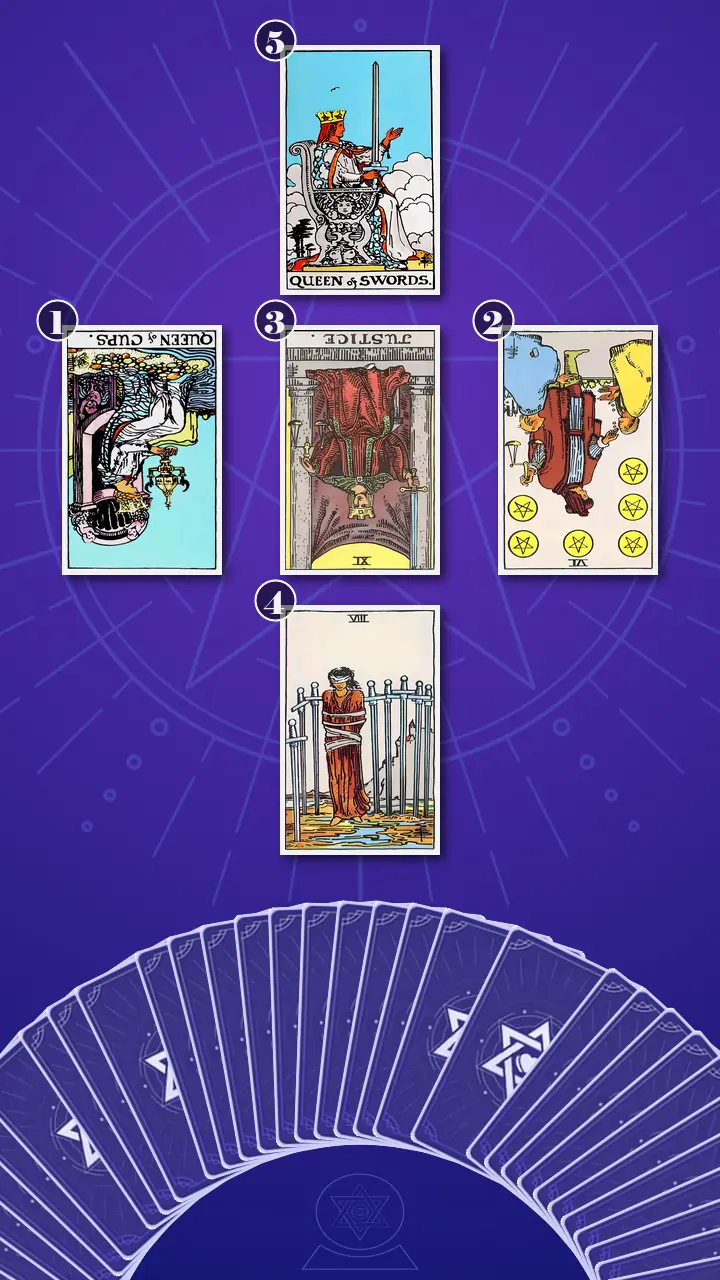
Reading the Fault Line: Card Meanings in Context
As I turned the first four cards, I kept translating everything into life-language. Card meanings in context matter more than abstract definitions, especially when someone is asking, in plain terms, “My friend brings up old favors when I say no—what boundary do I set now?”
Position 1: The Care That Starts Apologizing for Itself
Now I turned over the card representing the guilt-soaked people-pleasing response that shows up the moment she first says no. It was The Queen of Cups, reversed.
I pointed to the image and then back to her story. “This is the part of you lying on the bed with your work laptop still open, rereading the thread, imagining your friend’s hurt tone, and drafting a softer reply that manages her feelings more than your own capacity. What started as a limit becomes an emotional caretaking shift.”
In energy terms, this was excess. Not too much kindness in some moral sense, but too much responsibility for another person’s emotional weather. The Queen of Cups reversed does not stop caring; she becomes so porous that she starts treating someone else’s disappointment like her assignment. The lidded cup in the card felt important to me here. Jordan was trying to contain everything at once—her friend’s mood, her own guilt, the history between them, the future of the friendship—while the restless sea behind the queen kept spilling over the edges anyway.
I told her what I saw in real time: “This is the unread badge or typing bubble hijacking the body before the mind. You know what you need to say, but the second you imagine their reaction, it feels impossible to say it cleanly. That’s the split. Care is real. Self-erasure is not the same thing.”
Jordan gave a small laugh that had more sting than humor in it. Her fingers tightened around her sleeve, then released. “That is so accurate it’s almost rude,” she said softly. Then she nodded once. “Yes. That’s exactly how it feels.”
Position 2: The Hidden Ledger
The next card represented the pressure tactic that turns past support into leverage in the current boundary moment. I turned it over: Six of Pentacles, reversed.
“Here’s where the conversation tilts,” I said. “This is the friend responding to your no by bringing up old rides, old favors, emotional support, who showed up during the breakup, who was there first. Suddenly the present request is no longer the issue. The whole thing starts feeling like Splitwise, but for emotional labor.”
This was blocked reciprocity, the kind that looks like generosity on the surface but starts carrying a hidden invoice the second you say no. The card’s scales and falling coins told the whole story: giving that is remembered strategically, not held freely. I was careful with my words here. I was not interested in using one tarot card to declare her friend a villain. Tarot is more useful than that. What mattered was how this landed in Jordan’s experience: a friendship moment beginning to feel transactional, as though gratitude had quietly been converted into stored credit.
“Gratitude is not a forever tab,” I told her. “Past support can be real and meaningful. It still does not create permanent access to your time.”
At that, her jaw shifted. She looked down at the card, then away toward the window, as if some private math had finally been named out loud. “That phrase makes me uncomfortable,” she admitted. “Which probably means it’s true.”
Position 3: When Justice Reversed Turns a Boundary Into an AITA Hearing
The center card is always the heart of the pattern. I turned it over and found Justice, reversed.
I felt that familiar internal click I get with this card. As an artist, Justice reversed never makes me think of punishment first. It makes me think of an editing room—one honest line keeps getting cut, re-cut, buried under voice-over, until the original scene is almost unrecognizable. That was exactly what was happening in her texts.
“This,” I said, tapping the card lightly, “is the real issue. Your no is getting put on trial. The current choice isn’t being treated like a present-day question of consent and capacity. It’s being moralized. You’re not just deciding whether you can help. You’re suddenly trying to prove you are not selfish, unfair, or disloyal.”
I translated it into the modern scene she knew by heart: the screenshots in your head, the wording review, the urge to send your draft to two friends for approval, the sense that one normal no has turned into a private AITA hearing over whether you are still a good person. In energy terms, this was distortion. Fairness itself had become skewed. One person’s boundary was being examined in microscopic detail while the pressure being applied to that boundary escaped the same scrutiny.
“A clean no does not need a closing argument,” I said. “The minute you have to defend your character inside the boundary itself, the conversation has already been dragged out of the present.”
Jordan stared at the card for a long second. “That’s it,” she said. “I wasn’t just saying no; I was trying not to get convicted by it.” The words landed in the room and stayed there. Her shoulders lowered a fraction, not from relief exactly, but from recognition.
Position 4: The Typing Bubble Prison
Then I turned over the card beneath the center—the internal block, the hidden belief that saying no automatically makes her unfair, selfish, or disloyal. It was Eight of Swords, upright.
“This is the trap feeling total before it has actually been tested,” I told her. “This is you assuming every direct boundary will end badly, so you start softening it, bargaining, or reopening it before the other person has even fully responded. The body reacts first—jaw locks, shoulders rise, breathing gets shallow—and then the mind writes a story where there is no safe exit.”
In energetic terms, this was pure blockage. Not lack of intelligence, and not lack of care. Fear was acting like inevitability. The blindfold and loose bindings in the card mattered to me, because they showed the exact kind of prison people-pleasing creates: real in sensation, incomplete in fact. The consequences Jordan was predicting were vivid, but not proven.
I leaned in a little. “Notice the difference between forecasting and fact-checking. The trap starts loosening the second you realize fear is writing a trailer for a movie that hasn’t actually been filmed yet. Do not let fear write the reply.”
Her hand moved to her throat without her seeming to notice. “I always assume it means the friendship is about to break,” she said.
“Yes,” I said. “And that assumption is exactly why you start overexplaining. Not because the boundary is wrong, but because your nervous system thinks there is no safe way to be disappointing.”
When the Queen of Swords Lifted Her Blade
Position 5: Guidance That Sounds Finished
When I reached for the final card, the heater gave one last metallic click and went quiet. Even the street sound outside seemed to pull back for a beat. This was the most important card in the reading: the boundary that could be stated now, and the tone that would keep it clean, firm, and self-respecting. I turned it over and found The Queen of Swords, upright.
“This is the guidance,” I said. “A message that acknowledges the history without surrendering the present: ‘I appreciate what you’ve done for me, and I’m not available for this.’ Then you stop editing it into a plea for approval. The point is not to sound icy. The point is to sound finished.”
This card was balance—clean air after flooded water. And this was where one of my favorite diagnostic lenses came in. I call it Sidekick Syndrome Diagnosis: the moment I can see that a friend group, or sometimes one very defining friendship, has quietly assigned someone a fixed role so the whole system stays comfortable. Jordan had been cast as the reliable one—the first responder, the emotional organizer, the person whose availability keeps the scene moving. The Queen of Swords was not asking her to become colder. She was asking her to resign from a role that had turned her loyalty into open access.
I looked at her and gave the setup slowly, so her body had time to hear it. “You know that moment when you’re on your bed after work, rereading the thread with your throat tight, and what started as one boundary somehow turns into a full explanation of your character, schedule, and loyalty?”
Not every past favor becomes a lifetime debt; speak one clean sentence and let the Queen of Swords’ blade separate gratitude from obligation.
Jordan went completely still. First came the freeze: her breath paused, her fingers hovering above her tea mug as if her body had missed a step. Then came the cognitive drop-through. Her eyes unfocused and slid past me, and I could almost see the rerun happening behind them—the bed, the Notes app, the deleted drafts, the hot face, the Sunday-night scroll back through old messages like evidence. When she looked at me again, her eyes were brighter, not teary exactly, but lit from the shock of hearing the right thing too plainly.
“But if I say it that cleanly,” she said, voice thin at first, “won’t she think I’m cold?”
That was the vulnerable edge after clarity—the brief dizziness that comes when the path appears and suddenly belongs to you. I kept my voice gentle. “She may feel disappointed. That feeling can be real. It is still not proof that your boundary is wrong. Their disappointment is real; it is not your assignment.”
Her shoulders dropped a full inch after that. She pressed her lips together, then let out a breath that sounded like it came from somewhere below language. I asked, “Now, with this new perspective, can you think of a moment from last week when this would have changed how you felt?”
She gave a small, almost disbelieving laugh. “Sunday night,” she said. “I had the right sentence in draft three. I buried it under everything after.”
That was the shift, right there. Not from kind to cruel. Not from loyal to detached. From guilt-soaked over-explaining to grounded self-respect and concise truth.
I gave her one immediate reinforcement so the insight could land in action before the old loop reclaimed it. “Within the next ten minutes, open Notes and write two lines: ‘What I appreciate’ and ‘What I’m not available for.’ Then draft one boundary sentence in three lines or fewer. You do not have to send it tonight. If your body spikes, stop there. That still counts. Clarity doesn’t have to arrive as a dramatic speech. Sometimes it arrives as one clean draft.”
From Insight to Action: The Clean Sentence Boundary
By the time I looked back across the full spread, the story was clear. Jordan’s empathy had been turning inward against her in the Queen of Cups reversed: she felt the friend’s disappointment so fast that she abandoned her own capacity. The Six of Pentacles reversed showed why the thread felt sticky: past support was being pulled forward as leverage, and friendship was starting to carry hidden-ledger energy. Justice reversed put the whole thing in brutal focus: this was no longer just a request. It had become a moral trial, a referendum on whether she was still good. Underneath it, Eight of Swords showed the blind spot that kept the cycle alive—she was treating anticipated blame like settled fact. And above it all, the Queen of Swords offered the antidote: a clean sentence boundary that separates appreciation from obligation and lets the other person manage their own reaction.
The cognitive blind spot was simple, but powerful: Jordan had been confusing being understood with being allowed to have a limit. She thought the boundary would become valid only if she could make it land perfectly. But that is not how self-trust works. The transformation direction in this reading was much cleaner than that: shift from proving loyalty with explanations to stating limits clearly and letting the other person handle their own disappointment.
I told her this is where the reading becomes real life. Small actions. No performance. No waiting to become a different personality first.
- Draft the Clean Sentence in NotesTonight, or tomorrow morning before reopening the live iMessage thread, spend two minutes in Notes writing: “I appreciate what you’ve done for me. I’m not available for this.” If you need a third line, make it logistical: “I won’t be able to revisit this.”If it feels cold, remember that clarity is not cruelty. Save it first if you need to. You are allowed to wait until your body is calmer before sending.
- Make the Appreciation / Current Capacity NoteOn your phone, create a two-column note called “Appreciation / Current Capacity.” On the left, list one or two past kindnesses you genuinely value. On the right, list what you are still free to decline now. Read it once before replying to any guilt-heavy message this week.This is for your clarity, not for performance. If it feels overly formal for friendship, good—that probably means it is interrupting an old automatic script.
- Use The Role Resignation ActIf the negotiation starts again, do not generate fresh evidence. Send one graceful refusal of the character you have been assigned: “I know I’m often the one who jumps in, but I can’t do this, and I’m not reopening it.” Then, if needed, copy-paste your original boundary once instead of writing a whole new defense.This is me refusing the role of always-available sidekick, not rejecting the friendship. Before you send it, put the phone face down, unclench your jaw, drop your shoulders, and take one long exhale so fear does not write the first draft.
That was my actionable advice to her, and it was intentionally modest. A boundary does not become more real because it is dramatic. It becomes more real because it is repeatable.

A Week Later: The Quiet Proof
Five days later, Jordan sent me a short message. She had drafted the boundary in Notes during her lunch break outside the office, with cold Toronto air on her face and Slack still stacking up in the background. She used two lines. When the friend replied by reopening the conversation, Jordan copied her original boundary once instead of producing a fresh paragraph. Then she put her phone face down and sat alone in a coffee shop for twenty minutes, shaky but steady.
The next morning, she told me, her first thought was still, What if that sounded harsh? But this time she smiled at the thought instead of obeying it. She did not reopen the thread. That was the proof. Not a solved life. Not a perfect friendship. Just the first visible evidence that her self-respect had stopped needing courtroom paperwork.
That is what I love most about a real Journey to Clarity. The cards do not seize your life and fix it for you. They hand your own pattern back in a shape you can finally see. Jordan was the one who chose the sentence. Jordan was the one who let it stay clean. Jordan was the one who stepped out of the role and into authorship.
There is a very specific kind of loneliness in feeling your throat tighten around a no you already meant, because part of you still believes that disappointing someone could cost you your place with them. If that is where you are tonight, I want you to know that this ache is human. Seeing it clearly is not the failure of belonging; it is the beginning of self-trust.
So when the next thread lights up and the old script tries to cast you as the endlessly available sidekick, what one honest sentence would let you stay kind, step back into the lead of your own scene, and keep the boundary intact this week?