Finding Clarity in the 10:47 p.m. Skip-Level Spiral
If you are a 28-year-old product, design, data, or ops person in a city tech job and a skip-level meeting just landed on your calendar, you may already know the private weather of self-advocacy paralysis before a skip-level meeting: the invite arrives, and one honest sentence suddenly feels like a legal statement.
Maya brought that exact self-advocacy anxiety to me on a rainy London evening. She worked as a product insights analyst at a mid-sized tech company, respected by close teammates but unsure whether anyone above her direct manager could actually see the judgment she brought to the work.
At 10:47 p.m. the night before our reading, she had been at her small kitchen table in East London with a half-cold mug of tea gone tannic, laptop heat warming her wrists, and the Google Doc cursor blinking beside the sentence: “I led the customer insights synthesis.” She changed it to “I helped pull together some research context,” heard the laptop fan hum, felt her jaw lock, and told herself she was just being professional.
“I do not want to brag,” she told me, pressing her thumb into the side of her mug, “but I also do not want to disappear. My skip-level meeting got booked. How do I stop underselling myself?”
What I heard underneath her words was not lack of preparation. It was anticipatory anxiety with a hidden ache for recognition, like wearing a blazer lined with static: technically composed, but every movement sparking against the skin.
I said, “We are not going to turn you into someone louder. We are going to separate accuracy from exposure. Let us use the cards as a map for finding clarity, so you can walk into the meeting with evidence, context, and your own voice still intact.”

Choosing the Compass: The Four-Layer Insight Ladder Spread
I asked Maya to take one slow breath and bring the meeting into focus, not as a performance exam, but as a real conversation with a senior leader. I shuffled the deck slowly. In my practice, the shuffle is not theatre; it is a threshold, a way of letting the nervous system stop sprinting long enough to notice the pattern.
For this reading, I chose the Four-Layer Insight Ladder tarot spread for career visibility and self-advocacy anxiety. I use a Jungian psychological lens, so I am not asking the cards to announce a fixed outcome. I am asking them to show us the archetypal shape of the knot: where the symptom appears, what fear feeds it, what quality can transform it, and how that quality becomes behavior.
This spread fit Maya better than a large Celtic Cross. Her question was not really “Which option should I choose?” It was “Why do I keep softening my impact when I need to be clear?” Four cards were enough: the current snag, the root fear, the turning point, and the integration step.
I laid the cards left to right, like a sentence being edited from vague and apologetic into clean, accurate speech. I told her, “The first card will show where the self-censorship is happening in real time. The second will show the deeper readiness fear. The third will name the energy that challenges the belief that visibility equals arrogance. The fourth will give us the communication stance you can actually take into the room.”
Reading the Map: The Google Doc Cage
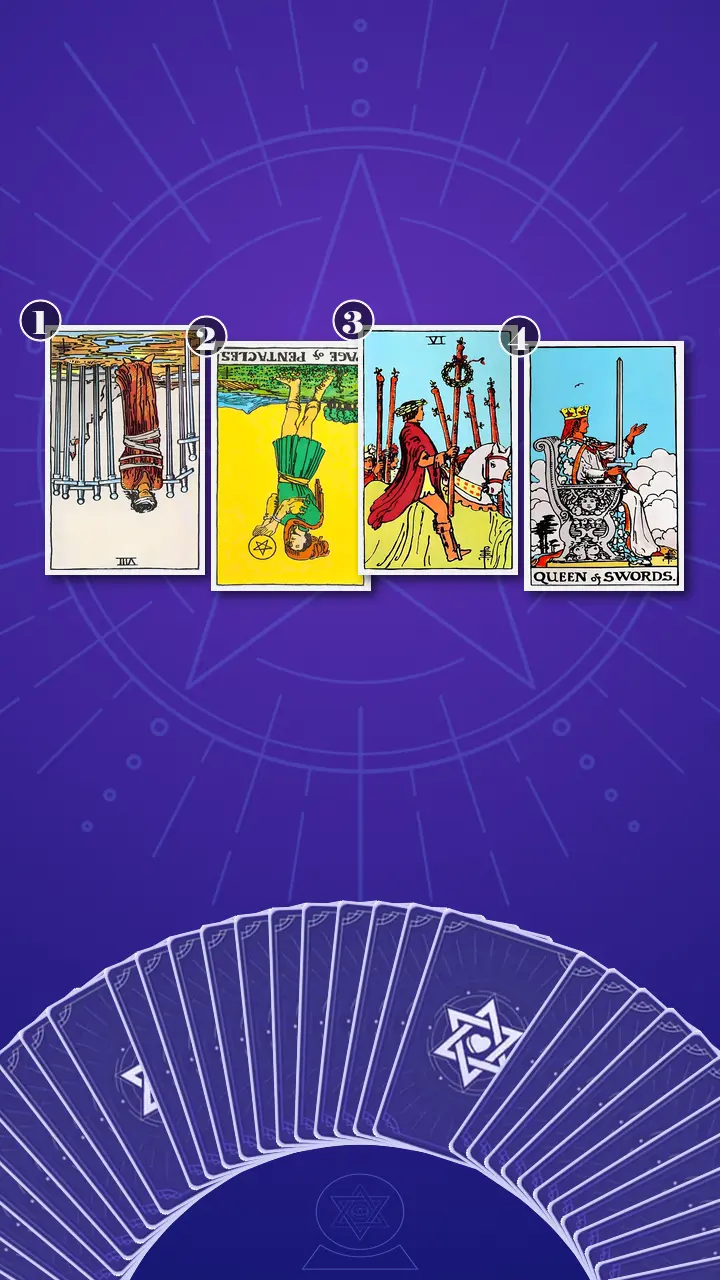
Position 1: Eight of Swords Reversed
Now I turned over the card representing the current visible snag: the specific habit of softening, deleting, or shrinking evidence before the skip-level meeting. The card was the Eight of Swords, in reversed position.
In the Rider-Waite-Smith image, a blindfolded figure stands loosely bound among upright swords. Reversed, I do not read this as doom. I read it as the beginning of release, but only if the person notices how the cage is being maintained. Here, the swords were not Maya’s actual accomplishments. They were the imagined judgments around them.
I told her, “This is not showing me that you have nothing to say. It is showing me that the Google Doc becomes a cage: every clear verb looks like a blade pointed back at you, so you rewrite ‘I led the synthesis’ into ‘I helped with some research context’ and call the shrinkage professionalism.”
The energy here was blocked Air. Thought, language, rehearsal, and analysis were all active, but they had turned inward. Instead of helping Maya communicate, her mind was policing every word for social risk. It was the same feeling as treating a calendar invite from a senior leader as a legal summons instead of a conversation.
I asked, “When you look at your prep doc, which accurate word are you most tempted to replace: led, shaped, recommended, owned, or something else?”
She gave a small, bitter laugh, then looked away from the card. “That is too accurate, honestly. A bit rude.”
I smiled, but kept my voice steady. “Rude would be using the card to shame you. I am using it to locate the hinge. The first draft often knows what happened. The anxious edit is what hides it.”
Her hand stilled around the mug. I watched the first loosening happen, not as instant confidence, but as the tiniest pause before the next self-correction. That pause mattered. It meant she could begin to see the edit as a move, not as truth.
Position 2: Page of Pentacles Reversed
Next I turned over the card representing the deeper root: the fear that clear self-advocacy will expose a lack of worth or readiness. The card was the Page of Pentacles, in reversed position.
The Page studies the pentacle carefully. Upright, that focus can be humble learning, practical growth, and early mastery. Reversed in this position, the focus had tightened into over-inspection. Maya was not just preparing a talking point; she was holding one accomplishment up to the light as if it had to prove her entire readiness for the room.
I said, “This is the part of you that keeps asking whether the example is strategic enough, senior enough, measurable enough, and perfectly phrased enough for a skip-level. Preparation turns into a private audit of whether you deserve to be there.”
Earth was present here, but unstable. The evidence existed: the project, the synthesis, the team’s prioritization discussion, the customer insight. But Maya’s trust in that evidence was deficient. She kept refreshing the internal dashboard, waiting for a metric that would make her impossible to criticize.
“It is like treating the skip-level as a courtroom,” I told her, “and every accomplishment as a fragile object under inspection. The question underneath is not only, ‘Will this sound arrogant?’ It is, ‘If they ask one follow-up and I freeze, what will that prove about me?’”
Her eyes dropped to the table. I noticed her breath pause high in her chest before it moved again. “That is the bit I hate,” she said. “I can explain the work if someone asks. But if I lead with it, it feels like I am inviting them to catch me out.”
I nodded. “That is why this is not just a wording problem. It is an evidence-trust problem. You are allowed to be a developing professional and still name real impact. Learning does not cancel authority.”
Having sat with people across cultures and industries, I have seen this pattern wear many outfits: the careful analyst, the quiet designer, the new manager, the person in the group chat joking about disappearing from capitalism while secretly wanting the compensation review to be fair. The surface language changes. The knot is often the same: a capable person waiting to feel untouchably senior before they speak plainly.
When the Six of Wands Let the Sentence Stand
Position 3: Six of Wands Upright
Before I turned the third card, the room seemed to narrow into the small space between Maya’s breath and the edge of the table. Outside, rain softened against the window, and a bus hissed at the curb like air leaving a held chest. I turned over the card representing the key transformation: the energy that directly challenges the belief that visibility equals arrogance or danger.
It was the Six of Wands, upright.
The figure on the card rides forward with a laurel wreath, visible among the people walking beside them. I watched Maya’s face tighten for half a second, because this is the card many self-effacing high performers secretly fear. Recognition. Being seen. A win allowed to remain visible.
I said, “In your work life, this is the sentence: ‘The project was cross-functional, and my part was leading the customer insights synthesis that helped the team prioritize the onboarding changes.’ That sentence does not erase collaborators, but it also does not erase you. It lets the senior leader understand the work, the contribution, and the shared benefit.”
This was balanced Fire: not hype, not a victory lap, not a LinkedIn promotion carousel with theatre glued to every slide. Fire, here, was the will to be visible in proportion to what happened. It was a project launch recap with the performance stripped out: one clear win, one real outcome, one honest learning edge.
This is where I brought in one of my signature tools, Imposter Syndrome Auditing. I drew two columns on a page. On the left, I wrote what could be verified: led synthesis, connected customer patterns to roadmap discussion, helped the team make a clearer prioritization call. On the right, I wrote the fears of exposure: they will think I am arrogant, they will ask a question I cannot answer perfectly, they will realize I am not senior enough.
I told her, “An audit is not a pep talk. It does not inflate your confidence. It separates objective professional competence from the subconscious fear of being found out. Your fear column is emotionally loud, but it is not the same as the evidence column.”
I set up the turn slowly because I could feel her mind preparing to negotiate the card down. It started with the doc open at 10:47 p.m., the cursor blinking beside “I led,” her jaw tight while she downgraded the sentence before anyone had even questioned it. She was still treating accurate visibility as if it were an audition for personal worth.
This is not about parading a false victory; it is about letting the laurel on the Six of Wands mark work that actually happened and naming it clearly enough to be seen.
I let that sentence sit between us. Then I added, “You are not bragging when your sentence is proportional to the work. Accuracy is not arrogance; it is how the room learns what actually happened.”
First, Maya froze. Her fingers hovered just above the mug, and for a moment her breath did not quite land. Then her gaze moved away from the card toward the rain-dark window, unfocused, as if she were replaying the Google Doc version history: the confident first draft, then every fear-based edit that made it blurrier. Finally, her shoulders lowered, not with cinematic relief, but with the strange dizziness of someone realizing a heavy thing had been self-protection for so long that it started to feel like personality. Her eyes grew wet at the edges. “But doesn’t that mean I have been making myself invisible?” she asked, and there was a flicker of anger in it, not at me, but at the years of swallowed verbs.
I answered carefully. “It means a protective part of you found a strategy that lowered social risk. We do not have to punish it. We just have to update it. Now, using this new view, think back to last week. Was there a moment when this insight could have made you feel different?”
She nodded after a long pause. “When my manager said, ‘Make sure you highlight your wins.’ I heard, ‘Perform.’ Maybe I could have heard, ‘Give them usable information.’”
That was the crossing. Not from fear to swagger. From anticipatory self-advocacy anxiety and self-censoring language to grounded visibility, accurate confidence, and clean meeting communication. It was one step toward letting the sentence be true without making it carry her entire worth.
Position 4: Queen of Swords Upright
Finally, I turned over the card representing the integration step: the communication stance and small actionable behavior Maya could practice without overclaiming or disappearing. The card was the Queen of Swords, upright.
The Queen holds the sword vertically, clear and exact, while her other hand remains open. That combination mattered. The sword cuts through vague phrasing; the open hand keeps the conversation relational. Precision does not have to be cold. A clean sentence can be warmer than a padded one, because it gives the other person something real to respond to.
I said, “This is the card for closing fourteen tabs before the meeting and keeping one note. Not a script you cling to. One note: what you worked on, what changed because of it, and what you are learning next.”
The energy had returned to Air, but now it was balanced. The same element that trapped Maya in the Eight of Swords became the Queen’s clean speech. Thought was no longer a prison. It was a tool.
I also named this as an Authority Archetype Integration moment. “You do not have to stop being thoughtful or collaborative,” I told her. “You are integrating the part of you that already thinks strategically with the part of you that can speak like an adult in the room. That is not ego. That is structure.”
I offered her three sentences to test: “I worked on the customer insights synthesis for the onboarding project. My contribution was identifying the patterns that shifted the prioritization discussion. I am still learning how to make those insights easier for stakeholders to use earlier in the process.”
Maya repeated the first sentence quietly. Then she repeated it without the word “just.” Her mouth twitched, half embarrassed and half amused. “I hate that it feels illegal.”
“That is why we practice it before the room,” I said. “Not until it feels effortless. Until it feels accurate enough to survive daylight.”
The One-Page Accuracy Edit
When I looked at the four cards together, the story was coherent. The Eight of Swords reversed showed the visible habit: anxious language-policing that made Maya’s work harder to see. The Page of Pentacles reversed showed the root: mistrusting growth-stage competence and waiting to feel fully legitimate before speaking. The Six of Wands upright brought the antidote: proportionate recognition, not inflated self-promotion. The Queen of Swords upright gave the form: precise, calm, boundaried meeting communication.
The blind spot was simple but costly. Maya thought modesty required deletion. She believed that if she softened every ownership verb, she would be safer and more likable. But the long-term effect was that senior leaders received an incomplete picture of her work. Being easy to like is not the same as being easy to understand.
The direction of the reading was not “be more impressive.” It was smaller and stronger: shift from trying to sound perfectly modest to stating two concrete contributions with evidence, context, shared benefit, and one honest learning edge. You are not asking them to decide your worth; you are giving them the evidence they need to understand your work.
I gave Maya three practical next steps, because a tarot reading for work should not end in mist. It should become something you can do before the calendar invite starts glowing on your phone.
- The 10-Minute Accuracy EditThis week, at your desk or kitchen table, open the skip-level prep doc and highlight every minimizing word: “just,” “helped,” “small,” “only,” “kind of,” or “some context.” Delete one of them, then write one evidence-based sentence: “I led, shaped, or recommended specific work, which helped the team or business outcome, and I learned one honest edge.”Set a 10-minute timer. If your jaw, chest, or hands spike, stop at one sentence. The point is not to force confidence; it is to practice staying accurate inside your own boundary.
- The Competence Anchoring ExerciseBefore asking a coworker for reassurance, draw two columns in your notebook or Notes app. On the left, write verifiable achievement: the problem, your specific contribution, and the outcome or learning. On the right, write fear of exposure: what you are afraid they will think. Let the left column anchor your self-worth to evidence instead of external validation.Use a 12-minute cap. One metric, one stakeholder quote, or one decision that changed because of your work is enough for one talking point.
- The “My Part Was” Shared-Benefit ScriptPrepare one Six of Wands sentence for the actual meeting: “The work was cross-functional; my part was leading the customer synthesis that helped the team prioritize X.” Use it with the skip-level manager when they ask what you contributed, or offer it when the conversation turns to recent impact.If visibility feels like taking credit away from others, keep the claim precise. Name the work, name your part, name the shared benefit. Collaboration and ownership can stand in the same sentence.
A Week Later: The Quiet Proof
Five days later, I received a message from Maya. It was short enough that I could feel the Queen of Swords in it.
She had done the 10-minute accuracy edit. She kept the word “led.” She closed the extra tabs before the meeting and left one note in front of her: problem, contribution, outcome, learning. When her skip-level asked what work from the quarter she felt had mattered, her voice wobbled, but she did not fold the sentence into “it was really a team thing” before naming her part.
She wrote, “I said it. Then I added the team context after, not before. I did not die, which is annoying because now I have to do this again.”
I laughed when I read it, not because the fear was silly, but because the nervous system often treats one accurate sentence like a cliff edge until the body learns there is ground underneath.
She also told me that night she slept through, then woke with the first thought, “What if I sounded too much?” This time, she smiled, opened the doc, and left the sentence standing.
That is the kind of proof I trust. Not a dramatic personality makeover. Not a guarantee of promotion, because I would never sell certainty where a human workplace is involved. Just a small transfer of authority back to the person who had been editing herself out of the story.
For me, this Journey to Clarity was not about tarot deciding Maya’s worth. The cards helped us see the pattern, but Maya chose the sentence. She moved from anxious editing to accurate visibility one verb at a time.
If you, too, keep shrinking a true sentence until your chest loosens for two seconds, I want you to know: that relief may feel like safety, but it can leave the most capable part of you standing just outside the room.
If one accurate sentence did not have to prove your entire worth, what would you let it say about the work you actually did?
This story is adapted from psychological research, written so that those in a similar struggle can see their own pattern in it — and find their next step clearly.These insights are not a substitute for professional psychological, medical, legal, or financial advice.
Learn more about our Journey to Clarity.
How did this insight land for you?
🫂 This Resonates Deeply
🌀 Living This Story
✨ Now I See Clearly
🌱 Seeing New Possibilities
🧰 Useful Framework
🔮 The Confirmation I Needed
💪 Feeling Empowered
🚀 Ready for My Next Step
Author Profile
 AI
AI“Having traveled across cultures... I've learned that what we often lack isn't a simple answer, but a moment of being truly understood. I use a Jungian psychological lens to help you deconstruct your subconscious patterns—not to prove anything, but to be the gentle companion who helps you unravel your knots, free of judgment, so you can reconnect with your inner wisdom.”
In this Career Tarot Reading :
Core Expertise
- Imposter Syndrome Auditing: Separating your objective professional competence from deep-seated subconscious fears of exposure.
- Authority Archetype Integration: Diagnosing the psychological friction hindering your transition from individual contributor to leadership.
Service Features
- The Competence Anchoring Exercise: A structural journaling prompt to logically anchor your self-worth to verifiable achievements rather than external validation.
Also specializes in :
Explore Related Patterns:
Authority HypervigilanceThe skip-level invitation lands on Maya's calendar and is experienced less like a conversation than a legal summons. Even her manager's supportive instruction to highlight her wins is initially translated into "perform," while clear ownership verbs begin to feel like evidence that could be used against her. Authority Hypervigilance makes status differences psychologically louder than the available facts justify. When you scan a senior interaction for signs of exposure, neutral cues become threatening, your body prepares for judgment, and your language is edited to reduce the target you imagine presenting. The authority figure does not need to criticize you for the defensive response to begin. The useful shift is not pretending that workplace power differences are unreal. It is distinguishing the actual power structure from the predicted courtroom drama, so you can respond to what the senior leader asks rather than to an internal prosecution that has already decided visibility is dangerous.
Secure VisibilityIn the skip-level meeting, Maya says what her part was before adding the team context. Her voice wobbles, but she does not replace ownership with "it was really a team thing," and she does not claim that the whole cross-functional project belonged to her. Secure Visibility is the capacity to let accurate recognition remain present without converting it into either self-erasure or inflated performance. You state the work, identify your contribution, and name the shared benefit as separate pieces of information. This preserves the boundary between collaboration and ownership instead of forcing one to cancel the other. The security is visible again when Maya wakes wondering whether she sounded like too much and leaves the sentence standing. The pattern is not confidence without discomfort. It is the growing ability to remain factually visible after discomfort returns.
Emotional Self-CensorshipAt 10:47 p.m., Maya changes "I led the customer insights synthesis" into "I helped pull together some research context," even though the original sentence more accurately describes what happened. The edit is driven by anticipated social consequences rather than a correction of the facts. When you pre-emptively weaken your own language, the immediate reduction in exposure can feel like professionalism or modesty. That brief relief reinforces an internal censorship loop: imagined judgment is treated as if it has already occurred, while the evidence another person needs to understand your work is removed before it reaches them. Emotional Self-Censorship does not mean that you lack a voice or evidence. It means your language is being recruited to manage fear instead of represent reality. The useful interruption is the pause Maya notices between the accurate first draft and the anxious edit, because that is where you can ask whether a change improves factual precision or only makes you less visible.
Imposter SyndromeMaya says she can explain the project when someone asks, yet leading with her contribution feels like an invitation for the senior leader to catch her out. One possible follow-up question is made to carry a much larger meaning: it could supposedly prove that she is not senior enough to belong in the conversation. This turns ordinary professional uncertainty into an exposure test. You may have direct evidence of competence while still assuming that competence is invalid unless it survives every question perfectly. Preparation then becomes a private investigation into whether you deserve the room, rather than a way to communicate work you have already done. Imposter Syndrome is visible here in the gap between Maya's demonstrated knowledge and the legitimacy she permits herself to feel. The corrective is not inflated confidence. It is allowing verified competence and ongoing development to coexist, so an unanswered question remains an unanswered question rather than becoming a verdict on who you are.
Perfectionism-Driven AvoidanceMaya keeps asking whether her example is strategic enough, senior enough, measurable enough, and perfectly phrased enough for the skip-level. The accomplishment is repeatedly inspected as if one more edit or metric could make it immune to criticism. The function of this standard is protective. If the sentence never feels finished, you never have to tolerate the vulnerable moment of stating it and allowing another person to respond. Preparation appears productive, but it quietly becomes avoidance when the acceptance threshold keeps moving and accurate evidence is downgraded instead of delivered. Perfectionism-Driven Avoidance explains why more preparation does not necessarily create more readiness in this story. The pattern loosens when the goal changes from becoming impossible to question to making one proportionate, evidence-based claim that can remain true even if the conversation includes uncertainty.
Reality TestingMaya places verifiable achievements in one column and fears of exposure in another. "Led synthesis" and "shifted the prioritization discussion" remain observable work facts, while "they will think I am arrogant" and "they will catch me out" are recognized as predictions rather than evidence. Reality Testing restores the distinction between what happened and what anxiety says might happen. When you give both categories equal factual status, the louder fear tends to control the sentence. When you separate them, you do not have to eliminate the fear before choosing language that corresponds to the work. Maya carries that distinction into the meeting through one note covering the problem, contribution, outcome, and learning. The note is effective because it gives evidence a usable structure without pretending that uncertainty or development has disappeared.
Threshold ToleranceMaya repeats the sentence without "just," enters the meeting with a wobbling voice, and still names her contribution. The next morning, the thought "What if I sounded too much?" returns, but she opens the document and leaves the accurate sentence unchanged. Threshold Tolerance is the ability to remain inside a manageable amount of discomfort long enough to make a deliberate choice. You do not wait for visibility to feel natural, effortless, or completely safe. You allow the physical tension and second-guessing to be present without automatically using them as instructions to retreat. This matters because the old editing cycle was reinforced by immediate relief: shrinking the sentence briefly lowered the tension. Maya creates a different learning loop by discovering that the discomfort can rise, pass, and return without requiring self-erasure each time.
Conditional Self-WorthMaya holds one accomplishment up to the light as if it must prove her entire readiness for the skip-level room. A single sentence is no longer carrying information about a project; it is being asked to establish whether she is sufficiently strategic, senior, and worthy of recognition. Conditional Self-Worth appears when permission to value yourself depends on meeting a constantly escalating condition. You may allow yourself to speak clearly only after the evidence feels criticism-proof, yet real professional work always contains learning edges, shared ownership, and questions that cannot be predicted in advance. The condition therefore protects you from recognition by making recognition perpetually premature. The story begins to change when Maya lets one sentence describe one contribution rather than her entire worth. That narrower frame preserves accountability while removing the impossible demand that every act of self-advocacy must prove the whole person behind it.
Explore Related Struggles:
Clarity-Exposure SplitMaya's preparation document is supposed to make her contribution legible, yet every precise verb makes her feel more available for scrutiny. The sentence becomes less useful each time she tries to make it socially safer, leaving clarity and protection pulling against each other inside the same edit. You can be fully committed to accuracy while still feeling exposed by the specificity accuracy requires. The resulting struggle is not solved by becoming louder. It asks you to hold the discomfort of being clearly understood without padding the truth until there is nothing concrete left for another person to recognize.
Visibility-Safety SplitMaya says that she does not want to brag, but she also does not want to disappear. She moves toward visibility by preparing an account of her impact, then applies the brakes by weakening the exact words that would allow a senior leader to see it. You can want accurate recognition and social safety at the same time, especially when naming your part feels as though it might threaten collaboration or likability. Neither side of the tension is trivial. The struggle lies in remaining visible enough to be understood while refusing to turn visibility into either self-erasure or exaggerated performance.
Voice-Safety FusionAt 10:47 p.m., Maya replaces a verifiable ownership statement with a smaller version before anyone has questioned her. Her jaw locks around the direct wording, and reducing the claim performs the immediate function of lowering social risk. When accurate ownership has become fused with safety, you can know that a sentence is true and still experience saying it as professionally dangerous. The struggle is not a missing achievement or a missing vocabulary. It is a locked arrangement in which your voice must become less visible before you can feel acceptable in the room.
Evidence DisconnectionMaya can list the work that happened, the synthesis she led, the decision it informed, and the team benefit it produced. Those facts remain available, yet the imagined possibility of sounding arrogant governs her wording more strongly than the project record or her colleagues' feedback. You can possess substantial evidence without feeling permitted to use it as an anchor. In that state, each achievement becomes another object to question rather than information that updates your self-assessment. The disconnection keeps your professional narrative dependent on anticipated judgment even when reality has already supplied a more accurate account.
Perfect Readiness TrapMaya holds one accomplishment up for repeated inspection, testing whether it is strategic enough, senior enough, measurable enough, and polished enough to survive every possible follow-up. Preparation keeps moving the threshold instead of bringing her closer to a usable statement. When readiness requires becoming impossible to question, you cannot arrive because ordinary professional development always leaves something unfinished. You may keep gathering evidence while withholding permission from yourself, waiting for a level of certainty that real work cannot provide. The trap keeps current competence silent in the name of proving future competence.
Performance-Worth FusionMaya is not only preparing to explain a project. She is asking one example to prove that she deserves the meeting, and she imagines that one difficult follow-up could expose a global lack of readiness. A bounded work conversation is forced to carry the weight of a personal verdict. When performance and worth are fused, you are no longer free to describe one contribution as one contribution. Every sentence must defend your legitimacy, so ordinary uncertainty becomes threatening and proportionate ownership becomes difficult. The structure locks you between proving too much and saying too little, even though neither response gives the room an accurate view of your work.
Self-Editing ExhaustionLate at the kitchen table, Maya spends more effort producing a less accurate sentence. The same system returns after the meeting when she wakes wondering whether she sounded like too much, despite receiving no reported evidence that the direct statement caused harm. You can become exhausted not from lacking words, but from repeatedly negotiating each word against an imagined social consequence. The edits consume attention while weakening the information they are meant to deliver. Because the cycle briefly rewards you with relief, it can restart even after reality shows that the unshrunk sentence was survivable.
Growth-Exposure SplitMaya can explain the work when someone asks, but leading with it feels like an invitation to test everything she has not yet mastered. Her existing contribution and her continuing development are both real, yet the meeting makes them feel difficult to hold in the same professional identity. You may be asked to stand as a learner and a credible contributor at once. That position carries exposure because naming present authority does not erase unfinished growth. The struggle becomes visible when you can tolerate neither pretending to be complete nor withholding the competence you already have.
Explore Related Emotions:
Authorship AnxietyAt 10:47 p.m., Maya changes 'I led the customer insights synthesis' into 'I helped pull together some research context.' The edit does more than soften her wording. It removes her from the causal story of the work before anyone else has questioned her contribution. When you experience Authorship Anxiety, an accurate ownership verb can feel like an unsafe social claim rather than a factual description. Recognizing that pressure lets you examine the edit itself and choose language that remains collaborative without making your work disappear.
Imposter Exposure FearMaya holds one accomplishment up to inspection as though it must prove that she is strategic, measurable, senior, and fully prepared for every follow-up. A normal question from the skip-level becomes loaded with the possibility that one imperfect answer could invalidate everything she already knows how to do. Imposter Exposure Fear makes visibility feel less like sharing evidence and more like inviting a verdict on your legitimacy. You regain perspective when the contribution is allowed to remain true even if you are still learning, because incomplete mastery does not erase demonstrated impact.
Visibility PressureThe skip-level invitation turns an ordinary conversation into something that resembles a legal summons, and Maya's jaw locks beside the blinking cursor. Even after she speaks successfully, her first waking thought asks whether she sounded like too much. Visibility Pressure keeps your attention fixed on the social cost of being noticed, so accurate speech can feel physically disproportionate to the claim being made. Naming that pressure creates room to judge the sentence by its evidence and scope rather than by the intensity of your body's reaction.
Cautious Self-TrustFive days later, Maya keeps the word 'led,' enters the meeting with one note, and speaks while her voice still wobbles. The next morning, the old question returns, but she opens the document and leaves the sentence standing. Cautious Self-Trust does not require you to feel completely certain or unexposed. It appears when you let supported evidence remain valid through discomfort, giving yourself permission to rely on what you know without pretending that every concern has vanished.
Clarity ReliefMaya places verifiable contributions in one column and fears of exposure in another, then reduces fourteen tabs to a single note. The work, its effect, and her learning edge no longer have to compete with every imagined judgment in the same sentence. Clarity Relief arrives when you can distinguish what happened from what you fear it might imply about you. That separation does not inflate the claim; it gives the claim a clean boundary, making accurate self-advocacy feel more navigable and less like a verdict on your entire professional identity.
Hard-Won ComposureIn the meeting, Maya's voice wobbles, but she does not fold her contribution into 'it was really a team thing' before naming her part. Closing the extra tabs and keeping one structured note gives her enough steadiness to remain with the sentence. Hard-Won Composure is not effortless confidence or the disappearance of physical activation. It is the grounded feeling that you can stay present, speak precisely, and complete the thought even while part of you still wants to retreat.
Quiet Self-RespectMaya says, 'My part was leading the customer synthesis,' then adds the team context rather than using collaboration to erase herself first. The claim stays proportional to the work and leaves room for both shared effort and individual contribution. Quiet Self-Respect is the felt permission to represent yourself accurately without turning the moment into a performance. You do not need to become louder; you need to stop treating your own contribution as the disposable part of the story.
Self-Audit AnxietyMaya keeps revising one sentence, opens fourteen tabs, and refreshes an internal dashboard that never produces a sufficient score. Preparation stops being a way to organise evidence and becomes a private review of whether she deserves to speak in the room at all. Self-Audit Anxiety leaves you checking for flaws long after the facts are usable. Separating verifiable contribution from imagined criticism gives that internal review a boundary, allowing you to prepare without turning every phrase into a referendum on your worth.
Explore Related Contexts:
Career Visibility ParalysisMaya changes "I led the customer insights synthesis" into "I helped pull together some research context" at 10:47 p.m., before the senior leader has heard or challenged either version. The edit removes verifiable ownership from the record while leaving the work itself unchanged. That deletion has organizational consequences because close teammates already respect Maya, yet people above her manager may not know what judgment she contributes. In a hierarchy where senior leaders encounter work through summaries and short meetings, accurate attribution is part of how contribution becomes legible rather than an optional layer of self-promotion. When you undersell yourself in a similar setting, the practical task is not to manufacture importance. It is to keep the problem, your specific contribution, the shared outcome, and one honest learning edge in the same account so the organization receives enough information to understand the work you actually did.
Safe Visibility TrialFive days later, Maya keeps the word "led," brings one note into the meeting, and answers the skip-level's question by naming her contribution before adding the team context. Her voice wobbles, but the sentence remains accurate and the conversation continues without the social penalty she had prepared to prevent. The meeting functions as a bounded visibility trial because the claim is specific rather than inflated. Maya identifies the work she owned, connects it to a shared prioritization outcome, and leaves room for what she is still learning. Ownership and collaboration are allowed to coexist in the same professional account. You can use that structure to test visibility without performing a different personality. The aim is to make one verifiable contribution understandable in a real workplace conversation, observe what actually happens, and retain the accurate language afterward instead of automatically editing yourself out.