Can You Hold Both Selves?

Explore this inner split through clear struggle language, related tarot cards, and Tarot Reading Insights from reflective sessions.

Shadow Integration Strain

What does this feel like?

Shadow Integration Strain is the moment you catch a thought, want, resentment, or flash of envy moving through you and immediately feel your whole self-image tighten around it. Maybe it happens after a perfectly normal conversation, when you're brushing your teeth and suddenly realize you were not only hurt, but also competitive, satisfied, curious, jealous, turned on, angry, or relieved in a way that does not fit the version of yourself you usually know how to defend. Your hand pauses at the sink, your mouth still tastes like mint, and your face in the mirror looks composed enough that the inside reaction feels even stranger. One part of you wants to be honest: yes, that was mine, yes, I felt it, yes, it came from somewhere in me. Another part starts building a courtroom immediately, lining up reasons why this feeling should not count, why it was just stress, why you are not that kind of person, why naming it might contaminate everything else you have worked so hard to become. The strain is not simply having a darker feeling; it is the pressure of letting it belong without letting it become the whole story. You may spend days carefully managing your tone, your posts, your jokes, your ambition, your desire, your anger, because the hidden material has become visible enough to disturb the clean outline you present to yourself. You do not want to repress it, but you also do not want to hand it the keys. So you hover in a charged middle place, trying to touch the raw part without being swallowed by it, trying to stay decent without becoming split in two, much like the woman in Strength, hands placed directly on the lion's mouth, close enough to feel the heat of its breath, steady enough not to mistake the lion for the whole self.

What's pulling at you?

You're not stuck because one part of you is bad and another part is good; you're stuck because both parts are carrying information you don't know how to hold at the same time. One side wants a clean, defendable identity, while the other keeps bringing up anger, envy, desire, need, or ambition that also belongs to you. The strain comes from trying to include the hidden material without letting it rewrite the whole definition of who you are.

How It Shows Up?

  • You close your laptop after a day of being measured and reasonable, then catch yourself replaying one line from a coworker with a sharp little satisfaction you don't want to admit. Your jaw tightens, your tongue presses against the back of your teeth, and your shoulders lift as if your body is trying to keep the heat from reaching your face. The part of you that wants to stay fair and the part that wants to win both sit in the same room, like two sphinxes facing the same road. You can notice the charge without deciding what kind of person it makes you.
  • A friend tells you good news, and you smile right away because you do mean it, but underneath the smile something small and bitter moves before you can stop it. Your stomach dips, your cheeks feel warm, and for half a second you monitor your own face like you're checking for evidence. The bright supportive self is there, but so is the black-cat signal at the floor of the room, quiet and impossible to erase. You don't have to turn one flash of envy into a full identity.
  • You're alone at night with your phone on your chest, scrolling through old photos, old messages, old versions of yourself, and a thought arrives that feels too blunt to belong to you. Your breathing gets shallow, your hand goes still, and you feel that strange split between recognizing the thought and wanting to push it back under the surface. It has the feel of The Moon's path, where the familiar response and the wilder signal both stand at the edge of the water. It's enough to name that something surfaced; it does not have to be solved before you sleep.
  • In a relationship conversation, you hear yourself being calm while another part of you is counting every unfairness with frightening accuracy. Your chest feels tight, your hands get colder, and your voice stays even in a way that almost makes the anger feel less allowed. You are trying to love someone while keeping resentment, need, fear, and tenderness from crowding the same sentence. You can pause without pretending the cleaner feeling is the only one in the room.
  • At a party, group dinner, or packed train platform, you notice a version of yourself appear that feels sharper, flirtier, more competitive, or more hungry for attention than the version you usually approve of. Your neck gets hot, your laugh lands a little louder than planned, and afterward you replay the moment with a tight feeling behind your eyes. The hidden material is not outside the social scene; it is standing inside it, visible in the temperature of your body. You can let the moment be information without making it a verdict.

Shadow Integration Strain in Tarot Cards

Shadow Integration Strain lives in the pressure of trying to include the part you usually hide without letting it take over the whole room. You may feel it as a tight jaw, a hot neck, or the small body-freeze that happens when envy, anger, desire, or need becomes visible. From an existential view, the structural framework of this struggle is about holding disowned material close enough to know it while keeping the self from collapsing into one single label. The Tarot Cards below make that divided-but-connected shape easier to see.

The Lovers Upright
The serpent is not outside the garden; it is wound directly around the fruitful tree while the angel remains visible overhead. The card holds the disowned and the sacred in the same frame, with the naked bodies placed between them. In shadow work, that arrangement can make integration feel like a threat to self-coherence. You may sense that the hidden want, resentment, or forbidden curiosity belongs to you, while another part of the inner system treats its arrival as contamination. Shadow Integration Strain names the pressure of trying to include what has been split off without letting it define the whole self. The Lovers carries this struggle because its paradise is already threaded with the very material it must learn to contain.
The Chariot Upright
The black and white sphinxes sit ahead of the chariot as necessary but divergent forces. They are not enemies in the image; they are the living traction of the vehicle, and their opposite coloring makes the split visible before any road opens. Shadow Integration Strain appears when growth asks you to carry ambition, doubt, appetite, restraint, fear, and discipline in the same vehicle without reducing yourself to one approved side. The card shows that movement depends on a shared direction between forces that do not naturally merge, so the struggle is not about becoming pure but about becoming internally governable.
Strength Upright
The white-robed woman bends toward the red lion instead of standing above it, placing her hands directly on the mouth where instinct would normally break into sound, teeth, and motion. The garland and the infinity sign do not erase the lion's heat; they create a circuit where animal force has to be touched, held, and lifted without being denied. That visual structure makes Shadow Integration Strain a precise fit for personal growth. The card does not show potential as something clean and motivational; it shows potential as a living force with claws, breath, and pressure under the hands. You are not simply trying to become better. You are trying to let a powerful part of yourself belong inside the self you are building, without letting it take over the whole structure.
The Hermit Reversed
The lantern stays close to the bowed head, and the mountain keeps the figure apart from the ordinary world below. Light is present, but the circuit is narrow: head, lamp, frozen ground, and back again. In reversed Hermit territory, shadow material can be repeatedly seen without being integrated. You may recognize the harsh inner critic, the old shame reflex, or the projection pattern, yet the recognition loops inside the same isolated chamber instead of entering a wider life. Shadow Integration Strain is the friction between exposure and absorption. The card shows the hidden material near the light, but not yet warmed, shared, or embodied enough to become part of a more livable self.
Wheel of Fortune Reversed
The serpent, jackal-headed figure, and the sphinx occupy the same wheel without merging into one calm symbol. Each presses on the system from a different angle: descent, passage, and containment all share the same rotating body. In introspection, that arrangement points to the difficulty of giving disowned material a place without letting it take over the whole inner field. Shadow Integration Strain names the pressure of holding the mask, the defense, and the raw rejected impulse inside one psyche long enough for their boundaries to become visible.
Justice Upright
The purple veil behind Justice is not empty decoration; it marks a hidden chamber behind the visible system of law, balance, and clean presentation. The figure can hold the sword and scales in the open, but the background insists that something important remains covered. In inner work, that covered space is where the unapproved material lives: resentment, envy, projection, old shame, and reactions that do not fit the version of yourself you can defend. The card holds the strain of bringing those contents into view without letting the inner judge turn them into evidence against you.
The Hanged Man Upright
The Hanged Man's face is calm and illuminated, but the hands are not available to the viewer. They sit behind the body, outside the field of contact, while the vivid colors of action, calm, and light are held in a posture that cannot move. Shadow Integration Strain appears here as a visual problem of access. Inner material can be lit up, named, and even held with composure, yet the hidden parts of the body remain behind the back, not fully brought into relationship with the rest of the self. For introspection, the card marks the pressure point where seeing a buried pattern is not the same as integrating it. You are not failing because the insight has not instantly changed you; the image shows that awareness and incorporation are different structural tasks.
Death Reversed
The white rose on the black banner compresses life and death into one emblem, and in reverse that compression becomes difficult to metabolize. The sign of renewal is still present, but it is held inside the same field that announces an ending, so the psyche cannot easily separate cleansing from threat. The horse keeps moving through a foreground of frozen, kneeling, and fallen bodies. That mismatch gives the card its shadow pressure: something inside is surfacing and changing, while the conscious self may still be delayed, braced, or overwhelmed by the form it takes. In introspection, Shadow Integration Strain appears when rejected material rises through the same channel as growth. You are not only discovering hidden content; you are trying to hold it without letting it define the whole self, and the card maps that strain through symbols that refuse clean separation.
Temperance Upright
The two cups stay separate, yet the liquid makes them part of one exchange. The angel's body mirrors that structure at the shoreline, touching water without leaving land, crossing a boundary without erasing it. That is the visual grammar of Shadow Integration Strain. In introspection, the disowned part cannot be healed by pushing it away, but it also cannot be allowed to swallow the whole identity; it has to be brought into relation while its edges remain visible. The card's gentleness should not be mistaken for ease. It shows the exact pressure of letting an old wound, hidden motive, shame residue, or rejected desire enter awareness without turning it into the total story of who you are.
The Devil Upright
The horned Devil sits above two human figures who have begun to show horns and tails of their own. The image does not place the animal elements outside the human field; it puts them on the body, next to the chain, inside the same dark chamber. For personal growth, this makes Shadow Integration Strain a struggle of using self-improvement to rise above parts of yourself that are already supplying force, hunger, ambition, and heat. You can keep building a cleaner persona, but the card's body logic shows that excluded material will still shape the posture, the choices, and the temperature of the goal.
Reversed
The horned body, bat wings, inverted pentagram, and altered human figures gather the rejected material of the self into visible form. Nothing in the scene is subtle: appetite, envy, status, sexuality, and power are given bodies instead of being hidden offstage. You may notice certain groups bringing out parts of you that feel uncomfortable to own. The Devil does not reduce those parts to a moral failure; it shows the strain of meeting your social shadow without yet having a stable way to integrate it into your sense of self.
The Tower Upright
Flames come out through the tower's windows, the very openings that should allow sight, air, and orientation. What was built as a sealed stone structure now reveals its interior through combustion, smoke, and forced exposure. That is the visual pressure behind Shadow Integration Strain. In introspection, the hidden material does not arrive as a clean insight; it pushes through the channels you normally use to stay composed, rational, and readable. The card holds the difference between revelation and integration. You can see what is burning, but the harder struggle is learning how to hold that exposed material without sealing it away again or letting it define the whole self.
The Star Upright
The figure divides contact between land and water while both vessels pour into different surfaces, one stream joining the pool and the other breaking into separate channels across the soil. The body becomes a living bridge between what can be felt and what can be grounded. For introspection, the struggle appears when shadow material is no longer hidden but has not yet become usable self-knowledge. You are carrying two modes of reality at once: the water that pulls you inward and the land that asks for shape, language, and integration.
The Moon Upright
The dog and wolf stand as two versions of instinct on either side of the path: one shaped by training, one closer to the wild. Below them, the creature from the pool rises out of the unseen water, bringing a lower, older layer of life into visible territory. In personal growth, this is the structure of Shadow Integration Strain. The parts of you that feel too messy, needy, angry, ambitious, sensitive, or unpolished do not disappear when you pursue self-improvement; they surface at the edge of the path and demand to be included in the map. The Moon does not frame those parts as enemies. It shows the strain of letting raw material become conscious without letting it hijack the whole journey, and without forcing it back underwater just to keep the self-image clean.
Reversed
The dog, the wolf, and the crayfish divide the landscape into civilized response, wild response, and submerged instinct. They are not decorations around the path; they are the bodies stationed at the point where any future route has to begin. Reversed, the scene shows those forces competing for the same center line instead of forming one usable signal. You may be trying to choose a direction with only the acceptable part of yourself, while the ignored instinct keeps rising from the water and disrupting every clean plan.
Judgement Upright
Pale bodies rise from open coffins while the red wings and red cross cut through a cold blue field. The image does not show hidden material staying buried; it shows buried material becoming visible before the old structures around it have disappeared. That is the exact pressure of shadow integration in inner work. You can feel parts of yourself surfacing that were once sealed off, but the surrounding system still belongs to the older life that learned to contain them. The card’s tension gives this struggle a boundary. The hidden part is not wrong for rising, and the container is not instantly gone because the lid has opened; the strain lives in the unfinished passage between exposure and incorporation.
The World Upright
The dancer at the center of the wreath is not fragmented across the card; every symbol gathers around one body. The scarf, the wands, the laurel ring, and the four corner figures all demand inclusion in a single moving field, while the body has to keep the rhythm without dropping any part of the composition. That is why this card can locate the strain of inner integration so precisely. In private shadow work, You may not be dealing with one isolated feeling, but with a whole system of selves, memories, defenses, desires, and public identities trying to occupy the same inner space. The image does not treat wholeness as a clean finish line. It shows wholeness as an active bodily negotiation, where every part must be brought into the ring without being forced into silence.
Ace of Cups Upright
Water falls from the chalice into a pool where lilies rest on the surface, rooted in a depth the picture does not fully expose. The dove's offering touches the cup first, then the water carries that contact into the darker body below. That is the strain of shadow work: clean insight must enter material that is not clean, resolved, or easy to name. You are not failing because old resentment or shame rises during reflection; the card locates the work in the passage between sacred contact and submerged emotional matter.
Two of Cups Reversed
The caduceus rises between two separate cups, binding the scene into a charged pattern of twin forces that approach but do not dissolve into one another. In reversal, the image can feel less like graceful balance and more like a fixed arrangement: each side needs the other to stay in place, yet neither side fully joins. That is the pressure point of shadow work. You may recognize the disowned part, speak to it, and feel its presence near the center of the psyche, but recognition does not automatically make space for it inside the self-image. Shadow Integration Strain belongs to this held, over-coupled middle ground. The card shows the exact difficulty of inner reconciliation: the rejected material is no longer outside awareness, but the system has not yet found a stable way to let it belong without reorganizing everything around it.
Seven of Cups Reversed
The dragon, snake, skull, mask, and shrouded figure are not placed in a separate dark corner of the image. They sit inside the same elevated cup system as the castle, jewels, and wreath, making the attractive and unsettling parts of desire share one architecture. Shadow Integration Strain emerges when personal growth asks for wholeness but the less polished material refuses to stay outside the frame. Ambition, envy, desire, image, fear of exposure, and hidden identity are all part of the same field you are trying to evolve through. The card does not let the growth project remain clean. It shows that the self you are trying to become is entangled with the parts you would rather keep symbolic, distant, or unnamed.
Eight of Cups Upright
The solitary figure moves between dark water, moonlight, and the ordered cups he no longer faces. The visible structure has been left behind, but the path ahead is not empty; it is filled with terrain that has to be felt through rather than neatly explained. That is the pressure of shadow integration in inner work. You are not being asked to destroy the old containers or romanticize the hidden material; the struggle is learning how to approach what was buried without letting it swallow the entire self-system.
Three of Pentacles Reversed
The doorway opens toward an interior the figures do not enter. All the visible effort gathers at the façade, where the tool touches stone, the plan is discussed, and the hidden inside remains structurally close but physically untouched. Reversed, that threshold becomes the shape of Shadow Integration Strain. The system can organize the visible repair, speak about the plan, and keep the surface coherent, while the material that most needs integration remains just behind the boundary. For introspective tarot, the card shows why inner cleanup can feel endless even when you are doing real work. The hidden part is not absent; it is held at the edge of the scene, waiting for enough containment to be brought into the same architecture as the self you already know how to show.
Five of Pentacles Reversed
The ragged figures carry the damaged, cold, and visibly unprotected parts of the scene outside the lit sacred window. In the reversed texture, the wall does more than separate inside from outside; it keeps the wounded material moving around the edges of the protected image. That is the inner strain of trying to maintain a coherent self while exiled parts continue walking in the snow. You are not being asked to romanticize the shadow; the card simply shows where the unloved material is still outside the room that claims to contain the whole self.
Eight of Pentacles Upright
The craftsman leans over a single pentacle with hammer in one hand and chisel in the other, turning value into shape through repeated, controlled impact. The object is not discarded; it is worked on at close range, where pressure and care occupy the same narrow point. That is the exact anatomy of shadow integration in an introspection spread. You are meeting material that cannot be solved by avoidance or brute correction, and the card locates the strain in the contact zone where hidden anger, shame, or projection has to be held steadily enough to take form without becoming another flaw to punish.
Nine of Pentacles Upright
The falcon sits alive on the gloved hand, but its head is hooded and its talons never touch skin. A creature built for sight, speed, and hunting is present in the garden as a controlled force rather than an active one. That arrangement gives Shadow Integration Strain a precise body. You can keep instinct, anger, desire, or unpolished truth close enough to manage, yet still deny it enough perception and movement that it never becomes fully integrated. In introspection, the card locates the friction at the glove and hood: contact without direct sensation, presence without release. The tension is not that the falcon exists; it is that so much energy is spent keeping it visible but unable to move through you with clarity.
Four of Swords Reversed
The fourth sword lies under the figure, parallel to the body, close enough to become part of the resting structure itself. Above, the stained-glass window carries color and spiritual reference, but it does not reach the concealed blade beneath the slab. Shadow Integration Strain forms when the hidden element is not outside the system; it is built into the place where the system tries to rest. You can create quiet, insight, and symbolic meaning, while the buried resentment, shame residue, or unspoken projection continues to shape the baseline from below. In introspection, this card locates the strain at the underside of recovery. The work is not about forcing exposure; it is about seeing that the calm surface and the hidden pressure have been sharing the same foundation.
Five of Swords Reversed
The two retreating figures do not disappear; they remain inside the same bleak shoreline, separated from the foreground by fallen swords. Their covered faces and turned backs make the unwanted parts of the scene present but unreachable. In shadow work, that spacing becomes Shadow Integration Strain. The part of you that wants control can gather the weapons and call the field settled, while the parts carrying embarrassment, resentment, or old hurt stay outside the circle of permission. The strain is structural because the card never gives the exiled figures a bridge back. You can sense the missing pieces of yourself, yet the inner terrain is still arranged to keep them at a distance.
Seven of Swords Reversed
The swords are taken from a camp rather than forged in the open, and the figure carries them away while still looking back. What has been removed from the shared scene does not disappear; it travels with the body as sharp material that must be held carefully. In inner shadow work, the card locates the strain around motives, impulses, and defensive intelligence that were useful but not fully owned. You regain agency by seeing the hidden material as part of the psyche's equipment, not as an enemy force outside your character.
Eight of Swords Reversed
The red robe is not removed by the white bindings; it remains visible underneath them. The card places force and restraint on the same body, so expression is not absent, but it is wrapped, segmented, and forced to share space with containment. In shadow-focused introspection, that is the pressure point of Shadow Integration Strain. Parts of the self that carry anger, desire, shame, or instinct are visible enough to be sensed, yet the immediate inner structure still organizes around holding them in place. The reversed image shows integration as a crowded physical problem, not a neat insight. You can see the open field beyond the swords, but the lived body is still inside the bindings, which is why naming the shadow may feel possible while metabolizing it into the self remains slow and charged.
Nine of Swords Reversed
The bed holds two layers at once: the figure's present wakefulness above and the exposed carved conflict below. The quilt covers part of the body but not the whole symbolic record, leaving shadow material attached to the very structure meant to support rest. Shadow Integration Strain takes shape in that partial exposure. The hidden content is close enough to be seen, but it has not been organized into a form the body can carry without freezing. The repeated signs on the quilt add more symbolic fragments without turning the buried image into a coherent inner truth. For introspection, You may sense the shadow material pressing up through dreams, body tension, reactions, or recurring images, yet still lack a stable container for it. Nine of Swords marks the strain of bringing the unseen into awareness before the system has fully learned how to hold it.
Ace of Wands Reversed
The thumb and base of the hand are exposed as the wand is held with firm pressure. The vitality is unmistakable, but it is gathered into one controlled shaft instead of diffusing through the landscape like ordinary growth. That compressed life force can mirror the way shadow material appears in introspection: desire, anger, ambition, envy, heat, or need becomes visible, then immediately gets gripped as something dangerous to manage. You can sense the charge, but the system tightens around it before it can become part of the whole self. The wand remains alive even under the clamp. The card frames this struggle as the strain of holding disowned vitality at arm's length, where integration requires seeing the energy's shape without reducing it to a threat.
Queen of Wands Upright
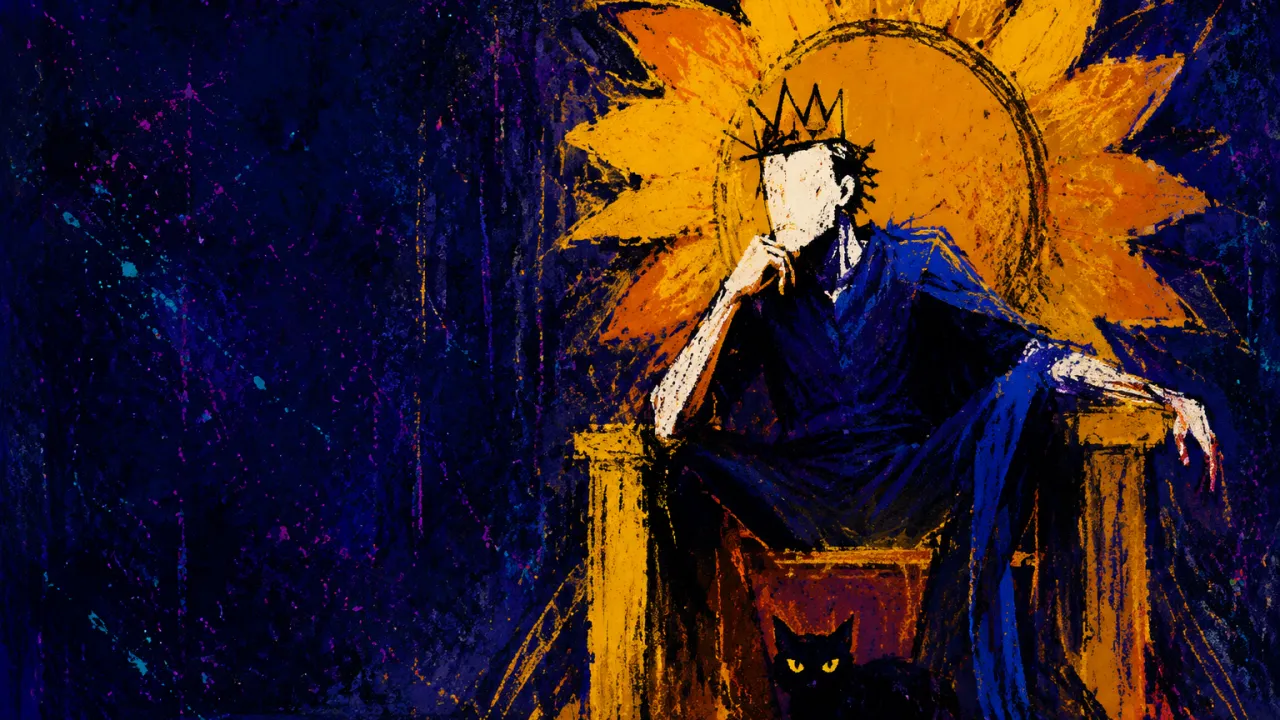
The black cat sits below the Queen's throne, directly beneath the bright field of sunflowers, lions, and golden-orange fabric. It is not outside the card's power structure; it occupies the lower threshold where instinct, secrecy, and bodily knowing collect. Shadow Integration Strain appears when the hidden signal belongs to the path but has not been given equal authority. You may sense that the future you are supposed to choose is missing a darker, truer, less polished part of your knowing, and the card gives that buried signal a precise place in the frame.
Reversed
The black cat sits at the queen's feet, directly under the open shape of her body, while the rest of the card radiates heat, gold, lions, and sunflowers. It is not outside the scene; it is placed inside the architecture of her power, but low enough to remain contained. In the reversed texture, the bright surface can over-organize the whole field. The darker instinctive point remains present, yet it is held under the throne rather than given equal participation in the queen's movement, choices, and self-definition. Shadow Integration Strain appears when personal growth has made the hidden material visible but not yet livable. You may recognize ambition, envy, anger, sensuality, or private hunger in yourself, but recognition alone does not integrate it; the strain comes from keeping that material close while still treating it as something that must stay beneath the polished self.

Shadow Integration Strain in Tarot Card Reading Insights

Shadow Integration Strain often follows people into readings when they are trying to hold the polished self and the hidden signal in the same frame. The readings below show how others have brought that pressure into the cards without needing to turn it into a neat conclusion. Tarot Reading Insights from sessions on this theme.

Psychological struggles related to Shadow Integration Strain