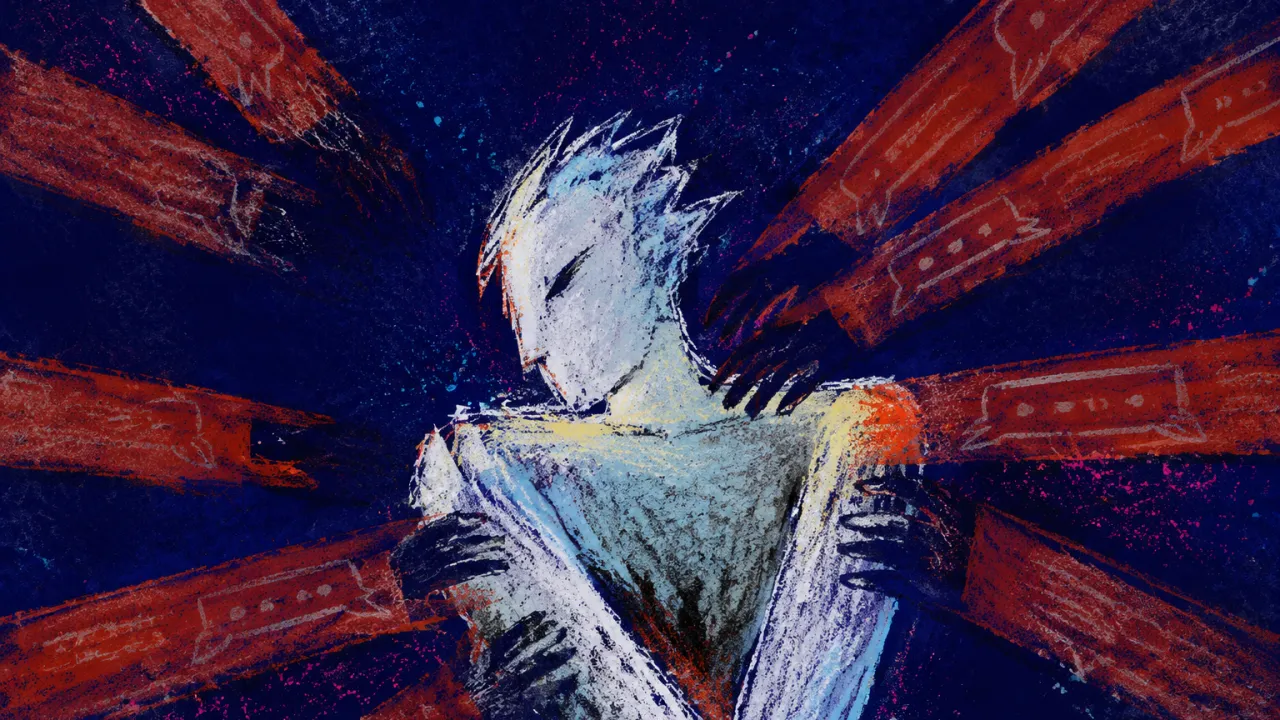
Family Boundary Backlash turns a normal limit into a visible point of pressure, especially when calls, visits, private choices, or delayed replies become something relatives test from several directions. The tight chest, raised shoulders, and stomach drop that show up before you answer another message are part of being placed inside that pressure field. This is an environmental, structural dynamic where the family system reacts to changed access, not a private failure of clarity or care. The Tarot Cards below reflect the shape of that backlash: the exposed line, the testing from below, and the effort it takes to keep a boundary from being talked out of existence.
The Fool ReversedThe white dog at the Fool's heels is the visible signal of an environment reacting to movement. Its raised body, the exposed edge, and the figure's continued stride create a scene where every step forward is accompanied by noise, warning, and pressure. Inside a family system, that becomes the backlash that starts when you set even a modest boundary. The boundary may be reasonable, but the surrounding structure treats it as a disruption, making autonomy feel like something that must be defended in full view of everyone.
The Magician ReversedThe Magician's table creates a visible boundary, but it also places the figure on display. In reversal, the same front-facing stance can feel like exposure inside a space where every limit becomes something others can inspect, challenge, or test. Family boundary backlash tends to appear after a concrete limit is named: fewer calls, shorter visits, separate holidays, no unsolicited advice, no access to private information, no automatic agreement. The backlash is the system's attempt to restore the old route of access. The card links this context to tools becoming enforcement symbols. You may be using language to create a clean boundary, while the family uses criticism, withdrawal, escalation, or moral pressure to push the table back into its old position.
The High Priestess ReversedThe veil behind the High Priestess is a boundary with texture, symbols, and weight; it does not disappear because someone stands in front of it. The pillars give that boundary architecture, making access something that has to be recognized rather than assumed. Family boundary backlash shows up when a private limit interrupts an old access route. You are not simply managing a conversation; you are watching a system react to the loss of automatic entry into your time, choices, or personal information.
The Emperor ReversedThe Emperor's body is locked into symbols of control while the stone chair absorbs nearly all personal softness around him. The space is defensive, frontal, and ready to respond when its borders are tested. In a family system, that becomes the backlash that follows a boundary. You set a limit around time, money, privacy, dating, or contact, and the structure tightens because the boundary exposes how much the household depended on access to you.
The Hierophant ReversedThe temple gives the followers one visible posture: face the authority, stay within the ritual, and remain below the raised hand. The architecture does not show a casual side door; movement is funneled through the sanctioned path. In a family system, boundary-setting can trigger backlash because it interrupts the posture everyone is used to seeing. A limit around visits, privacy, money, texting, or emotional availability can be treated as disorder because the system depends on your predictable access. The card shows why the reaction can feel larger than the boundary itself. You are not only changing a rule; you are disturbing a hierarchy that has relied on your compliance being automatic.
The Chariot ReversedThe chariot is framed by armor, cube, canopy, moat, and city wall, turning protection into nested containment. The figure is visible and elevated, but every layer around him defines where he may stand. In your family field, a boundary can be treated as a breach of the enclosure rather than a normal adult limit. The backlash appears when relatives respond to privacy, distance, or independent plans as if you have disrupted the whole household formation.
Strength ReversedThe lion's claws disturb the soft ground while its mouth is being held. The field is not calm beneath the restraint; pressure has moved into the terrain around the body. That is the texture of family boundary backlash. When you set a limit, the system may respond through anger, withdrawal, comparison, guilt, or sudden urgency because the old access pattern is being interrupted. Strength is especially exact here because the card shows pressure at the boundary itself, not after the danger has passed. You can see the backlash as evidence that the old arrangement is reacting to a new edge, rather than as proof that the edge should disappear.
Wheel of Fortune ReversedThe wheel's motion is not smooth or neutral: one force pulls downward, another pushes upward, and the figure above keeps the balance point under watch. The whole image shows a system reacting whenever the rotation shifts. When you set a family boundary, that same structure can appear as backlash. A new limit changes the family's access pattern, so the system may respond with guilt, comparison, sudden coldness, exaggerated concern, or pressure to explain yourself until the old arrangement is restored. The card frames the backlash as information about the system's dependency on your old availability. The pressure does not automatically prove the boundary is wrong; it reveals which parts of the family structure relied on your edge staying soft.
Death ReversedThe horse's iron hooves entering the foreground make the boundary physical. Every figure is exposed to the same crossing point, and the black standard turns a private change into something the whole field has to register. Family boundary backlash often appears when a limit stops being theoretical. The card's rigid armor and public arrangement show why the reaction can feel disproportionate: the system is not only responding to one request, it is reacting to the loss of an old layout. You can use this image to separate the boundary from the noise around it. The backlash reveals which roles depended on your availability, and that visibility gives you a cleaner map of what is being protected, challenged, or negotiated.
Temperance ReversedThe shoreline under the angel’s split feet is not a private interior space; it is a visible edge where two domains meet. When the figure changes the balance, the whole scene would have to adjust around that new position. That is the structure of family boundary backlash. A limit can be treated as disruption because the old system depended on your availability, access, or emotional flexibility remaining unchanged. Temperance shows the backlash as evidence that the boundary touched a real pressure point. The reaction does not automatically define the boundary as wrong; it reveals where the family arrangement was relying on you to keep the old flow intact.
The Devil ReversedThe chains are loose enough to remove, but each collar still runs back to the same central ring. Movement away from the altar is possible in theory, yet the first step outward immediately reveals who benefits from the old attachment. That is the reality of family boundary backlash. The card frames the reaction to your limits as evidence of the system defending its access, not proof that your boundary is cruel, selfish, or excessive.
The World ReversedThe wreath gives the dancer a perimeter that every corner can see. In the reversed state, that visible edge becomes the thing the surrounding system reacts to, especially when the person inside stops being fully available for inspection or control. Family boundary backlash often arrives as pressure, comparison, withdrawal, or sudden concern about what your limit says about the household. The card frames the conflict as a system response to changed access, helping you see the backlash without surrendering the boundary's basic legitimacy.
Eight of Cups ReversedThe figure's back creates a boundary before anyone in the scene gives him permission to have one. The river then makes that boundary concrete, separating the cup structure from the body that is no longer standing inside it. In a family context, backlash often appears when a boundary stops being theoretical and becomes visible through distance, silence, moving out, refusing a role, or changing access. The reversed image tightens the atmosphere around that crossing, making the boundary feel socially unsafe rather than practically impossible. This is why the card fits Family Boundary Backlash. The conflict is not only about the boundary itself; it is about the old system reacting when your body is no longer available to stabilize it.
Queen of Cups ReversedThe Queen's island is near another shore, but it is still an island. The wall, waterline, throne, and lightly placed foot all show contact being possible only through defined edges. Reversed in the family field, those edges become the flashpoint. When you limit calls, stop explaining every decision, decline a visit, separate money, or refuse an emotional role, the system may react as if a natural right of access has been taken away. The card helps locate the conflict where it belongs: not in the existence of your boundary, but in the family's adjustment to losing automatic entry. Its image shows that connection can remain possible without dissolving the shoreline that lets you stand as a separate person.
Eight of Pentacles ReversedThe craftsman's station is exposed: close to the house posts, open to the surrounding space, and organized around a line of work others can recognize. Any shift in how the work flows would be visible immediately. Family boundary backlash often begins at that moment of visibility. When you reduce access, stop overexplaining, decline a role, or make a choice that no longer feeds the expected family display, the reaction can focus on the boundary itself rather than the pattern that made the boundary necessary. The reversed Eight of Pentacles turns the backlash into a map of system resistance. It shows that pressure to return to the old role is not evidence that the boundary is wrong; it is evidence that the old production line depended on your continued availability.
Knight of Pentacles ReversedThe armored rider creates a visible boundary around the body before any movement happens. The field is open, but the first thing the eye registers is protection: metal, reins, saddle, gloves, and a carefully controlled hold on the coin. When this structure turns rigid in a family context, a boundary can trigger pressure from the people who benefited from your previous availability. Saying no, moving slower, limiting contact, or keeping plans private may be treated as rejection because the family system is used to crossing that protective line. The card makes the backlash understandable as a reaction to changed access. It keeps the focus on the external pattern: the system is responding to your boundary because the old arrangement depended on you not having one.
Ace of Swords ReversedThe disembodied hand grips the sword in exposed sky, with no walls, table, or shared ground around it. A boundary placed this visibly can attract immediate testing because the old system can see exactly where access has been cut. In the family field, the backlash is the structural response to a new line becoming real. The card’s sharpness helps separate the content of the boundary from the pressure campaign that follows it, so you can see which part is negotiation and which part is retaliation.
Three of Swords ReversedThe red heart hangs without ribs, skin, or any enclosing body, while the swords enter from separate angles and meet at the center. The card makes exposure visible before it makes pain visible: there is no protected edge where contact has to stop. Family Boundary Backlash fits this scene because the pressure intensifies at the exact point where a perimeter should exist. When you set a limit around visits, money, privacy, dating, location, or contact, the system may treat that limit as a wound inflicted on the family rather than a boundary around your life. The image helps separate the boundary from the backlash. The problem is not that the heart needs to stay open to every blade; the problem is a structure that has learned to experience your self-protection as rejection.
Five of Swords UprightFallen swords form a hard line between the person holding power and the figures walking away, turning the ground itself into a boundary after conflict. The separation is visible, but it is not peaceful; it is surrounded by sharp objects and a watchful posture. That is the family pattern where setting a limit does not end the argument, it triggers a response designed to make the limit feel dangerous. You may have drawn a reasonable line, yet the system reacts as though the old hierarchy has been attacked, using withdrawal, moral pressure, or comparison to push you back across it.
Eight of Swords ReversedThe gap between the swords is real, but the blades make the cost of movement visible before the step begins. The figure is not physically pinned to the ground; she is positioned inside a field where every direction carries a social penalty. That is the architecture of boundary backlash in a family system. You name a limit around time, money, privacy, visits, or communication, and the surrounding structure answers with pressure designed to make the boundary feel more expensive than compliance.
Nine of Swords ReversedThe swords are not scattered; they are lined up and aimed, crossing the zone where a person would speak, breathe, and hold a position. The dark room has no open path, so the immediate geometry is pressure after a point of contact. In a family system, this fits what happens after a clear no: calls multiply, guilt gets recruited, relatives weigh in, or affection is withheld until the boundary is softened. The card makes the backlash visible as a structural response to autonomy, not a sign that the boundary was wrong.
Ten of Swords ReversedThe fallen figure reaches the edge of a possible crossing, but the body is stopped before the river can be used. The swords do not scatter randomly; they are planted with a controlled downward force, turning escape into the exact point of impact. Family Boundary Backlash is anchored in that blocked exit. You may be trying to move out, say no, limit visits, stop explaining, or claim adult privacy, and the family system answers at the threshold rather than inside the old arrangement. The card makes the backlash legible as a structure, not a sign that your boundary was unreal. Pressure increases precisely where the old system detects that your access rules are changing.
Page of Swords ReversedThe Page keeps his sword raised on a ridge where the ground is uneven and the air is turbulent. The scene captures the moment after a line has been drawn: the body must stay balanced because the environment can turn one misstep into a slide. Family boundary backlash has the same physical logic. You name a limit, and the system responds with pressure, guilt, anger, or interrogation that makes the boundary feel more dangerous than the behavior it was protecting You from. The card shows that the backlash is part of the terrain, not proof that the line was imaginary.
Knight of Swords ReversedThe forward-leaning rider cuts through open space with the sword already raised, and the wind leaves no calm pocket around the scene. The body, blade, horse, and weather all move as pressure arriving at once. That visual pressure mirrors the family backlash that can follow a newly stated boundary. The issue is not only that someone disagrees; it is that the whole relational field can surge toward the boundary as if the line itself is an attack. You encounter this context when saying no creates explanations, accusations, guilt-heavy messages, or sudden demands for access. The card exposes backlash as a family system defending its old routes of entry, which helps separate your boundary from the reaction it triggers.
Five of Wands ReversedEach figure in the Five of Wands reaches outward, but the space they claim is immediately crossed by someone else's staff. The image captures the moment when a boundary does not create distance yet; it first reveals how many people feel entitled to push against it. In a family context, that is boundary backlash. A limit around visits, money, privacy, dating, career, religion, or communication can be treated as disrespect, abandonment, selfishness, or betrayal because the family system is used to unrestricted access. The card does not reduce the conflict to personality. It shows a crowded power field where your boundary exposes the old rules of access, and that exposure creates noise before it creates freedom.
Seven of Wands UprightA lone figure braces a diagonal wand above six rods rising from below, and the whole scene is organized around a line that has to be held. The high ground gives the boundary visibility, but the rugged ridge shows that holding it is not comfortable or effortless. Family boundary backlash works the same way: a new limit becomes visible, then the system tests it from several angles at once. The card turns the pressure into a map rather than a verdict, showing You where the pushback is coming from and why the boundary needs structure instead of endless explanation.
Eight of Wands ReversedThe scene contains no figure standing between the incoming wands and the ground. The open air becomes a boundaryless channel, and the objects move with enough coordination that their impact feels organized rather than accidental. Family boundary backlash often works the same way. After a limit is named, the response arrives through calls, texts, relatives, practical demands, or sudden concern, all moving toward the same point: restoring the old access route. You are not seeing conflict as random noise. You are seeing a system trying to land back on territory it assumes is available, which makes the real task identifying where the boundary has no external protection yet.
Nine of Wands ReversedThe wounded figure stands in front of a fence made of wands, gripping the one movable wand as if the whole line will fail if he relaxes. The wall is almost complete, but the gap beside the tallest wand makes the boundary visibly contested rather than secure. That image maps cleanly onto a family system where a boundary has been named but not yet accepted. You may have created a limit around calls, visits, money, privacy, or emotional access, yet the surrounding structure keeps testing whether that limit is real. The bandage and guarded posture show that this is not a fresh disagreement; it is contact after repeated impact. Family Boundary Backlash names the external pressure that arrives after you stop automatically absorbing the old role, when the family tries to pull the missing piece back into place.
Page of Wands ReversedThe Page lifts the wand as if claiming territory, but the landscape gives him no walls, no room, and no cover. The boundary is visible before it is protected. That is the pressure point in family boundary backlash. Once you say no, reduce access, or stop playing the expected role, the family system can turn the boundary itself into the problem. The card captures the exposed stage after the declaration, where your limit becomes something others try to inspect, correct, or reframe.
Knight of Wands ReversedThe horse hangs between leap and restraint, front legs lifted while the reins pull the surge into a visible struggle. The wand stands upright, the armor hardens the body, and the open desert leaves the rider exposed to whatever follows the first act of assertion. That is the structure of Family Boundary Backlash. Once a limit is stated, the family system may react as if the boundary is the injury, not the old pattern that made the boundary necessary. The pressure often arrives through guilt, comparison, sudden intensity, or demands for immediate explanation. The reversed Knight of Wands fits this context because the conflict is not quiet avoidance; it is hot movement meeting control. The card makes the backlash visible as a system response to interrupted access, giving you a clearer view of what is being protected and what is being provoked.
Queen of Wands ReversedThe Queen's open posture is powerful, but in reversal the same visibility can become exposure. The throne that should define her space becomes the frame through which everyone can see, measure, and challenge her position. Family boundary backlash happens when a limit is treated as disloyalty rather than structure. A shorter visit, a delayed reply, a private relationship, or a refusal to discuss money may trigger guilt, comparison, coldness, gossip, or a sudden campaign to restore the old access pattern. The family system reacts because the boundary changes the geometry of power. This card fits because its symbols gather around authority and visibility. You are not just managing one uncomfortable conversation; you are touching the architecture that tells relatives who gets access to whom. Seeing the backlash as a system response keeps it from being mistaken for proof that the boundary was wrong.
King of Wands ReversedThe staff hits the ground beside a throne covered in lions and lizards, making authority look immediate and reactive. In reversal, the fire symbols do not circulate; they flare around the seat of power and turn the surrounding space into an exposed arena. When a family reacts to your no with anger, interrogation, or public pressure, the backlash is not random noise. The card shows a control system detecting a boundary as a threat to its perimeter, which helps you see the blowup as structural feedback rather than proof that your limit was illegitimate.
No cards available for this filter.