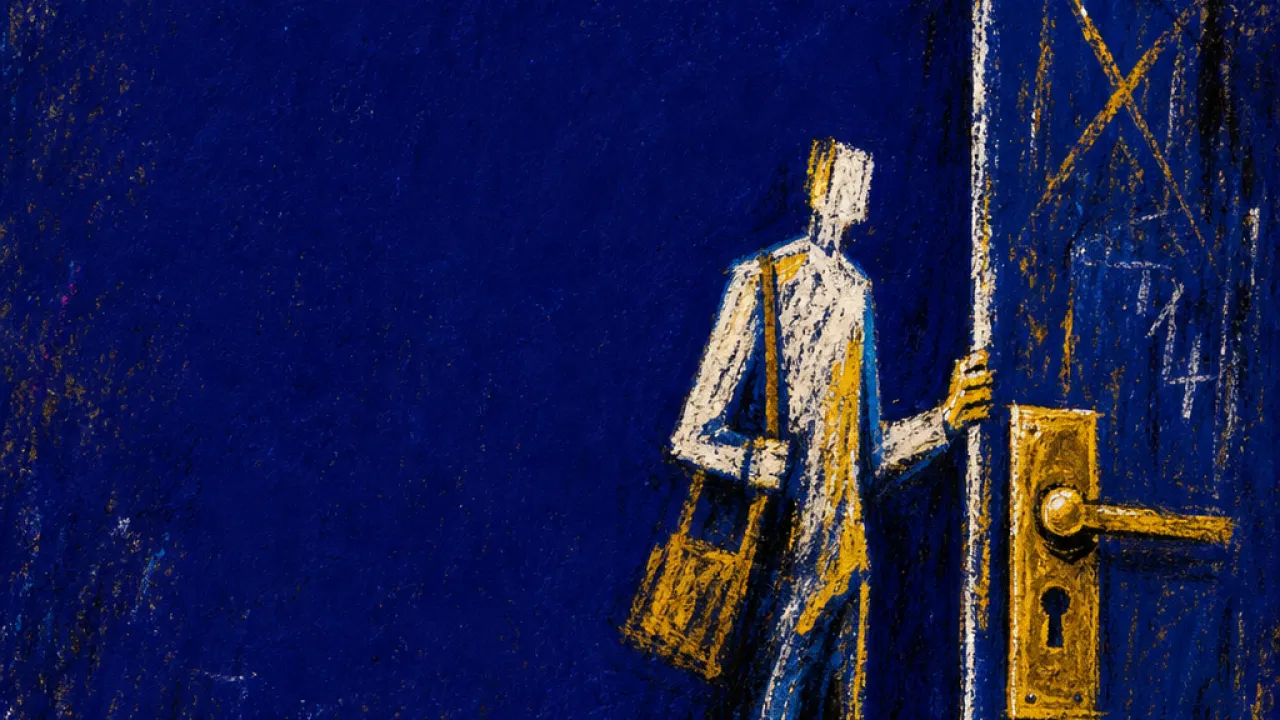
That moment when the next step is visible but your hand stays on the bag strap is the pattern in plain view. Your chest goes flat and your shoulders sink before the handle is even tested. From a Jungian perspective, archetypal theory gives this frozen agency a symbolic frame without turning it into a verdict. The cards below reflect the unconscious dynamics underneath learned non-movement: here are the Tarot Cards that map it.
The Devil ReversedThe collars in the Devil card are loose, but the figures remain in place. Their bodies do not test the opening; they stand as if the old restraint still has total authority. The image captures a body that has learned the shape of captivity so well that it continues performing it after the mechanism has weakened. This is not simple passivity. It is a learned response pattern in which repeated inner defeat trains the psyche to stop checking for exits. The raised hand, the altar, and the chain create a field where possibility is physically present but psychologically unavailable. In introspection, this pattern appears when You can name the loop, understand the loop, and still feel unable to move differently. The reversed Devil does not reduce the experience to laziness or weakness; it shows how an old constraint can become internal posture, and how awareness begins by separating the real lock from the learned freeze.
The Tower ReversedThe breached tower no longer protects the people inside it, and the falling figures cannot find a surface to push against. In the reversed texture, the image becomes less about one dramatic fall and more about being suspended after too many structures have failed. The old walls are gone, but a new ground has not yet been felt. Learned Helplessness appears when repeated career shocks train the system to stop expecting agency to matter. Opaque promotion rules, shifting managers, public setbacks, or ignored effort can teach the mind to conserve energy by not trying. The crown's separation from the tower mirrors the loss of belief that effort and outcome still belong to the same structure. The pattern is not laziness. It is a protective shutdown after the field has repeatedly failed to respond predictably. The tower asks where agency has been abandoned because past impacts made strategy feel pointless.
Judgement ReversedThe coffins are open and the bodies are upright, yet the figures do not climb out or choose a direction. The signal has awakened them, but agency remains suspended between the old container and the distant caller. That suspended posture is the visual logic of Learned Helplessness. The system has registered the need to respond, but repeated strain has trained the body to wait for something outside itself to create movement. In academic life, You may know the next step and still feel unable to take it after repeated low marks, confusing feedback, or failed study systems. The card shows a mind that is not empty of desire; it is caught in the gap between being called to act and no longer trusting that action changes the outcome.
Four of Cups ReversedThe youth is not surrounded by emptiness; he is surrounded by cups. The visual tension comes from the gap between available resources and a body that no longer seems able to register them as usable. Learned Helplessness forms when repeated academic disappointment teaches the system that effort and outcome are no longer connected. Tutoring, office hours, feedback, revision plans, and new methods may still be present, but they are metabolized as more cups that will not change anything. The Four of Cups captures that shutdown through stillness rather than drama. You may experience this as laziness or loss of drive, but the pattern is more structural. It is a learned prediction loop: why reach for the cup if previous reaching did not seem to matter? Naming the loop separates your actual capacity from the rule your academic nervous system has learned.
Five of Cups ReversedThe bowed head and black cloak can become more than mourning when the posture hardens into immobility. The spilled cups fill the foreground so completely that the bridge is no longer experienced as a route, even though it remains in the composition. Learned Helplessness forms when repeated disappointment teaches the system to expect futility before new evidence arrives. In personal growth, this is the moment where the self stops testing options because the body already anticipates another wasted effort. The reversed psychological texture is not simple sadness; it is stalled agency. You can still see the bridge, the standing cups, and the castle, but the internal field has learned to treat them as unreachable before they are even approached.
Five of Pentacles ReversedThe figures continue along the frozen path while the window remains beside them, high and bright but behaviorally unreachable. The crutch-step rhythm keeps motion alive without changing their relationship to shelter. In the reversed current, effort becomes evidence that nothing changes because the system repeats the same exhausted route. In personal growth, Learned Helplessness appears when past friction trains You to expect failure before testing a new door, leaving change feeling pointless even when conditions have shifted.
Six of Pentacles ReversedOne kneeling figure receives coins while the other waits beneath the scales with a hand extended. The platform gives everyone a place to stand or kneel, but the actual movement is controlled by the person holding the resources. Learned Helplessness appears when repeated waiting teaches the nervous system to treat agency as something granted from outside. In a direction reading, the card shows how a dead-end period can become a posture, where you keep looking for the world to open a door before trusting any movement of your own.
Three of Swords ReversedThe heart remains suspended in the storm while the swords keep their fixed positions. Nothing in the image suggests movement toward repair; the wound is organized, visible, and static. Learned Helplessness in personal growth appears when repeated painful attempts have trained the system to expect no meaningful effect from action. You may still think about change, read about change, or plan change, but the inner forecast has already decided that effort will land in the same wound. The reversed card captures that stalled expectancy. The mind is not simply afraid of trying; it has built a closed field where every line leads back to impact, making inaction feel less like laziness and more like a learned response to repeated disappointment.
Six of Swords ReversedThe woman and child sit low and enclosed while the ferryman does the visible work of movement. The boat progresses, but the agency inside the scene is uneven: one figure rows, and the others are carried. Learned Helplessness appears when the inner system begins to expect change to come from outside the self. In personal growth, this can look like waiting for the right coach, method, life event, or emotional state to finally make action possible. The card's tension is subtle because help is not wrong here. The issue is when guidance becomes the only imagined source of movement. You may be crossing into a new phase, but the pattern asks whether your own agency is awake inside the boat or still hidden under the cloak.
Eight of Swords UprightThe blindfolded woman stands inside a ring of swords that look threatening but do not actually touch her body. Her hands are bound, yet the arrangement leaves visible gaps in the enclosure, turning the card into an image of perceived captivity rather than total physical imprisonment. That visual tension maps directly onto Learned Helplessness: the inner system keeps responding as if movement is impossible because previous constraint has trained the body to stop testing the field. You may be looking at a psychological setup where old limits have become the default reality filter, even after the environment has changed. In introspective work, this pattern is especially sharp because the cage is made of thoughts, assumptions, and unseen fear rather than external force. The card does not shame the freeze; it exposes the mechanism by which a temporary restriction becomes an internal rule.
ReversedThe woman’s bindings are not total, yet her body reads the scene as if every exit has disappeared. The blindfold cuts off verification, the arms cannot reach, and the sword field compresses the space until possibility stops registering as usable. The physical facts show a temporary enclosure being processed like a permanent condition. Learned Helplessness appears when the mind stops checking whether effort still has leverage. You may have met enough blocked doors, failed starts, or invalidating feedback that the system begins predicting defeat before a new attempt has been made. The defense is understandable, but it turns past limitation into present obedience. In personal growth, this pattern can make change feel fake before it begins. The self says, "nothing works for me," and then under-invests in the very experiments that could update that belief. The card’s audit is exact: the danger is not only the swords, but the moment the nervous system stops testing the spaces between them.
Nine of Swords ReversedThe quilt under the woman is patterned, but the symbols feel incomplete and disordered, as if the support system has stopped forming a usable map. Her body is neither fully resting nor fully acting, held in the uncomfortable middle between collapse and alertness. Learned Helplessness emerges when repeated effort feels disconnected from outcome. The mind stops looking for the next workable move because previous attempts have trained it to expect the same pain, confusion, or defeat. In academic life, this can appear after repeated bad feedback, stalled research, or study methods that never seem to pay off. You may stop before beginning, not because you do not care, but because the internal model has started predicting that effort will not matter.
Ten of Swords UprightThe fallen body is pinned through the spine, the part of the body that normally lets someone stand, turn, and respond. The repeated swords do not look chaotic; they are arranged with a cold uniformity, as if the same message has landed again and again until movement itself has been trained out of the body. In a family system, this maps to the moment when repeated attempts to explain, negotiate, or set a boundary have taught You that action will not change the outcome. Learned Helplessness is not weakness here; it is a defense built from too many experiences of effort meeting the same wall. The card holds the cost of that defense: You may stop trying before the present moment has actually proved that nothing can move.
ReversedThe figure is pinned so completely that no repair gesture is visible. The calm river and faint light are present, but the body lies under a sky so heavy that possibility appears distant rather than usable. Learned Helplessness in personal growth grows from repeated experiences where effort seemed to end in the same impact. After enough collapsed attempts, the system stops asking, 'what can I test next?' and starts assuming that action will only confirm defeat. The card's reversed logic is not simple hopelessness; it is a trained expectation of non-agency. You are seeing the moment when the nervous system has confused previous impact with future law, and that confusion quietly blocks experimentation.
No cards available for this filter.