Finding Clarity in the 10:47 p.m. LinkedIn Scroll
If you are a junior researcher, designer, strategist, or grad student in a major city, and your LinkedIn headline gives you career pivot anxiety every time rent is due, this is probably not just a branding problem.
That was the first sentence I wrote in my notes after Maya settled across from me on a rainy evening in Toronto. She was twenty-seven, a junior UX researcher, and she had the look I often see in people who have been staring at their own professional identity until the edges blur: shoulders lifted, mouth polite, breath caught somewhere too high in the chest.
She told me about the night before. At 10:47 p.m., at the small kitchen table in her apartment, she had changed her LinkedIn headline from UX researcher exploring behavior, climate, and storytelling back to UX Research Associate | SaaS | User Interviews. The tea beside her laptop had gone cold. The screen was too bright. The radiator clicked in the corner while three former classmates' profiles sat open in separate tabs like quiet witnesses.
“My profile looks fine,” she said, folding and unfolding the sleeve of her jumper. “It probably looks better when it’s clean. But it makes me feel like I already chose the rest of my life.”
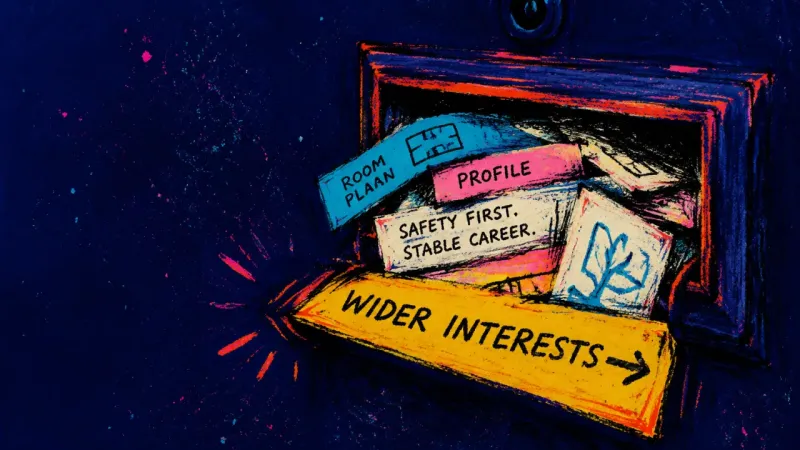
I felt the truth of that land in the room. LinkedIn profile anxiety has its own physical weather: the tight chest after a safe edit, the jaw that locks after a promotion post, the restless urge to change one more keyword even when the real discomfort is not about wording. For Maya, it felt like trying to fit an entire apartment, all its rooms and windows and half-read books, into a tiny mailbox.
“You are not trying to quit everything,” I said. “You are trying to sound credible without editing out the writing, climate, research, product, and cross-disciplinary thread that still feels alive. So today, I do not want the cards to tell you what your future must be. I want us to use tarot as a mirror, a clear one, so we can see where the future started feeling too small and where your own agency can begin again.”

Choosing the Compass: A Shadow Spread for Career Identity Compression
I asked Maya to place both feet on the floor and take one slow breath before I shuffled. I have spent sixty-seven years watching seasons turn over Highland hills and city windowsills alike, and I have learned that a pause is not decoration. It is the body remembering that it does not have to solve its whole life in one inhale.
For this reading, I chose The Shadow Spread, a five-card tarot spread for LinkedIn profile anxiety and career identity compression. I told Maya, and I tell you as the reader now, that this was not because LinkedIn itself is mystical or dangerous. It was because her surface question, “Why does my LinkedIn profile make my future feel too small?” was really asking about a deeper pattern: symptom, trigger, defense, hidden fear, and integration.
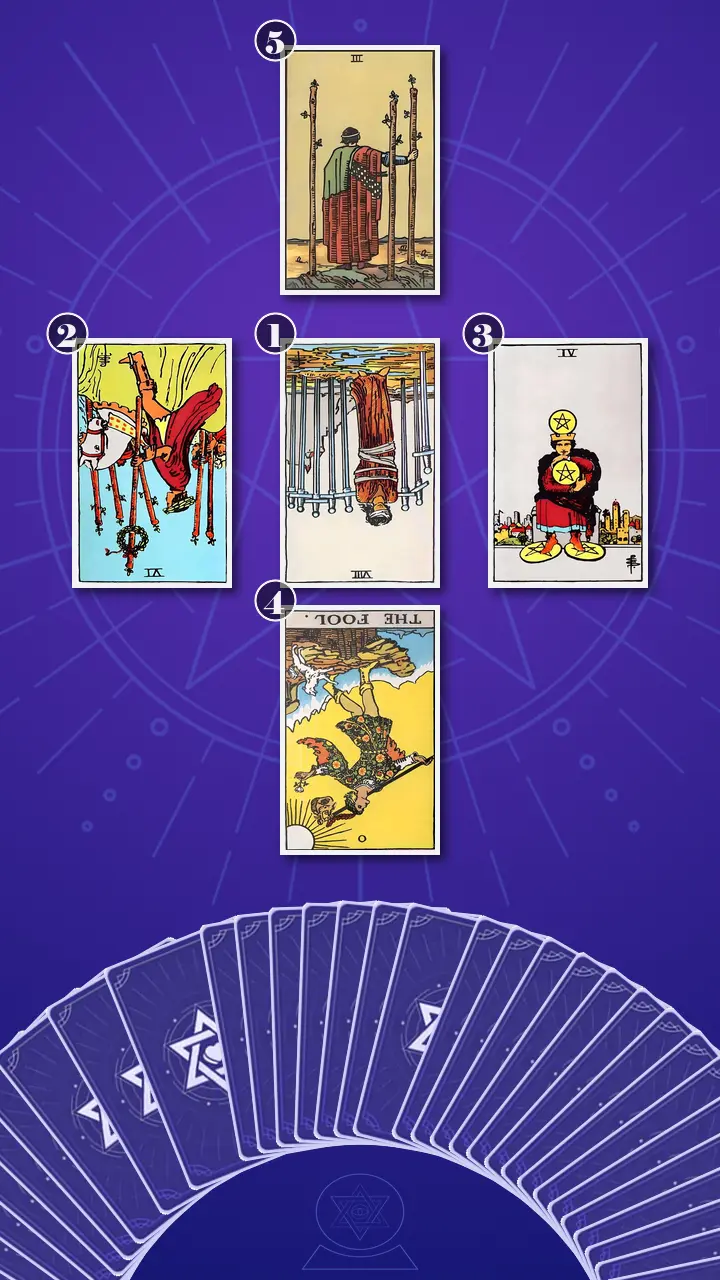
The layout was a small cross. The center card would show the present knot: how the profile had become a mental container for her compressed professional identity. The card to the left would show the external trigger, the public mirror of comparison. The card to the right would show the protective strategy, the tightening that made sense but cost vitality. The card below would name the deeper fear. The card above would offer the conscious medicine, the next step toward finding clarity without forcing certainty.
“So this is not a prediction,” I said, laying my hand over the deck. “It is a map. And a map is only useful if it returns your choices to you.”
Reading the Map: The Cards Beneath the Profile Field
The Present Knot: Eight of Swords Reversed
Now I turned over the card representing the present knot: how the LinkedIn profile had become a mental container for Maya's compressed professional identity and claustrophobic career anxiety. It was Eight of Swords, reversed.
In the Rider-Waite-Smith image, the woman is blindfolded, loosely bound, and surrounded by swords that look more final than they are. Reversed, this card often shows the first moment someone notices the cage is not as locked as it felt. The binding is loose. The enclosure is open-sided. There is more room than the mind has been allowing.
I brought it back to the kitchen table. “You can technically type anything into the LinkedIn headline field,” I said. “But the blank cursor feels like it only permits one acceptable professional self. So you delete the words that show range before anyone else can question them, then you mistake the relief of looking coherent for proof that the narrow version is the only safe one.”
Maya gave a small laugh, but there was no humor in it. “That is too accurate. It’s kind of brutal.”
I let the silence stay gentle. “Brutal is not the goal,” I said. “Accurate can feel sharp when it names a rule you have been obeying without consent.”
The energy here was a blockage beginning to loosen. The profile was not the whole prison. It was the place where platform logic had started sounding like her inner voice: I technically can write anything, but only one version feels allowed. This is how Eight of Swords reversed works in a career tarot reading. It does not say, “You are trapped.” It asks, “Which part of the trap is made of assumption, and which part is real enough to plan around?”
Her fingers stopped worrying the jumper sleeve. For a moment, she looked not at the card but at the empty space beside it, as if replaying the cursor blinking in that headline field.
The Trigger: Six of Wands Reversed
Next, I turned over the card representing the external platform dynamic and peer-comparison moment that intensifies the feeling that her future is being ranked or reduced. It was Six of Wands, reversed.
“This is the LinkedIn public scoreboard,” I said. “Not because recognition is bad. Recognition is human. Wanting your work to be seen is not vanity. But reversed, the Six of Wands shows what happens when the crowd gets inside your head and starts deciding which version of your future counts.”
The modern life scene was painfully familiar: a former classmate posts a promotion, the laurel wreath becomes likes and comments, the elevated rider becomes the peer whose path looks clean from the outside, and suddenly Maya rereads her own profile as if a silent audience is scoring whether she is falling behind.
“They look so clear,” she murmured. “And then my path feels like a draft.”
“That is the reversal,” I said. “Visibility turns into ranking. Inspiration turns into comparison fatigue. The crowd can applaud a version of you that you no longer fit.”
The energy dynamic here was excess: too much external recognition energy, too much imagined audience, too much CareerTok-style POV: everyone is ahead of you pressure poured into a private decision. The card was not shaming her ambition. It was naming the moment ambition gets outsourced to the scoreboard.
Maya’s eyes flicked down. Her mouth tightened first, then softened. I watched the three-step reaction unfold: her breath paused, her gaze went unfocused as if a dozen promotion posts were sliding behind her eyes, and then she exhaled through her nose, slow and irritated and relieved at once.
The Protective Strategy: Four of Pentacles Upright
Now I opened the card representing the concrete defense strategy: editing, tightening, and making the profile safe at the cost of vitality. It was Four of Pentacles, upright.
I have a tenderness for this card in career readings because people often expect me to criticize the grip. I do not. A grip usually begins as care. In this image, the figure holds one coin against the chest, balances another on the crown, and pins two beneath the feet. The whole body organizes around security.
“This is the part of you that knows Toronto rent is real,” I said. “The part that knows recruiters use filters, job titles matter, and a readable profile can open doors. You are not wrong to value employability. But the card asks what happens when credibility becomes a clenched posture.”
Maya nodded once, hard.
“Your title, industry label, and skill stack have started to feel like assets you must grip,” I continued. “The phrase UX Research Associate | SaaS | User Interviews is readable and stable. But if it becomes the only thing allowed to be true, the profile may protect opportunity while starving the part of you that needs air.”
The energy here was excess Earth: stability overused until it becomes immobilization. I told her the line that came through as cleanly as a bell: “Credibility should give your future structure, not shrink-wrap it.”
That was the moment her shoulders dropped. Not dramatically. Just enough that her neck looked like it belonged to her again.
The Hidden Fear: The Fool Reversed
The fourth card sat below the center, representing the deeper fear around worth and control, especially the fear that exploration would read as incompetence or lack of focus. I turned it over: The Fool, reversed.
The room seemed to hold its breath with her. Outside my window, rain tapped the glass in small irregular beats, like a dog’s paw against a door. In the card, The Fool stands at the edge of a cliff with a small bundle and an open sky. Reversed, the beginning is blocked. The threshold has been mistaken for a verdict.
“This is your Notes app list,” I said softly. “Climate UX. Research essays. Product storytelling. The list that gets labeled too random before anything becomes a twenty-minute coffee chat, a one-page memo, or a small portfolio addendum.”
Maya looked up quickly. “I literally wrote ‘too random’ under that list.”
“Of course you did,” I said. “Because when The Fool is reversed, a tiny step starts to feel like a cliff dive. A beta test gets treated like a public IPO. The fear is not only failure. It is being seen at the beginning of something before the story is polished.”
The energy here was deficiency: not enough beginner energy, not enough permission to test before explaining. I thought of the Highland winters of my childhood, when fields looked empty to impatient eyes. My grandmother would say, “Do not shout at the ground in January and call it lazy.” That memory rose in me as I looked at Maya’s card.
This was where my Seasonal Trajectory Alignment lens became useful. “You are trying to force a spring harvest from a winter field,” I told her. “Not because you lack growth, but because the season of this question is still gathering evidence. You do not need a public harvest yet. You need one protected seedbed.”
Her face shifted. First a flash of resistance, almost anger. “But doesn’t that mean I’ve been doing it wrong?”
“No,” I said. “It means you have been trying to stay employable in a climate that rewards certainty before people actually feel it. That strategy helped you survive. Now we are asking whether it is still the right season for the whole of you.”
When the Three of Wands Opened the Shoreline
The Integration Path: Three of Wands Upright
We came to the card above the center, the integration path: the key shift from proving a fixed identity to testing a broader through-line through small, self-directed experiments. I turned it over, and there it was: Three of Wands, upright.
The atmosphere changed. Not in a theatrical way. The rain softened. The little lamp beside the spread caught the gold in the card, and for the first time that evening, the table felt less like an editing screen and more like a window.
The Three of Wands shows a figure standing on solid ground, looking across water toward ships moving outward. The staffs are planted. The horizon is open. This is not reckless escape. This is planned expansion.
Maya had been caught in the thought, I must make the profile prove one correct identity before I can move. The card offered a different order: stand somewhere real, name a credible through-line, and send one small signal outward. The profile becomes a shoreline, not a cage.
You are not trapped inside the headline; stand at the Three of Wands' shoreline, keep one staff planted, and send one small signal toward the wider work that interests you.
I let the sentence rest between us.
For a second, Maya froze. Her hand hovered above the table and did not land. Then her eyes widened, not with shock, but with the strange discomfort of being given more room than she had prepared for. Her gaze moved from the Three of Wands to the earlier Eight of Swords, and I could almost see the frame widen in her mind: the headline field, the cold tea, the promotion posts, the safe title, all of it shrinking back into one chapter instead of a life sentence. Her jaw unclenched first. Then her shoulders lowered. Then she let out a small, shaky laugh that turned into a breath.
“That makes me feel better,” she said, then frowned. “And also kind of exposed.”
“That is honest,” I said. “Clarity often feels spacious before it feels easy. Now, with this new view, think back to last week. Was there a moment when this insight could have made you feel different?”
She closed her eyes. “After the networking call. I wrote the climate UX thing in Notes and killed it before I even asked anyone about it. I could have sent one message instead of trying to decide if it was my whole future.”
That was the crossing. Not from confusion to perfect confidence, but from claustrophobic LinkedIn comparison and imagined recruiter judgment toward grounded agency. Her profile did not have to be proof of one permanent, marketable identity. It could become a current chapter: stable skill, living value, emerging direction, one honest horizon.
“Your headline is a snapshot, not a life sentence,” I said. “And a wider profile does not have to be vague. It can be honest with a through-line.”
The Snapshot-Not-Contract Profile
When I gathered the five cards together in my mind, the story was clear. The Eight of Swords reversed showed the editable field that felt forbidden. The Six of Wands reversed showed the crowd that was not in the room but had taken up residence in Maya’s head. The Four of Pentacles upright showed the credibility grip: understandable, practical, and exhausting when it became her whole posture. The Fool reversed named the blocked beginner who needed a protected experiment, not a public declaration. The Three of Wands upright offered the medicine: one planted staff, several possible routes, and a profile that points toward the next honest horizon.
The cognitive blind spot was not that Maya cared too much about LinkedIn. It was that she had started treating a profile field as if it had the authority to settle her future. The transformation direction was simple but not simplistic: shift from using LinkedIn to prove a permanent professional identity to using it as a snapshot of current skills, values, and next experiments.
I gave her three small actions. Not a total reinvention. Not an overnight personal brand overhaul. Small steps, because winter ground is worked by patience.
- Write the Safety Version and the Horizon Version.Set a 10-minute timer. In a private note, write two LinkedIn headline drafts: one safe recruiter-readable version, and one Horizon Version with one stable skill, one emerging interest, and one honest direction.Do not post either for 24 hours. If your chest tightens, save the note and stop. The point is to notice that more than one truthful version can exist.
- Use the Winter Dormancy Protocol.Before editing your public profile, pause for one evening and gather resources: list three LinkedIn rules you are obeying, one piece of evidence for each, and one piece of evidence against each.Treat resistance as data, not a command. This is active dormancy: less frantic movement, more honest preparation.
- Send One Signal Toward the Horizon.Choose one low-risk outward signal this week: a portfolio caption, an About section sentence, or a short DM that says, “I am exploring how UX research connects with climate behavior and storytelling. Would you be open to a 20-minute chat sometime this month?”Keep it small enough that curiosity does not become obligation. One signal is not a pivot announcement.
Maya looked at the list and made a face I recognized: relief interrupted by logistics. “But what if even ten minutes turns into me spiraling for an hour?”
“Then we make it smaller,” I said. “Five minutes. One draft only. Or you write the first sentence and close the laptop. The measure of success is not whether you optimize the profile. It is whether you stop asking fear to be your only editor.”

A Week Later, the Quiet Proof
A week later, Maya sent me a message with no dramatic announcement attached. She had not quit her job. She had not rebranded her entire life. She had written a private Horizon Version, added one sentence to a portfolio note about research, behavior, and sustainable product decisions, and sent one DM for a 20-minute curiosity chat.
She told me she slept through the night after sending it. In the morning, her first thought was still, What if this looks scattered? But this time, she smiled at the thought before making coffee. Clear, but still human. Braver, but not suddenly fearless.
That is how I trust tarot most: not as a force that chooses for us, but as a mirror that helps us stop confusing a tight room with the whole landscape. Maya’s Journey to Clarity was not about defeating LinkedIn or pretending hiring systems do not exist. It was about reclaiming the difference between structure and shrink-wrap, between credibility and disappearance, between a headline and a horizon.
When a headline field makes your chest tighten, it can feel like you are choosing between being legible enough to be hired and honest enough not to disappear. But if your profile is allowed to be a shoreline instead of a cage, then clarity may begin with one planted staff and one small signal.
If your profile only had to point toward your next honest horizon, what tiny signal would you let it send this week?
This story is adapted from psychological research, written so that those in a similar struggle can see their own pattern in it — and find their next step clearly.These insights are not a substitute for professional psychological, medical, legal, or financial advice.
Learn more about our Journey to Clarity.
How did this insight land for you?
🫂 This Resonates Deeply
🌀 Living This Story
✨ Now I See Clearly
🌱 Seeing New Possibilities
🧰 Useful Framework
🔮 The Confirmation I Needed
💪 Feeling Empowered
🚀 Ready for My Next Step
Author Profile
 AI
AI“As the seventh generation of a Highland healing family, I see modern anxieties as a simple, temporary disconnection from nature's rhythm. I bring 67 years of lived seasons not to instruct you, but to hold space for you. Using tarot as a mirror, I want to gently guide you out of the chaos, helping you breathe deeply and rediscover the organic, steady heartbeat of your own life.”
In this Direction Tarot Reading :
Core Expertise
- Seasonal Trajectory Alignment: Diagnosing your deep sense of being 'stuck' as a structural mismatch—trying to force a spring harvest during a winter dormancy phase.
- Environmental Friction Sensing: Identifying the profound mismatch between your internal growth energy and the 'soil' of your current macro environment.
Service Features
- Winter Dormancy Protocol: A deliberate grounding ritual to actively pause, gather resources, and stop forcing directionless movement until the 'climate' aligns.
Also specializes in :
Explore Related Patterns:
Career Optics ParalysisMaya's 10:47 p.m. headline edit is the behavioral center of this pattern: she moves from a wider, more alive professional sentence back into the safest recruiter-readable version while former classmates' profiles sit open like witnesses. The profile field is not just being optimized; it is being treated as a public test of whether her future is coherent enough to deserve space. That is the mechanics of Career Optics Paralysis. You can technically make a move, send a message, or write a more honest line, but the imagined audience turns every small signal into a reputation risk. The defense is understandable: legibility protects opportunity, especially when rent, filters, and hiring systems are real. The cost is that visibility becomes so loaded with judgment that even low-risk exploration starts to feel like a permanent career declaration. The pattern makes the future feel small because the question stops being 'What signal is true enough for this chapter?' and becomes 'What public version of me will be safest from misreading?' Once that shift happens, the profile no longer reflects movement; it starts policing it.
Certainty SeekingMaya's thought that the profile must prove one correct identity before she can move shows certainty becoming a precondition for action. The editable field technically allows many truthful versions, but her mind treats only one version as permitted because ambiguity feels too costly. Certainty Seeking tries to reduce anxiety by forcing the future to become knowable before the next step is taken. You can see the loop when Maya treats one exploratory message as if it has to answer whether climate UX is her whole future. The mind is asking a small action to carry the weight of a life plan. The future feels too small because uncertainty is being interpreted as danger instead of data. Once the step is allowed to be a test, not a verdict, the profile can hold a direction without pretending the whole map is already finished.
Control CopingMaya's safe headline is not irrational. It is readable, stable, and aligned with the way recruiters search. The defensive move begins as practical care: keep the title clear, keep the industry legible, keep the skills searchable, keep the door open. Control Coping turns when that practical structure becomes the only way the nervous system is allowed to feel safe. You can see it in the grip around titles, filters, and credibility, as if every word has to prevent future loss before it can express present truth. The profile becomes a regulation tool for uncertainty, not just a communication tool. The pattern makes the future feel smaller because control is being asked to do more than organize the next step; it is being asked to eliminate ambiguity. Structure can support You, but when it becomes a clenched posture, it starts editing out the parts of You that need room to become real.
Identity ForeclosureMaya's line that the clean profile makes her feel as if she has already chosen the rest of her life is the clearest identity clue in the story. The problem is not that the headline is inaccurate; it is that the narrow version starts carrying the emotional authority of a final answer. Identity Foreclosure appears when exploration gets shut down too early in order to preserve coherence. You can feel the defense in the way Maya deletes the writing, climate, storytelling, and cross-disciplinary threads before anyone else can question them. The mind chooses a stable identity container because uncertainty feels exposed, but then mistakes that container for the whole self. This pattern compresses the future by turning a temporary professional label into a verdict. The profile becomes less frightening when it is allowed to be a current chapter, not a contract that decides which parts of You are allowed to keep developing.
Perfectionism-Driven AvoidanceMaya's Notes app list gets judged as 'too random' before it has a chance to become a twenty-minute chat, a one-page memo, or a small portfolio addendum. The story shows the avoidance happening before any real external feedback arrives; the inner critic blocks the experiment at the draft stage. Perfectionism-Driven Avoidance is not simple laziness or lack of ambition. It is a protective rule that says You should not be visible until the story is already polished enough to defend. In Maya's case, a tiny signal toward climate UX starts to feel like a cliff dive, and a beta test gets treated like a public IPO. The pattern shrinks the future by demanding finished certainty from beginner energy. When the first step has to look like a final brand, curiosity becomes dangerous, and avoidance starts to masquerade as professional standards.
Strategic VisibilityMaya's later actions are small but psychologically specific: she writes a private Horizon Version, adds one portfolio sentence, and sends one DM for a 20-minute curiosity chat. None of these actions require a total rebrand, but each one lets a wider through-line become visible in a controlled, testable way. Strategic Visibility is the adaptive counter-pattern here. You do not disappear behind the safest label, and You also do not force every emerging interest into a public declaration. The profile becomes a shoreline: one staff planted in real skills, one signal sent toward the wider work that still has energy. This matters because visibility becomes safer when it is scaled to the season of the question. A small signal gives the future oxygen without demanding a finished identity, allowing clarity to develop through evidence rather than pressure.
Comparison TrapThe three former classmates' profiles open in separate tabs turn Maya's private edit into a social ranking scene. A promotion post, a polished title, and a clean-looking path become evidence that other people are clearer, faster, or more legitimate, even though she is only seeing the public surface of their choices. Comparison Trap works by narrowing attention until someone else's visible milestone becomes the standard for Your inner timeline. Maya's own path starts to feel like a draft because she is reading it beside other people's finished-looking headlines. The cognitive distortion is subtle: visibility is confused with certainty, and certainty is confused with worth. This pattern does not mean ambition is wrong. It means the scoreboard has moved inside the decision-making process. When the crowd becomes the editor, the profile stops asking what is true and starts asking what will keep You from looking behind.
Explore Related Struggles:
Identity Verdict LockMaya changes her headline from a wider, more alive description back to a safe recruiter-readable line, then says the clean profile makes her feel like she already chose the rest of her life. The field is editable, but the meaning attached to it is not behaving like a draft; it is behaving like a verdict. You are meeting the profile as if a few public words can close the case on who you are allowed to become. That is why the future feels small: a snapshot starts acting like a contract, and every edit carries the weight of a life decision instead of the weight of a temporary description. The struggle is not about lacking options. It is about letting one professional label take on the authority to decide which parts of your future count as real enough to show.
Future-Proofing ParalysisMaya catches herself thinking that the profile has to prove one correct identity before she can move. A small interest in climate UX or product storytelling is not allowed to be a twenty-minute chat or a portfolio sentence; it has to defend itself as a whole future first. You are not stuck because you have no next step. You are stuck because the next step has been forced to carry evidence for the entire road ahead. The paralysis lives in that oversized demand. When every experiment has to be future-proof before it begins, curiosity turns into a courtroom, and even low-risk signals start to feel too consequential to send.
Security-Identity FusionMaya's safe headline is not irrational. Toronto rent is real, recruiter filters are real, and a readable profile can open doors. The problem begins when employability stops being a structure that supports her and starts becoming the condition for which parts of her identity are allowed to exist. You are caught between being legible enough to feel secure and being honest enough not to disappear. The grip starts as care, but it turns costly when every credible word has to push a living interest out of the frame. This is why the profile feels smaller than a normal branding choice. Security has fused with identity, so the safer version does not simply describe your work; it quietly decides how much of you can be professionally real.
Metric-Compass FusionThree former classmates' profiles sit open in separate tabs while Maya edits her own headline at night. Their paths look clean from the outside, and her own profile starts to read like an unfinished draft under a silent public scorecard. You are not only comparing achievements; you are letting the metrics of visibility become a compass for direction. Likes, titles, promotions, and polished paths begin deciding which future appears legitimate. That fusion makes the profile feel smaller because the horizon is no longer measured by your actual movement. It is measured by the crowd's apparent certainty, and the crowd can reward a version of you that no longer fits.
Growth-Exposure SplitMaya's Notes app already contains the live material: climate UX, research essays, product storytelling. But the list gets labeled too random before it can become a coffee chat, a memo, or a small portfolio addendum. You are trying to grow in a space where early movement feels overexposed. A beta test starts to feel like a public launch, and the beginning of something has to look polished before it has even had room to become coherent. The split is between expansion and exposure. The wider future is not absent; it is waiting at the threshold where being seen too early feels risky enough to stop the test before it can teach you anything.
Explore Related Emotions:
White-Knuckle SecurityMaya’s safe headline is not fake; it is readable, stable, and tied to real pressures like rent, recruiters, filters, and job titles. The problem begins when that useful stability turns into a full-body grip, with credibility held so tightly that no other truthful signal can breathe. The profile protects opportunity, but it also starts to shrink-wrap the future. You can sense the emotional strain in the way her title, industry label, and skill stack become assets that must be guarded instead of tools that can support movement. White-Knuckle Security names that tense safety state. It explains why the narrow profile can feel both rational and suffocating: it offers protection, but the cost is vitality, range, and the feeling that the future still has air in it.
Beginner ShameMaya has a Notes app list that names climate UX, research essays, and product storytelling, but the list gets judged as “too random” before it becomes anything small enough to test. A coffee chat, a one-page memo, or a portfolio addendum is treated as though it must already justify an entire future. The shame gathers around being seen too early. You can feel how a tiny exploratory move becomes oversized in her mind, as if beginning publicly would expose a lack of focus rather than reveal a normal stage of development. Beginner Shame belongs here because the profile makes unfinished curiosity feel disqualifying. The future narrows when the first step has to look polished, coherent, and recruiter-safe before it is allowed to exist.
Grounded AgencyMaya does not solve the whole career question by quitting, rebranding, or forcing certainty. She writes a private Horizon Version, adds one sentence to a portfolio note, and sends one curiosity-chat DM, which turns the profile back into something she can work with. The agency is grounded because it stays attached to reality: rent exists, recruiters use filters, and readable titles matter. You are not being asked to abandon structure; You are being shown how structure can hold movement instead of replacing it. Grounded Agency fits the integration because the emotional shift is practical and embodied. The future stops being a verdict inside a headline and becomes a set of small, self-directed signals that can be tested without surrendering credibility.
Horizon HungerThe writing, climate, research, product, and cross-disciplinary thread still feels alive even when Maya edits it out of the headline. That aliveness matters because it shows the question is not only about fear; it is also about a wider direction asking for room. When the profile becomes a shoreline instead of a cage, the emotional field changes. You can stand somewhere real, keep one skill planted, and send one small signal toward broader work without turning that signal into a total reinvention. Horizon Hunger names the forward pull inside the compression. It is the feeling that the current chapter is not false, but it is not large enough to hold every honest route that may be opening from it.
Inner ClaustrophobiaMaya’s body reacts before her career logic can fully explain itself: shoulders lifted, breath caught high, jaw locking after promotion posts, the screen too bright at a small kitchen table. The story keeps returning to physical compression, as if the profile field is pressing inward on a much larger internal landscape. The image of fitting an entire apartment into a tiny mailbox captures the core pressure. You are not watching someone dislike a platform feature; You are watching a whole set of rooms, windows, books, skills, and emerging directions forced through a space that only rewards one neat line. Inner Claustrophobia names the felt enclosure beneath the branding problem. The future feels too small because the available public format has started to feel like the size of the self, and the body registers that mismatch as tightness before the mind can translate it into choice.
Label Trap DreadMaya changes the headline back to “UX Research Associate | SaaS | User Interviews” after opening the broader version that included behavior, climate, and storytelling. The edit is technically small, but the room around it becomes charged: cold tea, a bright screen, classmates in separate tabs, and a body already bracing before the wording is even settled. The dread forms because the label starts acting like a container with more authority than it should have. A profile line that could be temporary begins to feel like a permanent settlement of identity, and You can feel how quickly a clean professional description turns into a narrowed future when only one version seems allowed. This is why the emotion fits the question so directly. The LinkedIn profile makes the future feel too small because the label is no longer being experienced as a snapshot; it is being felt as a trap that quietly edits out range, curiosity, and unfinished possibility before they can take up space.
Comparison FatigueThree former classmates’ profiles sit open beside Maya’s own edit, and their presence changes the meaning of her headline. The tabs are not speaking, but they function like witnesses, turning a private wording decision into a silent comparison scene. The pressure builds when recognition becomes a scoreboard. Promotion posts, polished titles, and clean-looking paths make her own direction feel unfinished in a way that reads as personal failure rather than normal development. You can feel the exhaustion of having every peer update quietly ask whether You are falling behind. Comparison Fatigue fits because the story is not driven by one moment of envy. It is the cumulative drain of reading the self through public metrics until inspiration turns stale, ambition gets outsourced to the crowd, and a living path starts to look like a draft beside someone else’s finished paragraph.
Cautious HopeMaya’s body gives the first proof of change: the jaw unclenches, the shoulders lower, and a shaky laugh turns into a breath. The profile has not become effortless, but it no longer fills the whole room. A week later, the hope remains modest and believable. She sleeps after sending one small signal, then wakes with the old thought, “What if this looks scattered?” and smiles at it before making coffee. You can feel the difference between sudden fearlessness and a steadier capacity to keep moving while fear is still present. Cautious Hope names that human-sized opening. The future feels less small not because uncertainty disappears, but because it no longer has to cancel the next honest step.
Premature Bloom AnxietyMaya tries to make the profile prove one correct identity before she gives herself permission to move. The hidden pressure is not simply to choose; it is to present the result of a process before the process has had time to gather evidence. The story’s winter-field image gives this emotion its shape. You can feel the strain of demanding a public harvest from something that is still in a protected, early stage, where the next honest step should be small, private, and reversible. Premature Bloom Anxiety captures the fear of having to flower on schedule for an audience. The future feels too small because emerging direction is being forced into finished-language too soon, and the profile becomes a place where curiosity is asked to perform maturity before it has roots.
Explore Related Contexts:
Career Identity AuditMaya is not choosing between a good headline and a bad headline; she is trying to account for UX research, climate behavior, storytelling, product work, and writing without making herself look scattered. The profile becomes the place where every thread has to justify its right to exist in one public sentence. That creates an identity audit rather than a simple branding task. The story keeps returning to the same structural question: which parts of her professional range are allowed to be visible, which parts must stay private, and what kind of through-line would make the wider version credible instead of vague. This context fits because Maya's future feels small when the profile is treated as a final verdict on who she is professionally. You get clarity when the audit shifts from proving one permanent identity to mapping current skills, living values, and one emerging direction that can be tested in public at a human scale.
Career Stability Lock-InMaya switches back to 'UX Research Associate | SaaS | User Interviews' because that version is stable, readable, and useful in a market where recruiters filter by recognizable titles. Toronto rent is part of the scene, so the safe wording is not irrational; it is connected to real employability pressure. The lock-in appears when the same structure that protects opportunity starts deciding the outer limits of the future. Her current role gives her a legitimate foothold, but the title, industry label, and skill stack become assets she feels she must grip so tightly that climate, storytelling, and broader research interests lose public room. This context matters because the profile feels small for practical reasons, not just personal ones. You are seeing the tension between staying legible enough to be hired and staying honest enough not to disappear inside the safest version of the career story.
External Scorecard PressureThe three former classmates' profiles sitting open in separate tabs are not background decoration; they are the public mirror that changes how Maya reads her own path. Their promotion posts make other careers look clean, timed, and already validated, while her own direction begins to look unfinished by comparison. The pressure comes from a visible ranking system built out of titles, announcements, likes, comments, and polished career narratives. Even when no one is directly judging her, the platform creates a silent audience effect, and Maya starts evaluating her headline as if it has to prove she is not falling behind. This makes the future feel too small because the scorecard compresses possibility into public evidence. You can still care about recognition and career momentum, but the story shows why Maya needs to stop letting peer visibility become the main instrument for measuring whether her own path is real.
LinkedIn Performance LoopMaya changes her headline at 10:47 p.m. from a wider, cross-disciplinary version back to a clean UX Research Associate line while former classmates' profiles remain open in separate tabs. The edit is technically small, but the scene shows a public platform turning one text field into a professional scoreboard, where keywords, titles, and peer promotion posts start carrying the weight of a whole future. LinkedIn is functioning here as more than a job-search tool. It rewards clean legibility, visible progress, and polished certainty, so Maya begins reading her own profile through an imagined audience of recruiters, classmates, and industry norms. The pressure is external and structured: the platform makes visibility feel measurable, and measurable visibility starts to feel like proof of whether her path is acceptable. That is why the profile makes the future feel too small. You are watching a loop where public professional performance keeps narrowing the version of Maya that feels safe to show, even though her actual interests are wider than the headline field can hold. The useful move is not to defeat the platform, but to separate what LinkedIn needs for legibility from what her future needs for room.
Premature Career Pivot PressureMaya's Notes app list contains climate UX, research essays, and product storytelling, but it gets labeled 'too random' before it becomes a coffee chat, a one-page memo, or a portfolio addendum. The story shows an early-stage experiment being forced to carry the stakes of a full public career pivot. That pressure is structural because modern career platforms often reward people for sounding certain before they have enough evidence to be certain. Maya treats a tiny step like a cliff dive and a beta test like a public launch, so exploration becomes overburdened before it can produce useful data. This context answers the small-future feeling by showing where scale has become distorted. You do not need the profile to announce a total pivot; you need one protected experiment and one outward signal that lets curiosity gather evidence without becoming a permanent declaration.
Professional Legitimacy ScrutinyMaya deletes the words that show range before anyone else can question them, then mistakes the relief of looking coherent for proof that the narrow version is the only safe version. That is the sharpest evidence of scrutiny in the story: the judgment does not need to arrive directly because the public professional field has already taught her what might be penalized. Recruiter filters, job-title conventions, and clean platform readability create a legitimacy test around focus. A junior UX researcher can be serious, but a junior UX researcher exploring climate, storytelling, and behavior risks being read as unfocused before the work has a chance to explain itself. The profile makes the future feel small because it becomes a defense against being misread. You can recognize the external standard without surrendering the whole frame to it: the task is to build a credible through-line that passes basic professional legibility while keeping the wider work from being edited out preemptively.