Moving Without a Map

Explore the unmapped middle between life chapters, related tarot cards, and tarot reading insights from similar sessions.

Pathless Transition

What is this situation?

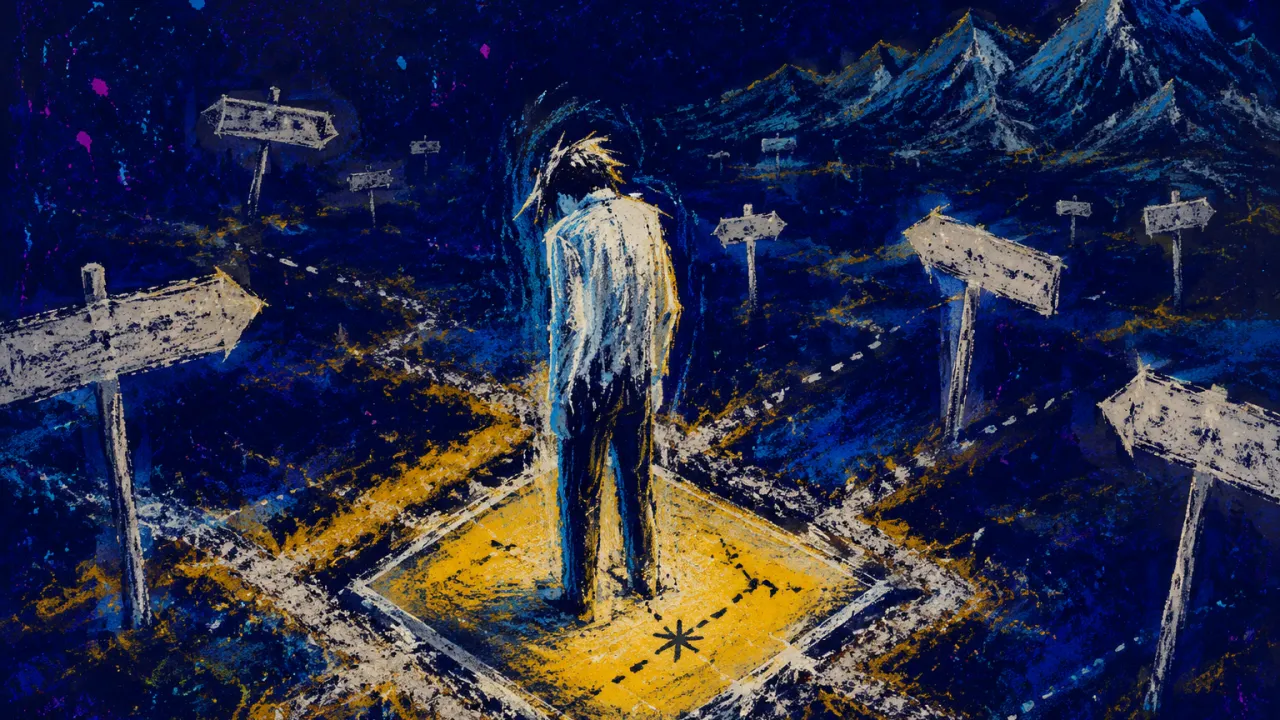
Pathless Transition: you are already outside the old structure before the next one has offered a road. It starts in a practical moment, not a cinematic one: a lease is ending, a program wraps up, a relationship changes your calendar, a job title no longer fits, or the city that used to organize your week stops feeling usable. People keep asking what your plan is, and every question assumes there is a clear menu somewhere - stay or go, apply or quit, commit or start over - but the world in front of you is more like open tabs, saved listings, half-filled forms, screenshots, budget notes, and conversations that end with "let me think about it." The old calendar still sends reminders, the old group chats still light up, the old commute or routine still exists in pieces, yet none of it tells you where to put your weight next. You may spend whole afternoons comparing options that look plausible from a distance but collapse when you try to turn them into dates, money, housing, support, or a first step. Your shoulders stay slightly raised, your sleep gets broken by planning loops, and even small decisions start to feel oversized because there is no trusted route for them to attach to. This is the exposed middle of a life change: movement has begun before a map has arrived, much like The Fool standing in open air with a small bundle, distant mountains ahead, and no road, gate, or visible place where the next step will land.

Why it's not you?

The problem is not that you are careless, behind, or secretly incapable; the pressure comes from a transition that has removed the old coordinates faster than it has supplied new ones. A lease date, job market, program ending, social label, or city move can create a real map gap, even when every option looks possible from the outside. Pathless Transition has a shape: it is openness without enough infrastructure.

Pathless Transition in Tarot Cards

Pathless Transition is the situation where movement has already started, but the outside world has not given you a usable route for the next role, city, plan, or identity. The raised shoulders and broken sleep from the unmapped middle are not separate from the scene; they are how your body registers the missing scaffolding. This is an environmental and structural dynamic, not a private flaw: the old coordinates are fading while the next ones have not become built enough to stand on. The Tarot Cards below reflect the contours of that missing road, the suspended middle, and the distant terrain that is visible but not yet walkable.

The Fool Upright
The figure stands at a threshold where no paved road continues forward. There is landscape, height, sun, and distance, but there is no socially approved lane telling the body where to place the next step. That is why this card fits a pathless transition in introspective work. The outside world has stopped providing a usable script, so your inner audit is not happening in comfort; it is happening because the old coordinates no longer organize the next move. The mountains in the distance keep the stage serious. This is not aimless wandering; it is a life phase where progress has to be redefined before movement can become grounded again.
Reversed
Open air, distant mountains, and a small bundle replace the usual signs of a prepared route. The Fool is moving, but the scene offers no road, gate, map, or visible place where the next step will safely land. In a choice spread, this describes a transition where leaving one structure is more developed than entering the next one. You may be between roles, cities, relationships, programs, or identities, and the real pressure comes from making decisions without the scaffolding that normally turns movement into a plan. The card brings the missing infrastructure into focus. It asks what must be built before the transition becomes livable: a timeline, a support network, a trial step, a resource floor, or a clearer definition of what the next terrain requires.
The Magician Reversed
The Magician has a full table and an open garden, yet there is no road leading out of the scene. In the reversed image, the body can become suspended between signal and action, with the tools visible but not yet converted into a path. That is the pressure of a pathless transition. You may not be blocked by a single closed door; instead, the difficulty comes from having enough possibility to stay suspended and not enough structure to move. The card gives that limbo a shape. It shows that the next direction will not appear simply because options exist, but because one tool, one boundary, and one grounded line of movement are allowed to matter more than the rest.
The Empress Reversed
The Empress's landscape is fertile rather than directional: wheat, trees, water, and daylight fill the frame, but no paved road organizes the next move. The scene has vitality without a visible route. For you, this points to a transition where possibility is present, yet the future refuses to arrange itself into a single track. The card does not reduce that uncertainty to indecision; it shows a living environment that needs a map before effort can become movement.
The Chariot Reversed
The vehicle stands at the edge of land and water, equipped with wheels and guardians but not visibly moving into a road. The old city is behind it, the open terrain is ahead, and the actual path between those coordinates is missing from the picture. That physical pause is the core of Pathless Transition. You may have outgrown one map without receiving a usable replacement, so effort alone no longer creates direction. The reversed Chariot makes the stalled route visible: the equipment exists, but traction has to be rebuilt before forward motion becomes real.
The Hermit Reversed
The summit gives the Hermit altitude, but the surrounding darkness hides any clear road down. The staff can hold the body in place, and the lantern can mark a small circle of visibility, yet neither one automatically produces a route through the wider terrain. Pathless Transition is the external stage where the old coordinates no longer organize your future, and the new ones have not stabilized into a usable map. You may have enough awareness to know the previous direction is over, but not enough visible structure to move cleanly into the next one. The reversed Hermit captures the pressure of that suspended middle. It shows direction as a terrain problem: not a lack of intelligence, not a lack of seriousness, but a life field where the next path has not yet become traversable.
Wheel of Fortune Reversed
The image has no road, floor, doorway, or horizon. Everything happens in a suspended field where the central mechanism dominates and ordinary human footing is absent. Pathless Transition fits when you are between life directions without a stable role, route, or social coordinate to stand on. The difficulty is not that the future contains no movement; it is that movement is happening without giving you a usable path to walk. The card turns the blankness into a spatial fact. Naming the transition as pathless helps separate the absence of visible road from the absence of capacity, so the next question becomes where a real coordinate can be built.
The Hanged Man Reversed
With no road, horizon, floor, or exit, the suspended figure has no ordinary coordinate system to move through. Even the basic distinction between up and down has been rearranged by the scene. That spatial blankness gives Pathless Transition its shape. The old map is no longer functioning, but the new one has not yet generated a visible route, leaving the body exposed in a middle state. You may be between identities, plans, cities, careers, or versions of adulthood without a reliable signpost. The card's empty field does not erase your agency; it shows why agency feels hard to locate when the external stage itself has stopped providing usable coordinates.
Death Reversed
The foreground of the card is crowded with bodies and discarded authority symbols, while the distant route sits far beyond the immediate impact. In the reversed texture, the scene becomes a transition where movement exists, but the people inside it do not yet have a walkable path. The fallen crown and scepter show that the previous organizing system has lost practical use. At the same time, the river and towers are too distant to function as an immediate plan, creating a gap between the end of one structure and the usability of the next. You may be under pressure to decide before the new terrain has become readable. The card gives that pressure a shape: the problem is not that you lack courage, but that the transition has removed old coordinates faster than it has supplied new ones.
Temperance Reversed
The road is present, but the body is still held at the shoreline, split between stone and water while the hands repeat the same careful transfer. In this orientation, the threshold stops functioning as a bridge and starts functioning as a holding pattern. That is the structure of a pathless transition: You can see fragments of a future, but the current stage keeps demanding balance, explanation, preparation, or emotional translation before movement begins. The result is not an empty life map; it is a map where the entry point has become blocked by the work of staying functional. The distant crown-like light intensifies the pressure because progress remains visible from far away. You are not lacking a horizon; the problem is that the present system has not created a usable road from here to there.
The Tower Reversed
The mountain tower has height but no visible road. Once the structure fails, the scene provides motion without a map, exposure without a landing plan, and altitude without orientation. That is the physical logic of a pathless transition. The old coordinates have collapsed, yet the new route has not appeared as a clean doorway, so direction has to be rebuilt from contact with reality rather than from inherited elevation. The reversed Tower gives this limbo a concrete shape. It helps you distinguish a genuinely absent path from the temporary disorientation that happens when a false path stops pretending to be the only one.
The Star Reversed
One foot touches the water while one knee holds the land, leaving the body suspended between two terrains. The horizon is visible, but the landscape offers no paved road, gate, or sequence of steps. In a reversed expression of The Star, visibility can become its own kind of pressure. You may be able to sense a wider future, yet the external markers that usually make movement feel legitimate are missing, delayed, or too vague to stand on. Pathless Transition captures that specific directional strain. The card does not reduce the situation to confusion; it shows a real threshold where the old terrain no longer contains You and the next one has not become solid enough to carry Your full weight.
The Moon Upright
The crayfish rising from the dark pool onto a narrow moonlit road gives this card its most immediate image of transition without a map. The path exists, but it is winding, dim, and framed by distant towers rather than by ordinary social markers or practical signposts. In personal growth, that visual structure mirrors the moment when an old identity has loosened but the next one has not become operational. You may have enough awareness to know the previous script no longer works, yet the environment offers only partial light, ambiguous signals, and a route that cannot be fully evaluated from the starting point. Pathless Transition fits the Moon because the card does not stage confident arrival; it stages the first exposed movement across uncertain ground. The value of the image is not a promise of clarity, but a precise map of where clarity is missing and where agency begins anyway.
Reversed
The path is visible only in fragments: it begins where water still interrupts the ground, winds through a dim field, and disappears toward distant towers. The crayfish has emerged, but its body is still marked by the environment it is leaving. That is the pressure pattern of a pathless transition. You are not simply undecided; the external route itself has lost stable markings, so ordinary planning tools cannot fully restore direction. The card gives shape to the stage where movement has begun before the map has caught up, which is why the future can feel both unavoidable and unreadable.
The World Reversed
The floating scene has no ground line, doorway, or ordinary horizon. Movement continues inside the wreath, but the image gives no visible route from the completed circle into the next practical stage. Pathless Transition names the outer reality of being between chapters without a believable map. You may still be moving, researching, or trying options, but the card shows why the motion can feel untranslatable: the old circuit is closed, and the next terrain has not yet become visible.
Four of Cups Reversed
The landscape stays open, but the figure has made no bodily move toward it. With closed eyes, folded limbs, grounded cups, and a suspended offer, the whole scene becomes a map with no chosen route running through it. That is the pressure of a pathless transition. You may know that a future exists in theory, but the available directions have not become trustworthy enough to turn stillness into motion.
Five of Cups Reversed
The river, bridge, and castle are all visible, yet the cloaked body is arranged around the foreground spill. The map contains a route, but the figure's orientation makes that route socially and physically unusable. For long-range direction, this is the texture of a pathless transition. You may be surrounded by theoretical options while none of them has enough weight to become a lived coordinate, so the first clarity is not choosing faster but seeing where the map has stopped functioning.
Eight of Cups Reversed
The figure is already separated from the cups, but the mountain path ahead is still dim and uneven. The image holds a difficult middle state: the old structure is no longer close enough to live inside, and the new one has not yet become a stable place to stand. Pathless transition is the outer shape of that in-between stage. You may have internally left an identity, belief system, role, or emotional contract, yet everyday life has not caught up with the change, leaving the next map underdeveloped. In introspection, this context matters because the absence of a clear path can be misread as failure. The card frames it as a threshold condition: the task is to recognize what has already been outgrown while resisting the pressure to invent a complete new self before the terrain has actually revealed itself.
Page of Cups Reversed
The sea rises behind the Page while the sky gives no landmarks, no road, and no visible destination. The platform provides a place to stand, but it does not provide a route. That spatial arrangement mirrors a transition where the previous coordinates have stopped working before new ones have appeared. You may still have enough ground to function day to day, yet the wider future feels unmapped because the structure that used to organize choices is no longer supplying direction.
Knight of Cups Reversed
The river cuts across the foreground before any clear road appears on the other bank. The rider can see a future landscape, but the actual continuation is withheld, turning the open scene into a suspended threshold. Pathless Transition fits because the card shows the strain of being between coordinates. You are not simply delayed; the next social position, role, or route has not become legible enough to step into, so the future remains visible but unusable.
Queen of Cups Reversed
The narrow sandbar, still water, and distant wall make the scene feel suspended between land and sea. The Queen has a throne, a cup, and status, but no road, boat, or open horizon to convert that position into forward movement. For a Pathless Transition, the pressure comes from being held at a threshold where the old coordinates still look polished but the next route has not appeared. You may be surrounded by symbols of stability while the actual mechanism for moving into the future remains missing.
King of Cups Reversed
The throne floats in open ocean with no dock, road, or visible land beneath it, while the sailboat moves at a distance. The scene has movement, but the central figure is not yet connected to a usable route. For Direction questions, this turns pathlessness into a concrete external stage rather than a personal defect. You are sitting inside a field of moving possibilities without a grounded bridge to any one of them, so the pressure comes from the missing infrastructure between insight and movement.
Two of Pentacles Reversed
There is no road under the figure and no fixed landmark behind them. The background path is water, and the ships advance by riding uneven waves rather than following a stable line across solid ground. This creates the outer stage of a transition without a clear map. You may be moving, applying effort, and handling responsibilities, while still lacking a visible route that confirms where the next life chapter begins. The card gives shape to that in-between state. Direction is not absent; it is being tested in unstable conditions where the next course has to be read through movement, timing, and what remains afloat.
Five of Pentacles Reversed
The road through the snow gives the figures somewhere to move, but not a destination they can recognize. They pass beneath an ordered window and a protected interior while remaining in the exposed margin of the scene, suspended between a visible structure and an unmarked route. Pathless Transition is the stage where motion continues after the old map stops working. You may be between identities, plans, cities, careers, communities, or versions of yourself, with enough momentum to keep going but not enough external signage to know what the movement is becoming. The card makes the liminal quality concrete. It shows that the problem is not simply indecision; it is a transition environment with poor visibility, weak thresholds, and no obvious place where the next chapter begins.
Two of Swords Reversed
The shore is visible, the far land is visible, and the island sits in the water, but no road, boat, bridge, or guide connects them. The woman sits at the edge of a landscape with coordinates and no usable passage. That spatial setup maps Pathless Transition with unusual precision. You can sense that one phase is ending and another is possible, yet the sequence between them has not appeared in a form you can walk. The issue is not a lack of desire; it is the absence of a socially legible route.
Three of Swords Reversed
Behind the pierced heart, there is no road, horizon, doorway, landscape, or destination marker. The entire scene is weather and impact, with the heart suspended in a gray field that gives no usable coordinates. That absence matters in a direction reading. Pathless transition is not simply being unsure; it is being between maps, where the old route has lost legitimacy and the new route has not yet taken physical shape in the world. The card captures the pressure of having a center that still registers what matters while the environment offers no clear passage forward. It does not reduce the situation to a lack of motivation; it shows a real navigation problem, where the next move depends on rebuilding coordinates before demanding speed.
Four of Swords Reversed
The chamber gives the knight a threshold but not a road. The body is positioned between withdrawal and return, raised from ordinary movement, yet no door or horizon appears to carry the scene forward. For direction questions, that absence is the point. You may have clearly outgrown one phase without receiving a usable map for the next one, leaving the transition real but externally unstructured. Pathless Transition fits because the card holds you at the edge between chapters without pretending the next route is already visible. Its value is diagnostic: it shows that the problem is not a lack of will, but the lack of a formed passage between the old architecture and the life that comes after it.
Five of Swords Reversed
The shore is visible, but it does not behave like a road. Water presses against one side, the distant bank is faint, and the gray horizon offers a place to look without giving the body a clear way to move. This is the external shape of a pathless transition: the previous conflict has ended, the old coordinates no longer organize the future, and the next shore is real enough to sense but not close enough to function as a plan. The planted sword becomes a brake, holding the scene in aftermath when movement needs a new map. Five of Swords ties this condition to direction by showing how unresolved conflict can flatten the horizon. You may be between chapters, but the deeper issue is that the available terrain has been organized by what just broke rather than by what can sustain the next phase.
Six of Swords Upright
The small boat has already left the fixed ground, but the far shore is still pale, quiet, and not yet detailed enough to become a stable address. The ferryman's oar gives the crossing direction, while the passengers remain turned away from the viewer, contained inside a vessel that is moving before its destination has fully taken shape. That visual structure maps cleanly onto a transition where movement exists before certainty. You are not standing at a crisp crossroads with labelled options; you are already inside the crossing, carrying enough history and obligation to make the route heavier, while the next long-range coordinate is still forming in the distance. In direction work, this card names the reality of being between life maps. The useful question is not whether motion is happening, but which current is actually carrying the boat and which pieces of old mental architecture are still determining the angle of travel.
Reversed
The far shore exists, but it is pale, distant, and almost without detail. The boat moves out of frame toward it, giving the scene direction without giving the passengers a fully mapped arrival point. That is the external shape of an inner transition where the old framework has already loosened, but the next stable identity or self-understanding has not become visible enough to trust. You may be moving because staying put is no longer accurate, while still lacking a clear picture of what the new shore will ask of you. In introspection, this card gives the in-between stage a container. The lack of detail is not emptiness; it is the visual evidence of a passage whose coordinates are still forming, where the task is to keep orientation without pretending the destination is already defined.
Seven of Swords Reversed
The ground ahead is uneven, the horizon is low, and the figure moves through dusk without a marked road. His body is already leaving the camp, but his gaze remains hooked to the structure behind him, turning movement into a threshold rather than a settled route. For you, this describes a transition where motion has begun before orientation has caught up. The card gives form to the strange pressure of moving between life directions when the old coordinates no longer work and the new ones have not become visible enough to trust.
Eight of Swords Upright
One foot rests on muddy ground while the other touches pooled water, placing the woman between two unstable surfaces. The castle in the distance gives the scene a destination, but the image offers no paved road, bridge, or clear approach to reach it. This is the outer shape of a direction phase where the next chapter exists as a distant outline rather than a usable route. You may be able to name the kind of future you want, but the ground between here and there is soft, partial, and hard to trust. The card makes the transition visible as a real stage, not a personal defect. The blockage sits in the missing infrastructure between present position and long-term aim, so clarity begins by mapping the terrain instead of forcing immediate certainty.
Nine of Swords Reversed
The image offers a bed, a wall, and a stack of blades, but no door, path, skyline, or forward vector. The body is neither lying down nor standing up, suspended in a narrow vertical posture inside a room that does not show where to go next. In direction work, Pathless Transition is the stage where the old route has stopped organizing the future and the new one has not become legible. The card does not turn that gap into failure; it makes the missing map visible so the next movement can be chosen from reality rather than reactive urgency.
Page of Swords Reversed
The ground under the Page is jagged, sloped, and exposed, with no paved road cutting cleanly through the ridge. The horizon is present, but clouds and uneven terrain make forward motion something that has to be negotiated step by step. That visual pressure matches a transition where the old route has lost authority before the new one has become visible. You are dealing with a map gap, not a simple lack of effort, and the card makes the missing infrastructure of the next phase visible.
Queen of Swords Reversed
The Queen is positioned above the clouds on a hill with no visible road leaving the throne. There is perspective in the sky, but the ground-level route is hidden, and the body remains fixed in observation. That image fits a Pathless Transition because the problem is not a lack of intelligence or effort. You can see enough to know the old map is finished, but the next path has not yet taken a form that can carry weight.
Two of Wands Reversed
The coastline opens outward, but the foreground offers no road from the battlement to the far terrain. The figure stands at the edge of a known world with the globe in hand, suspended between ownership of the present and physical movement into the next stage. Pathless Transition names a phase where the old container has lost authority before a new container has appeared. You may know that the current direction cannot fully hold you, yet the next identity, route, community, or structure has not become visible enough to step into. The reversed Two of Wands gives this limbo a map. The absence of a visible road does not mean there is no direction; it means the crossing requires a new kind of path-building rather than another attempt to force the old architecture to produce one.
Three of Wands Reversed
The cliff cuts off the land beneath the figure's feet, and the next visible territory lies across water rather than along a road. You are placed at an edge where the old route ends cleanly, but the new route has no obvious surface to walk on. This context is not simple indecision. The card frames a transition where the transport system itself has changed, so clarity depends on recognizing that the next phase may require a different vehicle, timeline, or support structure.
Eight of Wands Reversed
The wands move cleanly through the air, yet the ground below gives no road for a person to follow. The near bank is only an edge, the usable land sits across the stream, and the tiny house on the hill is visible without being immediately reachable. For you, this describes a transition with energy but no trustworthy route. Something in life may be moving quickly around you while your own next step lacks a bridge, a map, or a social container that makes the future feel walkable. Pathless Transition fits the reversed card because the visual field separates motion from passage. The sky is active, but the ground has not yet become a path you can inhabit.
Page of Wands Reversed
The desert around the Page has visibility but no road, no gate, and no immediate settlement to organize the next move. The upright wand becomes a point of focus in a landscape that offers width without instructions. For you, this captures a transition where the external world keeps presenting openness as freedom, while the actual structure gives you too few coordinates to move cleanly. The issue is not a lack of potential; it is that potential has not yet been converted into a navigable route.
Queen of Wands Reversed
The desert horizon is wide and bright, but there is no road drawn across it. The pyramids offer distant markers while the throne stays fixed in the sand, creating a field with visibility but no immediate route. This is the outer landscape of a transition where possibility is present without a usable map. You may be surrounded by options, references, and long-term signals, yet the next movement has not condensed into a path that your body can actually follow.

Pathless Transition in Tarot Card Reading Insights

When Pathless Transition shows up in readings, it often comes from people who are between roles, cities, plans, or versions of adulthood without a stable route to follow. The focus shifts from the card list to how this unmapped middle appears when someone brings it into a session. Tarot Reading Insights from sessions shaped by this kind of transition.

Psychological contexts related to Pathless Transition